Learning goals
We are learning to…
- explore the lived experiences of diverse communities in culturally responsive texts
- analyze cultural elements in texts
- plan, draft, and revise paragraphs
Success criteria
I am able to…
- read and express an understanding of a text about Navroz
- identify specific text details that show cultural traditions
- plan and write a paragraph that communicates at least three details about a celebration or tradition that is important to me
Thinking about celebrations and traditions
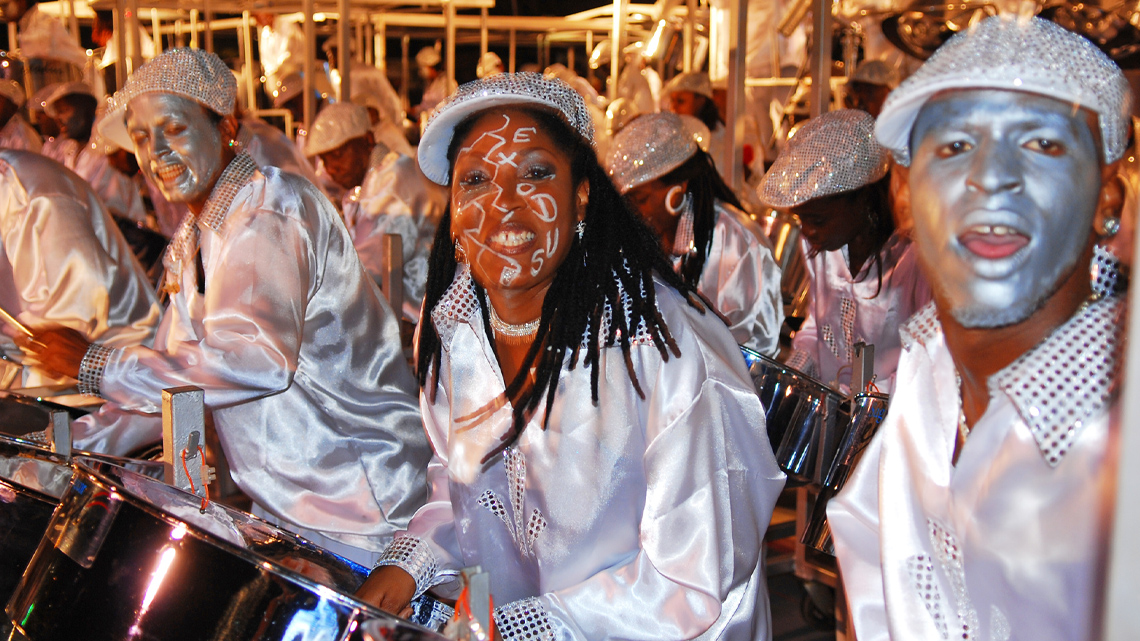
Traditions and celebrations are an important part of our identities and our communities. They help us feel connected to other people in our family and community and they can connect us to our culture.
Explore the following video in which Teacher Jessica explains the difference between a celebration and a tradition.
Explore the following video to learn more about celebrations and traditions.
Let’s review the definitions of these two important words:
Seasonal celebrations
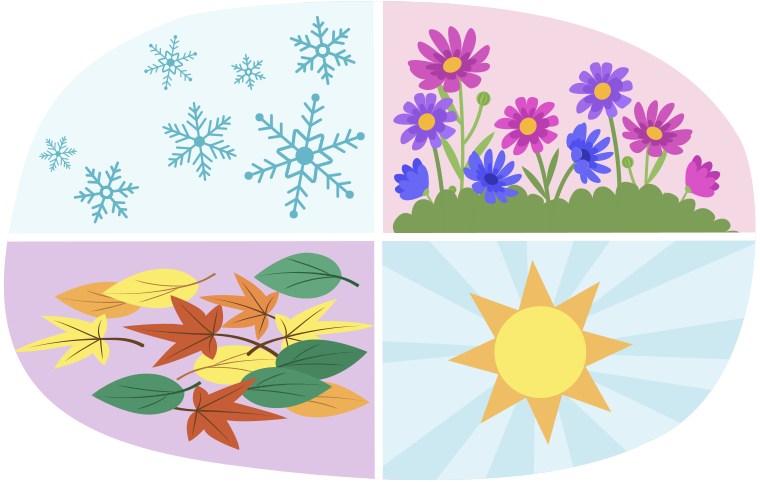
Many celebrations are connected to seasons or to specific dates.
Diwali and Rosh Hashanah are two examples of celebrations that happen in the fall.
Press the following tabs to learn more about autumn celebrations.
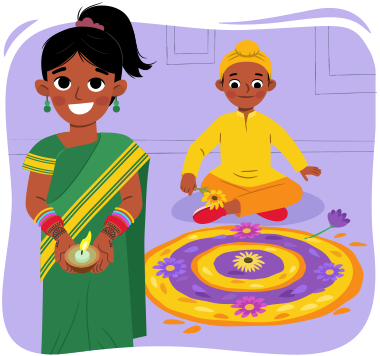
Diwali is a festival celebrated by different communities from India and Pakistan, often called the Festival of Lights.
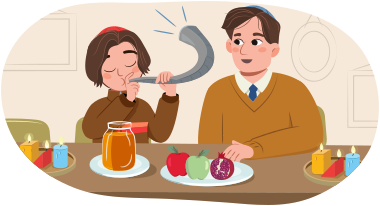
This is the Jewish New Year and is also called the Feast of Trumpets. It lasts for two days in September. There is candle lighting, horn blowing, and a large meal with family.
Traditions
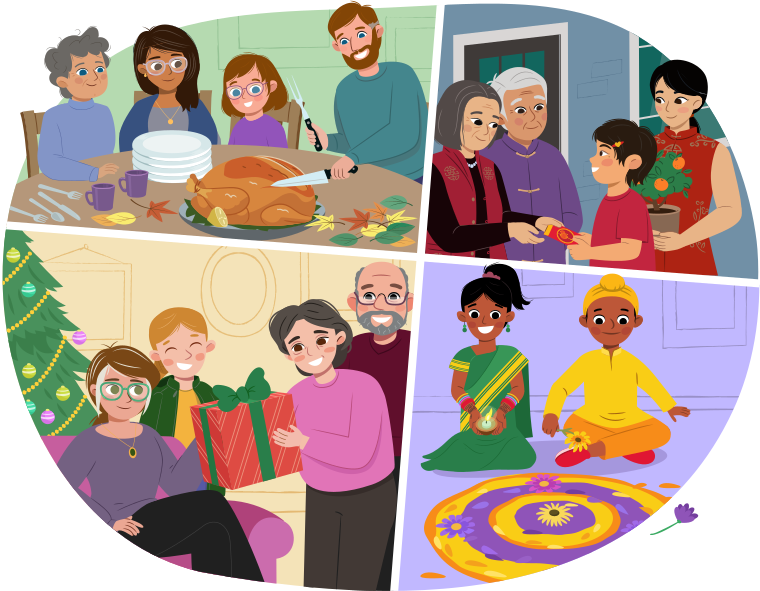
Many celebrations have specific traditions or ways of doing things. Some traditions are not connected to celebrations at all, such as going for family walks on the weekend or having pizza and watching a movie on Friday nights.
Traditions can look different in each family and people celebrate and keep traditions in many different and unique ways.

Student Success
Think
The following are some examples of celebrations. Based on your knowledge and experiences, can you think of an example of a tradition that happens during these celebrations? It can be one you have experienced personally or one you are aware of.
Share your ideas with a learning partner if possible or record them in your learning log.
| Celebration |
|---|
|
In this learning activity you are going to explore specific examples of celebrations and traditions. You will reflect on the celebrations or traditions in your life and practice your writing skills in a personal paragraph about one of them.

Reading about celebrations & traditions
Do you celebrate or mark the new year in some way?
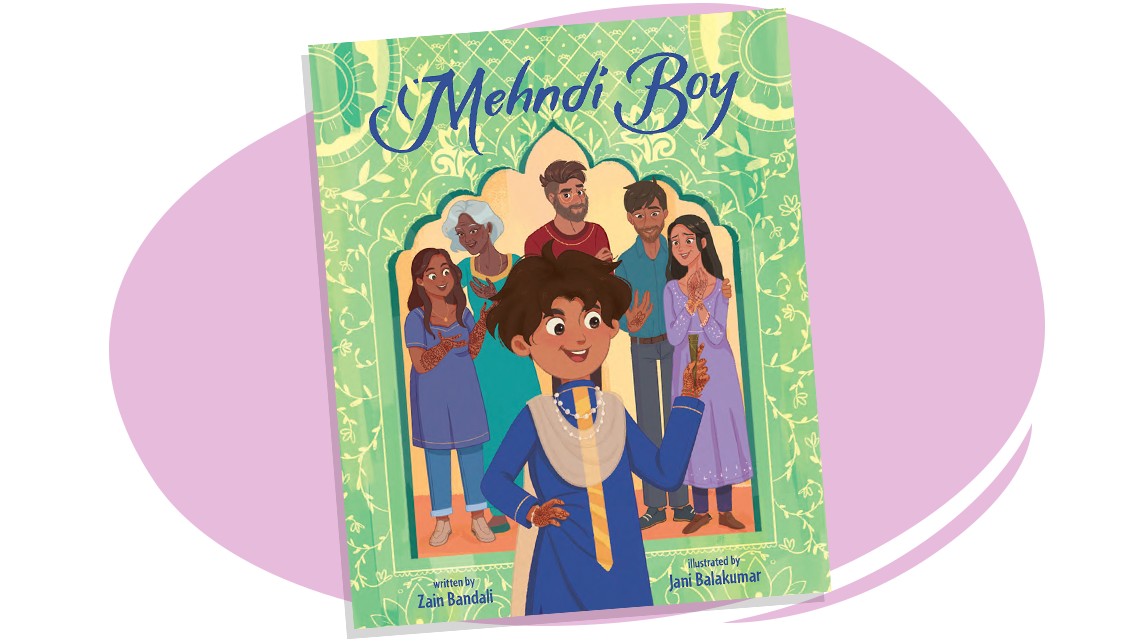
In Mehndi Boy (by Zain Bandali and illustrated by Jani Balakumar), you will read the first chapter that shows how one boy’s family prepares to celebrate Navroz. Navroz (or Nowruz) is the Persian New Year and the first day of spring.
Pre-reading
Predicting
When you read the title and look at the cover of the book, what kinds of things do you think this book could be about? What are some of your clues? What are some of your questions?

Today’s vocabulary
Before we begin reading, let's preview some vocabulary you will read in this text.

Kurta: a traditional loose-fitting tunic worn by both men and women.
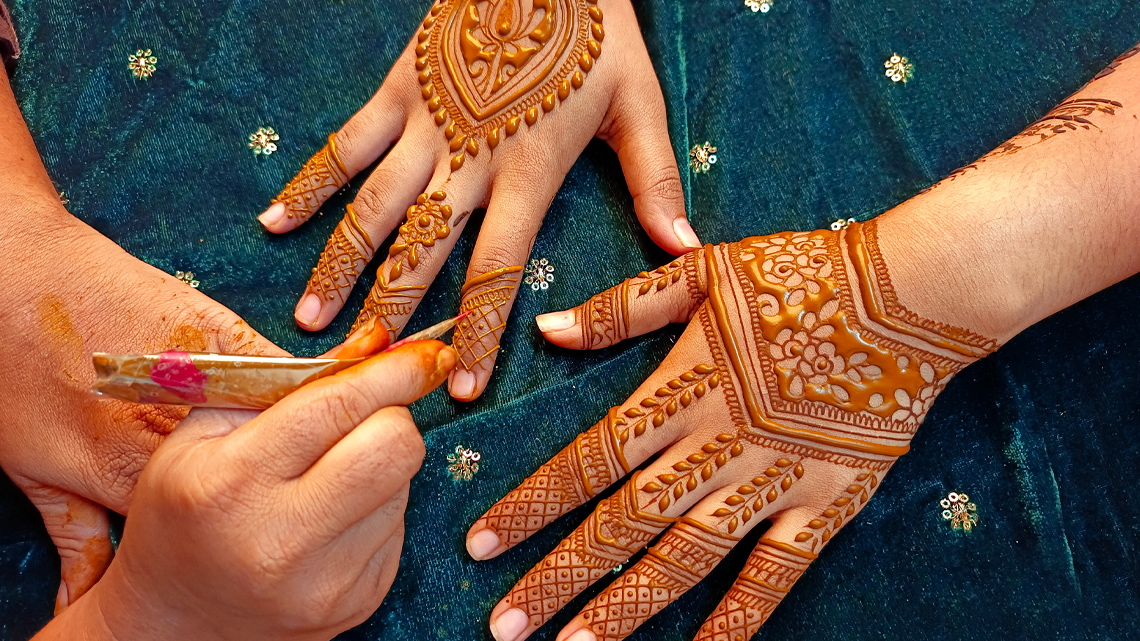
Mehndi: a temporary skin decoration that uses henna paste to draw designs on the hands and feet.
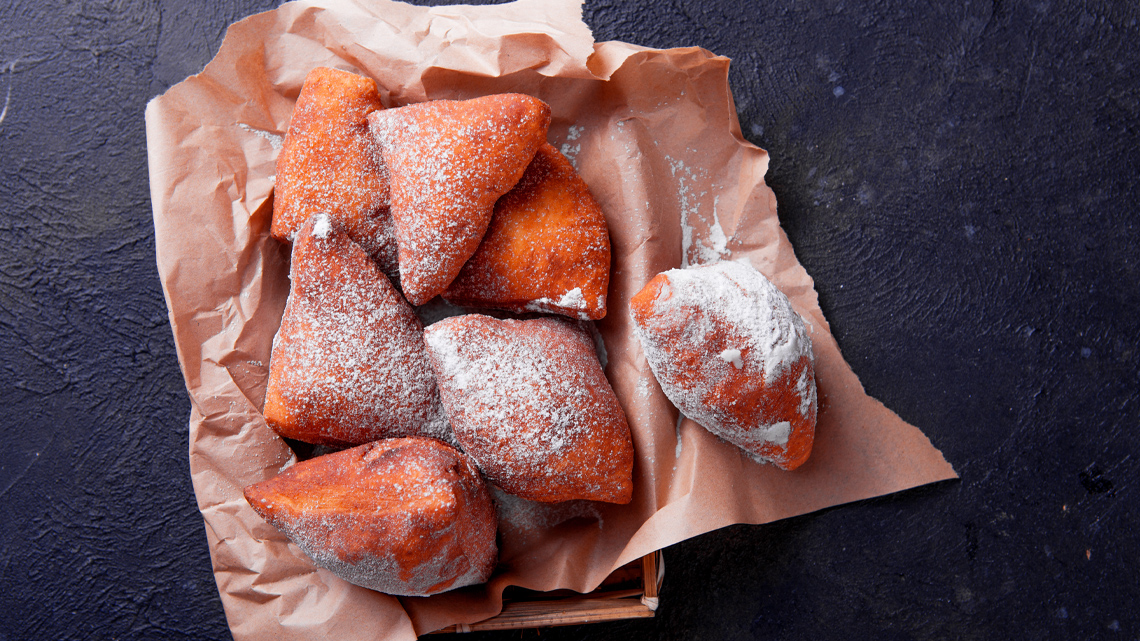
Mandazi: sweet fried doughnut in a triangular shape.
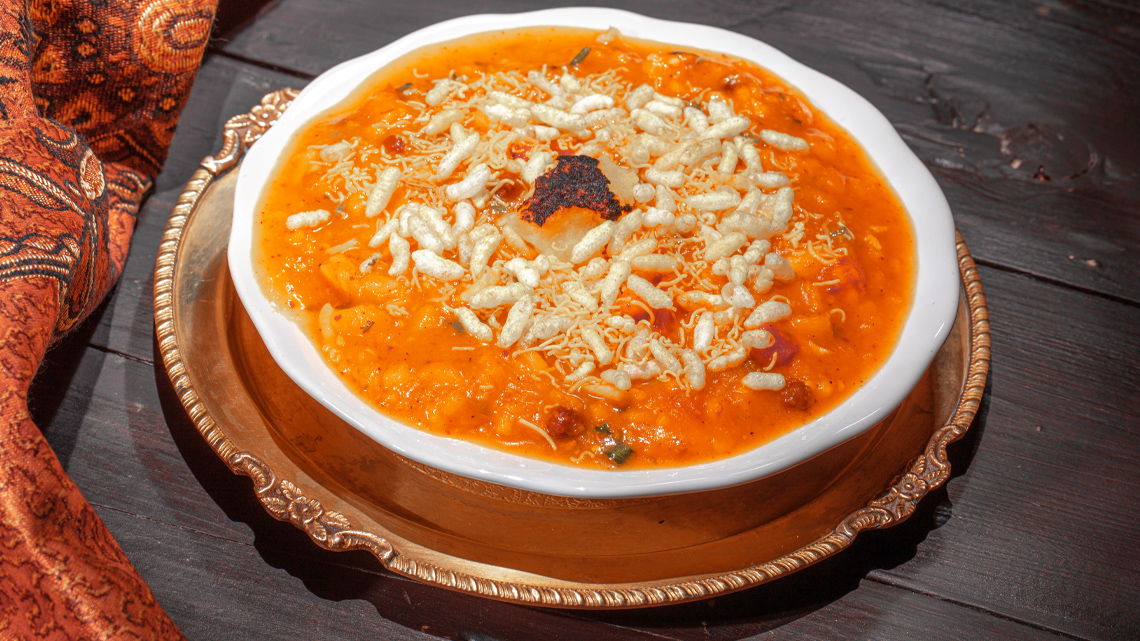
Channa Bateta: a chickpea and potato curry stew.
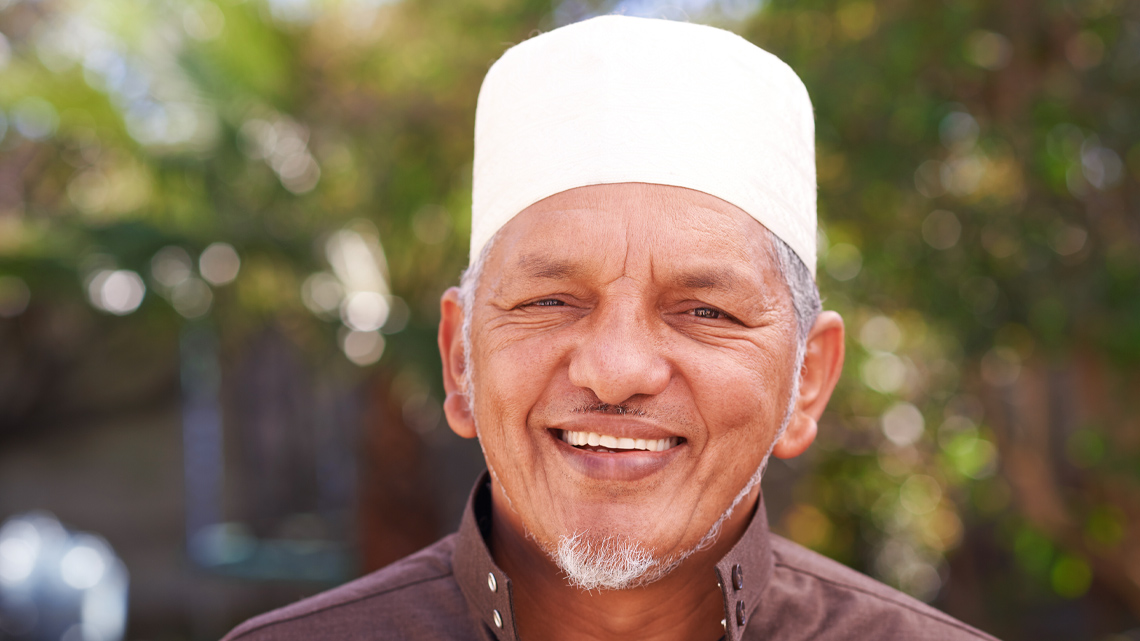
Topi: traditional caps worn by men.

Mehndi Boy
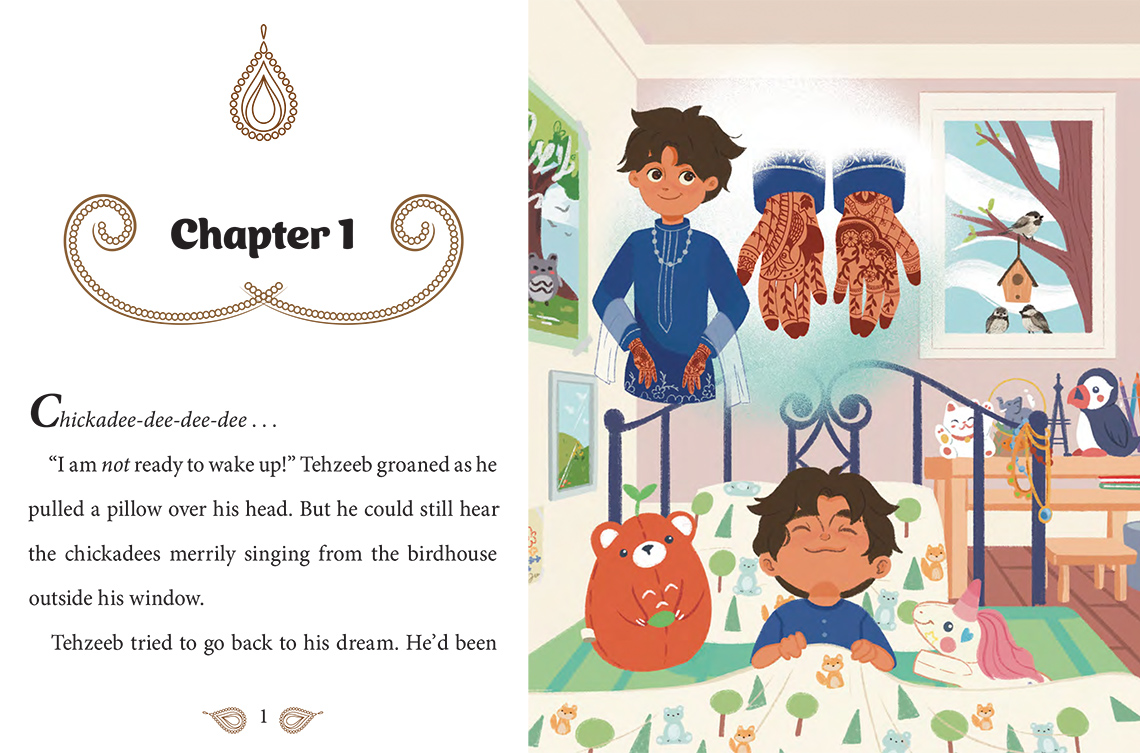
Chapter 1
Page 1
Chickadee-dee-dee-dee…
"I am not ready to wake up!" Tehzeeb groaned as he pulled a pillow over his head. But he could still hear the chickadees merrily singing from the birdhouse outside his window.
Tehzeeb tried to go back to his dream. He'd been…
Page 2
(The illustration shows Tehzeed in his bedroom, dreaming about a wedding where he was dressing up in his kurta and having his hands decorated with mehndi.)
Page 3
…
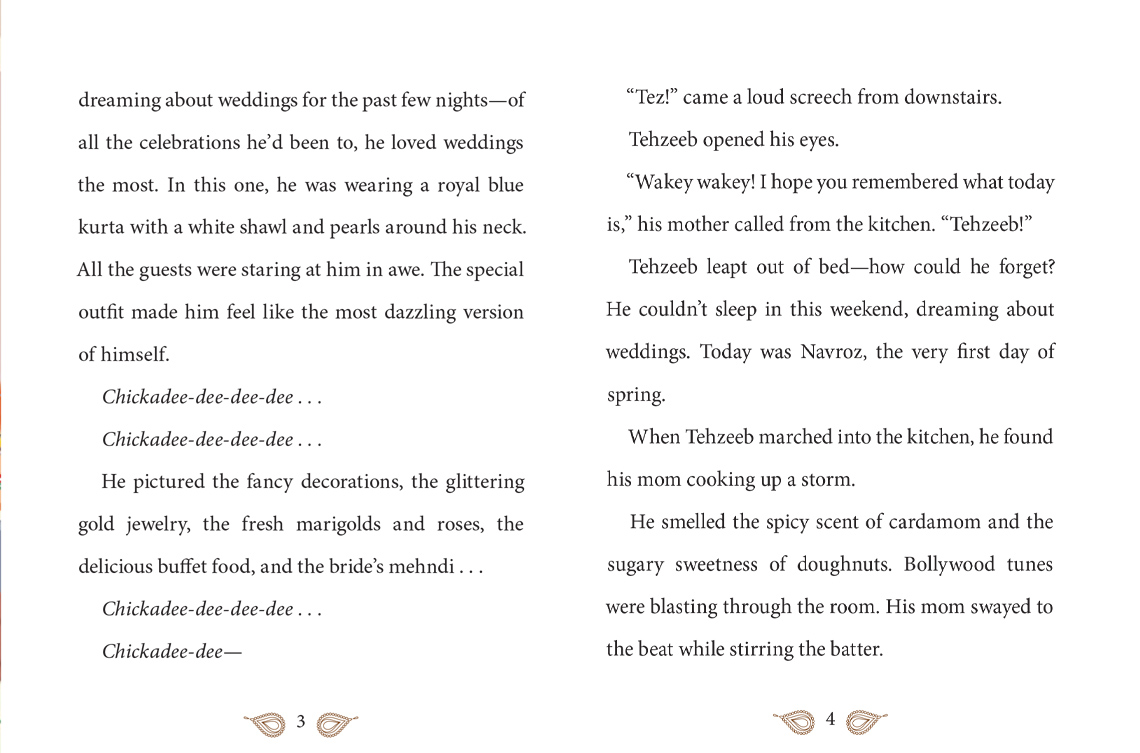
dreaming about weddings for the past few nights - of all the celebrations he'd been to, he loved weddings the most. In this one, he was wearing a royal blue kurta with a white shawl and pearls around his neck. All the guests were staring at him in awe. The special outfit made him feel like the most dazzling version of himself.Chickadee-dee-dee-dee…
Chickadee-dee-dee-dee…
He pictured the fancy decorations, the glittering gold jewellery, the fresh marigolds and roses, the delicious buffet food, and the bride's mehndi…
Chickadee-dee-dee-dee…
Chickadee-dee-
Page 4
"Tez!" came a loud screech from downstairs.
Tehzeeb opened his eyes.
"Wakey wakey! I hope you remembered what today is," his mother called from the kitchen. "Tehzeeb!"Tehzeeb leapt out of bed - how could he forget? He couldn't sleep in this weekend, dreaming about weddings. Today was Navroz, the very first day of spring.When Tehzeeb marched into the kitchen, he found his mom cooking up a storm.
He smelled the spicy scent of cardamom and the sugary sweetness of doughnuts. Bollywood tunes were blasting through the room. His mom swayed to the beat while stirring the batter.
Page 5
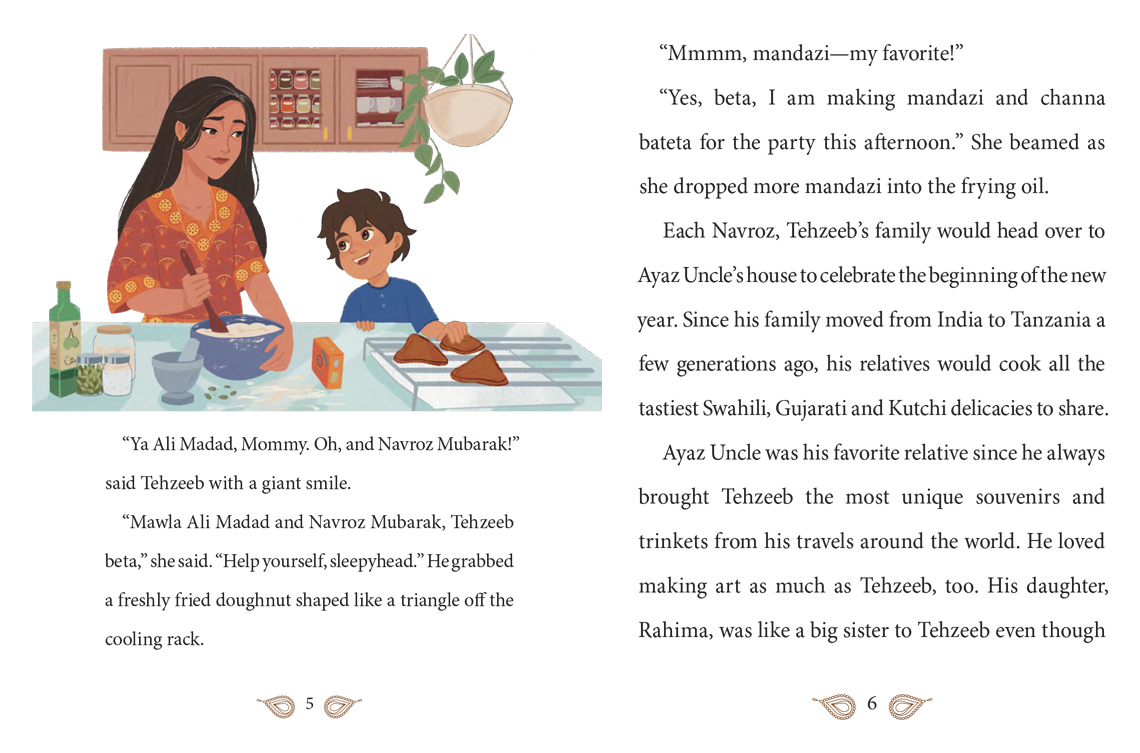
(The illustration shows Tehzeeb's mom mixing doughnut batter in the kitchen. Tehzeeb is picking up one of the cooked doughnuts.)
"Ya Ali Madad. Oh, and Navroz Mubarak!" said Tehzeeb with a giant smile.
"Mawla Ali Madad and Navroz Mubarak, Tehzeeb beta," she said. "Help yourself, sleepyhead." He grabbed a freshly fried doughnut shaped like a triangle off the cooling rack.
Page 6
"Mmmm, mandazi - my favourite!"
"Yes, beta, I am making mandazi and channa bateta for the party this afternoon." She beamed as she dropped more mandazi into the frying oil.
Each Navroz, Tehzeeb's family would head over to Ayaz Uncle's house to celebrate the beginning of the new year. Since his family moved from India to Tanzania a few generations ago, his relatives would cook all the tastiest Swahili, Gujarati and Kutchi delicacies to share.
Ayaz Uncle was his favorite relative since he always brought Tehzeeb the most unique souvenirs and trinkets from his travels around the world. He loved making art as much as Tehzeeb, too. His daughter, Rahima, was like a big sister to Tehzeeb even though…
Page 7
They were first cousins. She wore the prettiest outfits and always shared her old scarves, belts, and jewelry with him when she got tired of them. Tehzeeb didn't mind - he loved Rahima's hand-me-downs.
"Make sure to wear something special and don't forget to do your brush," his mom said, pretending to brush her teeth with a spatula.
Tehzeeb couldn't contain his excitement. He popped another mandazi in his mouth then galloped upstairs to get ready. He already knew just what he wanted to wear - the kanzu Ayaz Uncle brought him from Zanzibar last month. The kanzu was gold like the Serengeti grasslands and made Tehzeeb feel like royalty.
Page 8
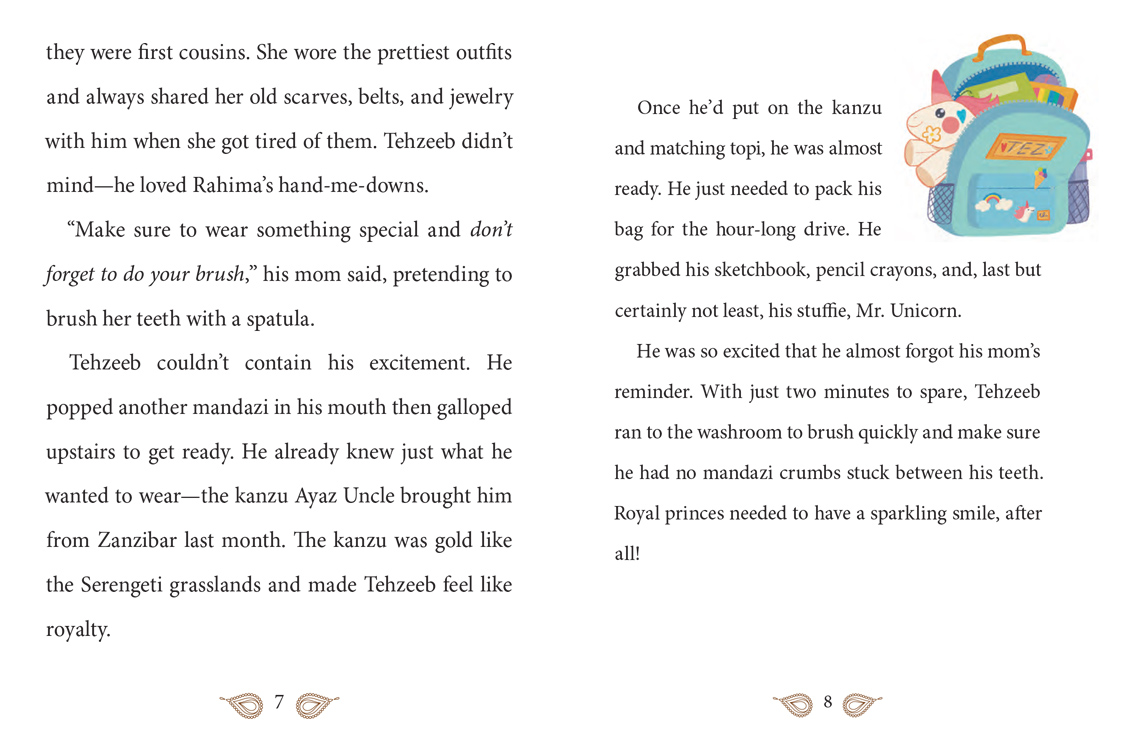
Once he's put on the kanzu and matching topi, he was almost ready. He just needed to pack his bag for the hour-long drive. He grabbed his sketchbook, pencil crayons, and last but certainly not least, his stuffie, Mr. Unicorn.
He was so excited that he almost forgot his mom's reminder. With just two minutes to spare, Tehzeeb ran to the washroom to brush quickly and make sure he had no mandazi crumbs stuck between his teeth. Royal princes needed to have a sparkling smile, after all!
(The illustration shows Tehzeeb's backpack with his sketchbook, pencil crayons, and unicorn stuffed animal inside.)
After reading
After reading, consider the following questions. You can write or record your answers in your learning log or discuss them with a learning partner.
In this text, Tehzeeb is excited to celebrate Navroz. What are some of the traditions he and his family have for Navroz?
Press Show Answer to learn more.
- special foods: mandazi and channa bateta and others
- greetings: “Navroze Mubarak” which means “happy new year”
- family gathering at Ayaz Uncle’s house
- special clothing: kanzu and topi

Pause and Reflect
Pause and reflect
Reflect on the following questions:
- Tehzeeb and his family celebrate Navroz, which is the start of the new year and the first day of spring. Does your family have a special celebration or tradition in the spring or at the start of a new year?
- Tehzeeb and his family speak to each other in Swahili, Arabic, Kutchi, Gujarati, and Hindi throughout this book. Do you know how to say “hello” in any other languages?

Student Wellness
Take a break!

Did You Know?
Direct and indirect quotes
Did you know when words are copied directly from a text, we put quotation marks around them?
Let’s examine the difference between direct quotes and paraphrasing (or indirect quotes):
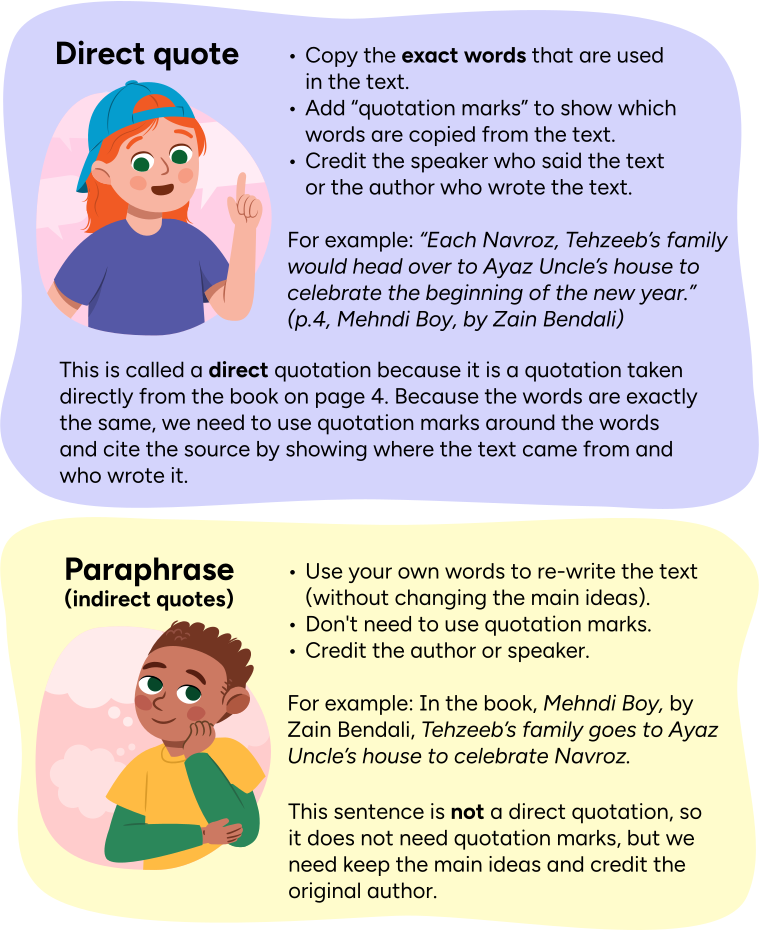
The definition of direct quote and the definition of paraphrase (indirect quotes.)
Direct quote:
- Copy the exact words that are used in the text.
- Add "quotation marks" to show which words are copied from the text.
- Credit the speaker who said the text or the author who wrote the text.
For example: "Each Navroz, Tehzeeb's family would head over to Ayaz Uncle's house to celebrate the beginning of the new year." (p.4, Mehndi Boy, by Zain Bendali)
This is called a direct quotation because it is a quotation taken directly from the book on page 4. Because the words are exactly the same, we need to use quotation marks around the words and cite the source by showing where the text came from and who wrote it.
Paraphrase (indirect quotes):
- Use your own words to re-write the text (without changing the main ideas).
- Don't need to use quotation marks.
- Credit the author or speaker.
For example: In the book, Mehndi Boy, by Zain Bendali, Tehzeeb's family goes to Ayaz Uncle's house to celebrate Navroz.
This sentence is not a direct quotation, so it does not need quotation marks, but we need keep the main ideas and credit the original author.
Learning check
Direct and indirect quotations
Using the following text from page 3 of Mehndi Boy, decide if the following sentences are direct quotations or indirect quotations, and sort them into the correct category.
Place the cards into categories that best match. Use the arrow buttons to navigate between cards.
Thinking about: my celebrations & traditions
In this learning activity, you’ve considered the difference between a celebration and a tradition and learned a little bit about the celebrations and traditions of Navroz.
Now it's time to connect this new learning by brainstorming different celebrations and traditions from your own life. Include as many as you feel comfortable sharing as you complete the following fillable and printable mind map.
Press Student Tips to learn more.
Celebrations and traditions can be big or small, and they can be from any part of your life.
Complete the fillable and printable Celebrations and Traditions Mind Map in your notebook or using the following document. If you would like, you can use speech-to-text or audio recording tools to record your thoughts.
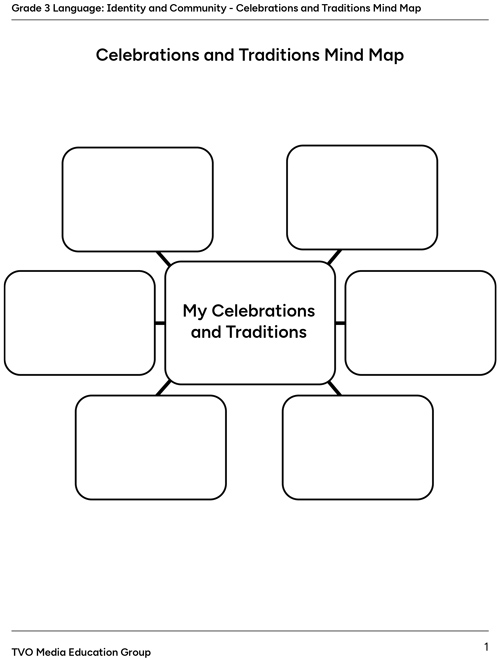
Press the Activity button to access the Celebrations and Traditions Mind Map.
Activity(Opens in a new tab)Press Example to check out an example.
The following document is an example of how a learner might record celebrations and traditions from their life.
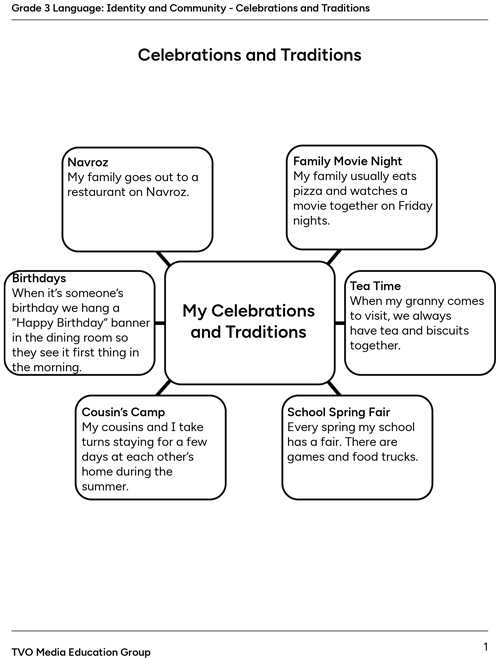
Press the Activity button to access the My Celebrations and Traditions document.
Activity(Opens in a new tab)Let’s check!
For each term select the corresponding definition.
Try it in cursive
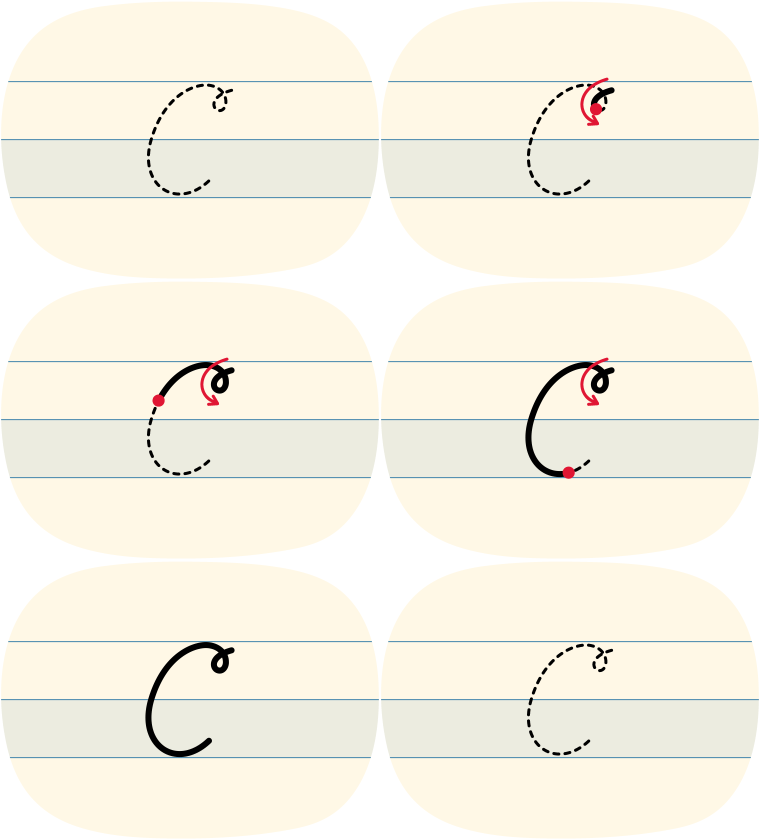
A student with speech bubbles, reading: Cursive is a style of writing. It helps builds muscles in our hands and gives us another option when we are writing messages, taking notes, or creating a final copy of our work. Let’s practice writing some cursive letters in uppercase.
|
|
Cursive |
|---|---|
|
A |
 |
|
B |
 |
|
C |
 |
|
D |
 |
|
E |
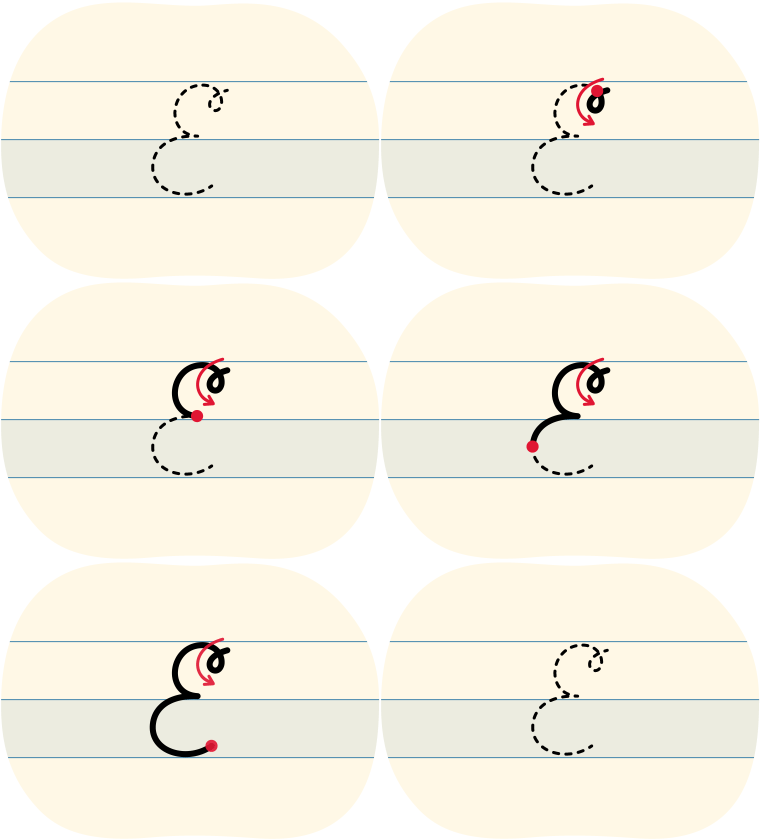 |
Before you begin, what do you notice about the shape of each cursive letter?
All of the cursive letters start from the bottom. Some of the letters have loops and they each create a different shape.
Tips for cursive letters

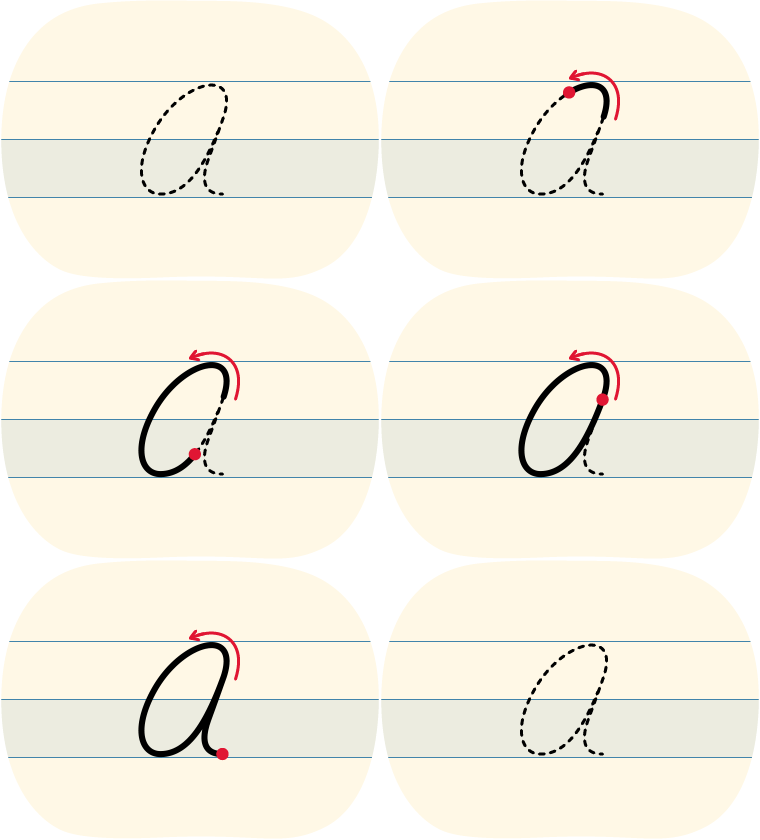
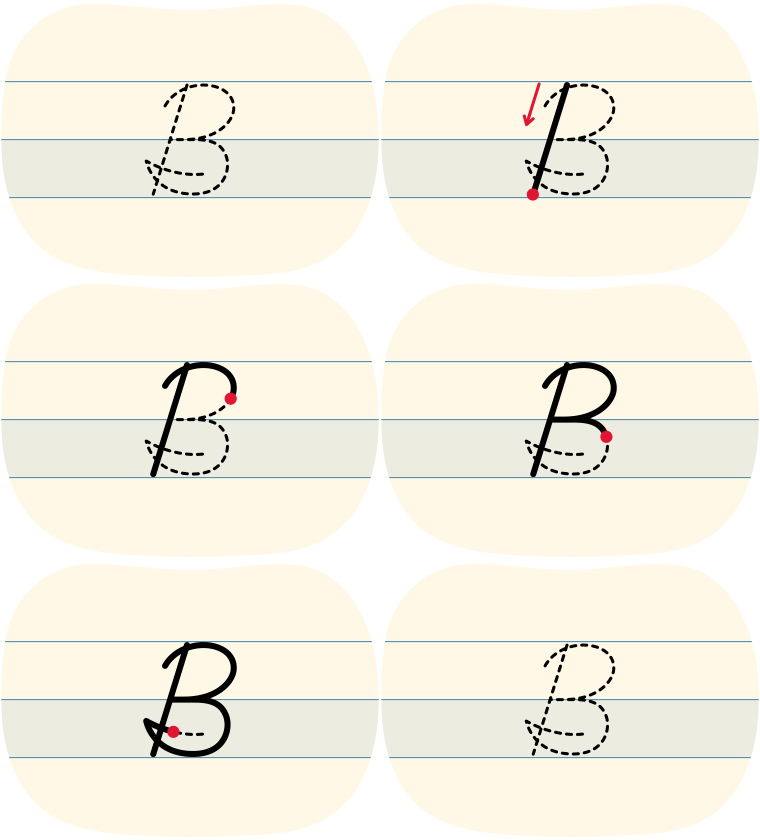
- Follow the arrows, sometimes when we write in uppercase we can start from the top, middle or the bottom.
- Try to keep the pencil on the page until you are done the letter.
- Create a finger space before you continue to the next letter.
- Try to press gently as you write so that your hand can move easily across the page.
Writing a paragraph
During the action phase of this learning activity, you brainstormed and completed a mind map about celebrations and traditions from your life.
Now you will select one celebration or tradition and write a paragraph about it.
Parts of a paragraph
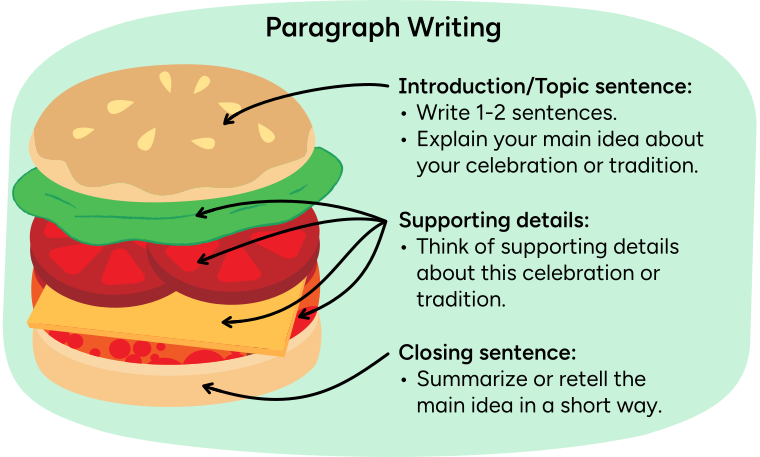
Paragraphs start with an indent which is a little space at the beginning of the first line. This helps the readers know that they are starting a new paragraph. Paragraphs begin with the main idea (topic sentence), have supporting details, and then end with a concluding (final) sentence. We often compare paragraphs to a hamburger:
Paragraph Writing
Introduction/Topic Sentence:
- Write 1-2 sentences.
- Explain your main idea about your celebration or tradition.
Supporting Details:
- Think of supporting details about this celebration or tradition.
Closing Sentence:
- Summarize or retell the main idea in a short way.
Writing your paragraph
Look at your Celebrations and Traditions Mind Map. Choose one celebration or tradition to write about.
Press Student Tips to learn more.
Think about:
- Why does this celebration or tradition take place?
- Where and when does this celebration or tradition happen?
- Who attends this celebration or tradition?
- What are some of the special parts of this celebration or tradition (for example, food, decorations, clothing, or greetings)?
- What is your favourite part of it?
Complete the fillable and printable Paragraph Planner in your notebook or using the following document. If you would like, you can use speech-to-text or audio recording tools to record your thoughts.
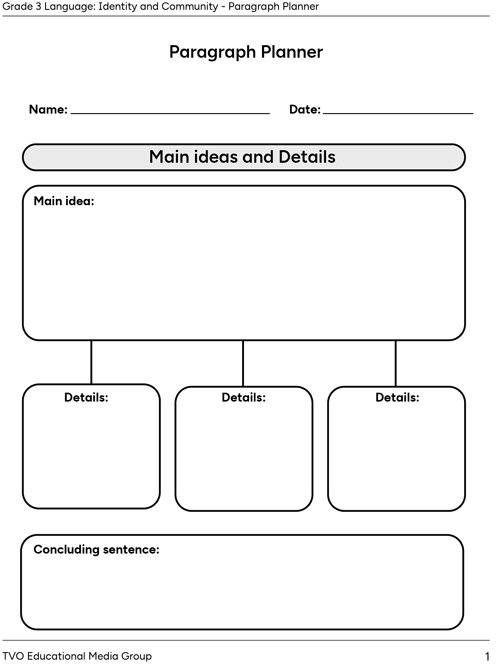
Press Example to learn more.
Check out the following example of a completed paragraph planner.
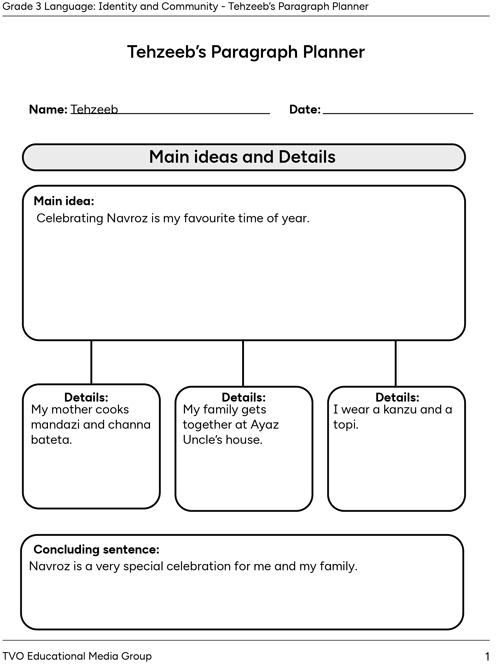
Check out the following example of what Tehzeeb’s paragraph might look like if he wrote about Navroz in Mehndi Boy.
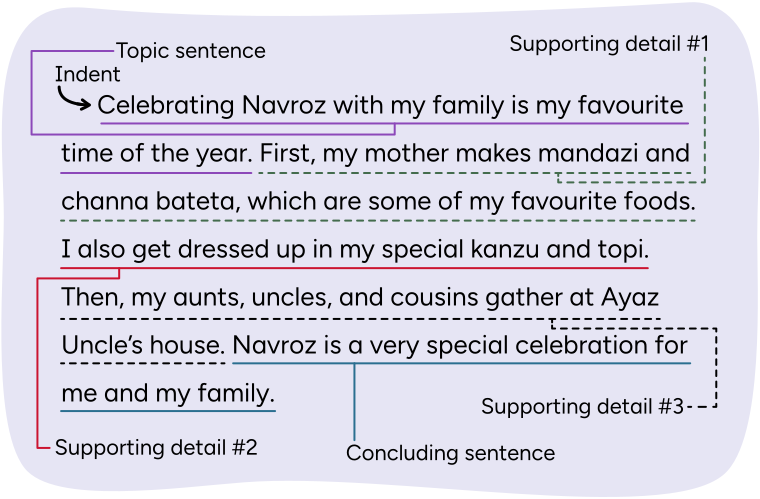
A sample paragraph, with each sentence labelled as a different part of a paragraph 'hamburger.'
Indent. Topic sentence: Celebrating Navroz with my family is my favourite time of the year.
Supporting detail #1: First, my mother makes mandazi and channa bateta, which are some of my favourite foods.
Supporting detail #2: I also get dressed up in my special kanzu and topi.
Supporting detail #3: Then, my aunts, uncles, and cousins gather at Ayaz Uncle's house.
Concluding sentence: Navroz is a very special celebration for me and my family.
You are ready to write your ideas in a paragraph format.
Use the following checklist to guide your writing.
Paragraph writing checklist
Press Student Tip to learn more.
You can always make changes and create more interesting sentences with the ideas from your paragraph planner.
Pause and Reflect
Pause and reflect
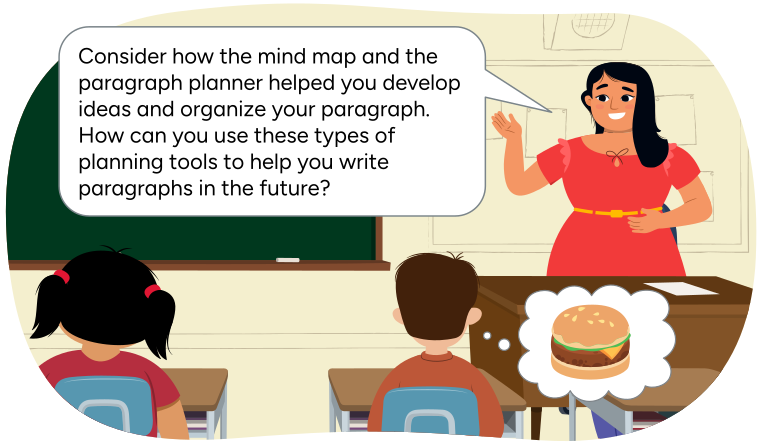
Reflection
How do you feel about what you have learned in this activity? Which of the next four sentences best matches how you are feeling about your learning? Press the button that is beside this sentence.
I feel...
Now, record your ideas about your feelings using a voice recorder, speech-to-text, or writing tool.