Learning goals
We are learning to…
- explore texts by Indigenous Peoples about the concepts of identity, the environment, and perspective
- use prior knowledge as well as knowledge from new texts to understand the importance of environmental activism
- draft and produce a letter, using appropriate tools, in order to express our opinions
Success criteria
I am able to…
- learn about Indigenous identity and consider the elements that make up my own personal identity
- read a book to learn about the connection between Indigenous Peoples and the environment
- write a letter to a community leader with my questions or suggestions for protecting the environment
Indigenous Peoples and the environment
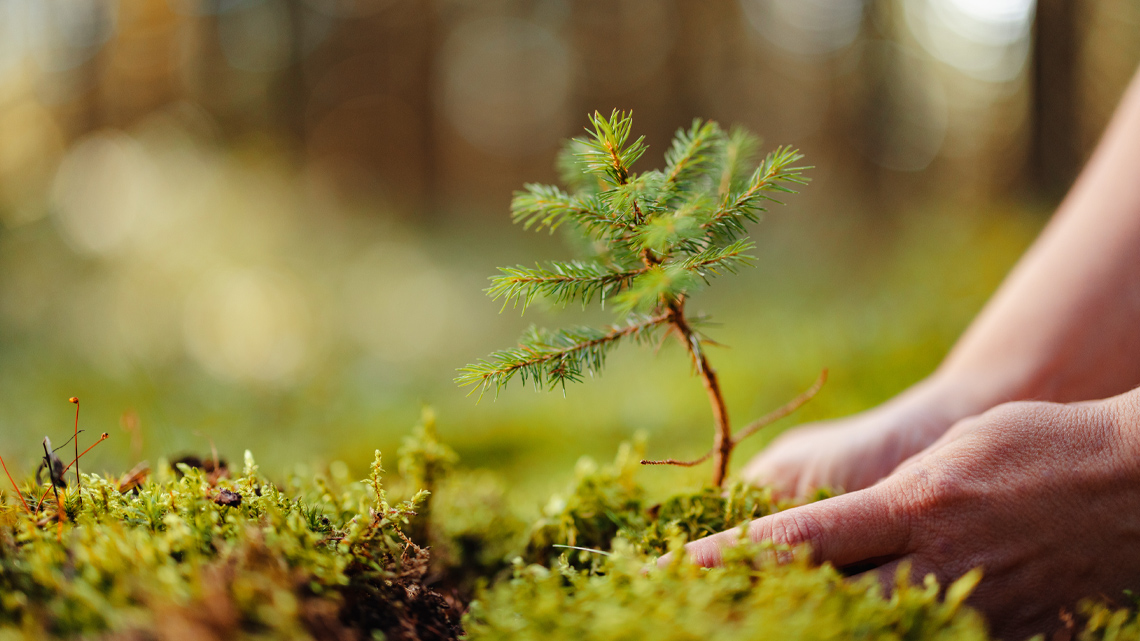
Throughout history, Indigenous Peoples have relied on, and cared for, the environment to survive. This connection between the environment and Indigenous identity continues to have cultural and spiritual importance today.
It is important to remember that there are many different Indigenous communities throughout the lands now commonly referred to as Canada. Each has its own beliefs, values, and knowledges about the environment. Although some communities may share similarities, it is important not to make generalizations.
Picture book: “Be a Good Ancestor”
In this learning activity, we will explore a picture book called “Be a Good Ancestor.” Explore the front cover:
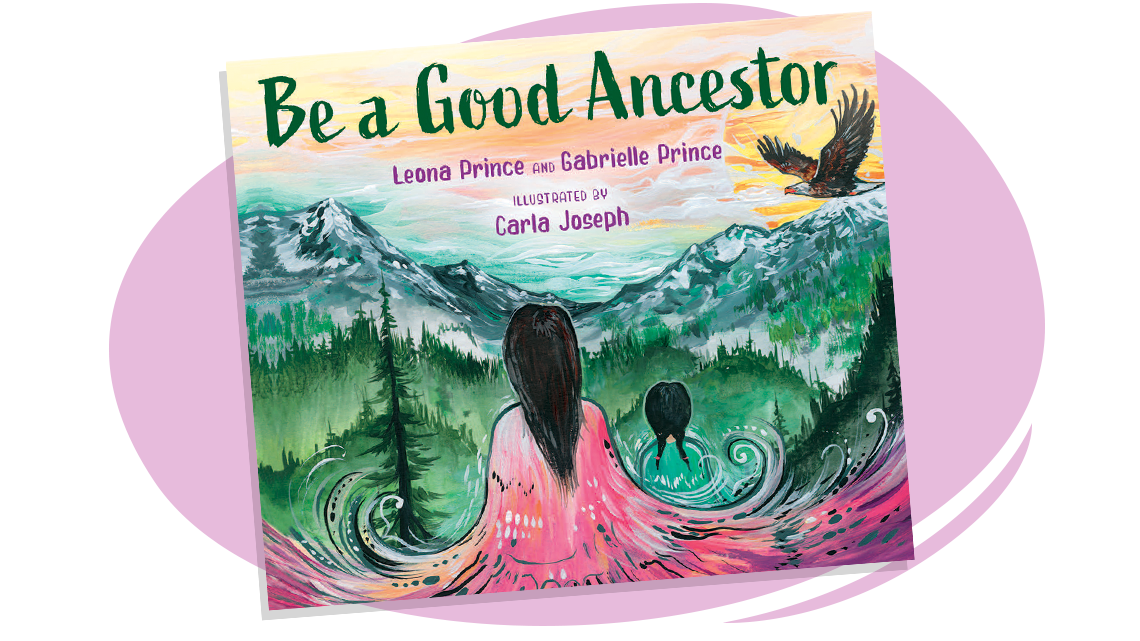
The book cover of ‘Be a Good Ancestor’ is a painting of an adult and a child looking out over a forest and mountains. There is an eagle flying overhead. The adult has a colourful robe that begins to swirl at the base. The robe looks like it could be wings or could be interacting with the nature around it.
Before you read a book, it can be a good idea to ask questions and make predictions. This can help you focus on the meaning and content while you’re reading.
Pre-reading questions
Examine the front cover of the book “Be a Good Ancestor” and consider the following questions. Write your answers in a journal of your choice.
- What do you notice?
- Can you make any predictions about this book?
- What are your questions about this book?
“Be a Good Ancestor”: About the authors
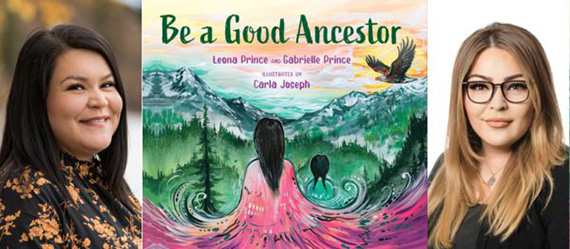
“Be a Good Ancestor” is written by Leona and Gabrielle Prince, who are Dakelh sisters from the Lake Babine Nation and Nak’azdli Whut'en, located in what is now called British Columbia. They belong to the Lhts’umusyoo (Beaver) Clan. They created this book together, basing it on the things they had learned as they were growing up.
The illustrations in the book are by Carla Joseph, a Cree artist from what is now called Prince George, British Columbia.
Thinking about the title: “Be a Good Ancestor”
Have you heard the word ancestor before? Do you know what it means? Record your answer using a method of your choice, then press Check Answer.
Ancestors are the relatives or relations who came before you, such as parents, grandparents, great-grandparents, great-aunts, and great-uncles.
Now explore the book to find out how and why the authors are asking the reader to “be a good ancestor.” You will read the book in two parts.
Part 1: “Be a Good Ancestor”

Vocabulary words
To learn some words that will help you understand the first part of the book, explore the following flashcards!
Now read the first half of “Be a Good Ancestor.”
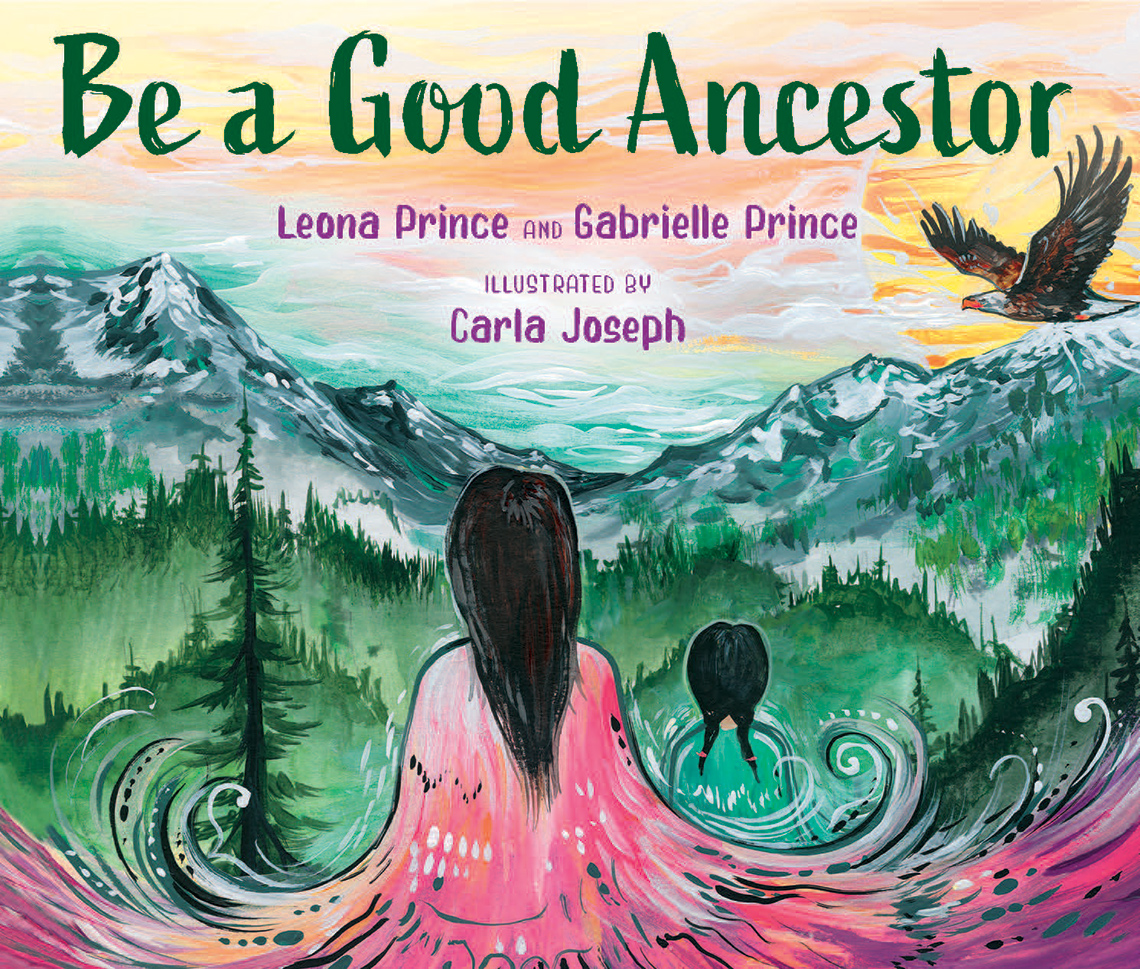
There is an elder person and a child looking out mountains and forest. There is an eagle flying in the sky.
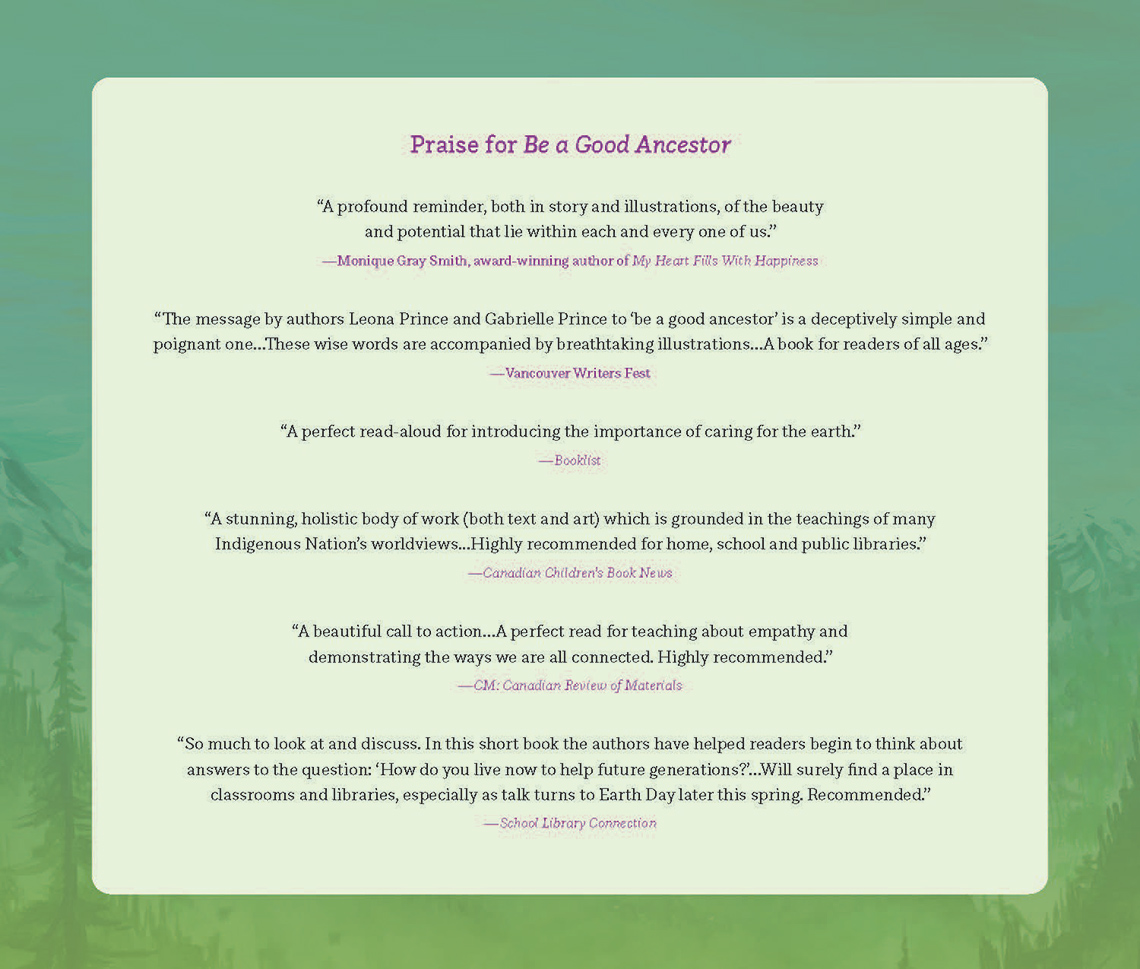
This page consists of different advance praises for the book.
One of the praises reads:
“A perfect read-aloud for introducing the importance of caring for the earth”
This is the title page.
This page reads:
Be a Good Ancestor
Leona Prince and Gabrielle Prince
Illustrated by Carla Joesph Orca Book Publishers
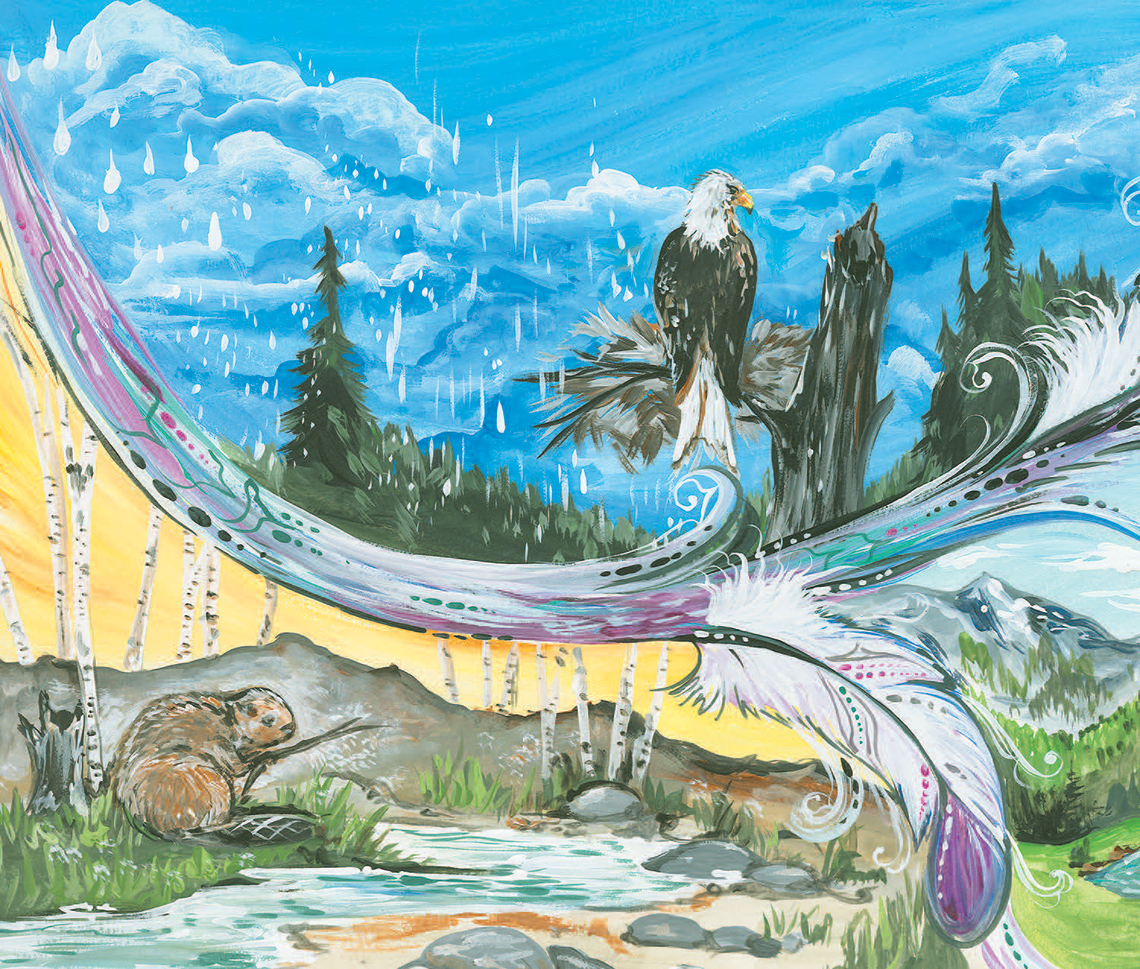
There is a bever near a dam holding a piece of grass in their hands. There is an eagle sitting on a tall tree stump. In the background there is a forest of trees and a sky full of clouds. There is a feather flowing across the page.
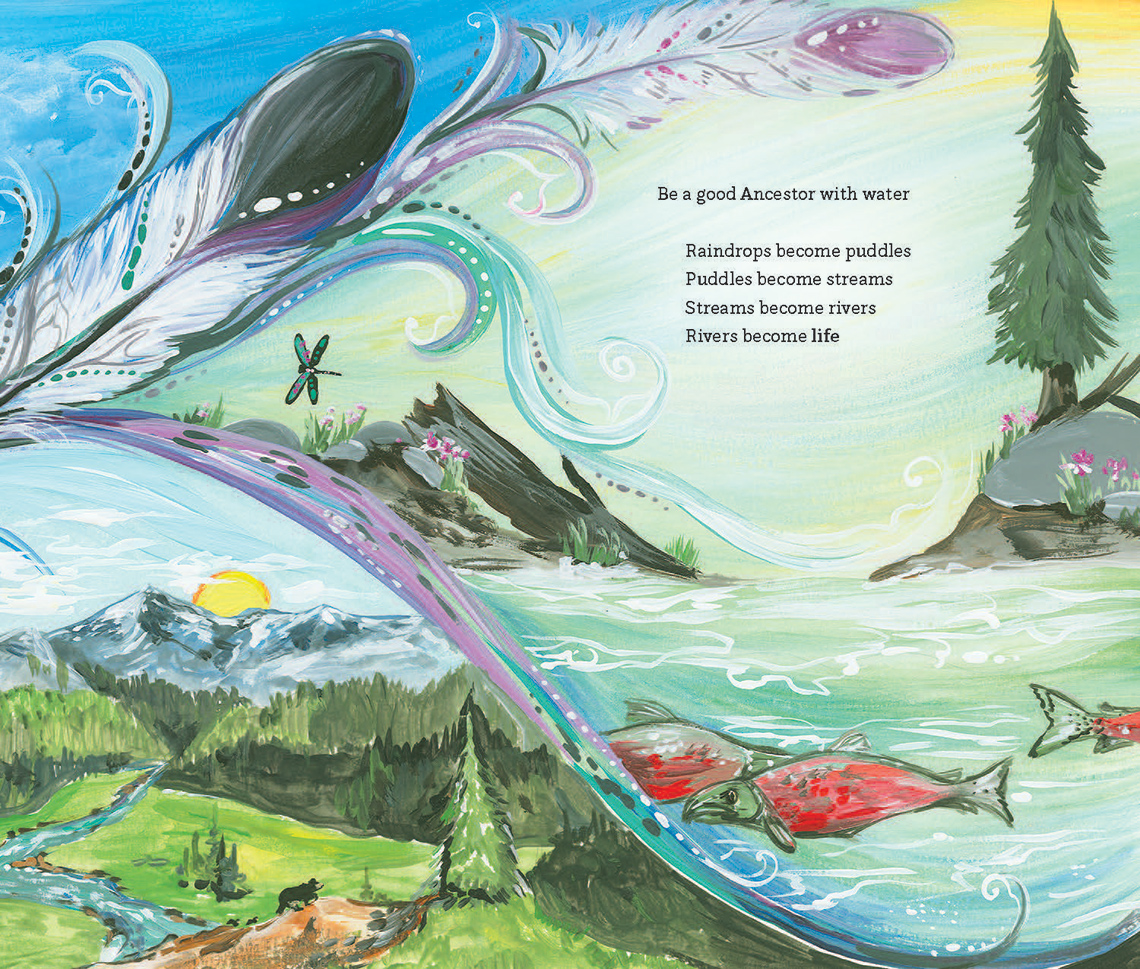
The same feather is flowing in this page which splits up the images. The bottom image is a scenery of a river flowing into the forest with mountains in the background. The sun is peeking out of the mountains. There is also a small bear walking up a small hill near the river.
The top image is of fish swimming under water. Above the water there is a dragon fly and a small tree.
This page reads the following with the word life bolded:
Be a good Ancestor with water
Raindrops become puddles
Puddles become streams
Streams become rivers
Rivers become life
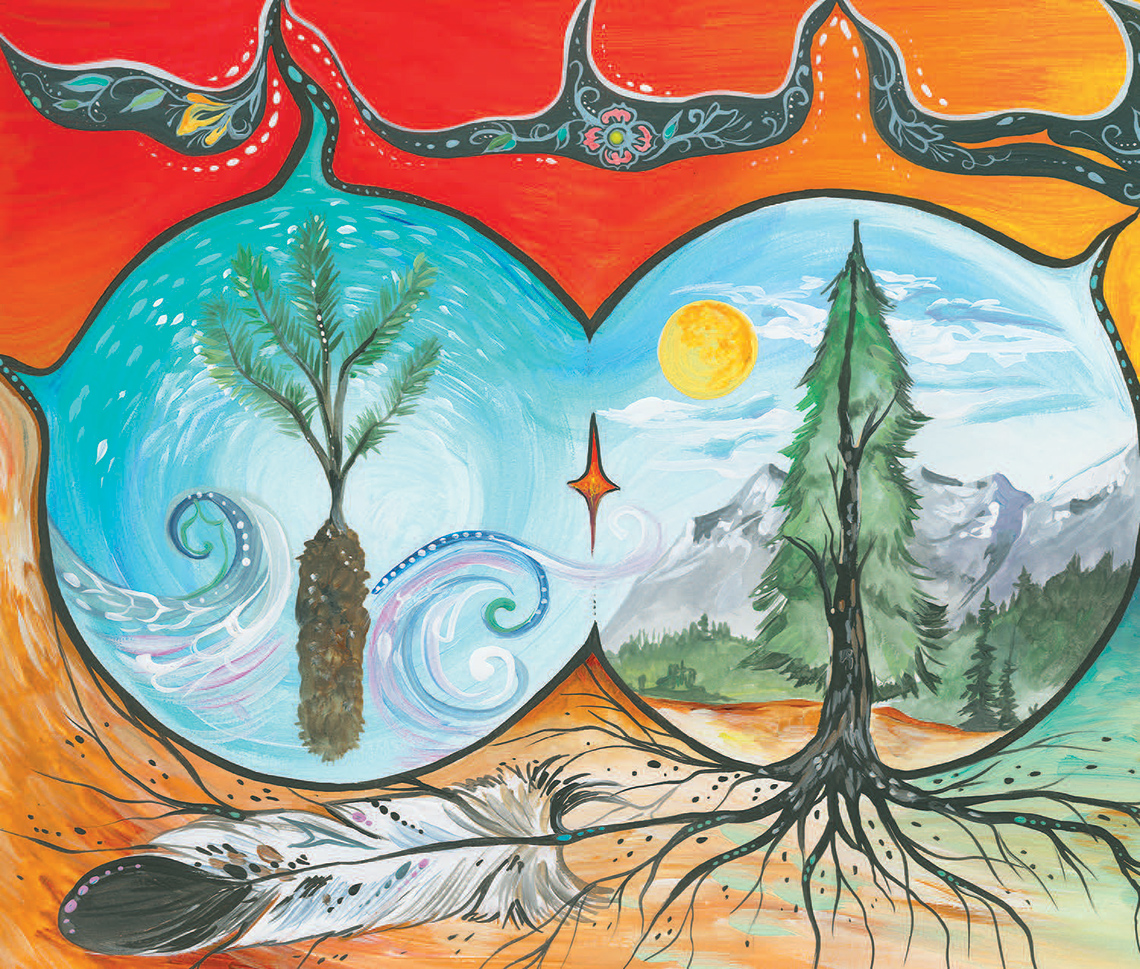
This page is split between two images that are in a shape of a circle but are connected. The first circle has a small growing tree, and the second has the tree with the roots growing out underground. One of the roots is connected to a feather.
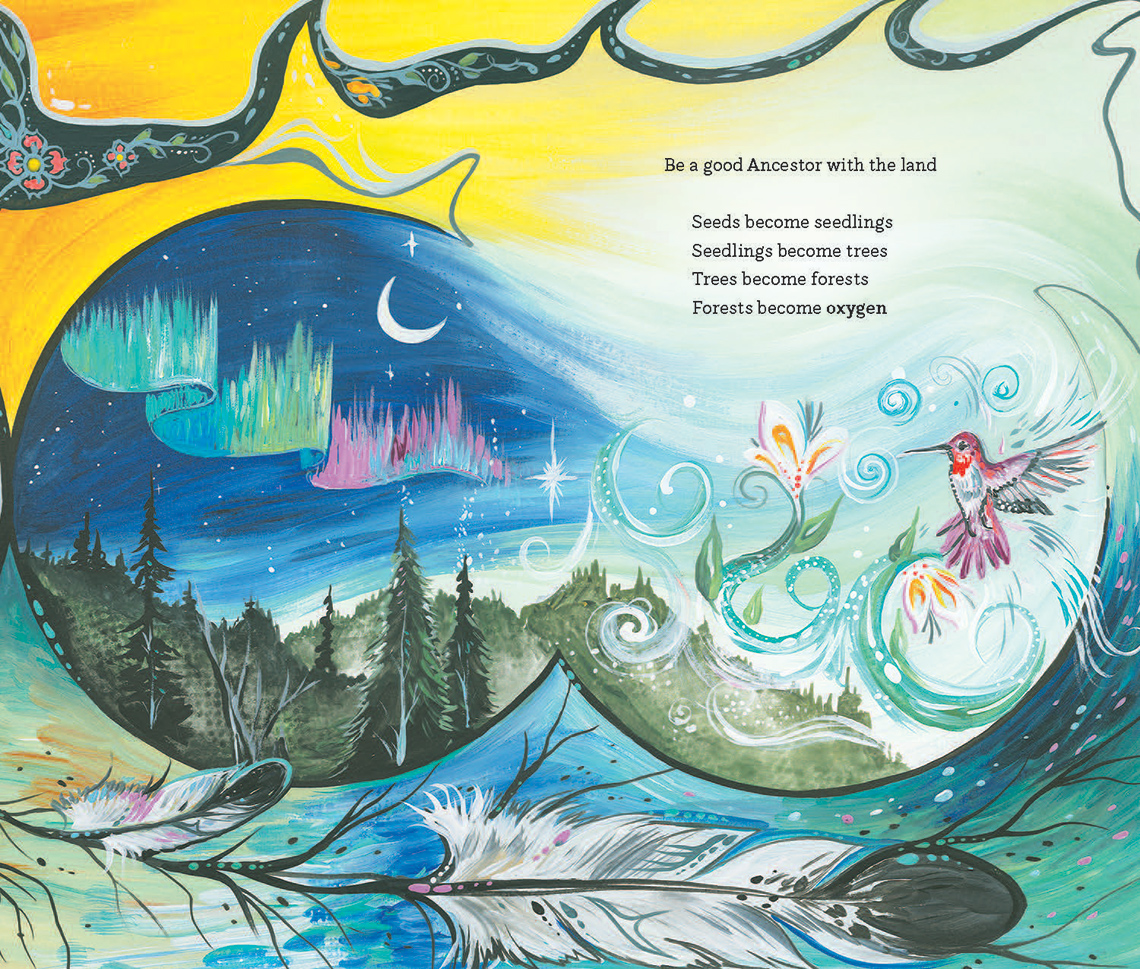
The roots from the tree continue onto the bottom of this page with two feathers. On the top there is a scenery of the top of a forest in the night sky. The moon and stars are in the sky. The night sky blends into scenery of a hummingbird and small flowers.
This page reads the following with the word oxygen bolded:
Be a good Ancestor with the land.
Seeds become seedlings.
Seedlings become trees.
Trees become forests.
Forests become oxygen
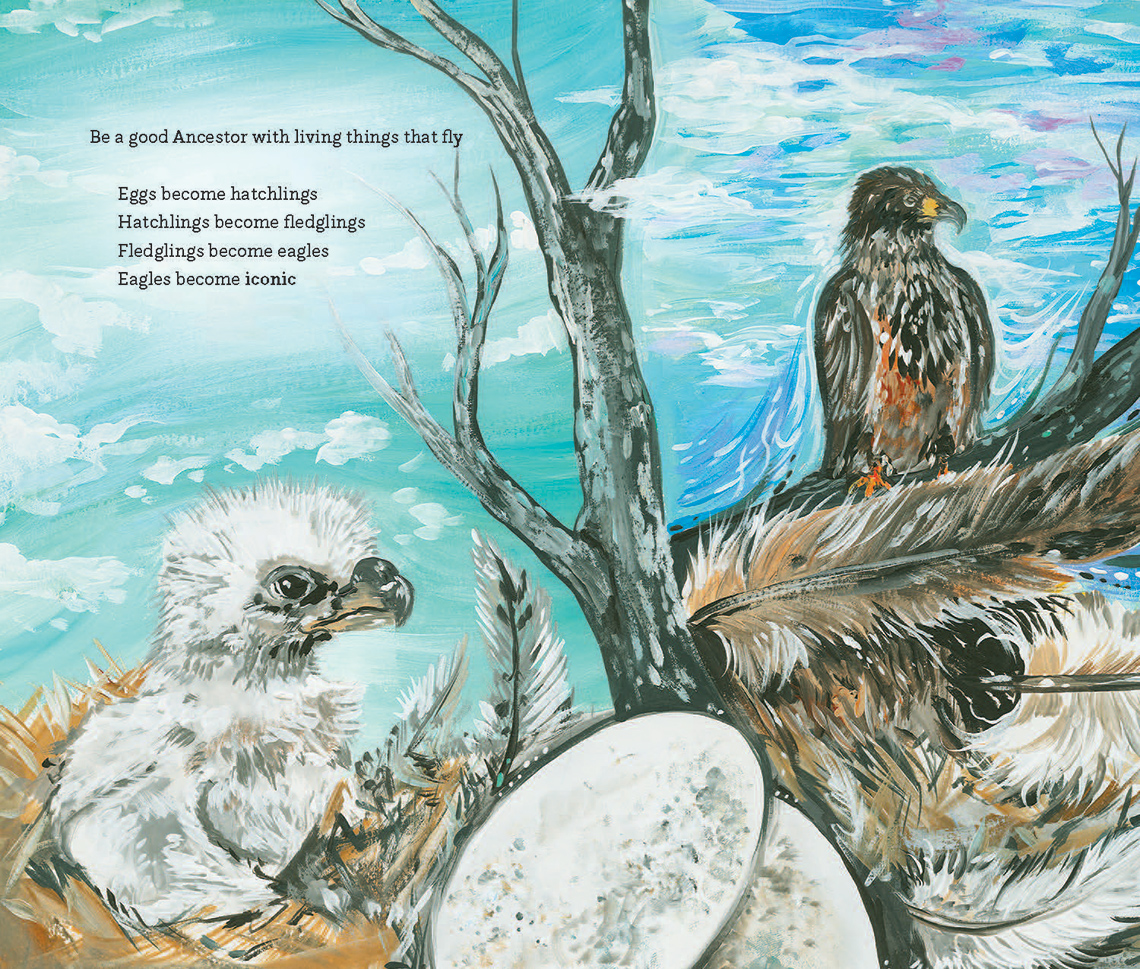
There are two baby eagles sitting. One is sitting on a branch and the other in a nest with two eggs.
This page reads the following with the word iconic bolded:
Be a good Ancestor with living things that fly
Eggs become hatchlings
Hatchlings become fledglings
Fledglings become eagles
Eagles become iconic
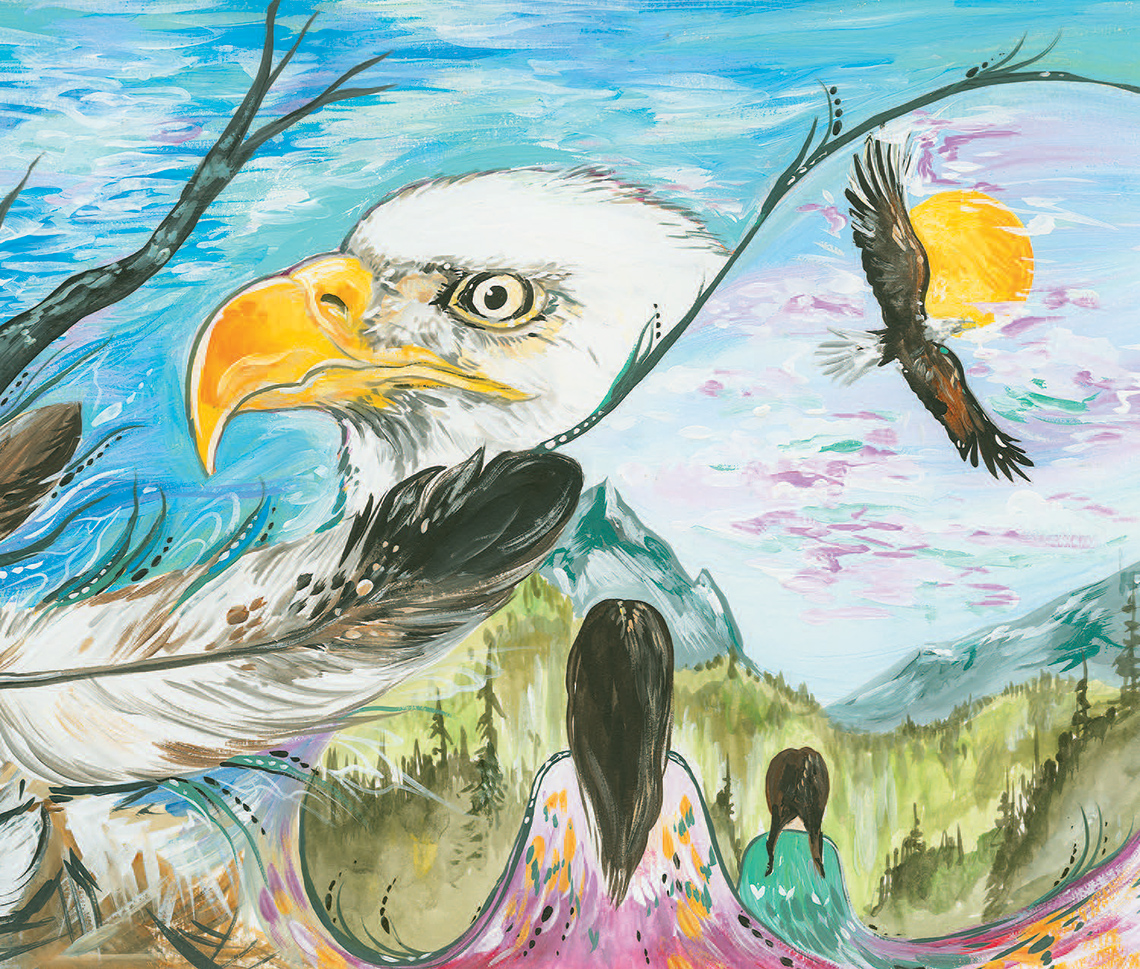
There is an elder and a young child looking out into the forest and mountains. There is an eagle flying in the sky with the sun shining in the sky. On this page at the top left there is a large image of a side view of an eagle with a large feather underneath.
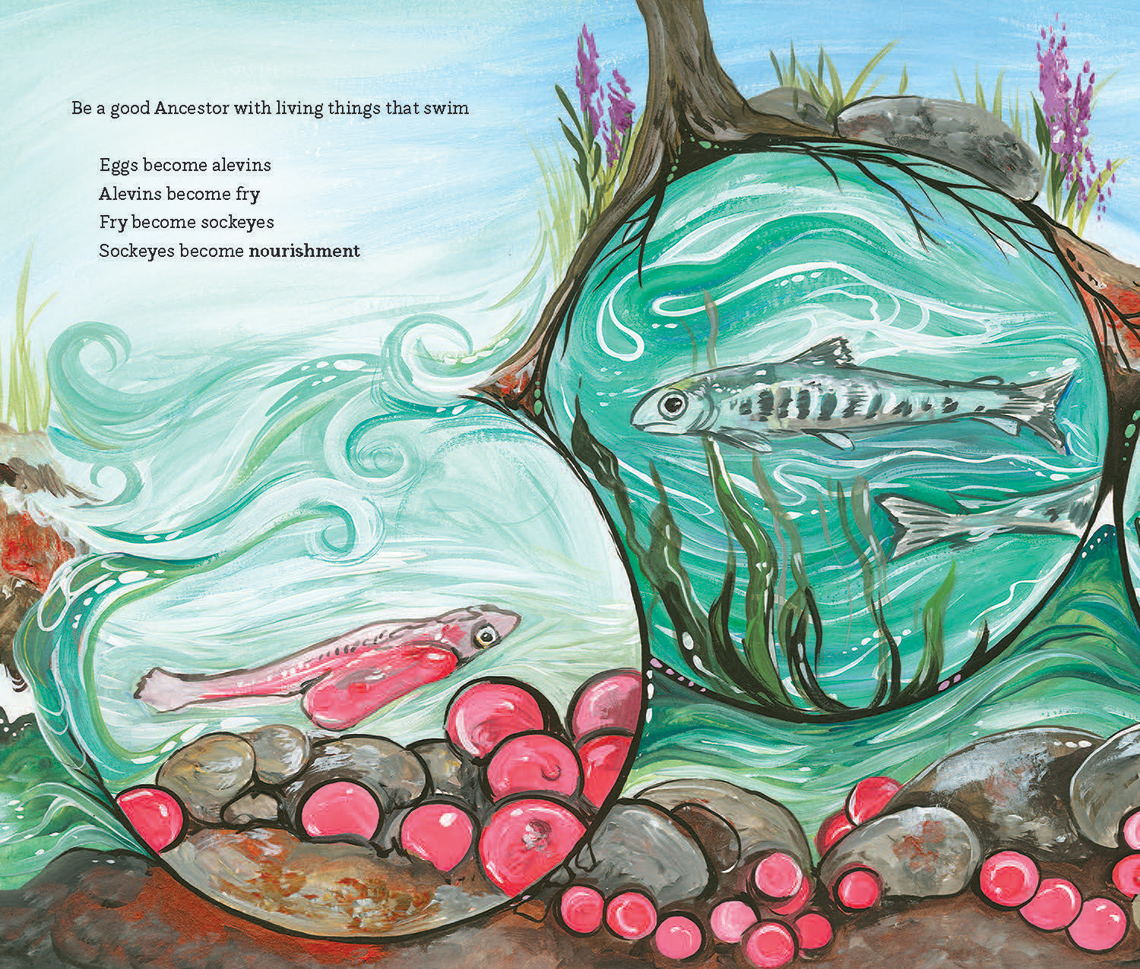
There are several eggs underwater with an alevins floating on top. There are also sockeyes swimming.
This page reads the following with the word nourishment bolded:
Be a good Ancestor with living things that swim
Eggs become alevins
Alevins become fry
Fry become sockeyes
Sockeyes become nourishment
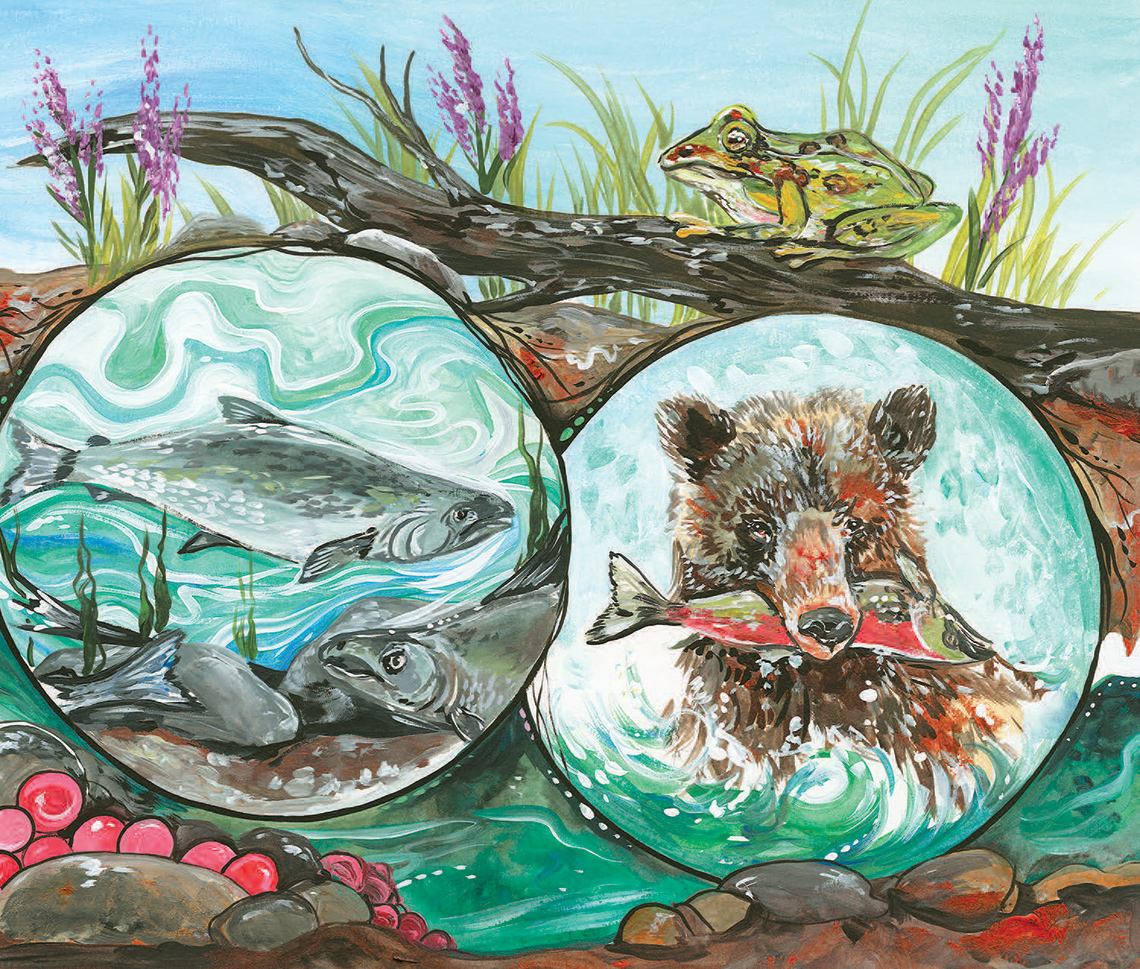
There is a frog sitting on top of a large branch. Under the branch there are two sets of images. The first image is underwater with three sockeyes swimming. The second image is of a bear with a fish in his mouth.
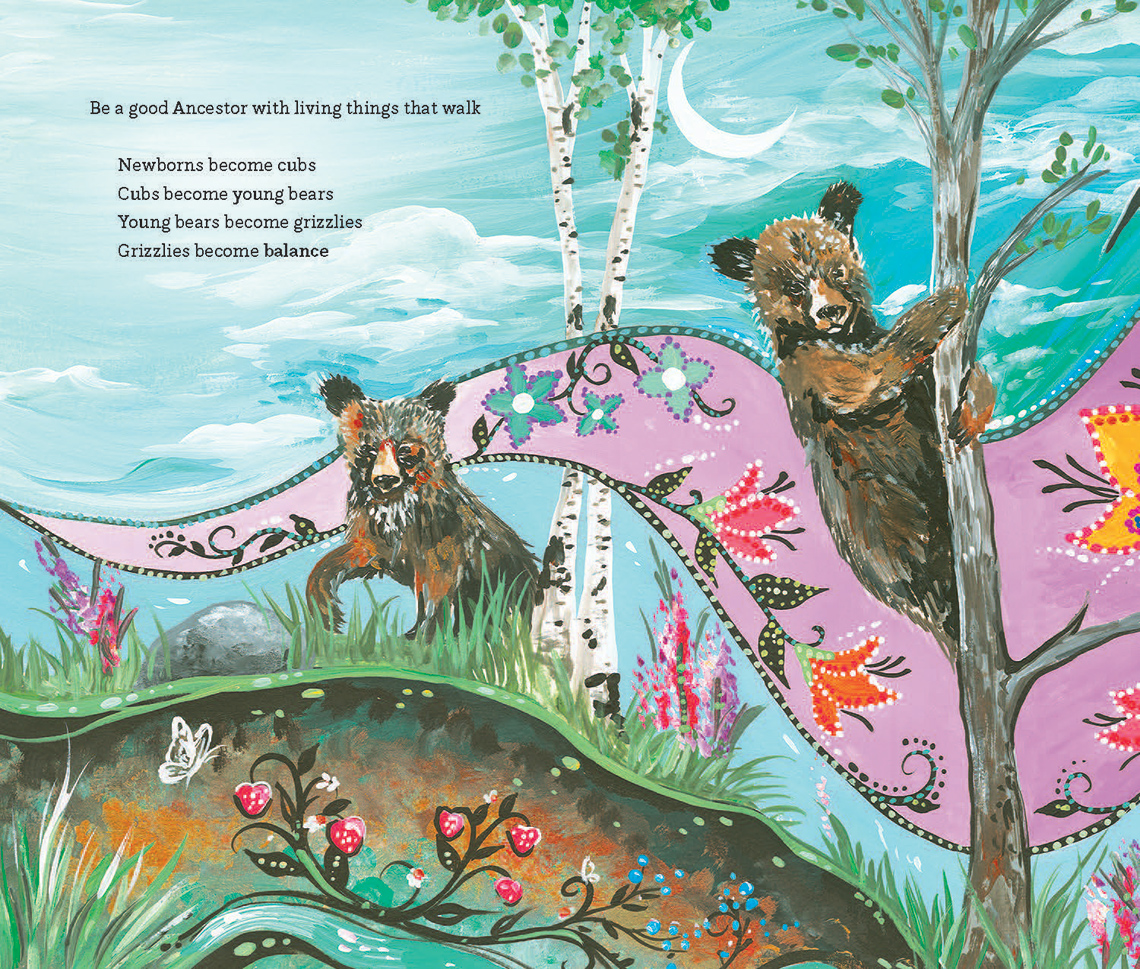
There is a baby bear climbing a tree and another bear in the grass.This page reads the following with the word balance bolded:
Be a good Ancestor with living things that walk
Newborns become cubs
Cubs become young bears
Young bears become grizzlies
Grizzlies become balance
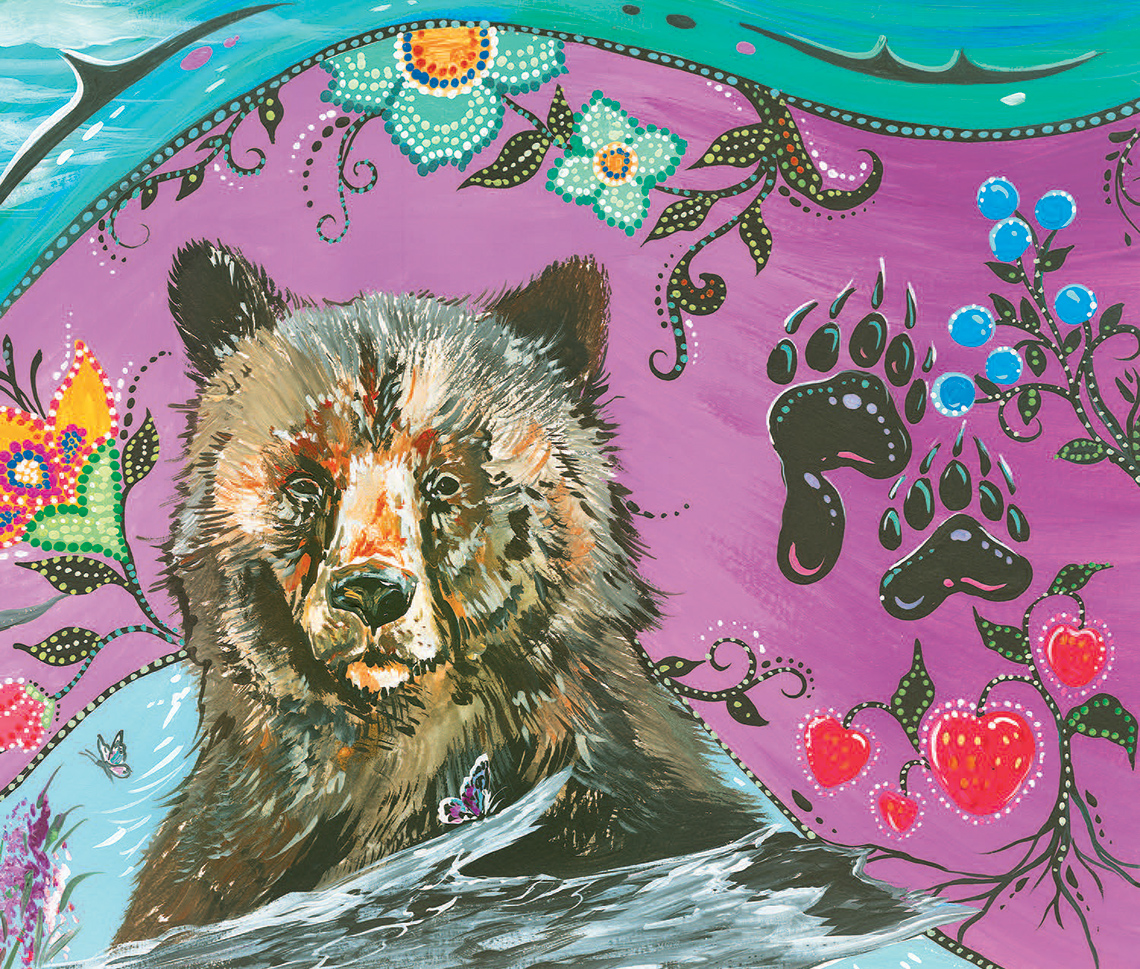
The final illustration is a portrait of a bear surrounded by plants, flowers, and butterflies. Some of the plants are painted in a style with many brightly coloured dots, which is similar to Indigenous beadwork patterns. The bear’s footprints are also included as part of the pattern.
Post-Reading
Answering questions can reinforce your understanding of what you have read.
Select the correct answer to the following multiple-choice question. Then press the Check Answer button to see how you did.
Why do you think this word is repeated so often? Write your answer in a journal of your choice, then press Possible Answer to compare.
The word “become” is repeated many times to remind us that everything in life changes and evolves. The word also suggests that a small action or creature can end up having a big impact.
Part 2: “Be a Good Ancestor”
Vocabulary words
To learn some words that will help you understand the second part of the book, explore the following flashcards!
Now you will finish reading the story.
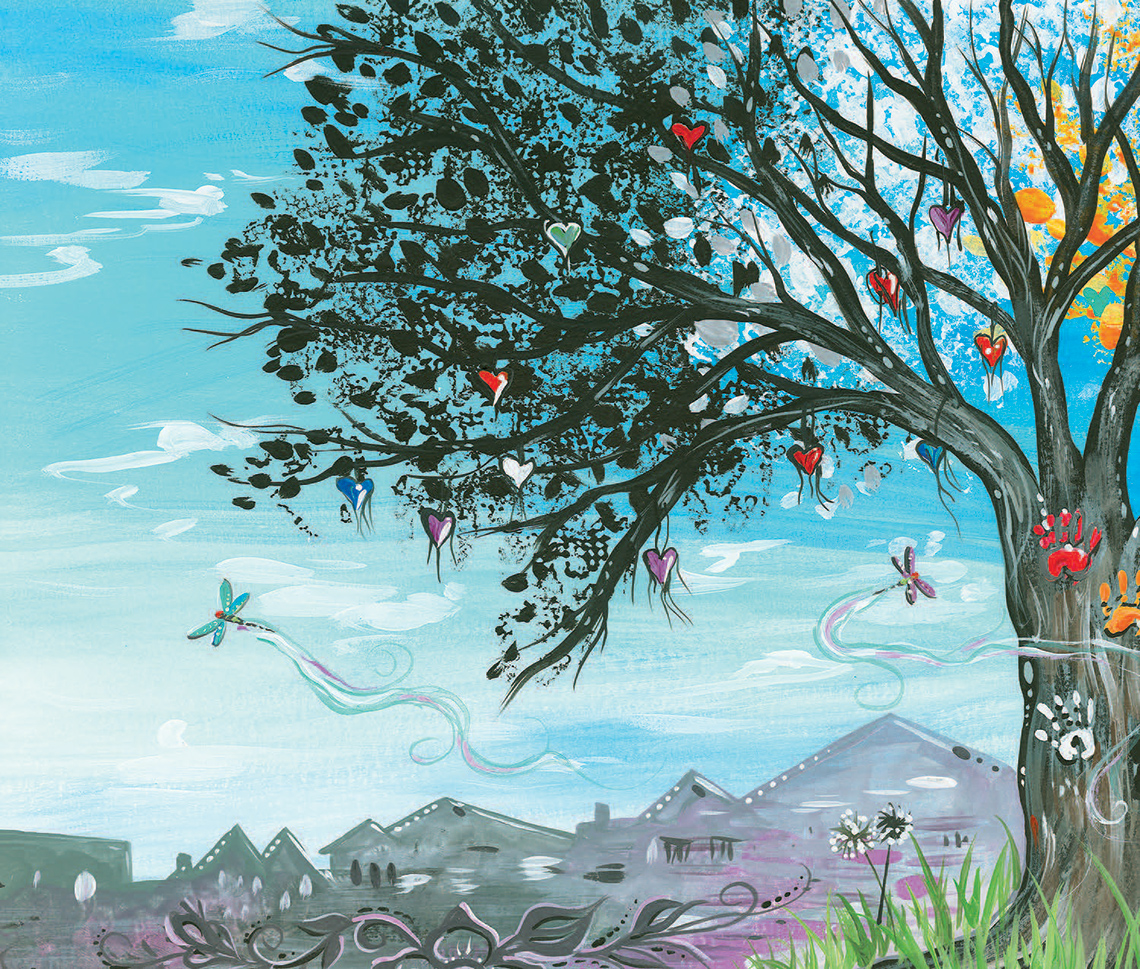
A large tree with branches that have leaves. There are heart-shaped ornaments hanging from the branches. On the tree trunk there are three handprints. There is an outline of house roof tops in the background with a dragonfly flying away.
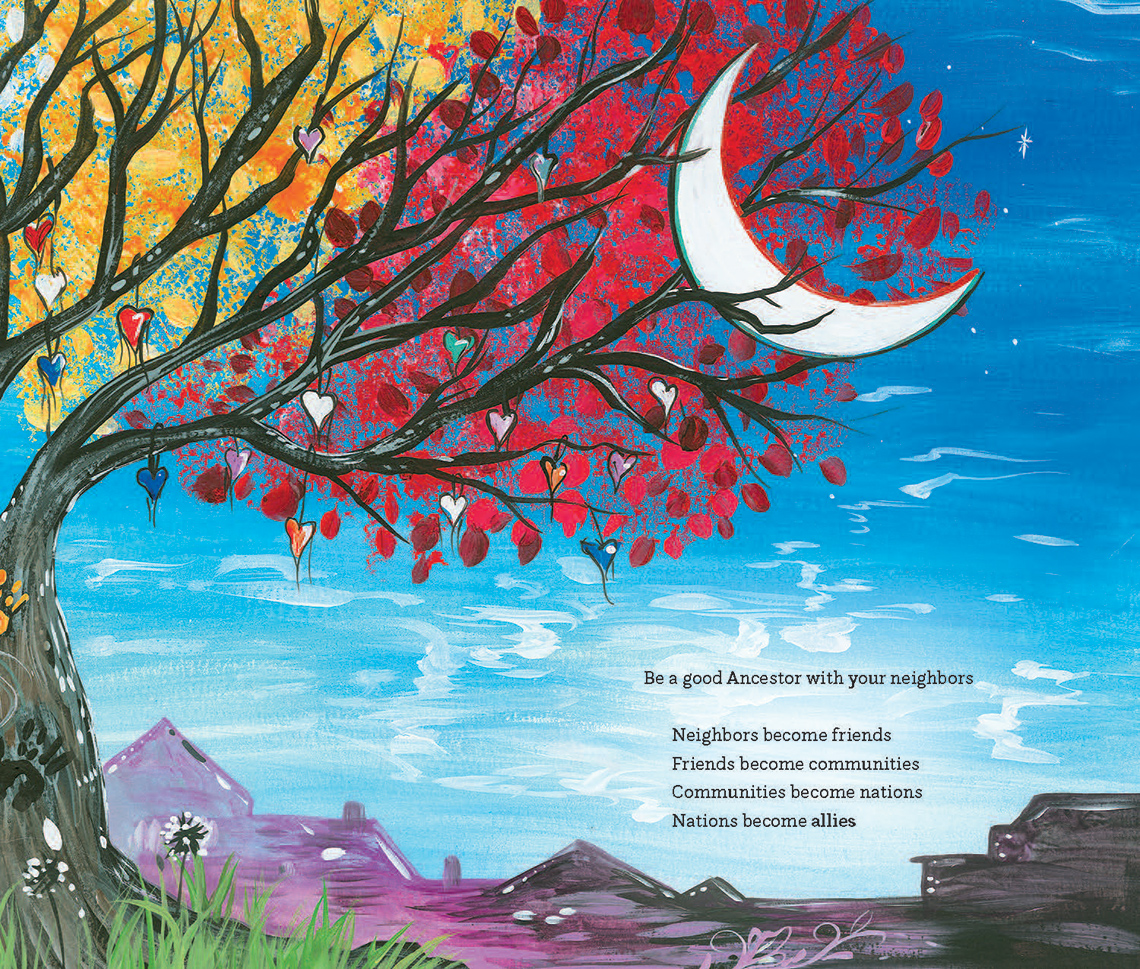
There is a tree filled with leaves and heart shaped ornaments hanging all over. There is also a moon sitting in one of the branches. The background has an outline of house rooftops.
This page reads the following with the word allies bolded:
Be a good Ancestor with your neighbours
Neighbours become friends
Friends become communities
Communities become nations
Nations become allies
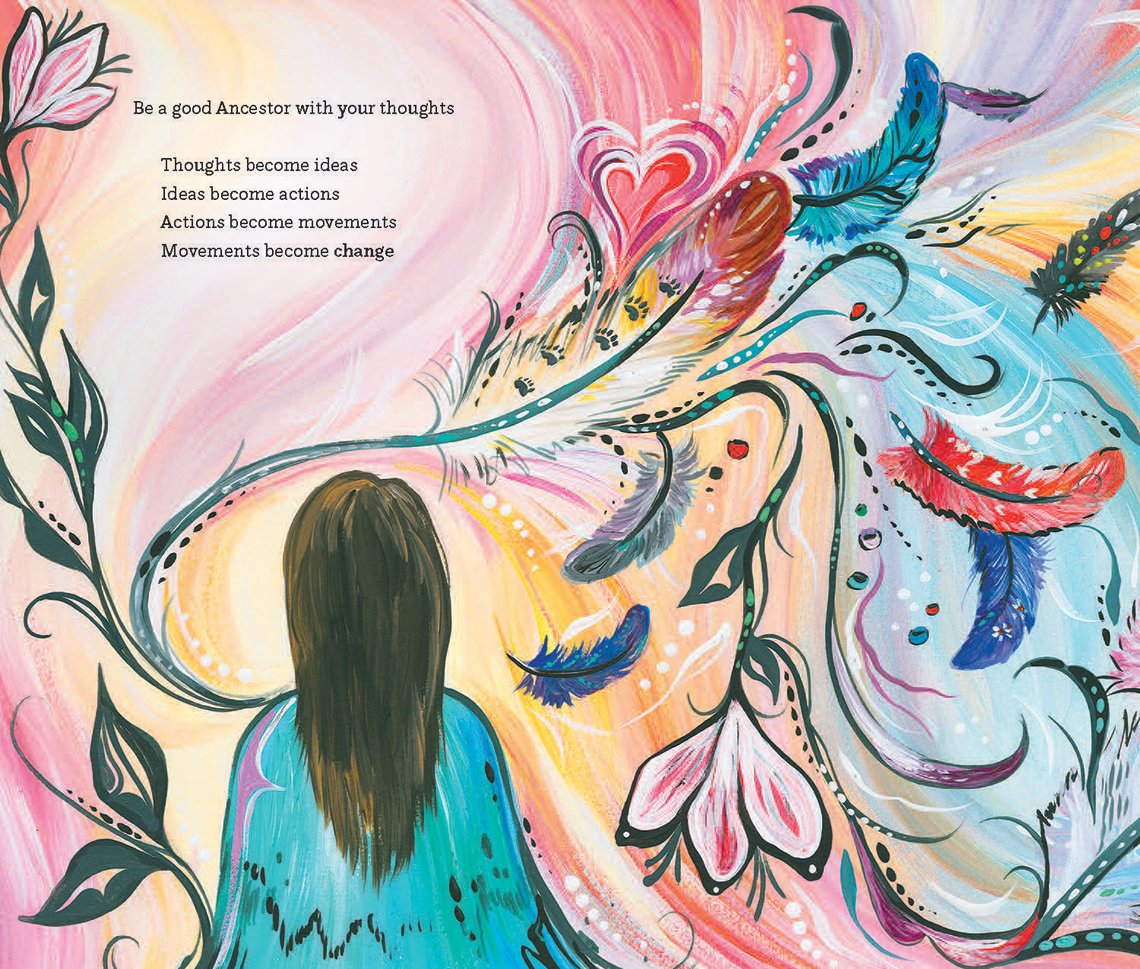
A teenage child with different leaves and feathers flowing in the background.This page reads the following with the word change bolded:
Be a good Ancestor with your thoughts
Thoughts become ideas
Ideas become actions
Actions become movements
Movements become change
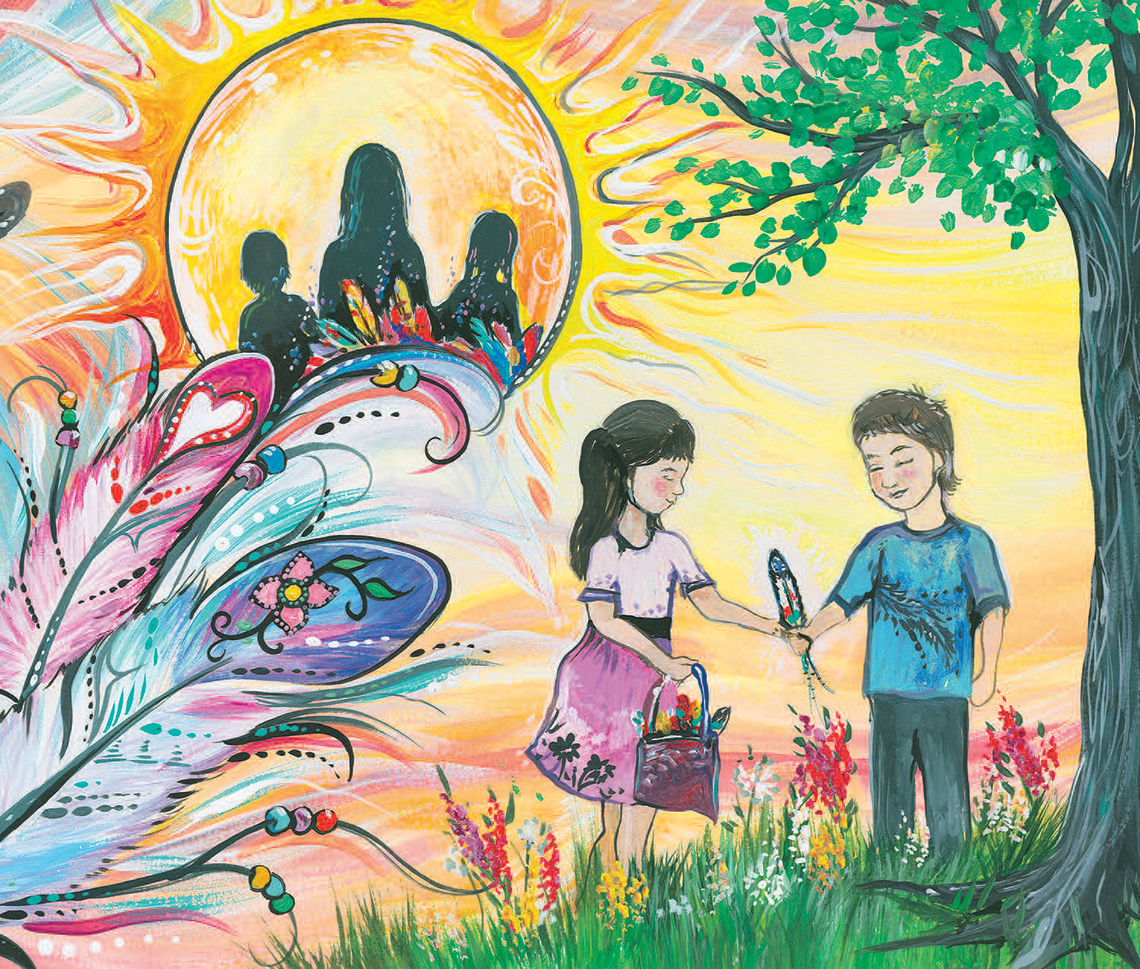
The bottom left corner has a large feather peeking out. There are two school aged children exchanging feathers in front of a tree. In the background there is a sun with a shadowed outline of an adult and two small children one on each side.
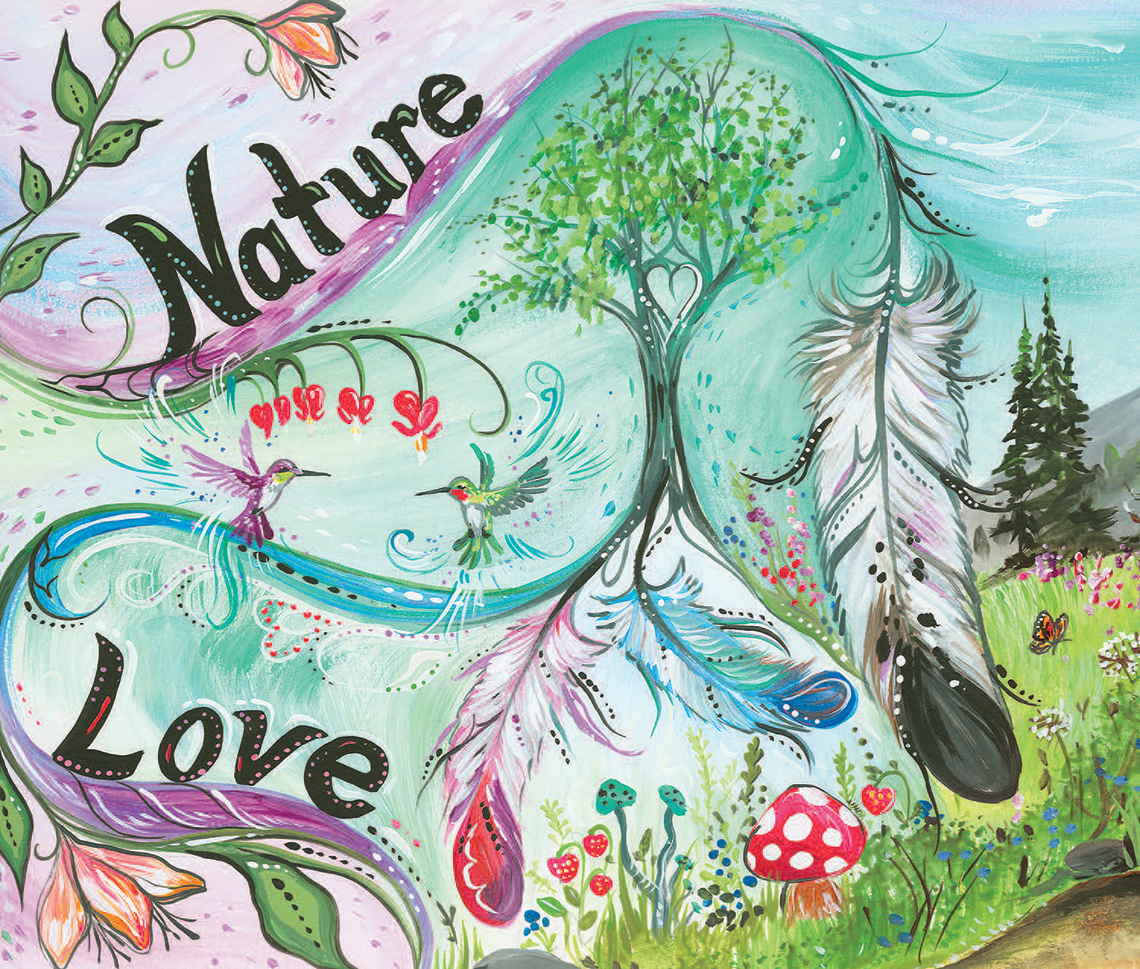
There is a medium size tree in the middle of the page. The roots are attached to feathers. One of the roots spreads out into a curved line with the words “Love” at the end of it. The word “Nature” is mentioned at the top left corner of the page with a feather at the ends.
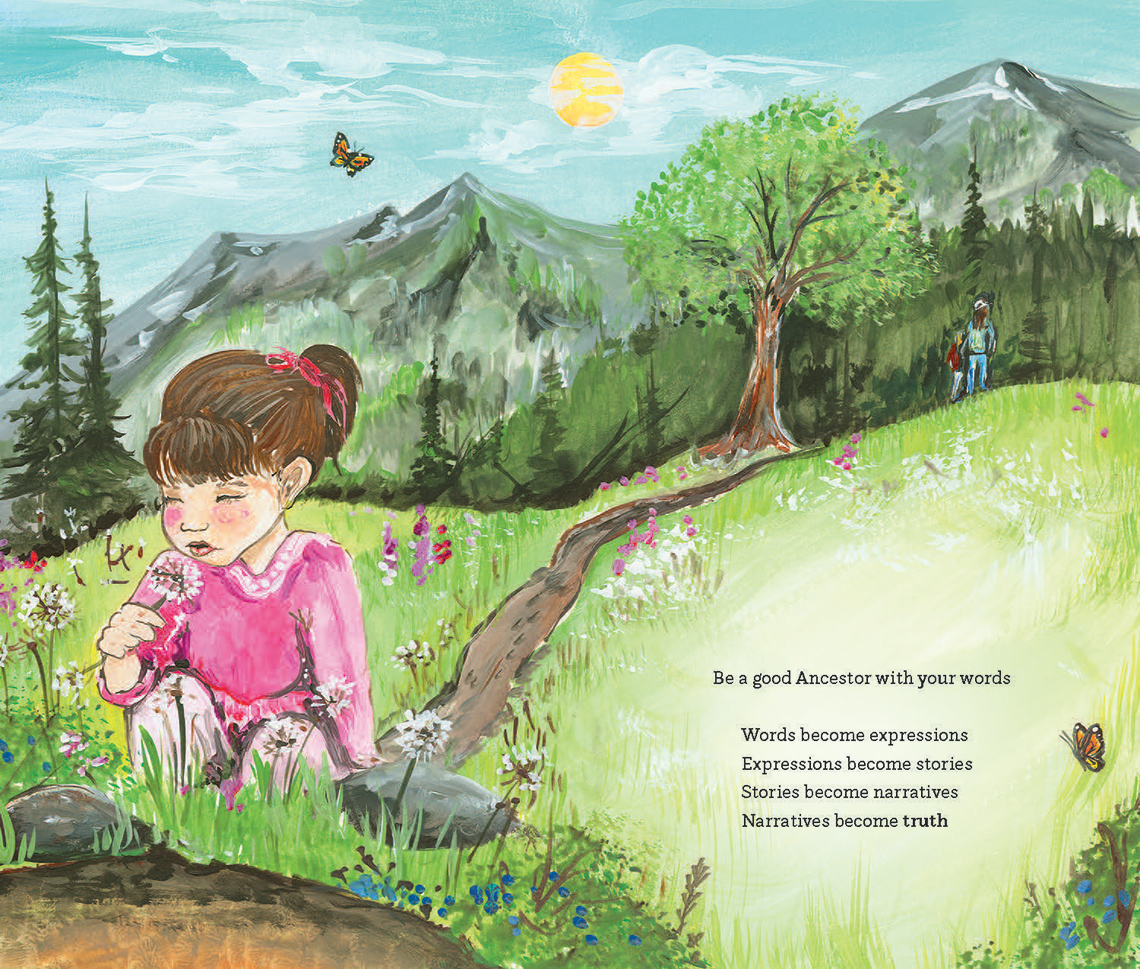
There is a small child sitting in the grass at the bottom of a hill holding a dandelion in her hand. In the background there is a forest and a mountain view. The sun is in the sky hiding behind clouds with a butterfly flying.
This page reads the following with the word truth bolded:
Be a good Ancestor with your words
Words become expressions
Expressions become stories
Stories become narratives
Narratives become truth
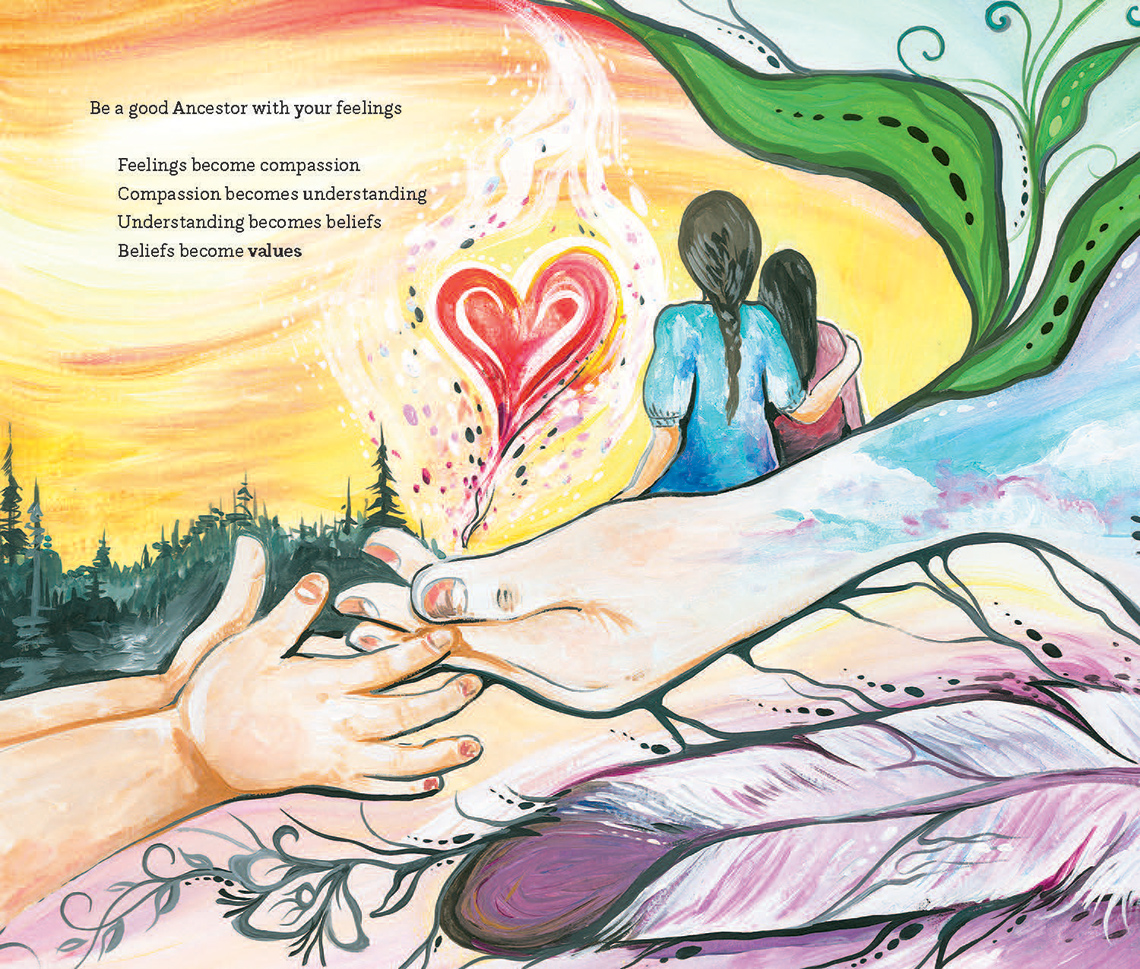
The center of the pages there are hands of a small child reaching towards an adult’s hand. There is a heart floating out from the palms of their hands. Sittig on the arm of the adult hands there is a mother and daughter looking out into the sky.
This page reads the following with the word values bolded:
Be a good Ancestor with your feelings
Feelings become compassion
Compassion becomes understanding
Understanding become beliefs
Beliefs become values
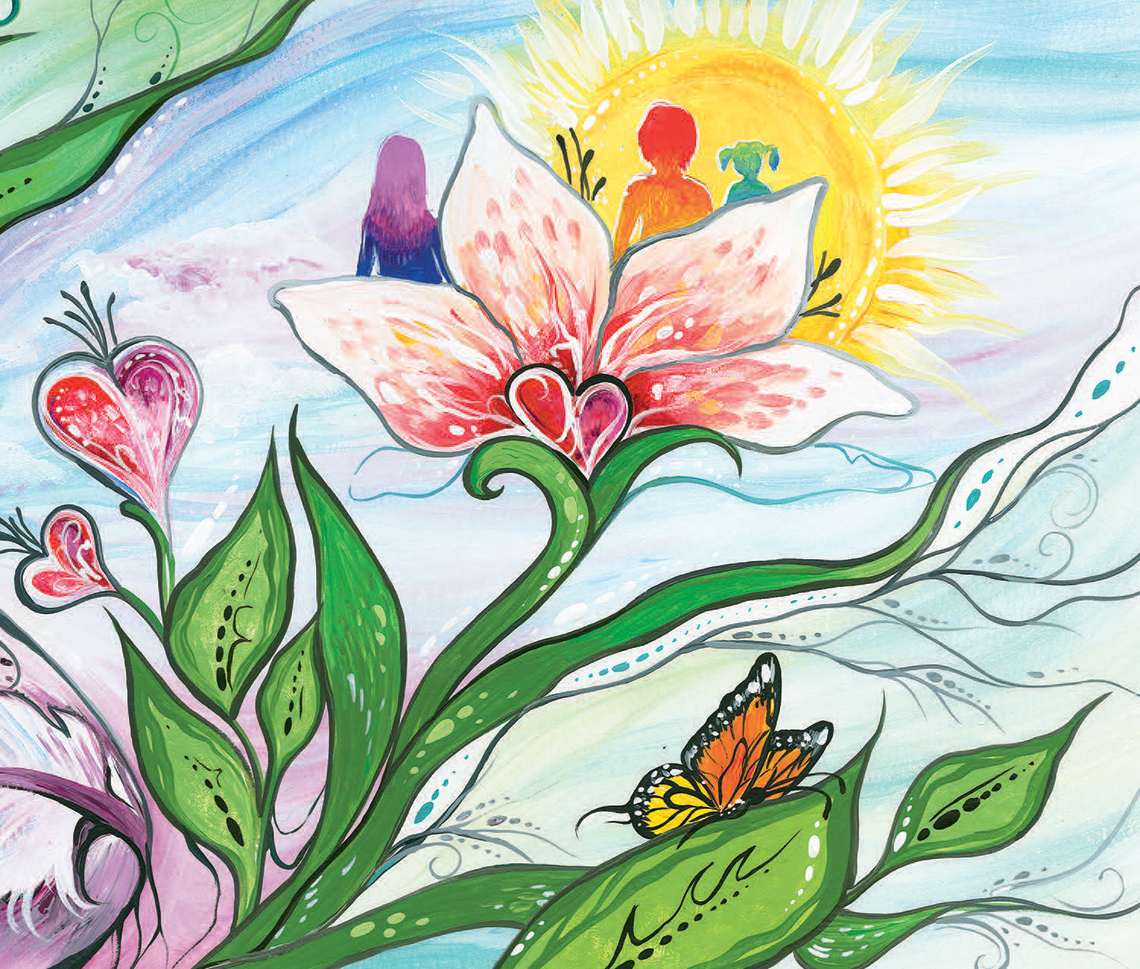
There is a large flower in the middle of the page. On the petals there are three small children sitting. There is the sun in the background.
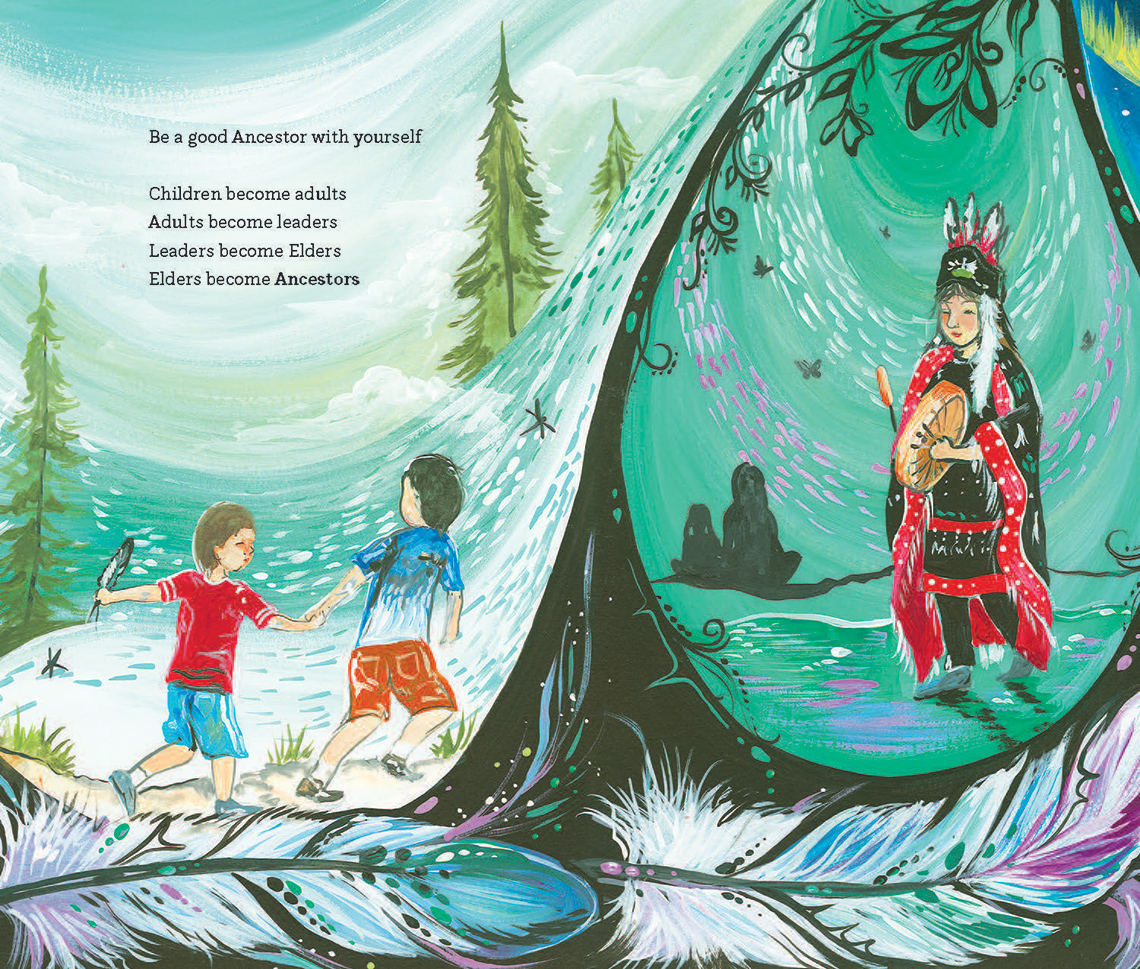
There are two young boys holding hands and walking. One of them has a feather in their hands. There is also an Elder wearing their cultural clothing and holding an instrument in their hands.
This page reads the following with the word Ancestors bolded:
Be a good Ancestor with yourself
Children become adults
Adults become leaders
Leaders become elders
Elders become Ancestors
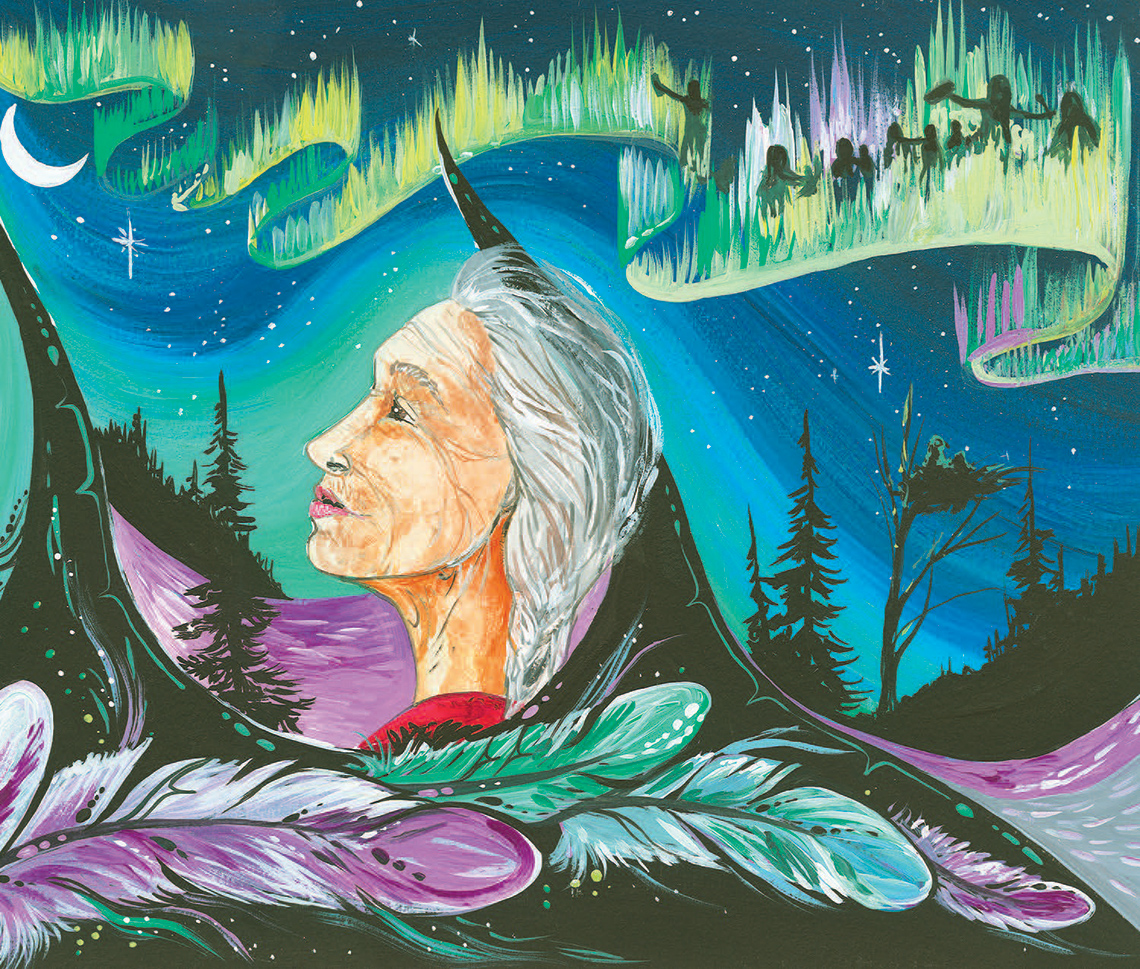
There is a side view of an Elder looking at the moon in the night sky. In the sky there are also a small group of people holding instruments in hand. The background has trees and in the fore front there are feathers.
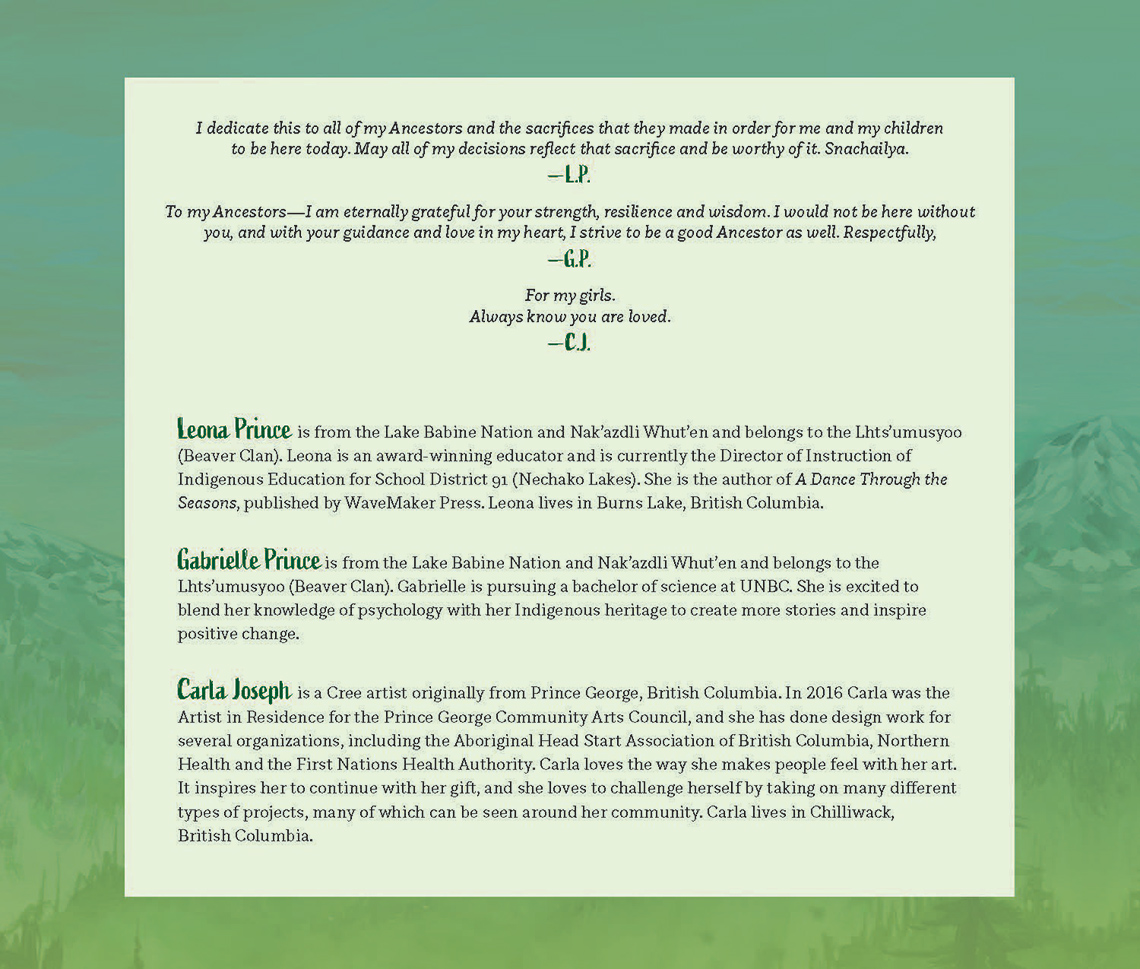
This page consists of different dedications for the book.One of the decations reads:I dedicate this to all my Ancestors and the sacrifices that they made in order for me and my children to be here today. May all of my decisions reflect that sacrifice and be worthy of it. Snachailya.
Copyright information of the book Be a Good Ancestor by Leona Prince and Gabrielle Prince. This section of the book lists its publication, legal, copyright, and printing details.
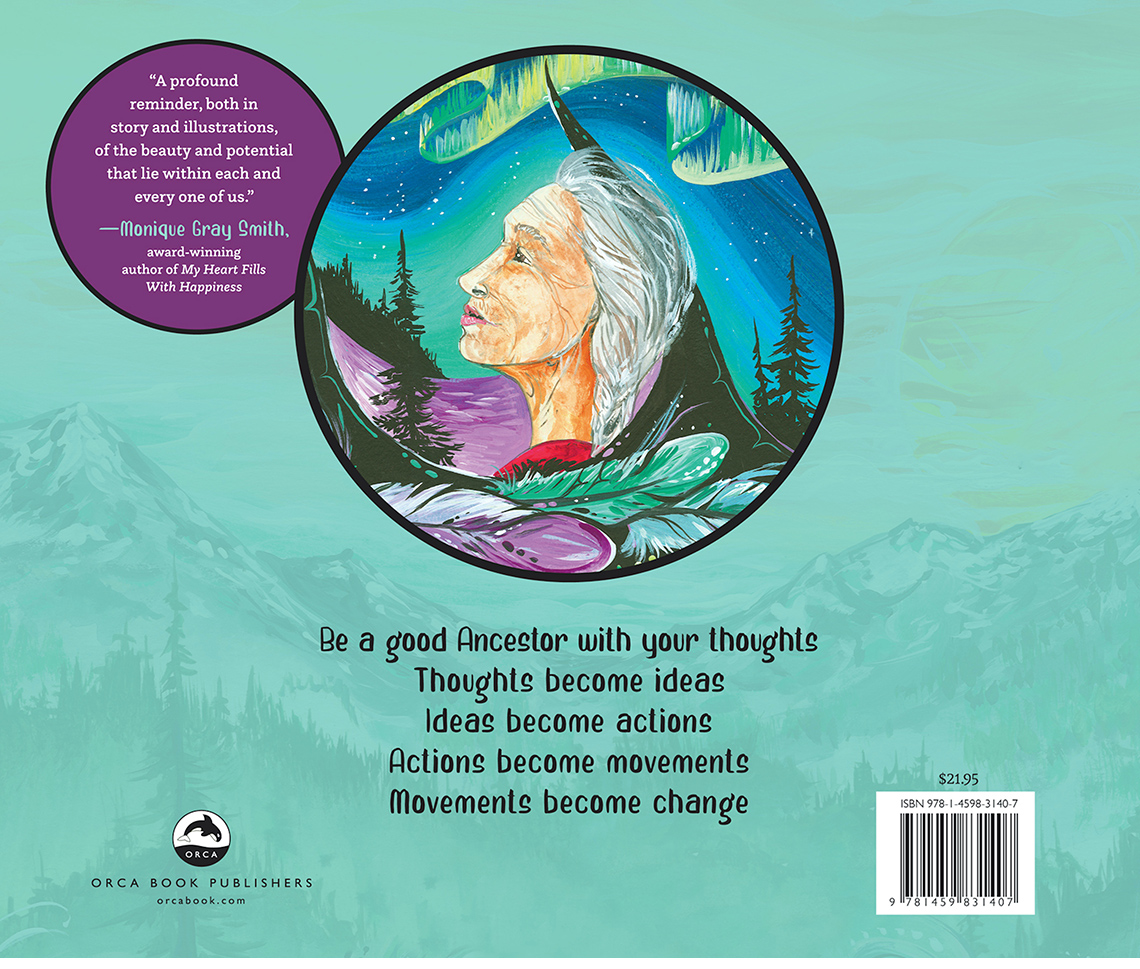
Back of the cover page of the book Be a Good Ancestor by Leona Prince and Gabrielle Prince
Post-Reading
Now that you have finished reading the whole story, you are going to think about the big ideas. What does this story make you think of? Check off all the items that apply.
This story makes me think of…
Back to the title…
The word “ancestor” means people in our families and communities who have come before us.
This is a picture book aimed at young people. So why are the authors asking the reader to be “a good Ancestor”?
Record your thoughts using the method of your choice, then press Possible Answer.
We need to be “good Ancestors” to the land, water, and air so that the Earth remains healthy for future generations. We can consider ourselves part of a long chain of people who care for the environment. You don’t need to be “old” to be a “good Ancestor” to the Earth.
Making your own connections to the book
Respond to two of the following questions in a journal of your choice. Make sure to read all six of the questions before you choose which two you will respond to!
1. Did the story match your predictions? Why or why not?
2. Look back at the questions you had before you read the book. Were your questions answered?
3. What might the text or the images teach the reader about Indigenous Peoples' connection to the environment?
4. How did the images or the words make you feel?
5. What do you think the main idea of the book might be?
6. Why are the authors asking the reader to “be a good Ancestor?
You have done a lot of thinking about the book “Be a Good Ancestor.” Now is a great time to take a break before we learn about how to write book titles!

Student Wellness
Take a break!
Time for a body break! If possible, stretch your body and move around your space.
Thinking about language!

Writing book titles
Take a look at the title of the book we’ve been exploring: Be a Good Ancestor
Think about how capital letters are used in this title. Record what you notice, then press Possible Answer.
Be a Good Ancestor
In this title…
- the first word has a capital (“Be”)
- the word “a” does not have a capital
- the word “Good” and the word “Ancestor” both have capitals
What are the rules?
When we write the title of a book or a film, there are special rules about how to use capitals:
- The first word is always capitalized (for example, “Be a Good Ancestor”).
- Important words in the title are capitalized (for example, “Amazing Canadian Hockey Stars”).
- Smaller words such as the, and, of, in, a, an do not have capitals unless they are the first word of the title (for example, “The Loon and the Trout”).
Your turn!
Capital letter or small letter? Pick the right word to complete the book title, then press Check Answer to see how you did.
Good work! You now know how to write titles correctly.

Reading aloud
Choose a page from “Be a Good Ancestor” to read aloud. Read it several times to practise your speed, volume, and pronunciation. This is what we call your reading fluency: how easily you’re able to read the words correctly and with expression.
When you are ready, read the page aloud to a learning partner if possible, or record yourself on a recording device of your choice.
Protecting the environment
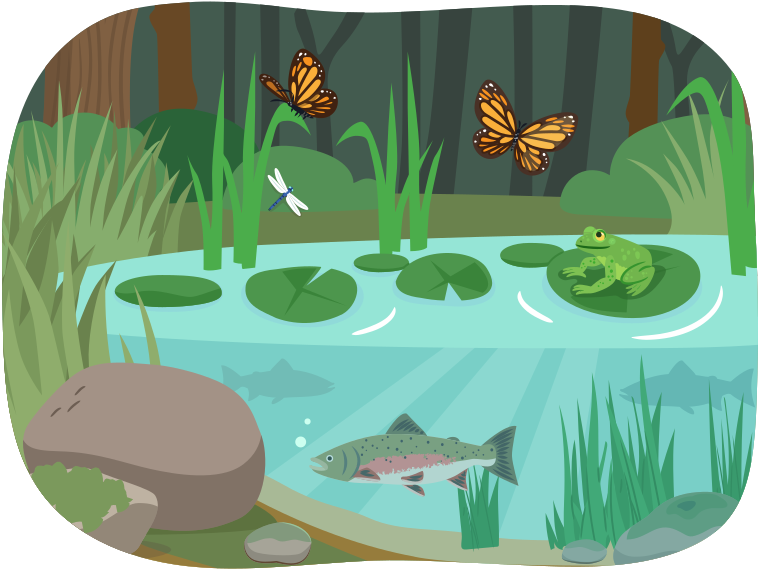
In the book “Be a Good Ancestor,” the authors talk about protecting water, animals, and the land. Examine the following text:
Be a good Ancestor with your thoughts
Thoughts become ideas
Ideas become actions
Actions become movements
Movements become change
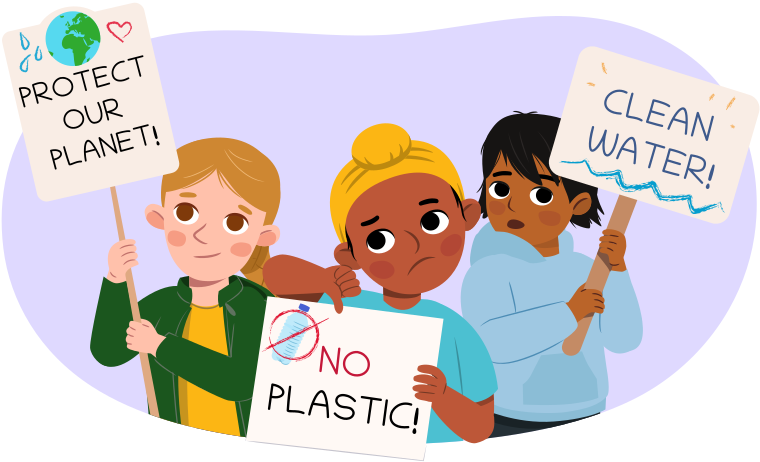
Reminder: In this situation, the word movement means “an organized group of people who are trying to create change.” For example, the students in the following picture have organized a protest. They are part of a movement to help the environment:
Taking action
What kinds of things can you do to bring about change and to help protect the environment?
You could…
- organize a day to clean up your local park
- turn off the lights when you leave a room to save electricity
- create an environment club at your school
- write a letter to a community leader
We are going to focus on this last option.
Writing a letter
One way to take action and help protect the Earth is to write a letter to a person who is a leader in your school or community, asking them to consider the environment when they are planning and making decisions.
Formal or informal?
What is the right tone for a letter like this?
Try the following multiple-choice question. Select the correct answer, then press Check Answer to see how you did.
When you write to an adult in the community, your letter will be formal. This means that the letter is more official and talks about a serious topic. We use full sentences and respectful language in formal writing.
Finding the right words
What kinds of things can you say in a letter to influence your audience? In other words, how can you explain what you are worried about and convince the person to help?
You could use some of the following sentence starters to help guide your writing:
- I am concerned about...
- I have noticed...
- Is there any way you could...
- I am hoping we could...
- It would be helpful if...
Letter structure
What are the parts of a formal letter? To find out, explore the following interactive image.
Writing a letter to a community leader
One way to take action and protect the Earth is to write a letter to a person who is a leader in your school or community and suggest an idea to help the environment.
Who are the leaders?
Who are the leaders in your community? You may choose to address your letter to one of the following people:
- a local politician
- a school principal or teacher
- a local business owner
It’s important to choose the right person for your suggestion or request. You wouldn’t write to the prime minister to ask them to add recycling bins to your school playground… and you wouldn’t write to your teacher to ask them to change a law!
Creating your letter: Steps

To create your letter, follow these steps.
Step 1: Find your idea
What is your concern about the environment? Use the following questions to brainstorm ideas.
- What are you concerned about in the environment?
- What would you like to see happen in your community or region?

Student Tips
Tip: Be specific!
When you come up with your concern and your request, be specific.
- Asking someone to add more recycling bins to the playground is specific.
- Asking someone to “protect the environment” is not specific.
Step 2: Plan your letter
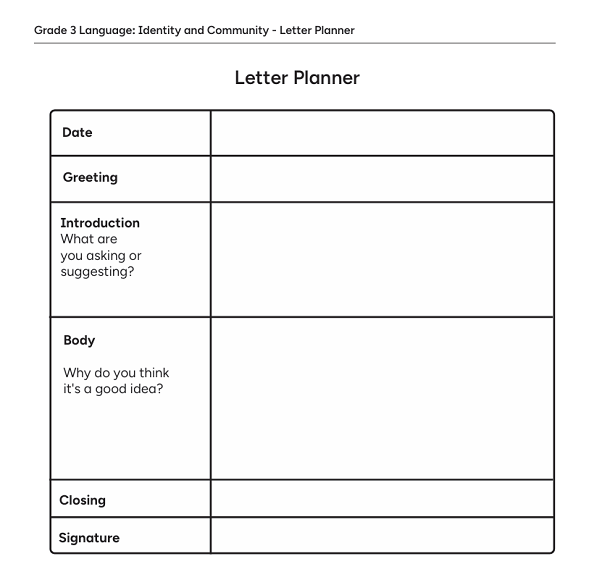
A graphic organizer can help you plan what you’ll say.
Complete the fillable and printable Letter Planner, or copy it into a journal of your choice and fill it in.
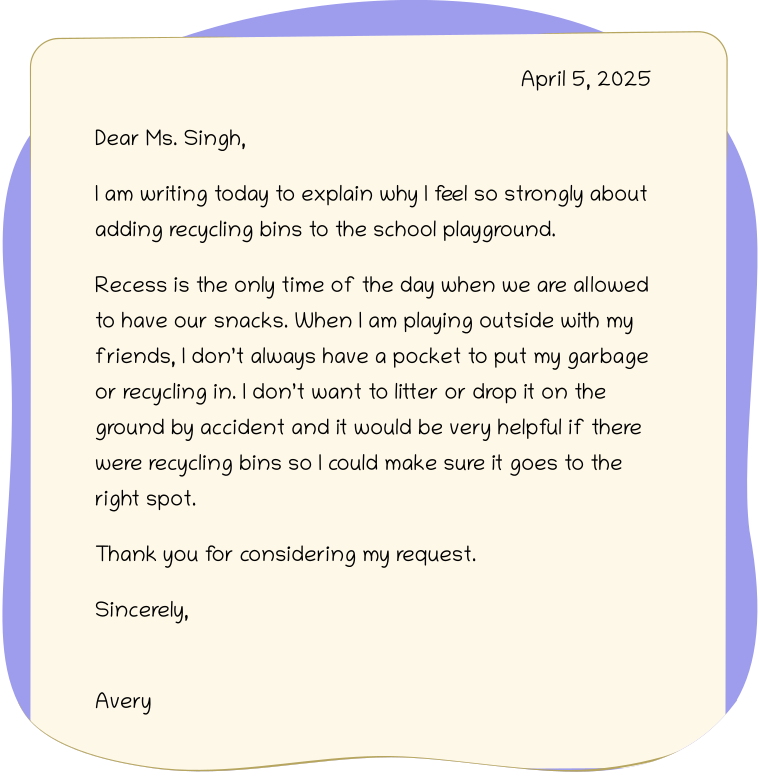
Step 3: Write your letter
When you are happy with the outline of your letter, write it in a journal of your choice. To remind yourself of how your letter should look, review this letter:
Step 4: Check your work
When you have finished, use the following checklist to make sure you have all the elements of an effective letter.
My Letter: Checklist:
I have...
Good work! It’s important to think about how you can take action to help the environment.
Reflection
How do you feel about what you have learned in this activity? Which of the next four sentences best matches how you are feeling about your learning? Press the button that is beside this sentence.

I feel...
Now, record your ideas about your feelings using a voice recorder, speech-to-text, or writing tool.