Learning goals
We are learning to…
- demonstrate an understanding of various forms of texts by various Indigenous creators
- develop cultural awareness to communicate and collaborate in respectful and inclusive ways
- gather, evaluate, and use information to create texts considering credibility, accuracy, and perspectives
Success criteria
I am able to…
- explain themes explored in specific examples of Indigenous art and interpret how these themes are represented in different ways
- share examples of elements of Indigenous art that represent the diverse identities, perspectives, and communities of the artists
- research and present information on the art of one of the members of the Indigenous Group of Seven and the impact of their art

Medicine Bear delivering Soul Fishes
Indigenous art expresses the unique identities, perspectives, culture, and beliefs of the individual artist and the community that they belong to.
Let’s explore one example of an Indigenous art style known as Woodland Art (also known as Woodland School of Art or medicine painting).
Examine the following painting.
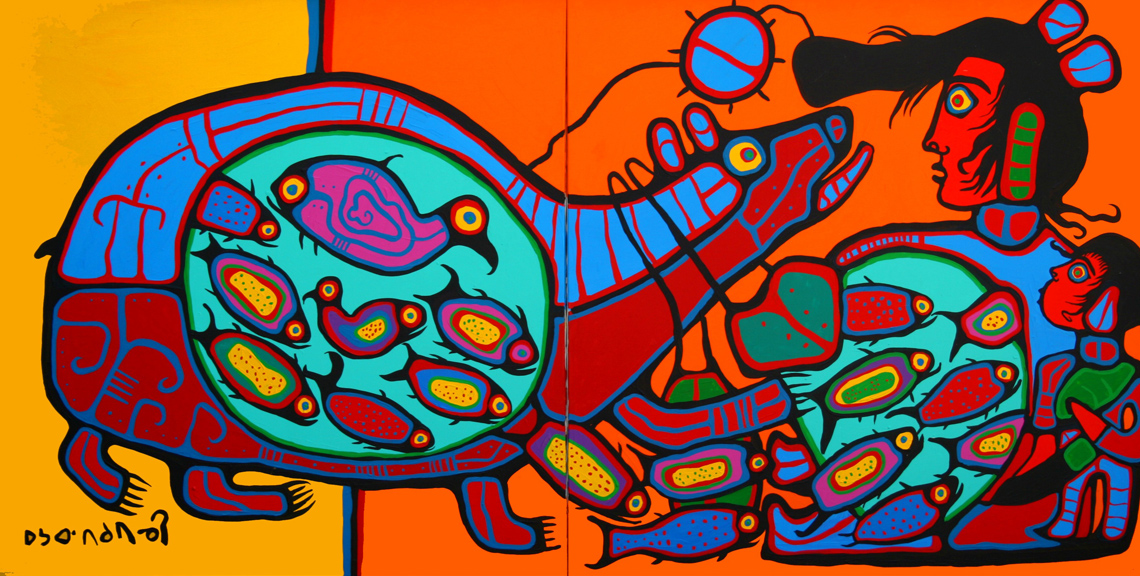
Medicine Bear delivering Soul Fishes by Norval Morrisseau, 1990

Brainstorm
Brainstorm
What do you notice about the painting? How does the painting make you feel? What is a possible message that this painting might be communicating?
Record your thinking in a notebook or using another method of your choice. If possible, share your thoughts with a partner.
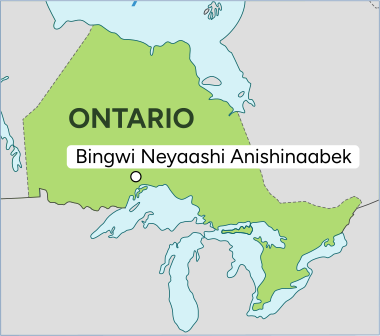
The Woodland style of art was founded by Anishinaabe artist Norval Morrisseau, from Bingwi Neyaashi Anishinaabek First Nation near Lake Nipigon, Ontario.
Morrisseau believed that Anishinaabe values and perspectives of the world needed to be reintroduced to modern art to showcase the depth and beauty of Indigenous art and art forms. His work reflects Anishinaabe worldviews and the teachings he learned throughout his life.
There are many more Indigenous artists who use their art and art forms to celebrate their Indigenous identities and educate Indigenous and non-Indigenous people alike about the beauty of their cultures, their unique identities, and the wisdoms and teachings of their Elders.
In this learning activity, we will explore some examples of Indigenous artists and their art forms and learn more about the importance of diversity and inclusion in the arts.

Identity in Indigenous art
Indigenous art comes from living cultures, which means it can change over time. In Canada, there are many kinds of Indigenous art. Indigenous Peoples have a wide range of cultures and communities, so their art and stories vary depending on each distinct nation’s unique perspective and expressions of their worldviews.
For many years, Indigenous art forms were oppressed by Western art and values. Indigenous art forms are distinct from Canadian or Western art forms because the values, histories, and worldviews that are used to design and create a piece are quite diverse and reflect traditional Indigenous storytelling and culture.
Indigenous art is based on Indigenous cultural and community knowledges, teachings, and lived experiences. These forms of art have also been treated differently both in the past and in the present.
Throughout modern history, art was mostly interpreted through a Western perspective. This meant that Indigenous art forms were not valued the same way and thought of as “lesser” to Western art. As a result, Indigenous art was not featured in mainstream art galleries.
The Indigenous Group of Seven
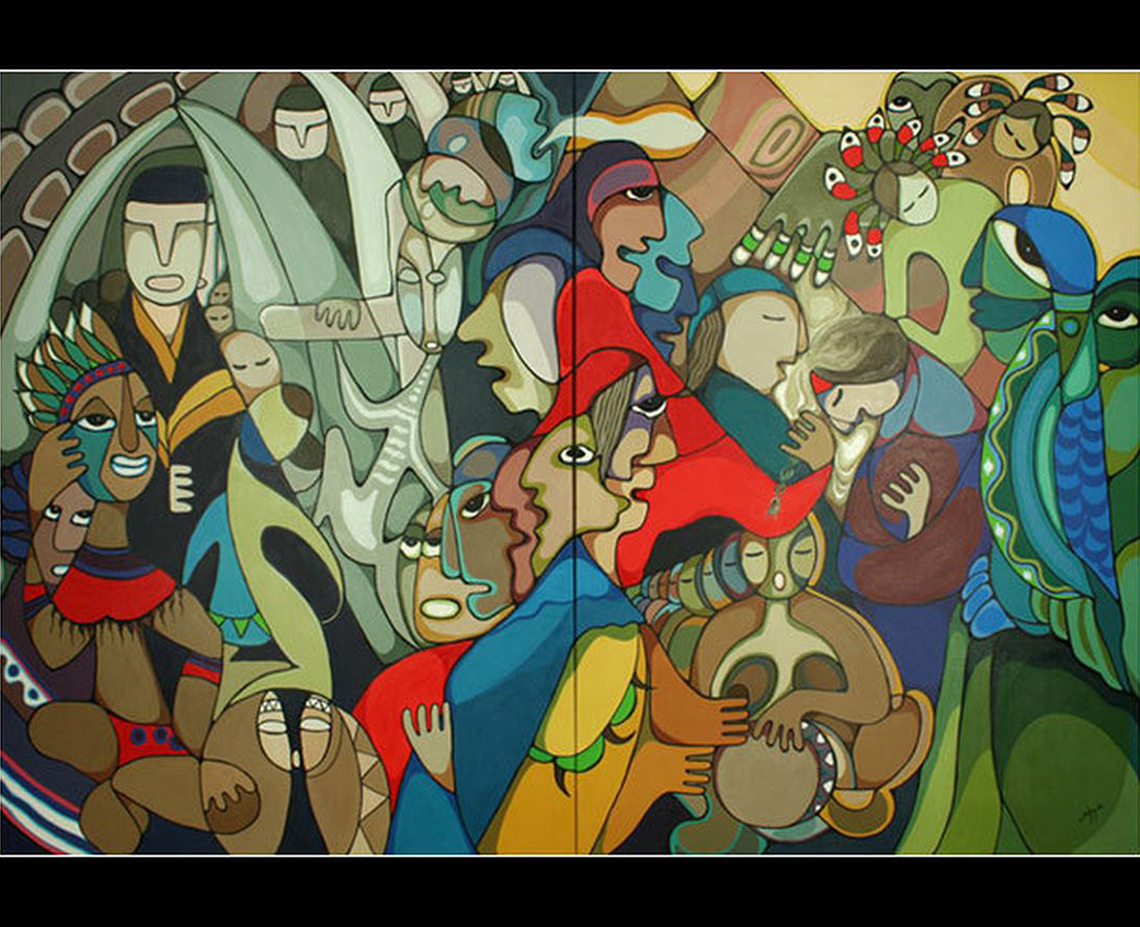
Spiritual Renewal by Daphne Odjig, 1984
This piece of artwork is divided into two sections through the centre. One the left there are traditional figures, both Indigenous and European figures. On the first are Indigenous figures that have come together. One figure is drumming, and the others are gathered around the drummer. The colours on the traditional side of the painting are muted, using blacks, whites, and browns, mostly where the colours on the other side, where the figures are gathered together are brighter and include blues, oranges, yellows, greens, reds, and browns. The figures on the right side, gathered around the drum, all are created with lines that blend together where the figures on the left, in the more traditional side, overlap but do not blend together as much.
In the Minds On section, we explored one example of a type of Indigenous art called the Woodland style of art, founded by Anishinaabe artist Norval Morrisseau, from Bingwi Neyaashi Anishinaabek First Nation near Lake Nipigon, Ontario. Morrisseau was one of the Indigenous Group of Seven.
In the 1970s, Norval Morrisseau and six other Indigenous artists formed the Professional National Indian Artists Inc. or, as they are more commonly known, the Indigenous Group of Seven. These artists are:
- Jackson Beardy (Cree)
- Eddy Cobiness (Ojibway)
- Alex Janvier (Dene, Saulteaux)
- Norval Morrisseau (Ojibway)
- Daphne Odjig (Potawatomi, Odawa)
- Carl Ray (Cree)
- Joseph Sanchez (Pueblo, Spanish, German)
This group of Indigenous artists came together to advocate for more representation and recognition of Indigenous art and artists in Canada. They also preserved the cultural teachings of their communities within their work so Indigenous people would feel pride in these pieces and never forget where they came from.
Their work covers decades and continues to challenge Canadian society to think critically about Indigenous histories and worldviews, and recognize the beauty in Indigenous art.
Today, the works of Morrisseau and the Indigenous Group of Seven continue to inspire generations of young Indigenous artists and educate all people about the diverse identities, perspectives, relationships, truths, and legacies of Indigenous Peoples in Canada.
Brainstorm
Reflect
In a notebook or using another method of your choice, answer the following questions:
- Why is diversity and inclusion in art important? In the arts in general?
- Why do you think the work of Indigenous Group of Seven is important in representing Indigenous culture and the stories of different groups and communities?
Exploring Woodland Art
Woodland Art is a specific style of art founded by Norval Morrisseau. Woodland Art is influenced by creation stories and shares the relationships between animals, people, creation, and the environment. Indigenous communities have their own creation stories that express their understanding of the universe and its origins, and how the physical, spiritual, and human world came to be.
Indigenous Peoples have extremely diverse cultures and communities, and their stories and their art forms are equally diverse according to the ways each distinct nation expresses its worldview.
Morrisseau’s work reflects Anishinaabe worldviews and the teachings he learned growing up in Bingwi Neyaashi Anishinaabek First Nation, and throughout his life.
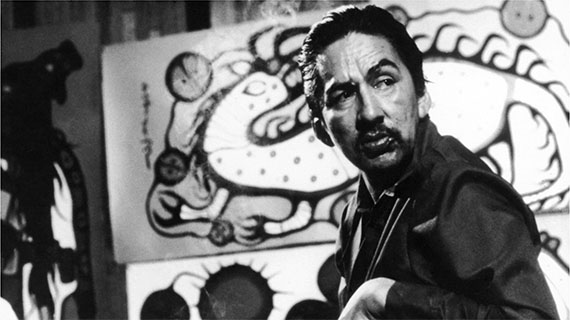
He believed that Anishinaabe values and worldviews needed to be shared to showcase the depth and beauty of Indigenous art and artforms.
Morrisseau developed common elements of design in the Woodland School of Art that helped to share the main concepts of the style.
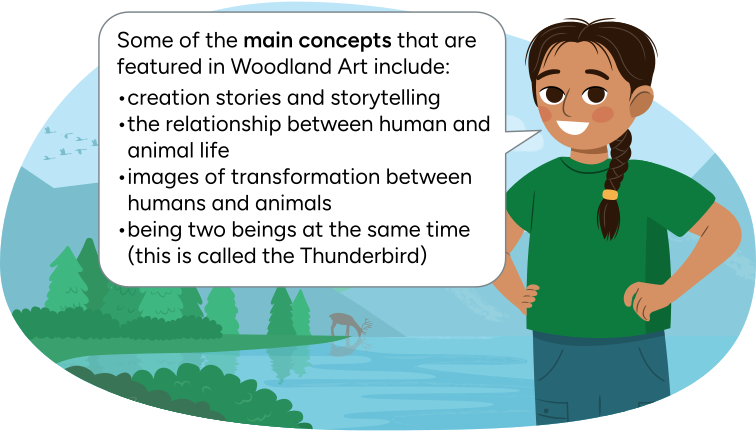
A student describes the main concepts in Woodland Art. Some of the main concepts that are featured in Woodland Art include: creation stories and storytelling, the relationship between human and animal life, images of transformation between humans and animals, and being two beings at the same time (this is called the Thunderbird).
Let’s reexamine Norval Morrisseau’s painting explored in the Minds On section titled Medicine Bear delivering Soul Fishes.
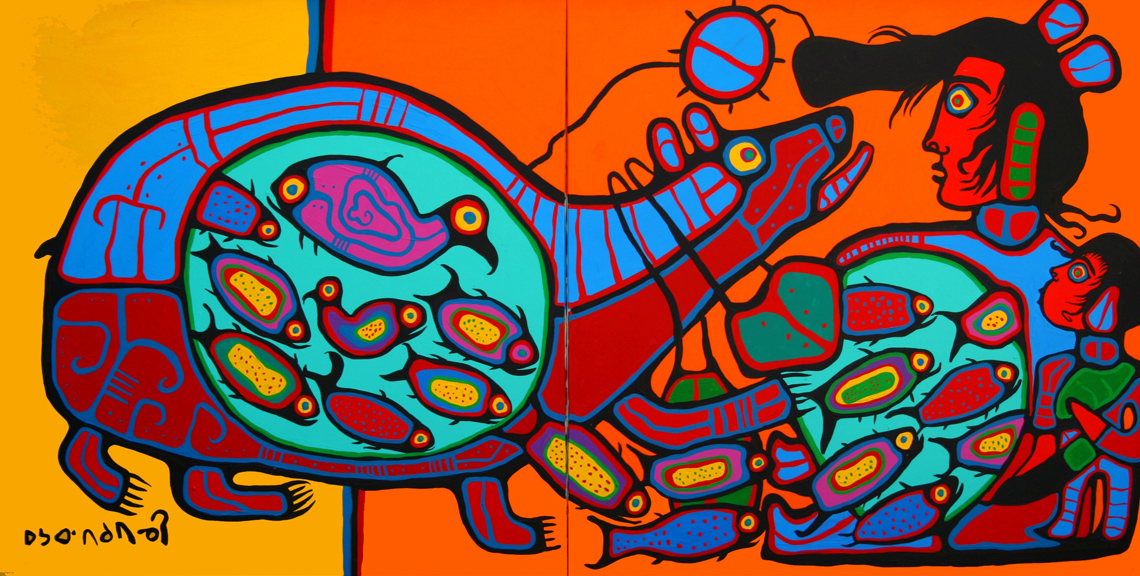
This painting features many of the concepts of Woodland Art. What concepts can you identify?
Press the Check Answer button to see if you were correct.
Some of the concepts of Woodland Art featured in the painting Medicine Bear delivering Soul Fishes by Norval Morrisseau include: the relationship between human and animal life and transformation of animals into human life.
“My aim is to reassemble the pieces of a once proud
culture and to show the dignity and bravery of my
people”.
- Norval Morrisseau, 1969

Whenever we repeat the exact words and phrasing that someone else has said, we must use a direct quote. A direct quote is created by putting quotation marks around someone else's exact words to show our audience that we’re repeating them exactly as they were said or written by their speaker. We also need to make sure we include the name of the person who spoke or wrote the words. Direct quoting is an important step to make sure we are giving credit where credit is due and not plagiarizing, or copying, other people’s work or ideas.
The works of Norval Morrisseau and the Indigenous Group of Seven have inspired many generations of Indigenous artists to share their identities and the culture of their communities with the world.
Spotlight on Leland Bell
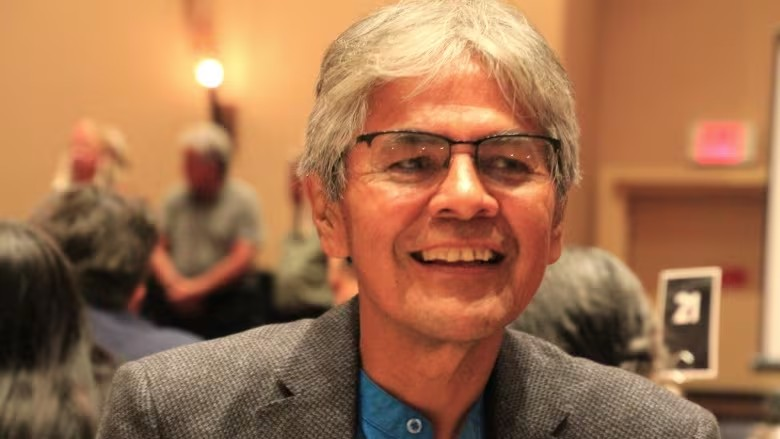
Internationally recognized artist Leland Bell is Anishinaabe from the Wikwemikong Unceded First Nation on Manitoulin Island.
In 1972, Leland was one of the young Indigenous artists mentored by the Indigenous Group of Seven at the Manitou Arts Foundation, a summer school held on Schreiber Island.
“He was deeply inspired by the work of the Woodland artists and with the help of elders has made the connection between the Anishinaabe concept of vision quest and his own commitment to living life as a good being.” (King St Gallery, n.d.)
Examine Leland’s painting titled In the Light, 2022.
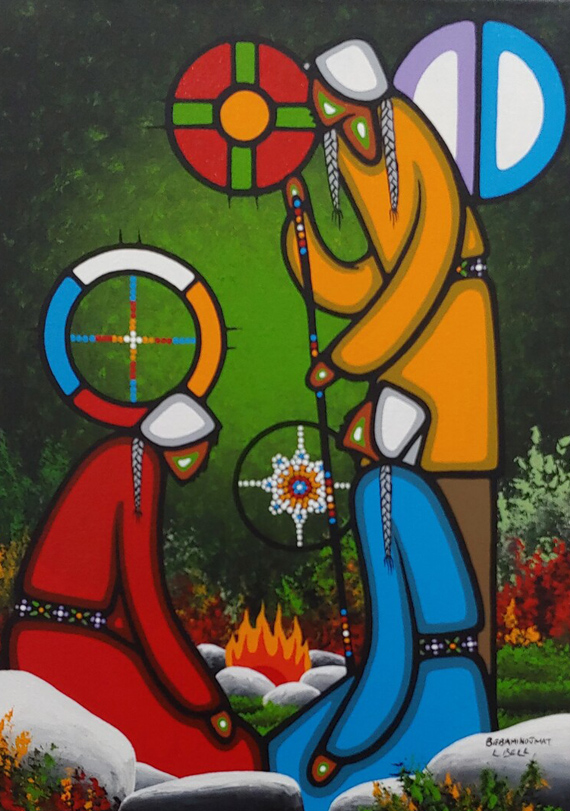
In the Light by Leland Bell, 2022
Leland Bell's piece, In the Light. Three stylized figures in red, blue, and yellow garments sitting around a small fire, surrounded by foliage and colorful flowers.
What observations can you make about the painting? What questions could you ask the artist about this piece?
Today, because of the advocacy of the Indigenous Group of Seven, more spaces are dedicated specifically to showcasing Indigenous arts. With more education about Indigenous Peoples and their creations, audiences are able to interpret and analyze the artworks with a stronger understanding of the culture.
A teacher says: Did you spot the direct quote in the spotlight on Leland Bell? The quotation marks let the audience know that information is a direct wording taken from a source. The parentheses tell the audience who the source of the information is from.
Select the correct answer, then press Check Answer to see how you did.

Putting it all together
Examine the following painting by Norval Morrisseau.
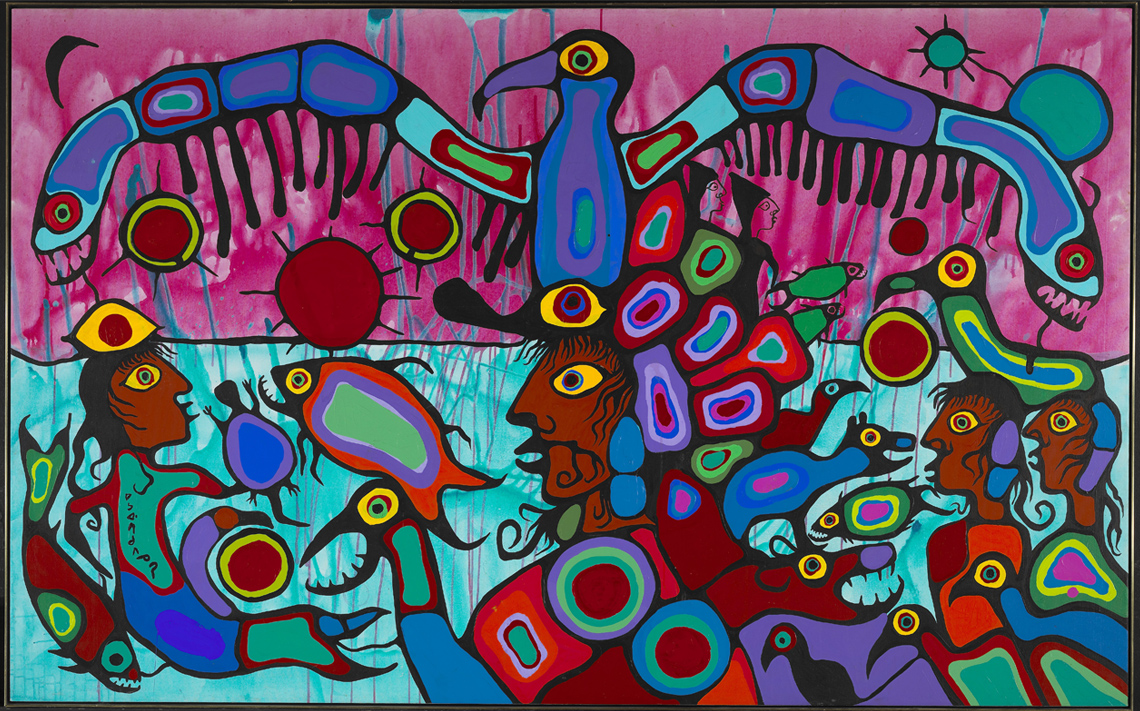
Artist and Shaman Between Two Worlds by Norval Morrisseau, 1980
DescriptionArtist and Shaman Between Two Worlds by Norval Morrisseau. A colorful abstract painting featuring a large bird, human figures, and circular motifs against a multicolored background.
Brainstorm
Perform a task on your own!
In a notebook or using another method of your choice, answer the following questions.
- What observations can you make about Norval Morrisseau’s painting titled Artist and Shaman Between Two Worlds?
- What main concepts of Woodland Art are featured in the painting?
- How did learning about Woodland Art and Indigenous art forms help you understand the possible message communicated in this piece of art?
Researching and reporting

In this learning activity, you learned about the significance of the Indigenous Group of Seven, Norval Morrisseau, and Woodland Art, and the importance of understanding and supporting Indigenous art and artforms.
To consolidate your learning, you will now choose an artist from the Indigenous Group of Seven (other than Norval Morrisseau) to learn more about their style of art and any messages communicated in their art.
Choose one artist from the following list:
- Jackson Beardy (Cree)
- Eddy Cobiness (Ojibway)
- Alex Janvier (Dene, Saulteaux)
- Daphne Odjig (Potawatomi, Odawa)
- Carl Ray (Cree)
- Joseph Sanchez (Pueblo, Spanish, German)
You will conduct some research to learn about:
- who your chosen artist is (What nation and community are they from? When were they born?)
- two different works (examples) of their art
- how their art represents their identity, culture, and the Indigenous community they belong to
- a direct quote from the artist about their art
- the impact they have had in the art community in Canada and for Indigenous Peoples
A teacher shares tips to conduct online research. They say: Always consult with a trusted adult before doing research online and remember that when researching information related to Indigenous Peoples to try and find sources that are from Indigenous communities or authors to make sure you are getting first-hand information. Don't forget to use direct quotes for words that are someone else's and to list the source the information has come from.
How will you record your research? How will you share and present your findings? Use strategies and formats that will help you communicate information to your audience in a clear way. If you don’t know where to begin, ask a trusted adult to help you.
Making connections
- How do the arts help people express their distinct identities and cultures and communicate them to others?
- Reflect on your own identity. Do you have stories from your own life that are expressed in your art?
- What are some examples of how you could use art to express your connections to your community, personal values, or cultural heritage and traditions?
Reflection
As you read through these descriptions, which sentence best describes how you are feeling about your understanding of this learning activity? Press the button that is beside this sentence.

I feel...
Now, record your ideas using a voice recorder, speech-to-text, or writing tool.