Learning goals
We are learning to…
- apply critical thinking skills to understand texts and analyze perspectives that are communicated
- generate content that reflects our voice and our lived experiences
- select and use appropriate digital and media tools to express our voice through texts
Success criteria
I am able to…
- identify examples of bias in texts and explain messages connected to diversity and inclusion
- select and categorize words and phrases that reflect diverse and varied aspects of my identity and lived experiences
- use a digital tool of my choosing to create my own representation of my unique identity
Who are you?

If someone were to ask you “Who are you?”, how would you answer?
It seems like a simple question, but it is quite complex because human beings are quite complex.
What makes you who you are?
- Is it your name, your family and/or friends, or your culture?
- Is it your talents, your skills, or your smarts?
- Is it the way you talk, the way you look, or the way you act?
- Is it your beliefs and values, or your hopes and dreams?
The truth is no one thing makes us who we are. Our identity is formed by everything about, within, and around us.
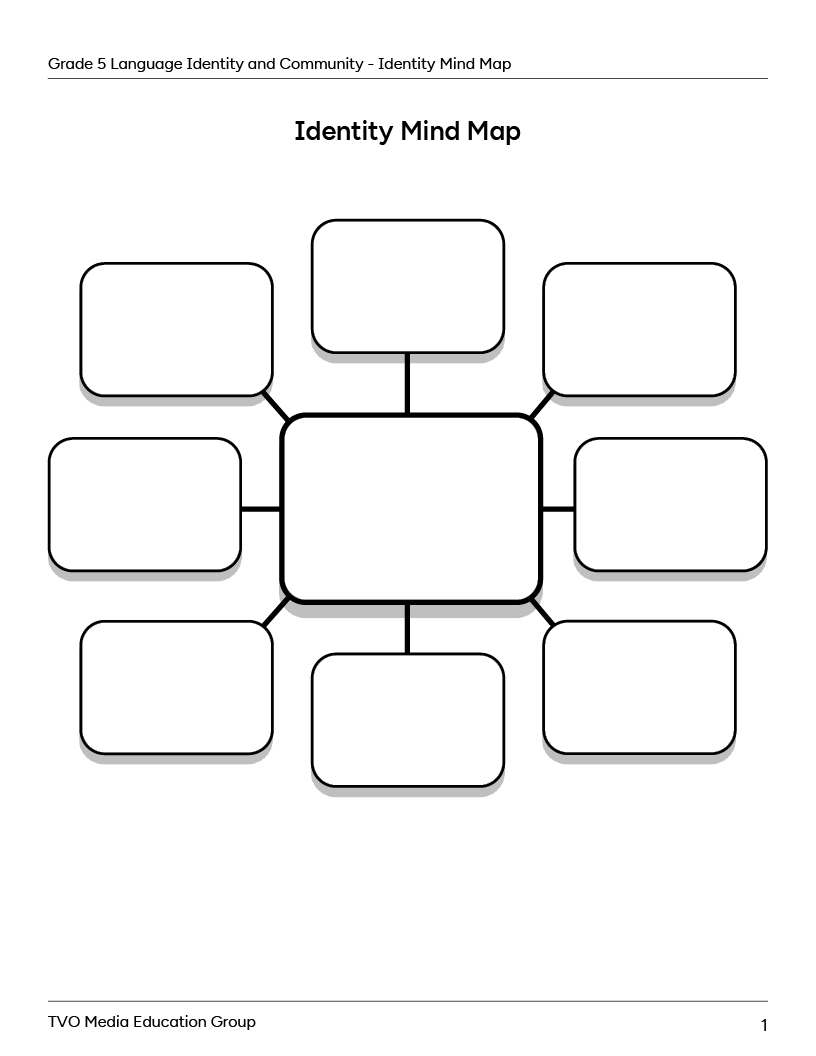
Complete the fillable and printable Identity Mind Map in your notebook or using another method of your choice. Begin with your name in the middle and add in what makes you, you. Use the prompts you recently explored to help you brainstorm ideas.
In this learning activity, you will explore the concept of identity, generate ideas about your identity, and celebrate your unique identity in a text.
The danger of a single story
Human beings and their identities are complex. There is so much more to us than what can be seen or observed, and no one thing makes us who we are. We are multi-dimensional, not one-dimensional.
When we view ourselves as only one thing, it creates a limited or one-dimensional sense of identity. It leaves out so many wonderful parts of us that deserve to be celebrated. Focusing too much on just one part of ourselves could lead to negative thinking or low self-esteem when we make mistakes or struggle.
For example, if you think of yourself only as a “smart fifth-grade student” then getting one low grade might make you feel like your whole world is crumbling around you. Or if you think that your physical appearance is the only thing that matters, a single pimple could feel pretty devastating! Fully appreciating all the things that make us who we are is vital for a healthy self-image and mental wellness.
The same is true for how we think about other people. Sometimes, we make assumptions about other people based on a single thing we see or observe about them. We tell ourselves a story about who or what they are and we miss the things that make them great.
Author Chimamanda Ngozi Adichie calls these “single stories.” She says that the danger of these single stories is that they are incomplete, and they rob people of their dignity. Single stories are based on generalizations and assumptions, and they are usually incomplete.
Check out the following excerpt from Chimamanda’s TED talk “The Danger of a Single Story” which begins with a story from her childhood in Nigeria. Notice the single stories she has experienced and how they limited people’s identities.

Student Success
Think!
In a notebook, or using another method of your choice, answer the following questions.
- What was the single story young Chimamanda created about Fide? Why was this a problem?
- What was the single story Chimamanda’s university roommate created about her? Why was this a problem?
- Bias is an opinion, feeling, preference, or prejudice that limits someone’s ability to make fair, objective, or accurate judgements. What biases are presented in the clip?
- Why is it important to recognize our own biases?
When you are done, press the Sample Answers button to review some possible answers to the questions.
- Chimaamanda created a single story about Fide and his family and what it meant to live in poverty. It prevented her from seeing them as anything other than poor and ignored other aspects of their identity such as their skills as artists and basket-makers.
- Chimamanda’s roommate created a single story about her based on assumptions about people from Nigeria. She made assumptions about her language abilities, her skills, and experiences and didn’t expect them to have things in common.
- Some of the biases presented were the assumptions that because Fide’s family was poor, they were not capable of creating anything such as the woven baskets. Another bias presented was Chimamanda’s roommate’s assumption that people from Africa couldn’t speak English or cook with stoves.
- Recognizing our own biases is important because it helps us make fairer and more just decisions. When we're aware of our biases, we can work to see things from different perspectives and avoid letting personal opinions or preferences unfairly influence our actions. This leads to more objective thinking and helps build a more just and inclusive world.
The identity iceberg
Not all parts of our multi-dimensional identities can be seen or observed from the outside.
Icebergs are sometimes used as a metaphor for our identities.
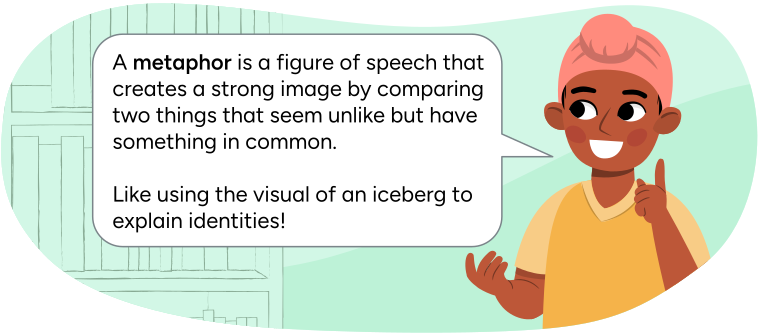
A student describing a metaphor. They say: A metaphor is a figure of speech that creates a strong image by comparing two things that don't seem alike but have something in common. Like using the visual of an iceberg to explain identities!
When we examine an iceberg, the part that can be seen above the waterline is small compared to what is below the waterline. Most of an iceberg is underwater.
Some parts of identity can be seen by looking at someone or spending a little time with them, but most parts of who someone is are below the surface.
Explore the following interactive to learn more.

My identity iceberg
What parts of your identity do you feel are:
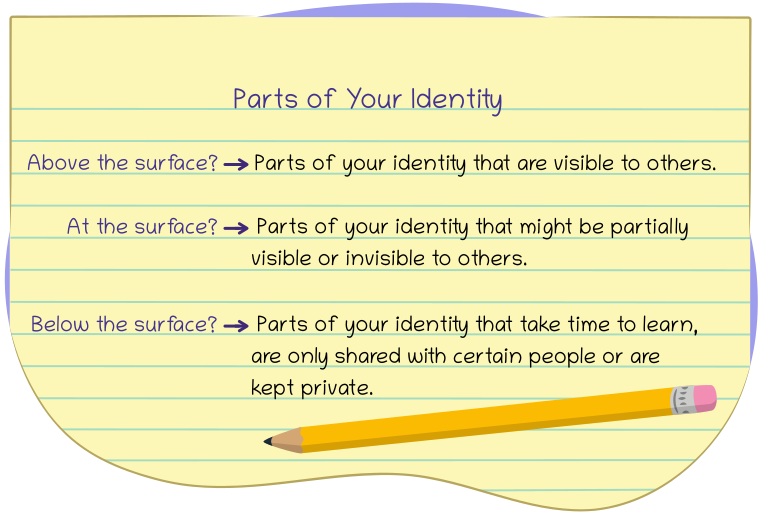
An illustration of a lined piece of paper containing notes about identity jotted down in pencil. The first part reads: Above the surface? Which are parts of your identity that are visible to others. The second part reads: At the surface? Which are parts of your identity that might be partially visible or invisible to others. The last part reads: Below the surface? Which are parts of your identity that take time to learn, are only shared with certain people or are kept private.
Press the Examples button to explore categories or parts of identity for you to consider. Where on the iceberg would you place some of these parts of your identity?
|
|
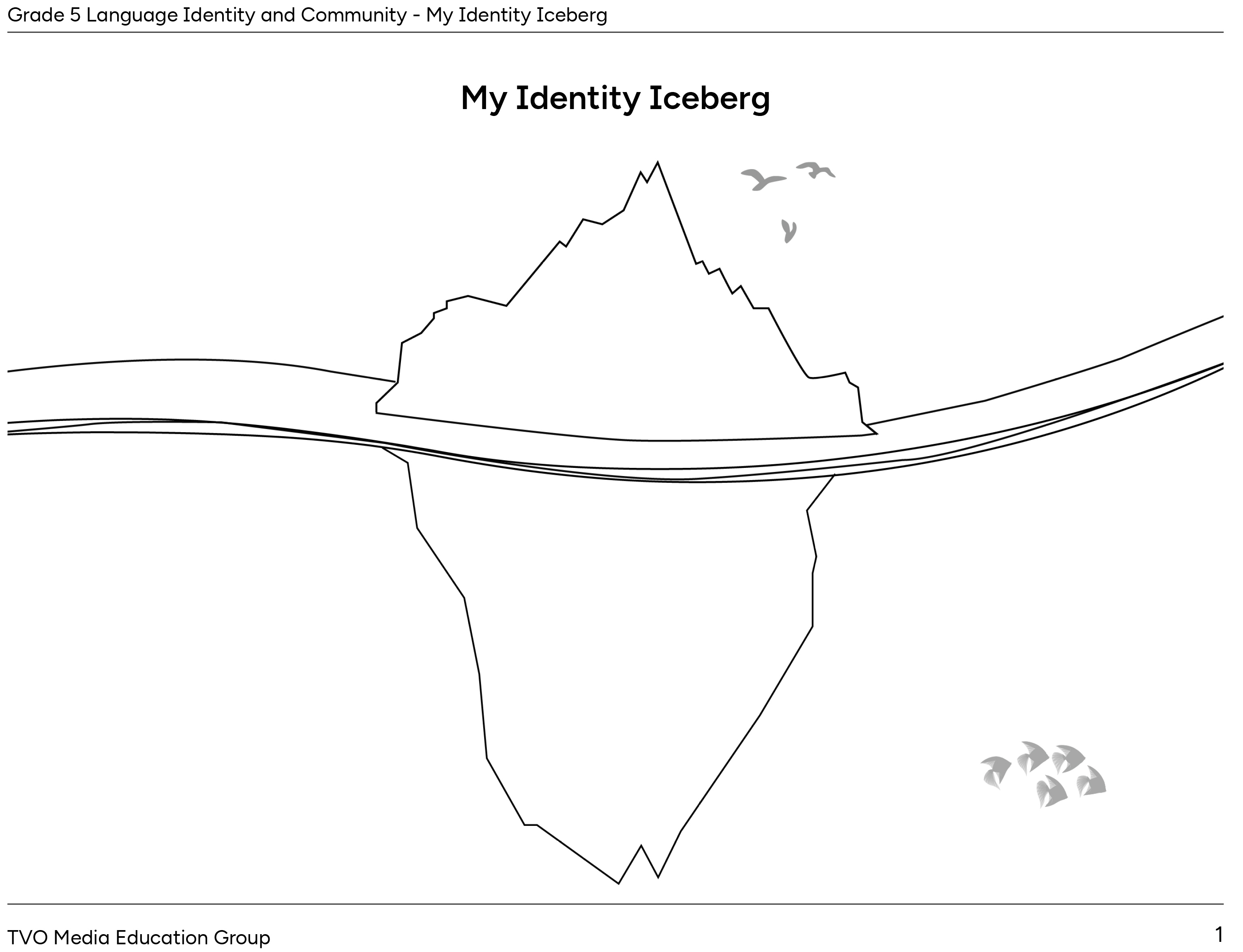
Use the following graphic organizer, or another method of your choice, to create your personal identity iceberg. You might consider writing short sentences or phrases to list some of your identities or you may choose single words for others.
It is your choice which parts of your identity you choose to share on your identity iceberg and which you keep private.
Access the following My Identity Iceberg to complete the activity.

Nouns, verbs, and adjectives
Review the content of your identity iceberg.
How did you use different parts of speech to identify and describe your identity? Your iceberg likely contains nouns, verbs, and adjectives. Can you identify some of them?
In a notebook, or using another method of your choice, identify the nouns, verbs, and adjectives you used in your identity iceberg.
Consider creating a chart like the following to organize your list.
| Nouns relating to my identity | Verbs relating to my identity | Adjectives relating to my identity |
|---|---|---|
|
|
|
Learning check!
Check your understanding of what you have learned so far by completing the following multiple-choice questions.
Select the correct answer, then press Check Answer to see how you did.
Putting it all together
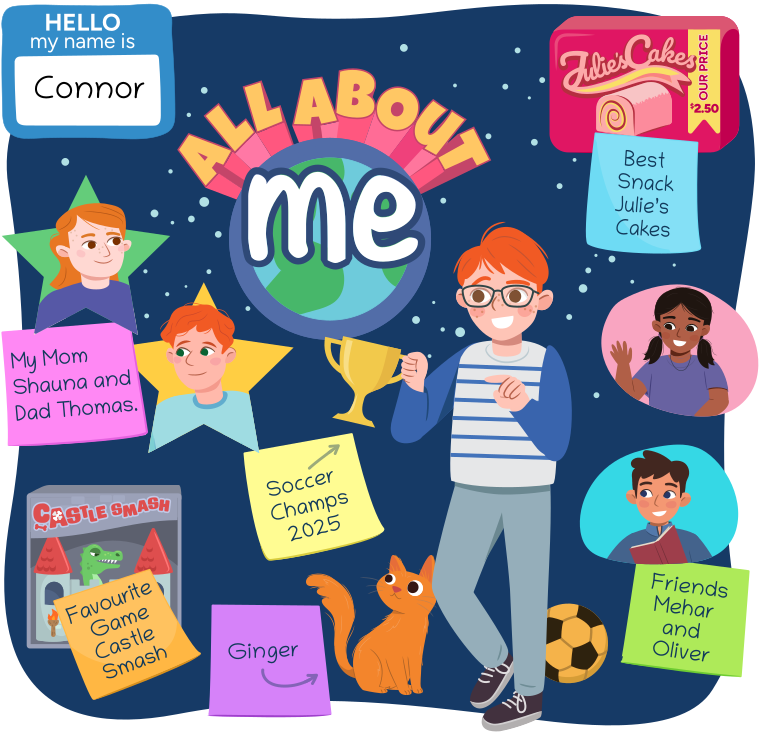
In the Action section of this learning activity, you explored the many things that make up someone’s identity and you mapped some of those out in an identity iceberg.
To consolidate your learning, you will now use a digital graphic tool of your choice to create your own representation of your identity and what makes you!
For example, you might consider creating a word cloud of words and phrases that capture the essence of who you are. A word cloud is a cluster of words that are connected in some way. They are depicted in various colours, sizes, fonts, and directions.
Here is an example of one:
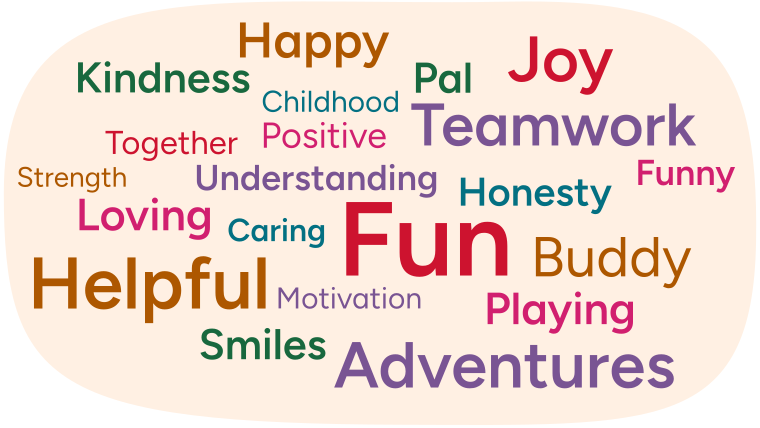
Press the following tabs to learn more about guidelines to help you create your final product.
Does your identity iceberg reflect the important aspects of your identity and life that you wish to communicate? Revising means to add or remove content. Does your iceberg need additional content? Is there anything you’d like to remove?
Consider these prompts to help you identify any additional content to include.
- What do you like doing? What are you good at?
- Names of people who are important to you, family, people who take care of you, close friends
- Family traditions or customs
- Favorite foods or foods you’d like to try
- Important events that have happened in your life
- Specific titles or genres of books you like best
- Hobbies or things you enjoying doing for fun
- Names of movies, shows, video games, podcasts you like
- Name of the place where you live or places you have lived
- The full name that you wish to be called, and any other versions of names or nicknames you use
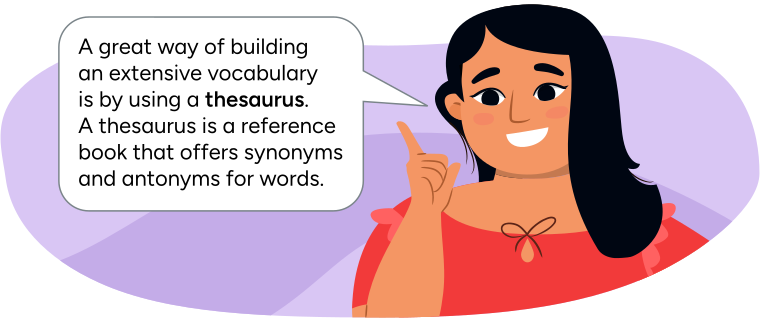
Revision also means substituting simple or repetitive language with more interesting and advanced language.
| Synonyms are words that have similar meanings such as | big – humungous |
| Antonyms are words that have opposite meanings such as | humungous – minuscule |
Choose a digital design and production tool to create your identity representation. There are many options for digital design tools available for free online.
Check with your teacher or a trusted adult before choosing one.
Consider the following questions and record your answers using a method of your choice.
- What did you learn about yourself in this activity?
- Did anything surprise you?
- Did you discover parts of your identity that you hadn’t considered before?
- Did your selected digital tool help you communicate your identity in the way you were hoping it would? Would you use the same tool again or would you try another?
Reflection
As you read through these descriptions, which sentence best describes how you are feeling about your understanding of this learning activity? Press the button that is beside this sentence.

I feel...
Now, record your ideas using a voice recorder, speech-to-text, or writing tool.