Learning goals
We are learning to…
- analyze themes of diversity and inclusion
- make connections to texts
- draft complex texts of various forms and genres
Success criteria
I am able to…
- explain different responses to gender diversity and inclusion conveyed in texts
- form a text-to-text connection between the Gender Unicorn diagram and a narrative text
- write a short script or reflective journal that communicates my learning about gender diversity and inclusion in a respectful and inclusive manner
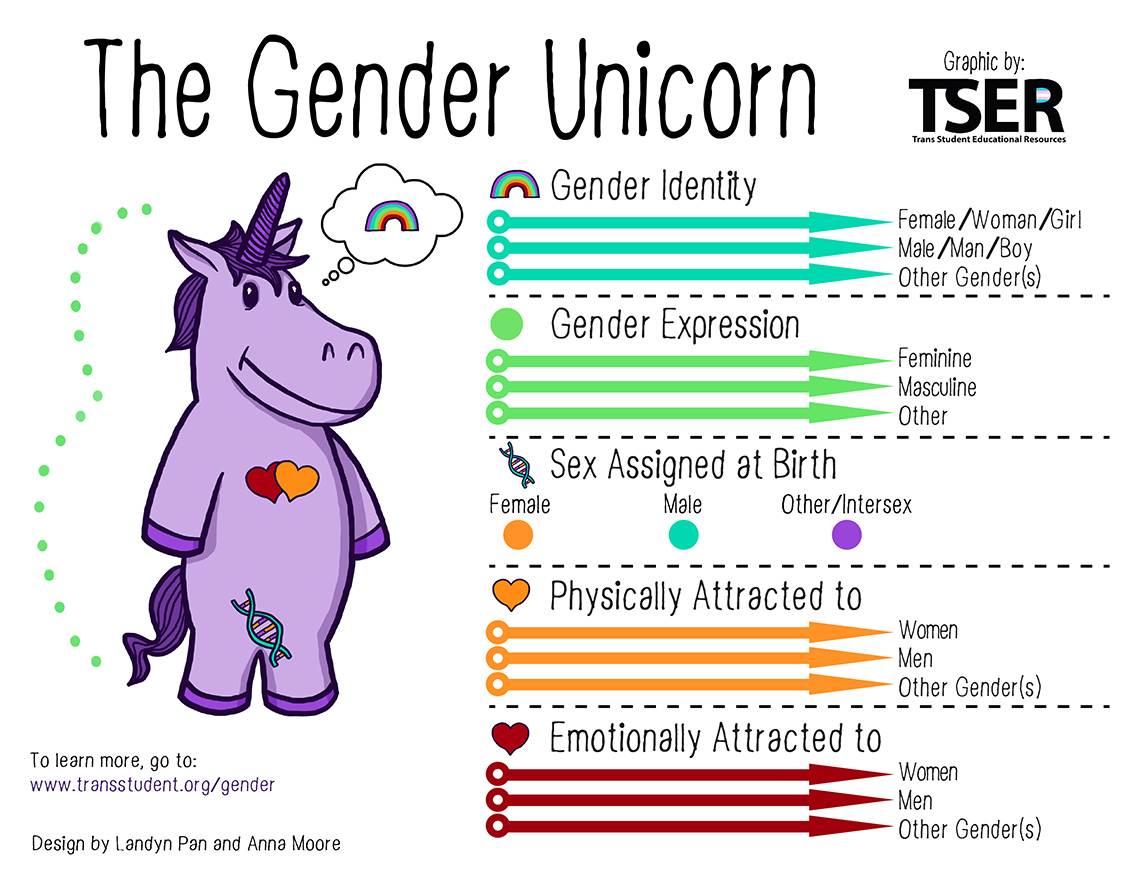
The Gender Unicorn diagram explains complex topics in way that is easy to understand.
DescriptionGender identity: One’s internal sense of being male, female, neither of these, both, or another gender(s). Everyone has a gender identity, including you. For transgender people, their sex assigned at birth and their own internal sense of gender identity are not the same. Female, woman, and girl and male, man, and boy are also not necessarily linked to each other but are just six common gender identities.
Gender expression/presentation: The physical manifestation of one’s gender identity through clothing, hairstyle, voice, body shape, etc. Many transgender people seek to make their gender expression (how they look) match their gender identity (who they are), rather than their sex assigned at birth.
Sex assigned at birth: The assignment and classification of people as male, female, intersex, or another sex based on a combination of anatomy, hormones, chromosomes. It is important we don’t simply use “sex” because of the vagueness of the definition of sex and its place in transphobia. Chromosomes are frequently used to determine sex from prenatal karyotyping (although not as often as genitalia). Chromosomes do not always determine genitalia, sex, or gender.
Physically attracted to: Sexual orientation. It is important to note that sexual and romantic/emotional attraction can be from a variety of factors including but not limited to gender identity, gender expression/presentation, and sex assigned at birth.
Emotionally attracted to: Romantic/emotional orientation. It is important to note that sexual and romantic/emotional attraction can be from a variety of factors including but not limited to gender identity, gender expression/presentation, and sex assigned at birth. There are other types of attraction related to gender such as aesthetical or platonic. These are simply two common forms of attraction.
The diagram teaches us that gender identity, gender expression, sex assigned at birth, and physical and emotional attraction are all different things.
In this learning activity, we will learn more about these terms, explore different identities through texts, and form connections to our own lived experiences.

Understanding identity
Let’s take a closer look at the components of the diagram you saw in the Minds On section.
Access the following Gender Unicorn diagram. If you wish, you can download a copy for reference.
Match game!
To check your understanding of the components of the Gender Unicorn diagram, complete the following matching activity. For each term, select the corresponding definition.
Challenging gender norms
Gender norms are the expectations society has about how people should act, look, and behave based on their gender.
Gender norms can be expressed in advertising. What messages do the following two ads send?
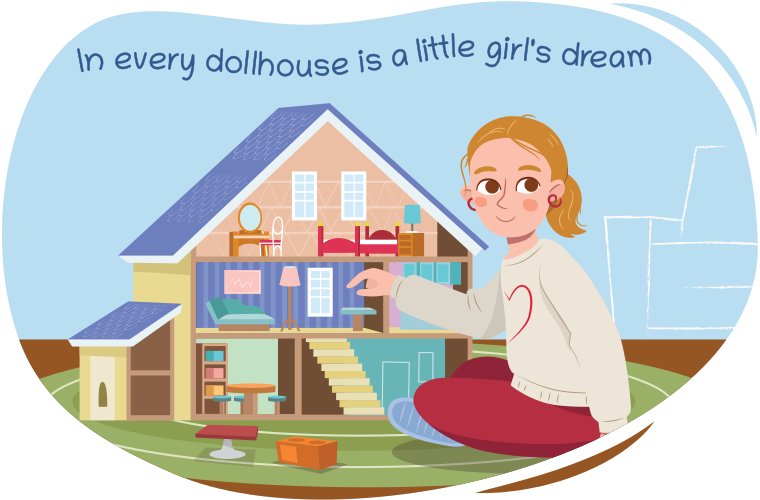
Gender norms are not based on science or biology. They are based on the values and opinions of a society. These vary from society to society, and also change over time.
Sort it out!
Consider the following gender norms. Do you agree with them or not?
Place each card in the appropriate category.

Pause and Reflect
Reflecting on your opinions
In general, did you agree or disagree with these statements? Think about the reasons why. Record your thoughts in your notebook, or using the method of your choice.
What’s the problem?
Gender norms can be limiting and problematic for various reasons.
They are based on a binary system – the assumption that all people identify as either male or female. This viewpoint does not reflect individuals who identify as non-binary – neither exclusively male or female.

The non-binary flag
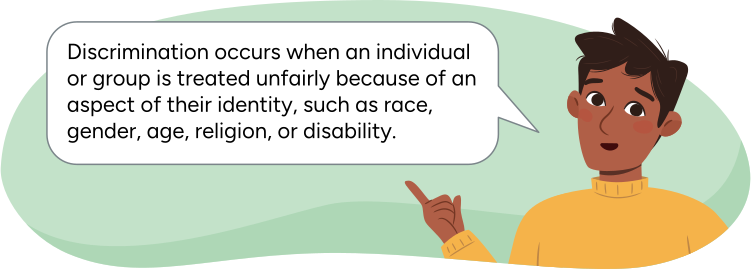
Gender norms also place limitations on how people should act, dress, or experience life. People who challenge gender norms sometimes experience discrimination.

Vocabulary: Key terms
Choose one of the following graphic organizers, or another method of your choice, to record the vocabulary term discrimination and explore its meanings. This task will form the beginning of your vocabulary notebook.
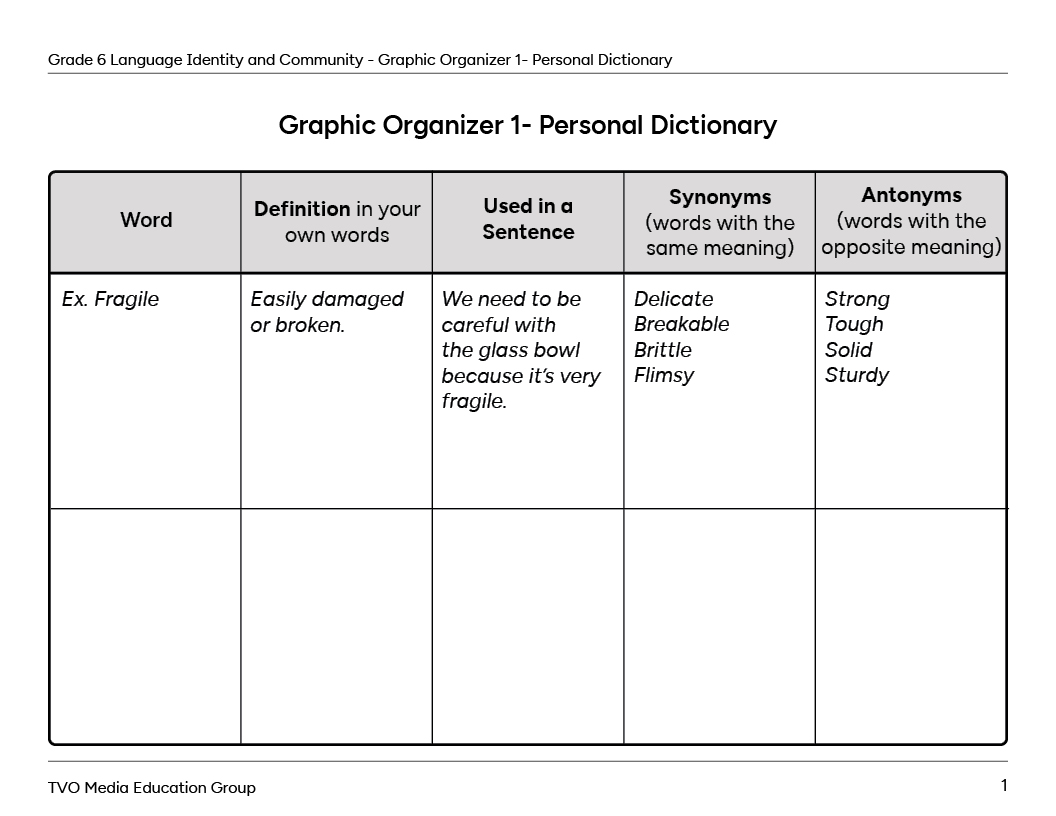
Press the Activity button to access the Graphic Organizer 1 - Personal Dictionary.
Activity(Opens in a new tab)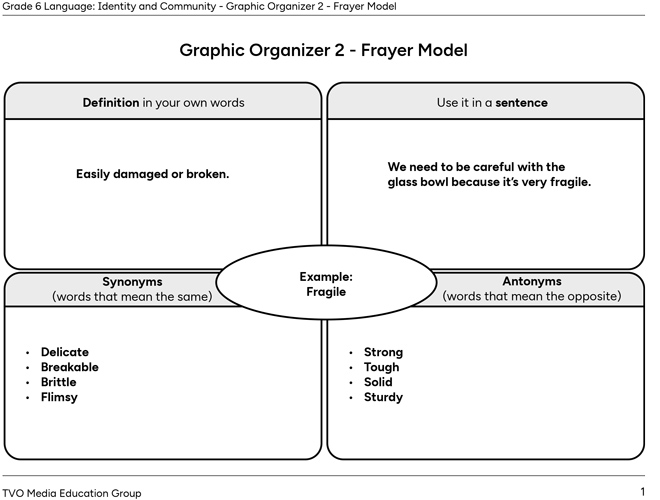
Press the Activity button to access the Graphic Organizer 2 - Frayer Model.
Activity(Opens in a new tab)Exploring gender norms through texts
Because gender norms are cultural expectations, they vary from one society to the next.
Reading can be a great way to learn about gender norms and the challenges they present. We are going to explore a couple of texts. But first, take a moment to reflect…
Pause and Reflect
Before reading
Answer the following questions in your notebook, or record your thoughts using a method of your choice.
- Have you ever experienced being made fun of or picked on?
- How did it make you feel?
Now let’s turn to our first text…
A Boy Named Queen
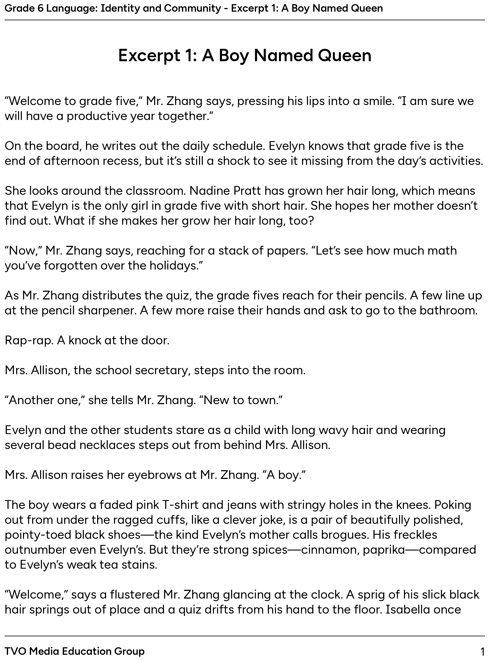
Excerpt 1: A Boy Named Queen
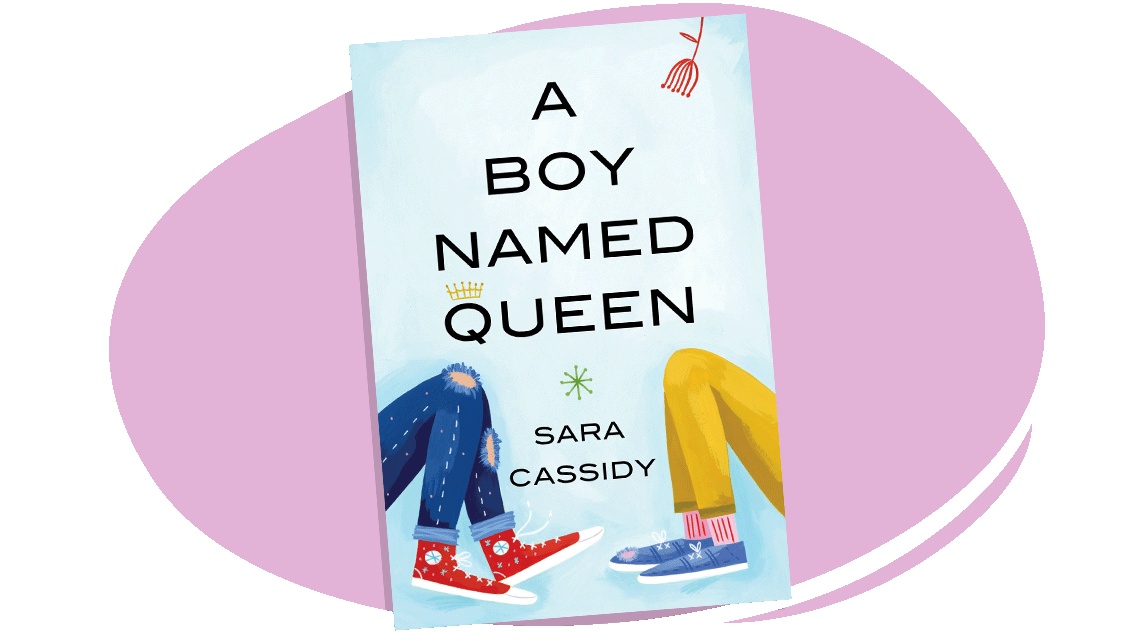
A Boy Named Queen, a novel by Sara Cassidy, is about a new student who joins a Grade 5 class. As you read the following excerpt, notice what gender norms the character Queen challenges, and how his new classmates and teachers respond.
Access Excerpt 1: A Boy Named Queen. You can print or download a copy if you wish.
After reading
Answer the following questions in your notebook, or record your thoughts using a method of your choice.
1. Summarize what you have learned about the character Queen so far.
2. Describe how the teachers react to Queen. Use specific text evidence to support your answer.
3. How does Connor Linman react to Queen?
4. What gender norms does Queen challenge or disrupt?
Press Sample Answers to see student Marcel’s answers.
1. Queen is a new Grade 5 student who has just moved to Hillsberry. He has wavy hair and freckles and speaks confidently to both teachers and students. On his first day of school, he wears a pink t-shirt, jeans with ripped knees, and pointy-toed shoes.
2. The staff behaves awkwardly and does not model inclusive and welcoming behaviour. Mrs. Alison raises her eyebrows when she says “A boy.” Mr. Zhang says “Really?” when Queen tells him his name. They appear to be uncomfortable with or shocked by how Queen presents himself.
3. Connor misgenders Queen by using the pronoun her. He is being unkind and making fun of Queen for not conforming to his own gender expectations.
4. Queen challenges the gender norm that boys should not have long hair or wear pink. He also challenges the expectation that the name Queen is only for girls.
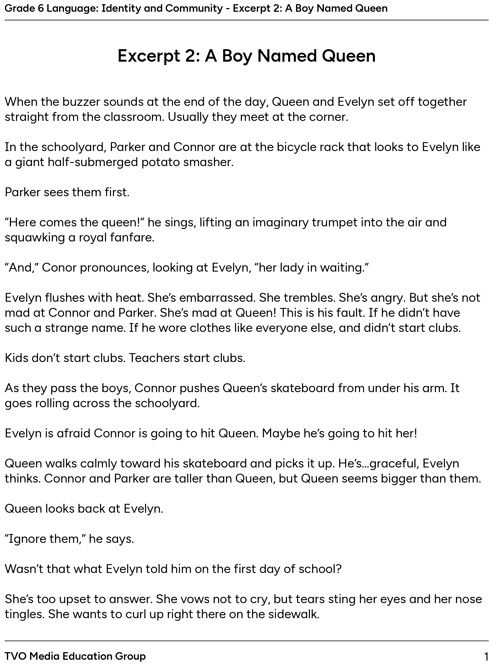
Excerpt 2: A Boy Named Queen
The next excerpt takes place a few weeks later. Evelyn is going to Queen’s house after school to celebrate his birthday.
Access Excerpt 2: A Boy Named Queen. You can print or download a copy if you wish.
After reading
Answer the following questions in your notebook or record your thoughts using a method of your choice.
- At the end of the school day, what does Connor do to Queen and Evelyn? How do Queen and Evelyn each react?
- Describe what Queen’s “force field” is. What do you think of this visualization strategy?
- How would you summarize what you have learned about Evelyn and Queen in relation to gender norms?
Press Sample Answers to check out student Marcel’s answers.
- Connor once again misgenders Queen and makes fun of Evelyn for being his friend. Evelyn feels angry and embarrassed. Queen remains calm and ignores the bullying.
- Queen’s “force field” is an imaginary barrier that he sets up in his mind where he can visualize hurtful things bouncing off and not getting through to him. A visualization strategy like this could be useful for staying calm in the face of unkindness or in a difficult situation.
- In this excerpt, Evelyn feels anger towards her friend and momentarily even blames him for the bullying he receives. She wishes that he conformed to gender norms and didn’t call attention to himself. Queen has the strength to ignore the behaviour of people who don’t matter to him.
In the book, Queen’s supportive family makes space for everyone to be who they are. This gives Queen the confidence to navigate the world without apologizing for or hiding who he is.
Exploring an Indigenous identity
Because gender norms are connected to cultural expectations, they can be, and are often, different from one society to the next.
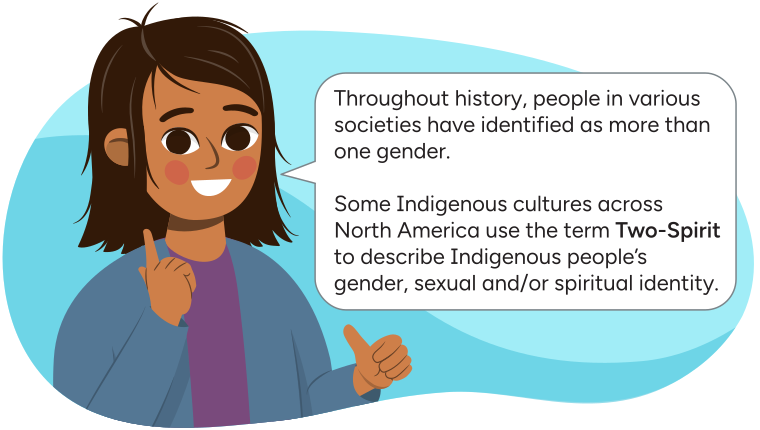
Student Neebin is talking, she is saying:
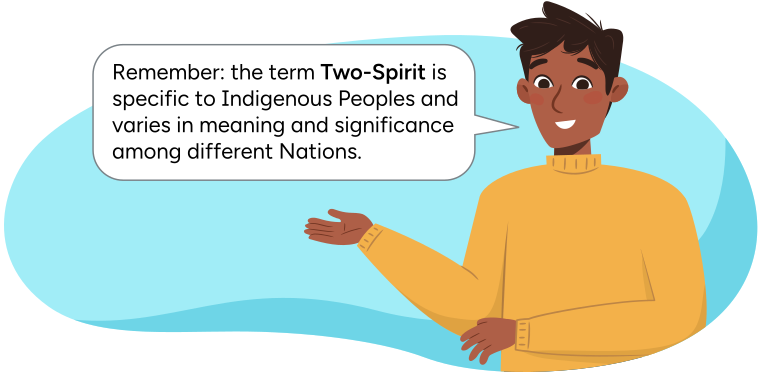
Throughout history, people in various societies have identified as more than one gender. However, it is important to understand that the term “Two Spirit” is specific to Indigenous Peoples.
Two-Spirit describes an Indigenous person who embodies both masculine and feminine qualities or who has a gender identity that is different from the binary system of male or female.
Two-Spirit people have always been here. Although Two-Spirit is a relatively new term, there are over 130 terms in different Indigenous languages to describe people who identify outside of the western gender binary. It reflects a traditional understanding of gender diversity within many Indigenous cultures, where Two-Spirit people often have unique roles and responsibilities within their communities.
Video: Meet Shine!
To learn more about Two-Spiritedness, check out the following clip from the “Shine” episode of the series Raven’s Quest. Shine is a seven-year-old from Tsuut'ina First Nation who lives in Calgary, Alberta. They explain their pronouns and what being Two-Spirit means to them.

Pause and Reflect
Post-viewing
Record your answers to the following questions using the method of your choice.
- How does Shine summarize what being Two-Spirit means to them?
- What pronouns does Shine reference in the video clip? List them.
You have done a lot of thinking about gender identity. Now is a great time to take a break before we turn to grammar!

Student Wellness
Take a break!
Time for a body break! If possible, stretch your body and move around your space.

Exploring pronouns
Personal pronouns are words used to refer to people or things in a sentence.
There are several categories of pronouns. Press the following tabs to learn more.
Subjective pronouns (or subject pronouns) are used as the subject of a sentence, meaning that they perform the action of the verb.
Explore the following table:
|
Subject pronoun |
Sample sentence |
|---|---|
|
I |
I love camping. |
|
you |
You love camping too. |
|
he |
He prefers soccer. |
|
she |
She also enjoys soccer. |
|
it |
It looks like a skunk. |
|
we |
We are afraid of skunks. |
|
they |
They scare us. |
Objective pronouns (or object pronouns) are used as the object of a verb or preposition in a sentence. They receive the action of the verb or show the relationship with the preposition.
Explore the following table:
|
Object pronoun |
Sample sentence |
|---|---|
|
me |
Camping relaxes me. |
|
you |
Camping also relaxes you. |
|
him |
Reading passes the time for him. |
|
her |
Reading helps her unwind. |
|
it |
That skunk? I’m scared of it. |
|
us |
Skunks scare us. |
|
them |
We’re afraid of them. |
Possessive pronouns are used to show ownership or belonging. They replace nouns to indicate who something belongs to.
Explore the following table:
|
Possessive pronoun |
Sample sentence |
|---|---|
|
mine |
The red bike? It’s mine. |
|
yours |
The blue bike is yours. |
|
his |
The yellow book is his. |
|
hers |
The black pen? It’s hers. |
|
ours |
Help yourself to the ginger cookies. They’re ours. |
|
theirs |
Don’t touch the oatmeal cookies. They’re theirs. |
Reflexive pronouns end in “self.” They are used when the person or thing performing the action is the same as the one receiving it.
Explore the following table:
|
Reflexive pronoun |
Sample sentence |
|---|---|
|
myself |
I taught myself to play bridge. |
|
yourself |
Don’t kid yourself! |
|
himself |
My dog saw himself in the mirror. |
|
ourselves |
We will help ourselves to the cookies. |
The “self” pronouns can also be used for emphasis. When they’re used this way, they’re often called intensive pronouns.
Explore the following table:
|
Intensive pronoun |
Sample sentence |
|---|---|
|
myself |
I myself prefer ice cream. |
|
herself |
She changed the oil herself. |
|
itself |
The attitude itself is the problem. |
|
themselves |
They made the cookies themselves. |
Gender pronouns
So far you have looked at two options for third-person singular pronouns that follow a binary way of looking at gender:
- he
- she
As we explored earlier in this learning activity, gender is not binary, meaning not all people fit into male and female categories. Individuals might use pronouns other than “he” and “she” to reflect their personal identity.
Infographic: Gender pronouns
To learn about some pronouns that are used today, you are going to explore an infographic created by the Trans Student Educational Resources.
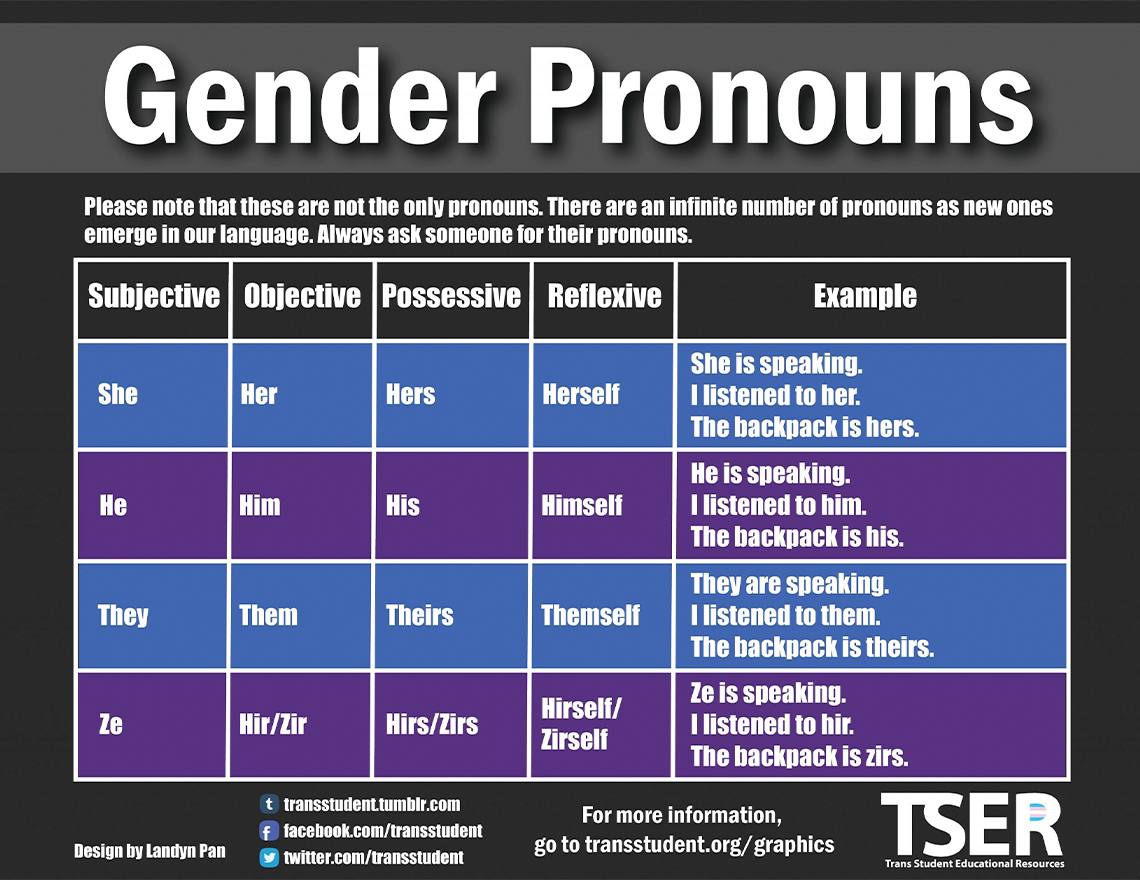
The Gender Pronouns poster includes examples of each pronoun in four different forms: subjective, objective, possessive and reflexive. It also provides each pronoun used in three example sentences. The acknowledgements are listed at the end of the poster.
Gender Pronouns
Please note that these are not the only pronouns. There are a wide variety of pronouns as new ones emerge in our language. Always ask someone for their pronouns.
Subjective: She
Objective: Her
Possessive: Hers
Reflexive: Herself
Example sentences: She is speaking. I listened to her. The backpack is hers.
Subjective: He
Objective: Him
Possessive: His
Reflexive: Himself
Example Sentences: He is speaking. I listened to him. The backpack is his.
Subjective: They
Objective: Them
Possessive: Theirs
Reflexive: Themself
Example Sentences: They are speaking. I listened to them. The backpack is theirs.
Subjective: Ze
Objective: Hir/Zir
Possessive: His/Zirs
Reflexive: Hirself/Zirself
Example Sentences: Ze is speaking. I listened to hir. The backpack is zirs.
Design by Landyn Pan. Transstudent.tumblr.com, facebook.com/transstudent, twitter.com/transstudent
For more information, go to transstudent.org/graphics
TSER Trans Student Educational Resources
Your turn!
Check your understanding by completing the following multiple-choice questions.
Select the correct answer, then press Check Answer to see how you did.
Modelling inclusivity
It’s important to create a safe space for people to be themselves. This is how we work towards a more just and inclusive society.
What can we do to model inclusivity?
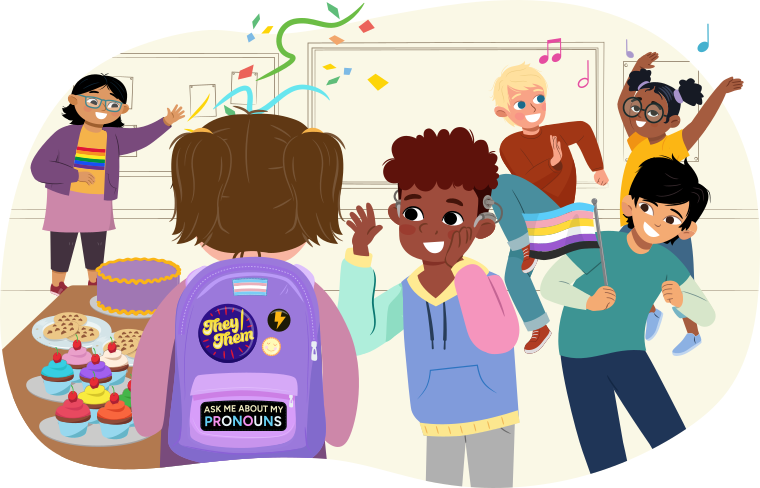
Examine the following tips for modelling gender inclusivity:
- Don't assume anybody's gender based on their appearance or name.
- Use the names and pronouns people introduce themselves by/call themselves.
- Respect the terms people use for themselves.
- Model the sharing of your pronouns, but do not force or require others to do so.
- Use gender-neutral general terms like “folks” or “friends” or “everyone.”
- Don’t expect people to define or explain themselves to you.
- Don’t laugh at jokes, slurs or negative comments that put down gender-diverse or sexually diverse groups.
Let’s check!
You have learned several key terms in this learning activity. To check your understanding, try the following matching activity.
For each term, select the corresponding definition.

Connections
Text-to-text connections
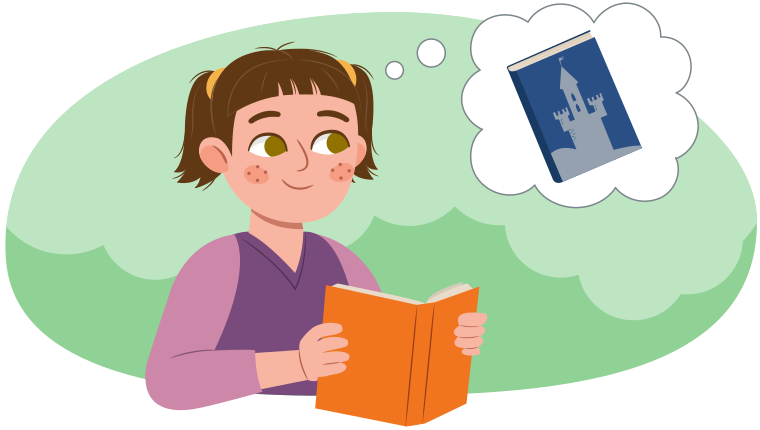
How do the ideas expressed in the Gender Unicorn diagram connect to the messages conveyed in the text A Boy Named Queen and/or the Raven’s Quest: Shine video?
Record a text-to-text connection in your notebook or using another method of your choice. Try using these sentence-starters:
- The part when… reminds me of…
- This helps me understand the story better because…
Putting it all together
In this learning activity, you were introduced to the Gender Unicorn and learned the difference between gender identity, gender expression, sex assigned at birth, and physical and emotional attraction. You also read texts with characters of diverse gender identities and experiences.
To consolidate your learning, you will complete one of the following activities using a digital or media tool of your choice.
Press the following tabs to learn more about your choices.
Write two journal entries about what you learned from reading A Boy Named Queen and/or any other part of the learning activity.
You may wish to include a reflection about a character or topic that you related to or that you would like to learn more about. Remember to be mindful, model inclusivity, and incorporate your learning from the Learning Activity.
Write a script for a short scene in which characters of your choice model inclusivity. Try to incorporate your learning about gender identities and gender expressions into your script. When you have finished, consider performing your script.
Checking your work
Use the following checklist to assess your work.
Checklist: Assessing my writing
Reflection
As you read through these descriptions, which sentence best describes how you are feeling about your understanding of this learning activity? Press the button that is beside this sentence.
I feel...
Now, record your ideas using a voice recorder, speech-to-text, or writing tool.