Keeping traditions and sharing experiences
Peggy Janicki is a Dakelh teacher from the Nak’azdli Whut’en First Nation, born and raised in the
unceded territory of the Stó:lō Coast Salish peoples. When Peggy was a child, her mother Mary
and her auntie Carrie taught her traditional Dakelh
(Carrier) sewing and beadwork, beading moccasins, and sewing intricate
floral patterns onto hides.
Peggy’s mother Mary became a master Salish weaver and a member of the Salish Weavers Guild in
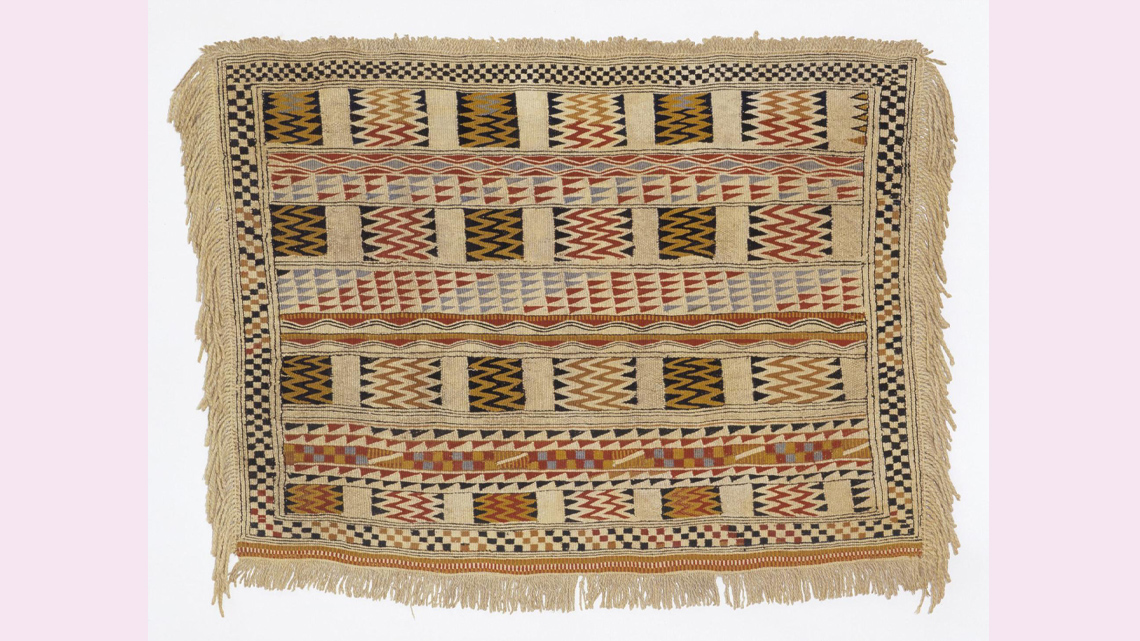
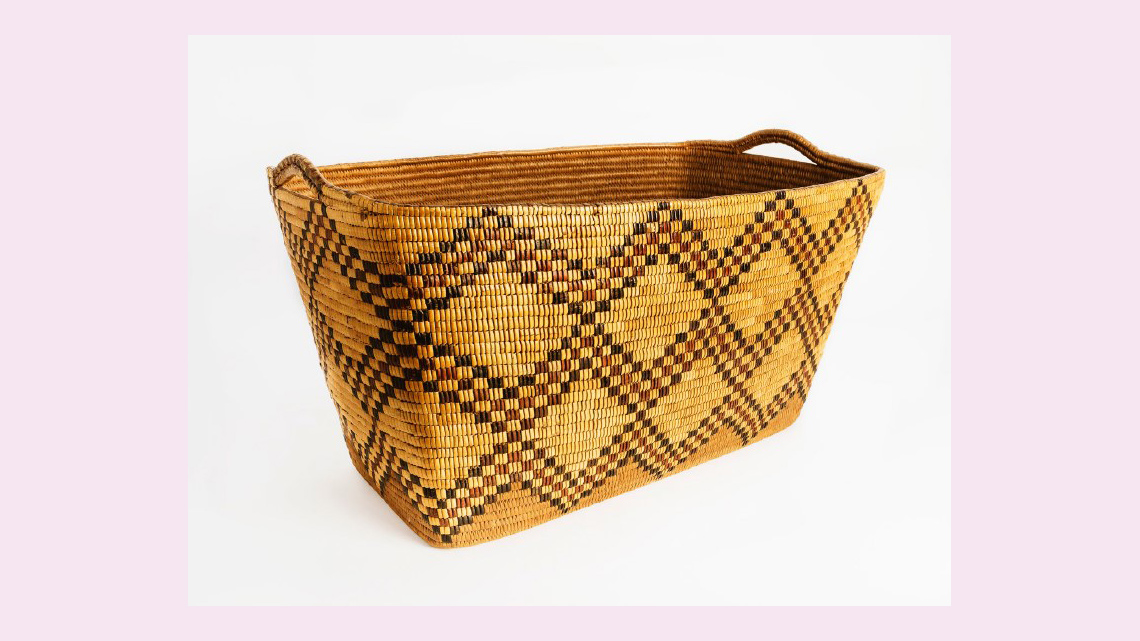
Chilliwack, B.C. In the 1960s and 1970s, the guild helped bring back traditional weaving skills
lost during the residential school era. Bringing weaving back to life rebuilds and celebrates
part of their identity that was damaged by colonialism.
In her later years, Mary gifted Peggy with a story from her time at residential school. Mary’s
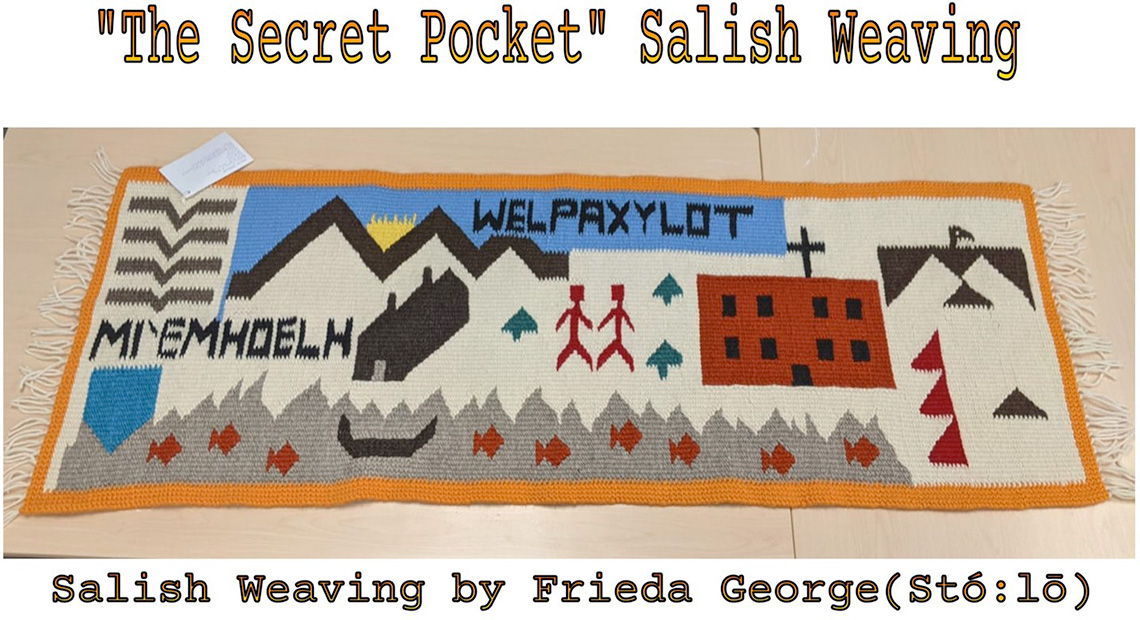
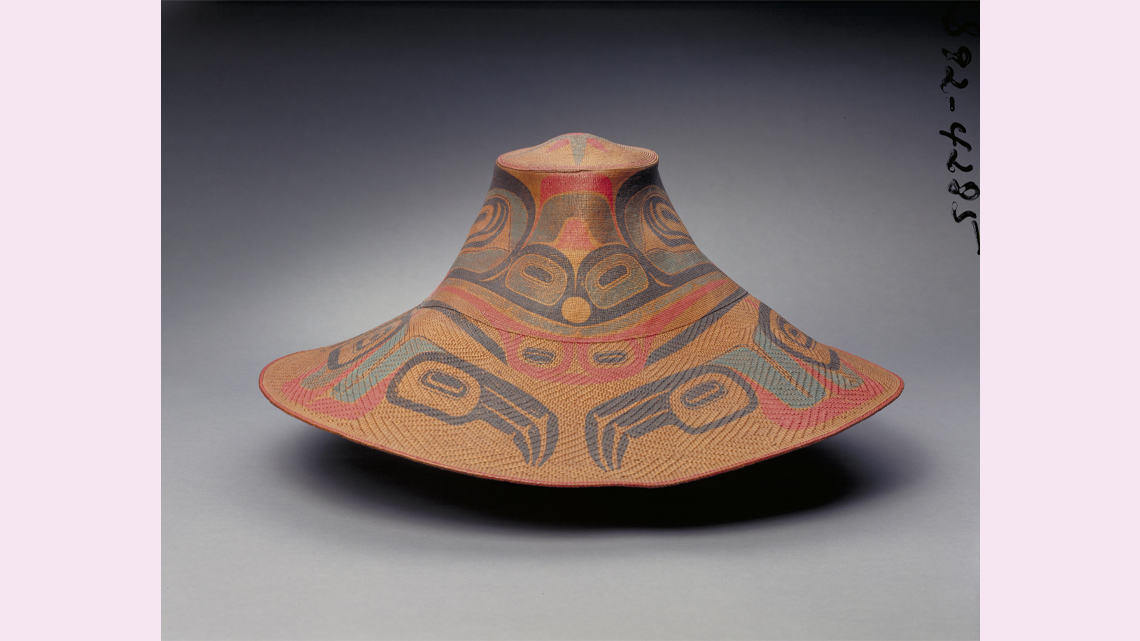
story became the book The Secret Pocket and inspired the artifact of Salish weaving we
examined in the Minds On section.

Pause and Reflect
Reflection question
In a notebook or using another method of your choice, reflect on the following
question.
How did residential schools aim to harm Indigenous identities and cultures?
Surviving residential schools
The residential school system operated for more than 100 years in Canada. More than 150,000 First
Nations, Métis, and Inuit children were removed from their families and forced to attend
residential schools where they were abused, mistreated, and alienated from their families and
culture.
Although the 130 different institutions were called “schools,” their focus was unlearning
Indigenous culture rather than learning school subjects. Indigenous children were not allowed to
speak their own language, practise their spirituality, or follow the wisdom and teachings of
their Elders. They were punished severely if they did these things. It was hoped that they would
lose their Indigenous identity and assimilate into Canadian society.
Residential schools caused generational trauma that continues today. Children
taken to the schools were robbed of their childhood, while older generations were robbed of
their children. Generations of children and grandchildren have also suffered, as their parents
and grandparents are haunted by the experiences.
There are no happy-ending stories about residential school systems. But there are stories of
resilience and ingenuity in those shared by survivors and their children and families. When
faced with the worst circumstances, many children used traditional skills and teachings to cope.
The Secret Pocket picture book
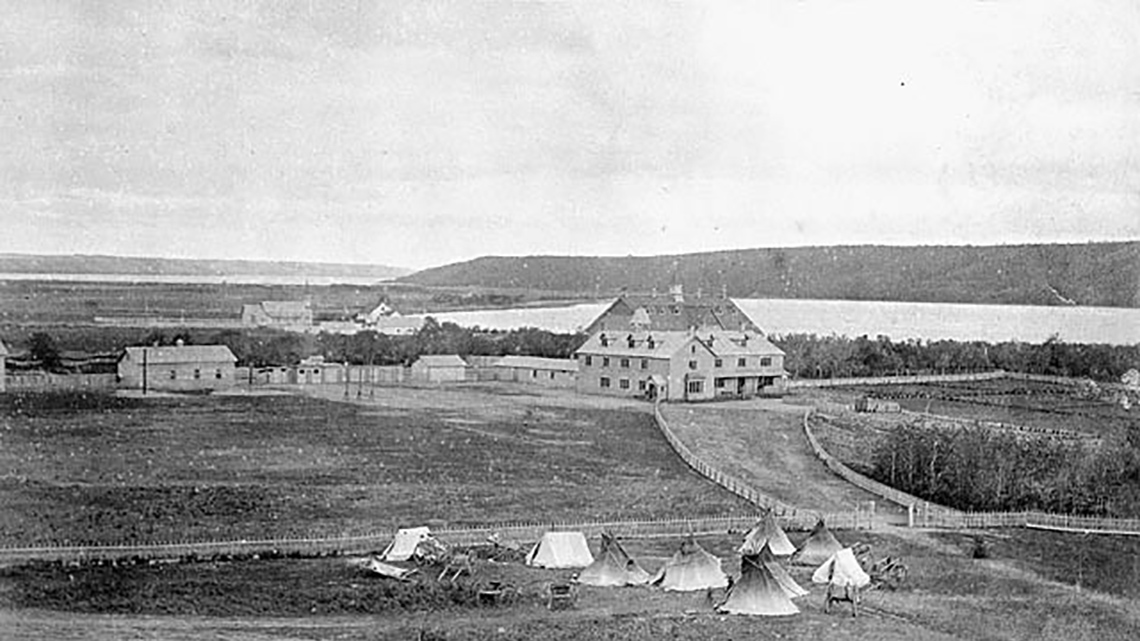
Mary and other Dakelh children from the Fort James area were forced to attend the Lejac
Residential School. As you read The Secret Pocket, notice how the girls used their
knowledge to help them survive physically, emotionally, and spiritually.
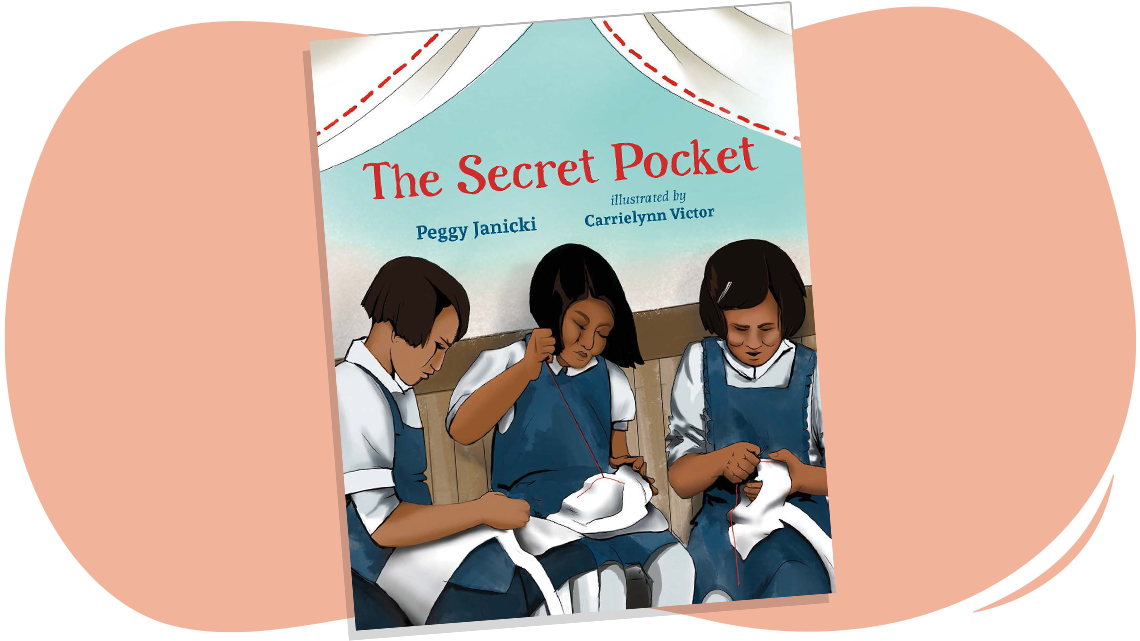
The Secret PocketThe Secret Pocket
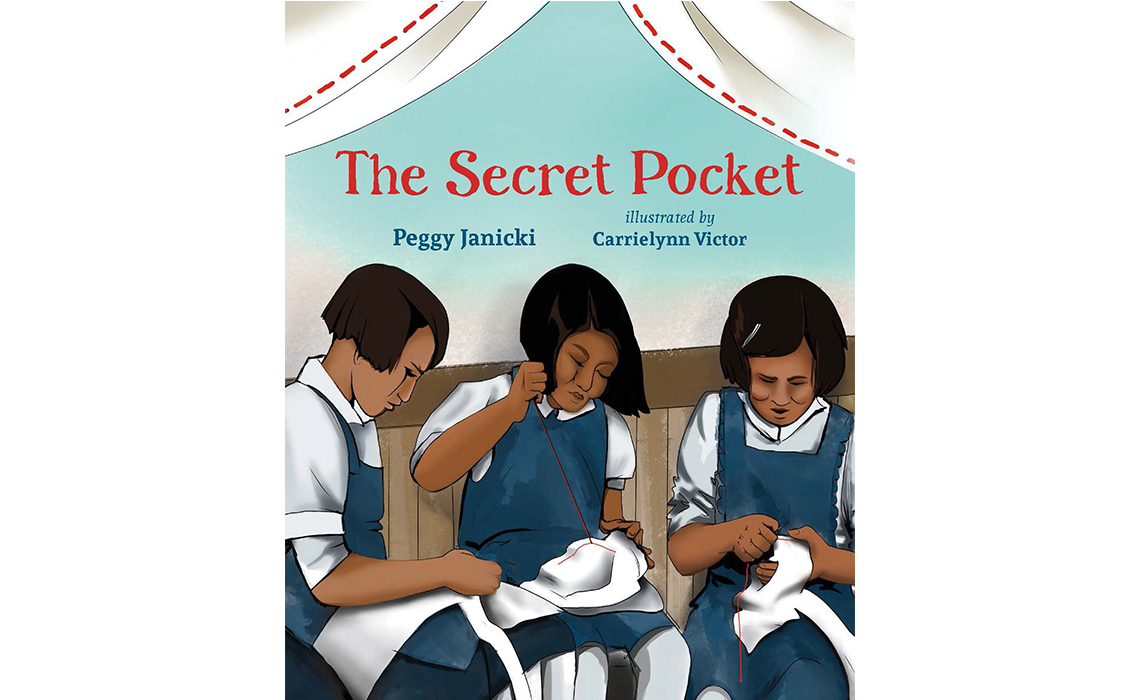
The Secret Pocket by Peggy Janicki,
illustrated by Carrielynn Victor
Praise for The Secret Pocket
“Peggy Janicki takes us on a powerful and gentle journey of truth as she
shares the lived experience of life before, during and after residential
school. She reminds us of the genius within, the importance of caring for
others and, of course, love. This moving story had me from the first page,
and I am sure it will influence hearts and minds for generations.”
- Monique Gray Smith, award-winning author of My Heart Fills
With Happiness
“In this important story of courage and resistance, educator Peggy Janicki
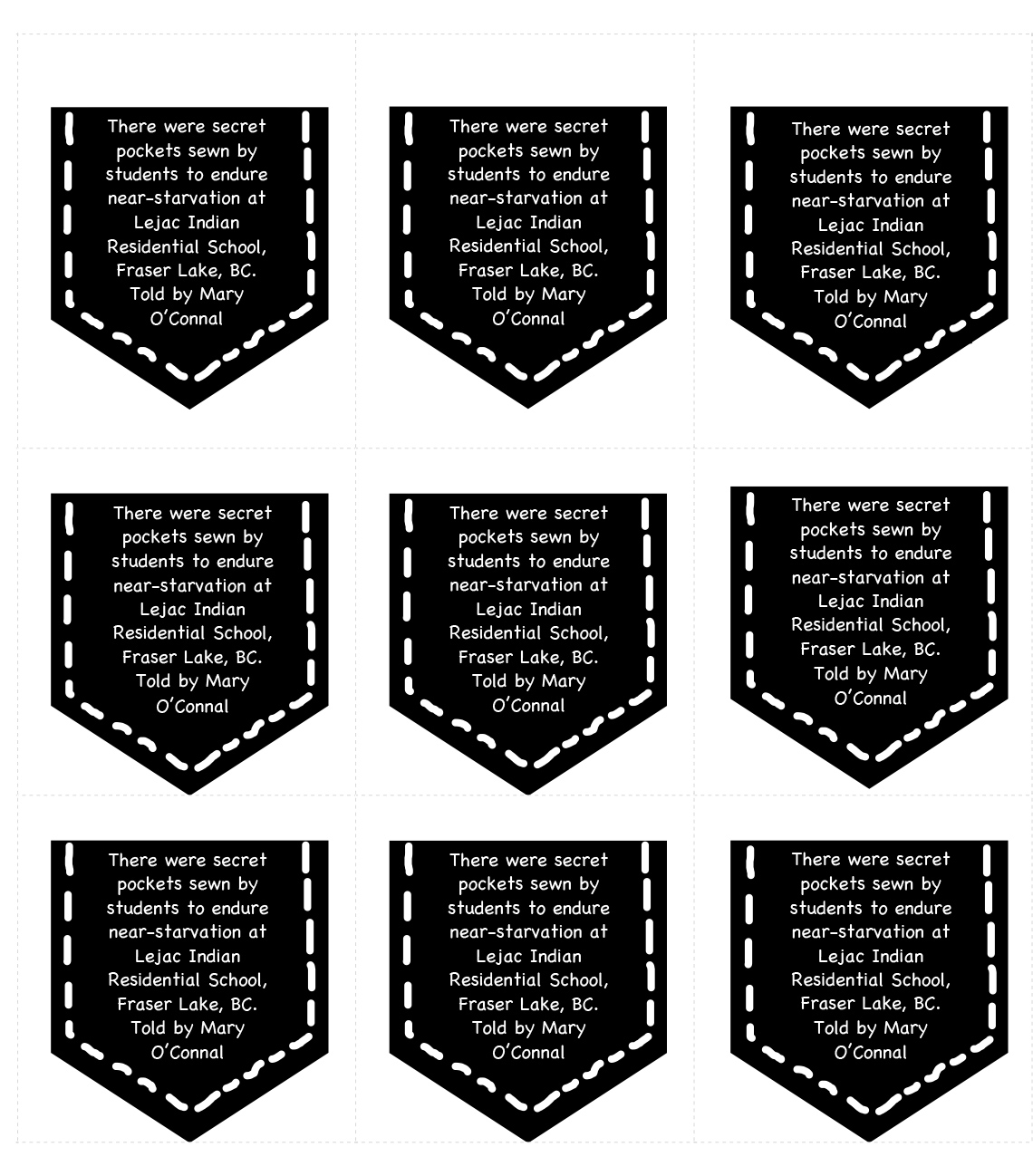
shares the story of her mother and other Survivors who sewed secret pockets
into their dresses to hide food to feed themselves and others at Lejac
residential school. We need to continue to hear these stories and share them
with our children so we can move forward in our collective healing.”
- Dr. Sara Florence Davidson, co-author of Potlatch as
Pedagogy: Learning Through Ceremony
“Beautifully illustrated and powerfully narrated, The Secret Pocket
amplifies the voices and experiences of Indian Residential School Survivors.
In doing so, Peggy Janicki and Carrielynn Victor make an important
contribution to the work of putting truth before reconciliation.”
- Sean Carleton, historian and author of Lessons in
Legitimacy: Colonialism, Capitalism, and the Rise of State Schooling in
British Columbia
“A first-person viewpoint gives this story an immediacy that captures the
sympathy of readers and holds their attention… An age-appropriate telling by
an Indigenous creative team of a tragic historical period.”
- School Library Journal, starred review
“Though the tale is emotionally fraught, young readers are left with an
uplifting reminder about the power and resolve of Indigenous people… A
moving tribute to Native children’s survival in the residential school
system.”
- Kirkus Reviews
My mother, Mary, shared a story with me. It’s a secret story that began
in Nak’azdli Whut’en. And now I’m going to share it with you in her
words.
- Peggy Janicki
The Secret Pocket
Peggy Janicki
Illustrated by Carrielynn Victor
Orca Book Publishers
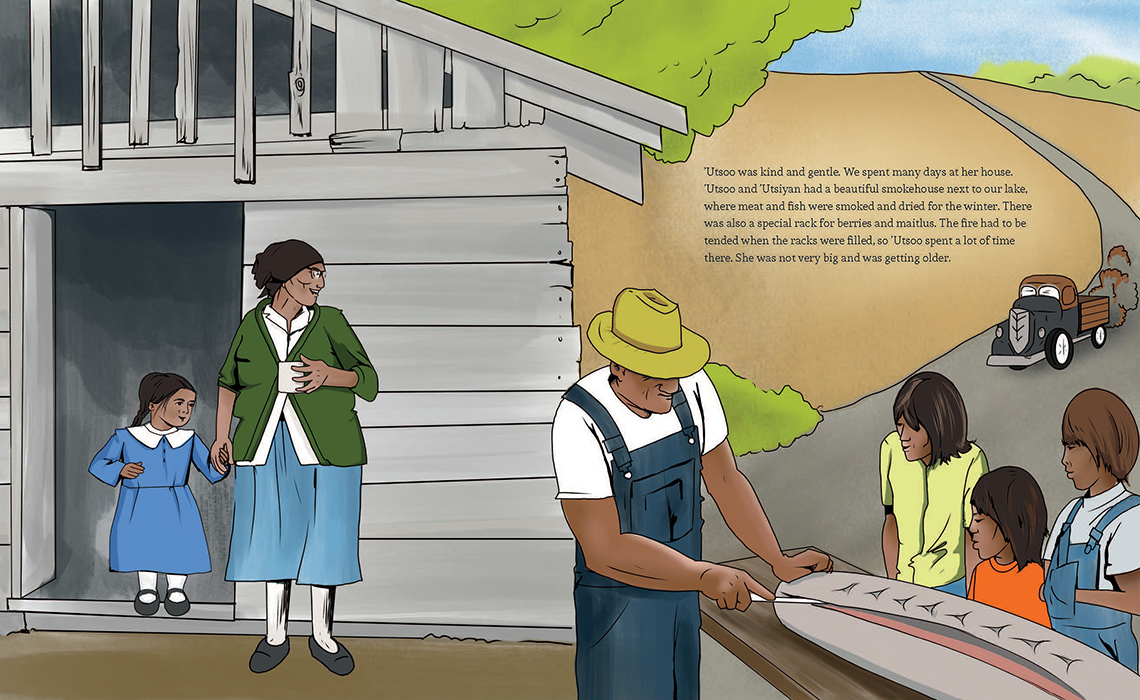
‘Utsoo was kind and gentle. We spent many days at her house. ‘Utsoo and
‘Utsiyan had a beautiful smokehouse next to our lake, where meat and fish
were smoked and dried for the winter. There was also a special rack for
berries and maitlus. The fire had to be tended when the racks were filled,
so ‘Utsoo spent a lot of time there. She was not very big and was getting
older.
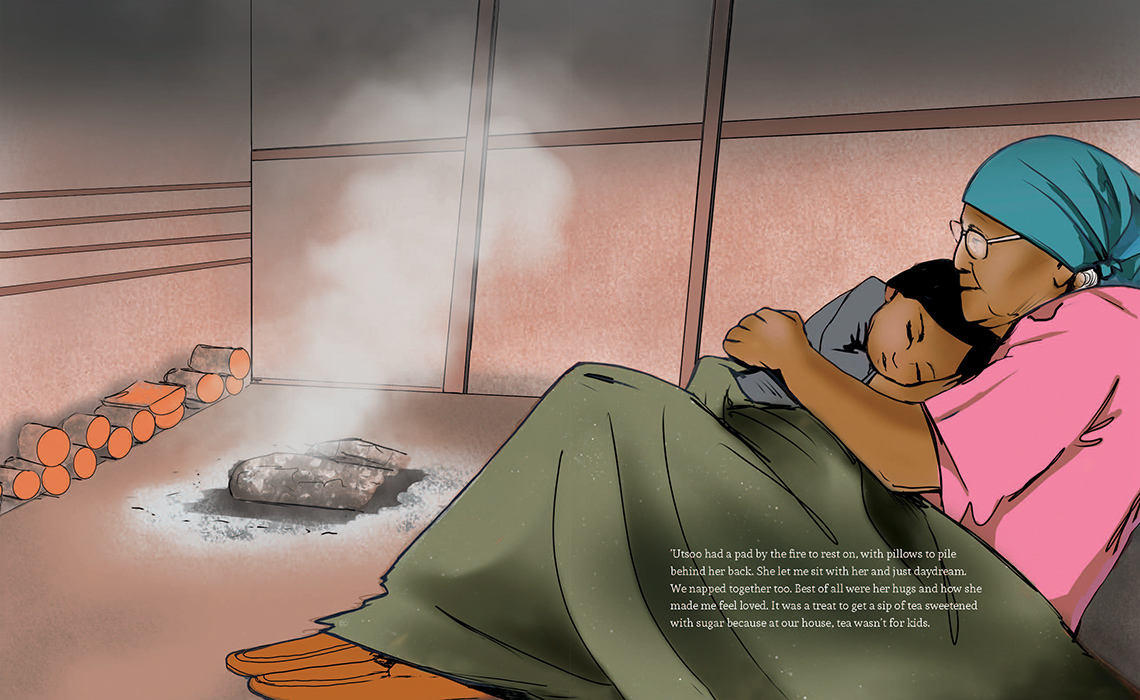
‘Utsoo had a pad by the fire to rest on, with pillows to pile behind her
back. She let me sit with her and just daydream. We napped together too.
Best of all were her huds and how she made me feel loved. It was a treat to
get a sip of tea sweetened with sugar because at our house, tea wasn’t for
kids.
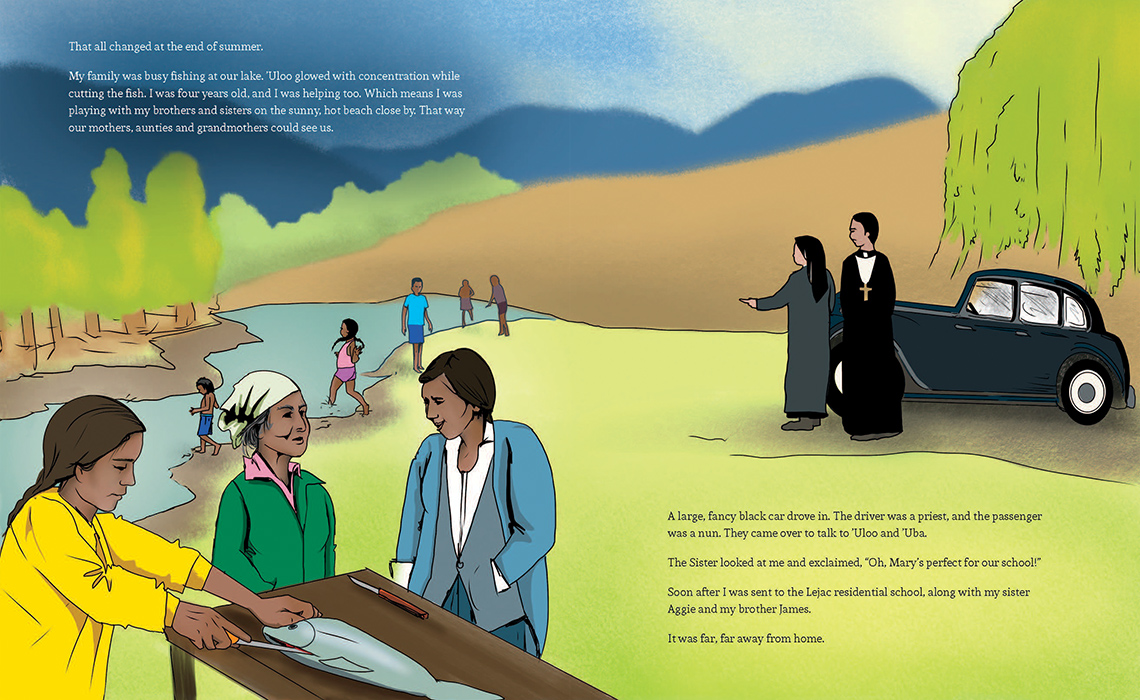
That all changed at the end of summer.
My family was busy fishing at our lake. ‘Uloo glowed with concentration while
cutting the fish. I was four years old, and I was helping too. Which means I
was playing with my brothers and sisters on the sunny, hot beach close by.
That way our mothers, aunties and grandmothers could see us.
A large, fancy black car drove in. The driver was a priest, and the passenger
was a nun. They came over to talk to ‘Uloo and ‘Uba.
The Sister looked at me and exclaimed, “Oh, Mary’s perfect for our school!”
Soon after I was sent to the Lejac residential school, along with my sister
Aggie and my brother James.
It was far, far away from home.
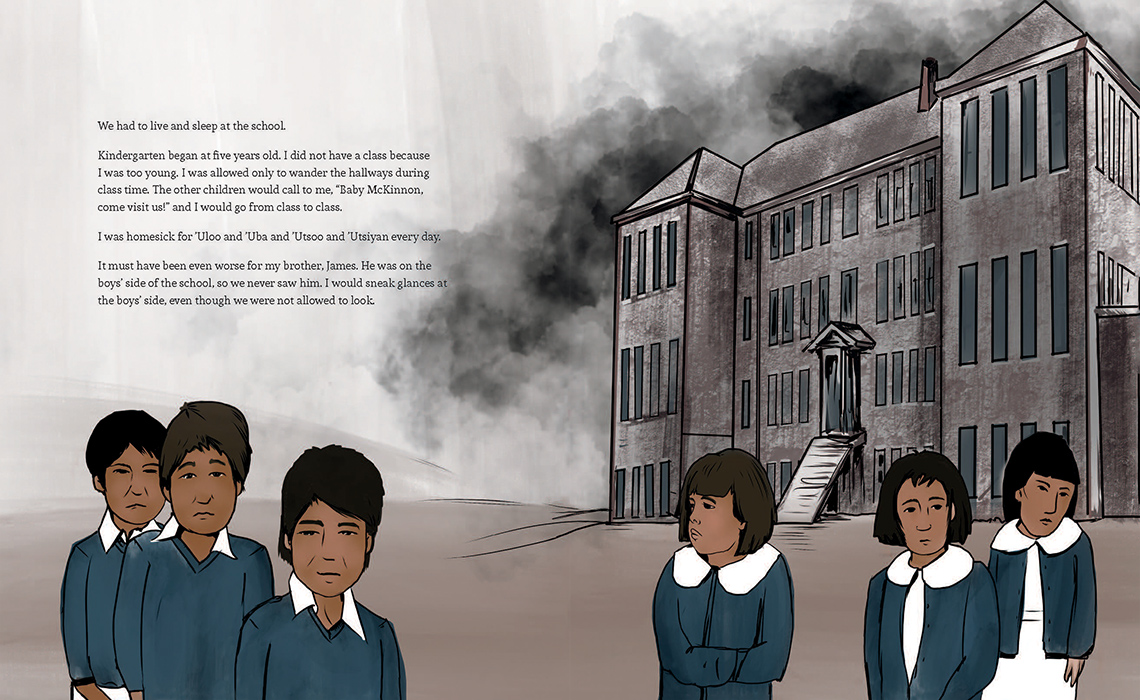
We had to live and sleep at the school.
Kindergarten began at five years old. I did not have a class because I was
too young. I was allowed only to wander the hallways during class time. The
other children would call to me, “Baby McKinnon, come visit us!” and I would
go from class to class.
I was homesick for ‘Uloo and ‘Uba and ‘Utsoo and ‘Utsiyan every day.
It must have been even worse for my brother, James. He was on the boys’ side
of the school, so we never saw him. I would sneak glances at the boys’ side,
even though we were not allowed to look.
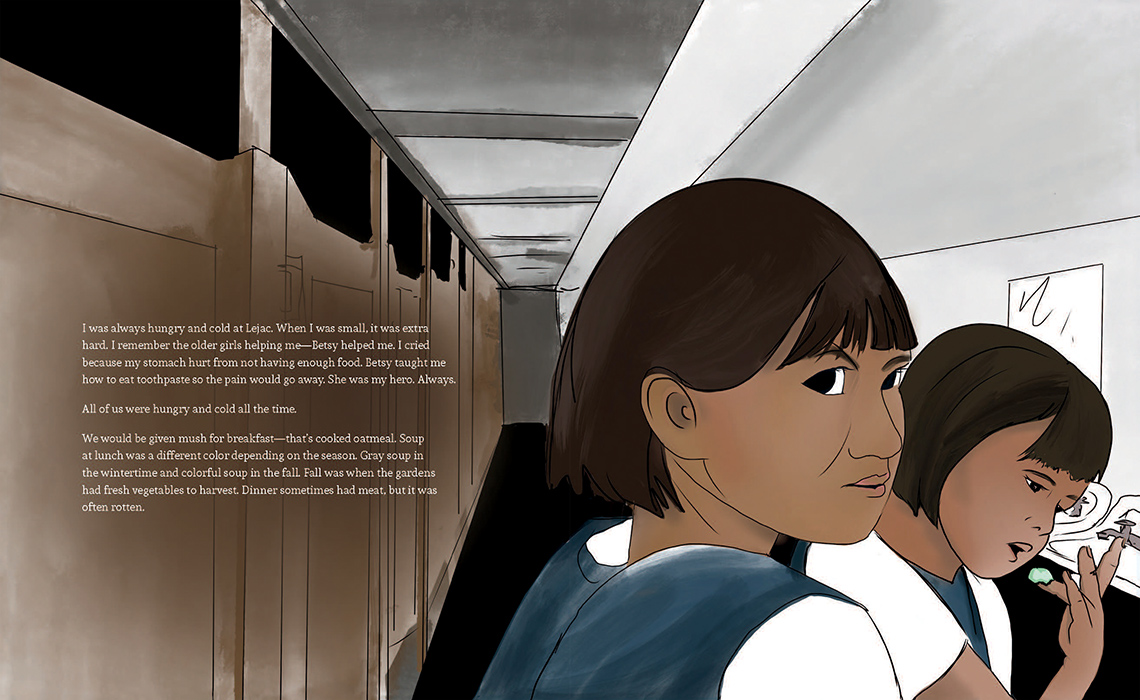
I was always hungry and cold at Lejac. When I was small, it was extra hard. I
remember the older girls helping me – Betsy helped me. I cried because my
stomach hurt from not having enough food. Betsy taught me how to eat
toothpaste so the pain would go away. She was my hero. Always.
All of us were hungry and cold all the time.
We would be given much for breakfast – that’s cooked oatmeal. Soup at lunch
was a different color depending on the season. Gray soup in the wintertime
and colorful soup in the fall. Fall was when the gardens had fresh
vegetables to harvest. Dinner sometimes had meat, but it was often rotten.
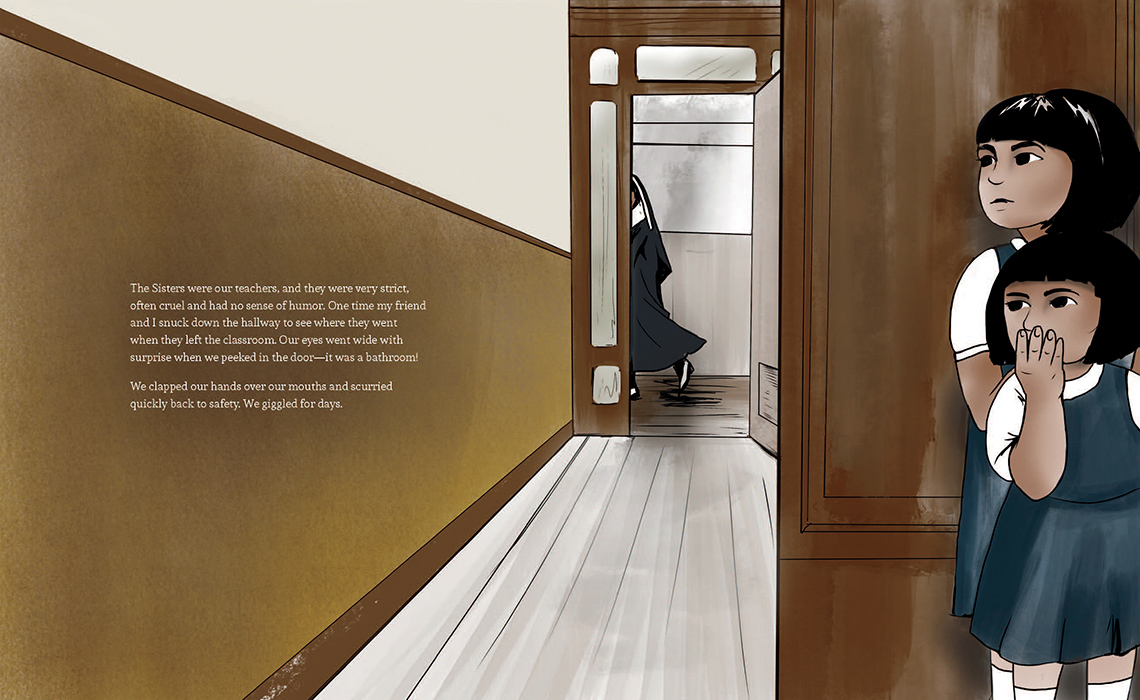
The Sisters were our teachers, and they were very strict, often cruel and had
no sense of humor. One time my friend and I snuck down the hallway to see
where they went when they left the classroom. Our eyes went wide with
surprise when we peeked in the door – it was a bathroom!
We clapped our hands over our mouths and scurried quickly back to safety. We
giggled for days.
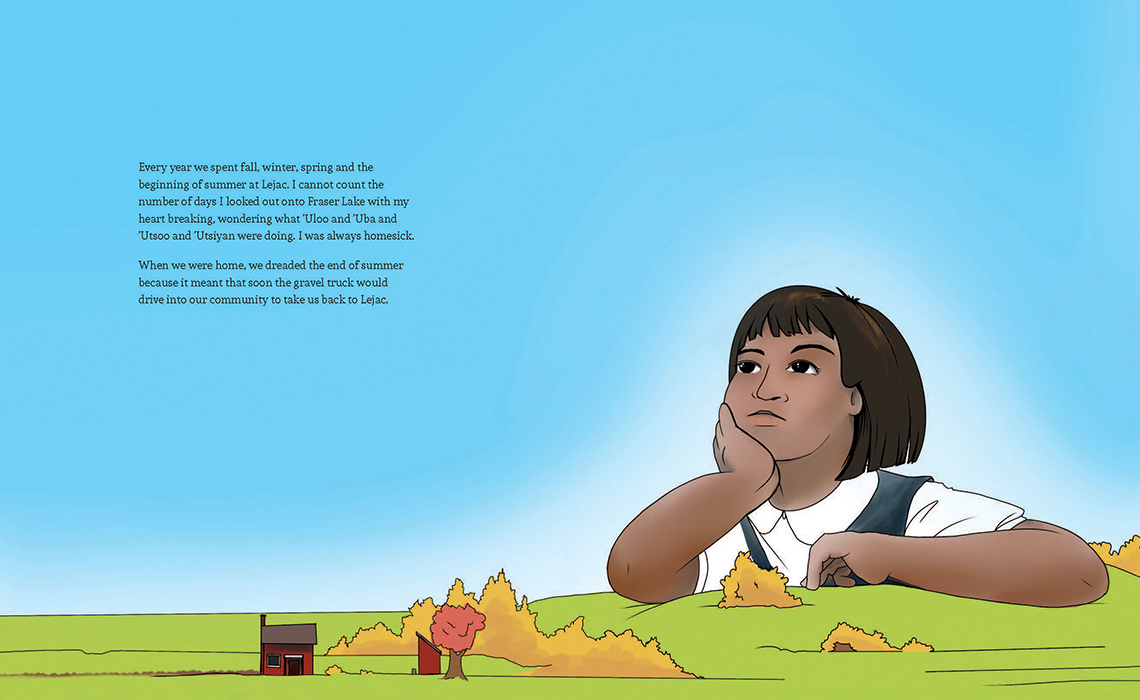
Every year we spent fall, winter, spring and the beginning of summer at
Lejac. I cannot count the number of days I looked out onto Fraser Lake with
my heart breaking, wondering what ‘Uloo and ‘Uba and ‘Utsoo and ‘Utsiyan
were doing. I was always homesick.
When we were home, we dreaded the end of summer because it meant that soon
the gravel truck would drive into our community to take us back to Lejac.
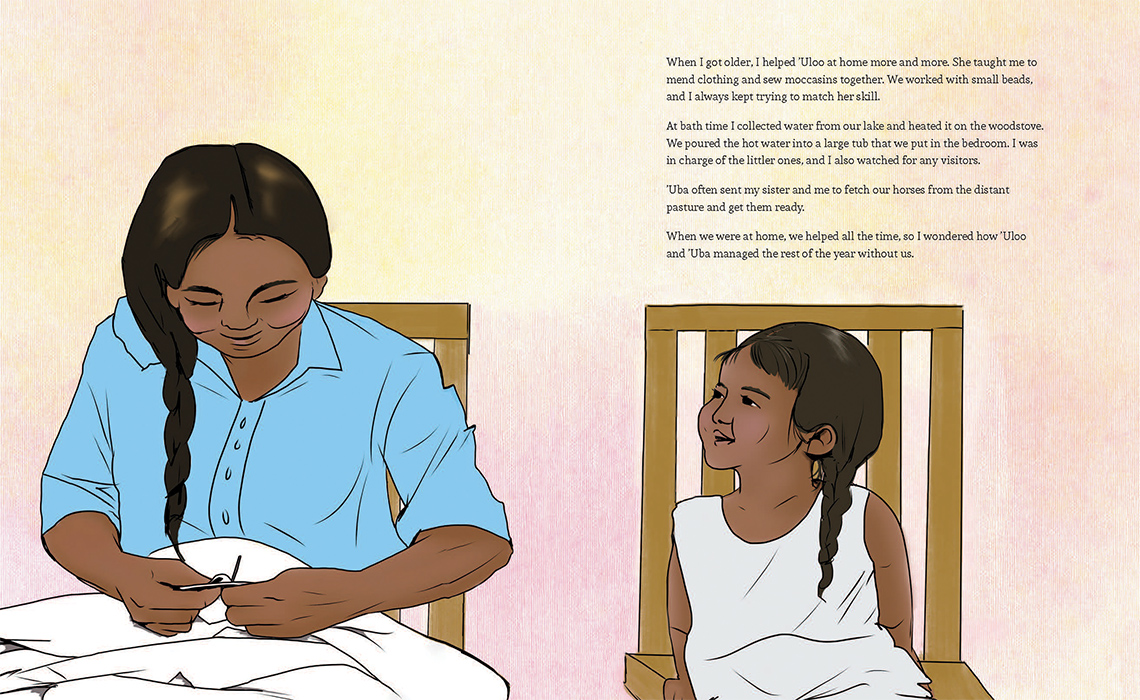
When I got older, I helped ‘Uloo at home more and more. She taught me to mend
clothing and sew moccasins together. We worked with small beads, and I
always kept trying to match her skill.
At bath time I collected water from our lake and heated it on the woodstove.
We poured the hot water into a large tub that we put in the bedroom. I was
in charge of the littler ones, and I also watched for any visitors.
‘Uba often sent my sister and me to fetch our horses from the distant pasture
and get them ready.
When we were at home, we helped all the time, so I wondered how ‘Uloo and
‘Uba managed the rest of the year without us.
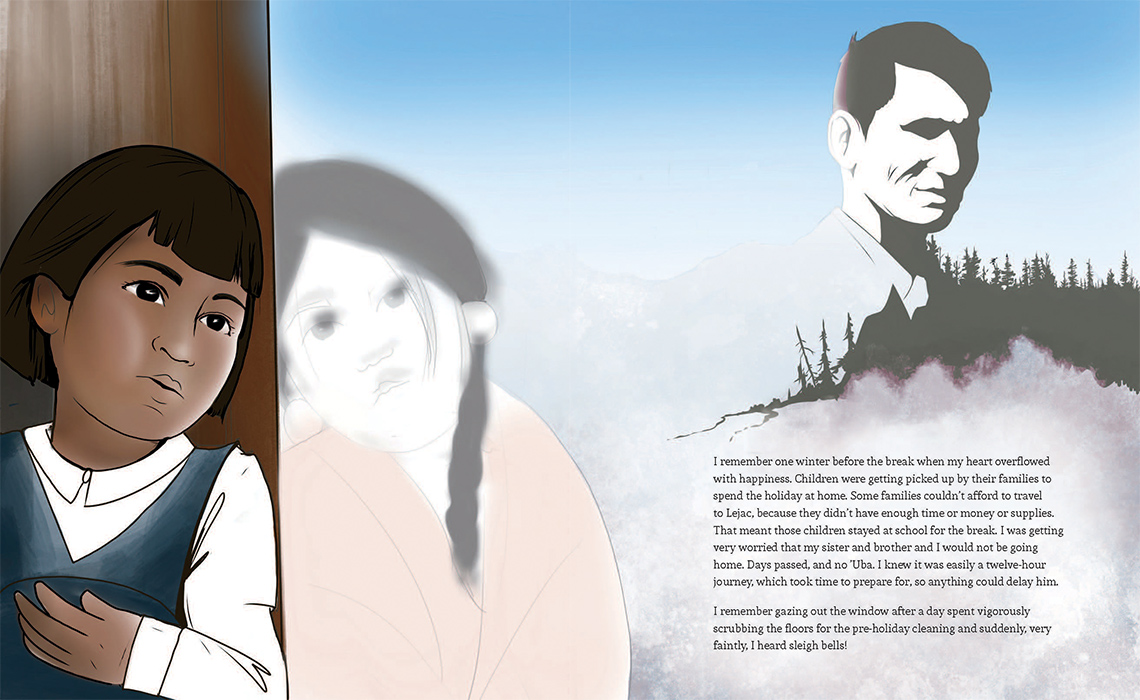
I remember one winter before the break when my heart overflowed with
happiness. Children were getting picked up by their families to spend the
holiday at home. Some families couldn’t afford to travel to Lejac, because
they didn’t have enough time or money or supplies. That meant those children
stayed at school for the break. I was getting very worried that my sister
and brother and I would not be going home. Days passed, and no ‘Uba. I knew
it was easily a twelve-hour journey, which took time to prepare for, so
anything could delay him.
I remember gazing out the window after a day spent vigorously scrubbing the
floors for the pre-holiday cleaning and suddenly, very faintly, I heard
sleigh bells!
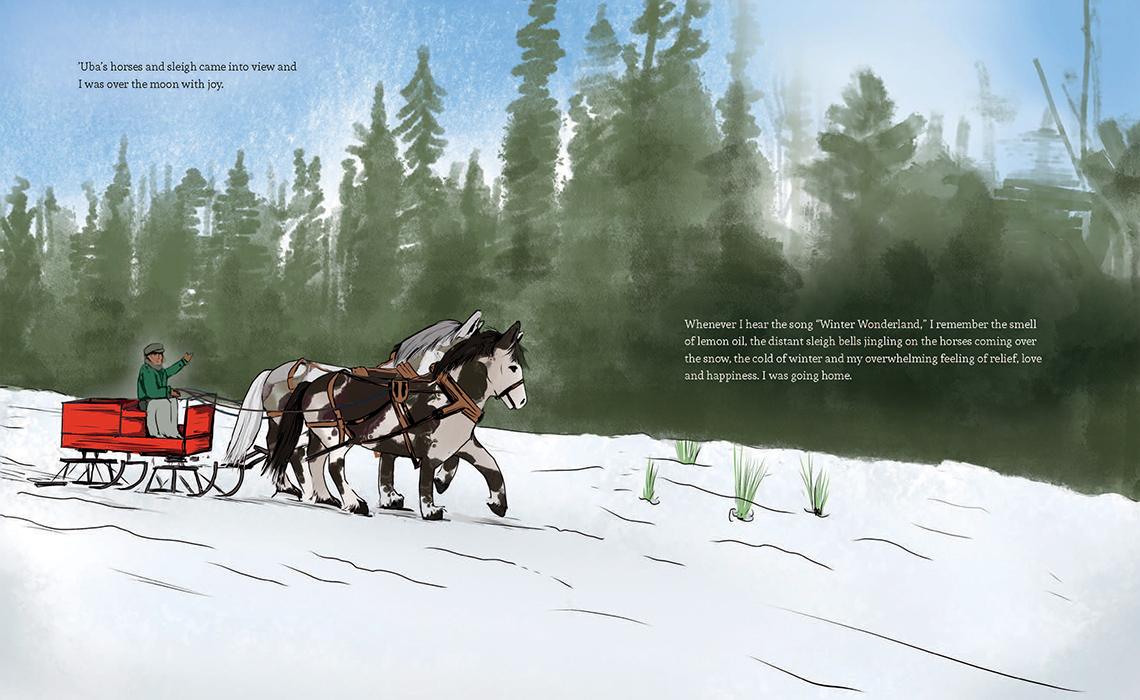
‘Uba’s horses and sleigh came into view and I was over the moon with joy.
Whenever I hear the song “Winter Wonderland,” I remember the smell of lemon
oil, the distant sleigh bells jingling on the horses coming over the snow,
the cold of winter and my overwhelming feeling of relief, love and
happiness. I was going home.
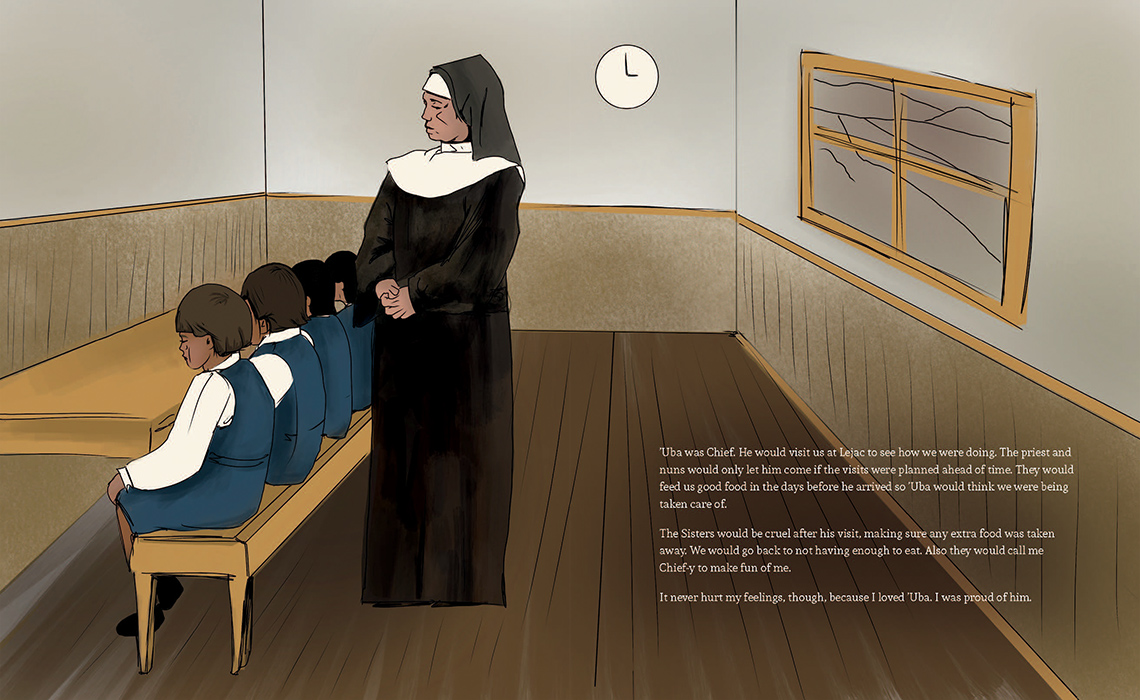
‘Uba was Chief. He would visit us at Lejac to see how we were doing. The
priest and the nuns would only let him come if the visits were planned ahead
of time. They would feed us good food in the days before he arrives so ‘Uba
would think we were being taken care of.
The Sisters would be cruel after his visit, making sure any extra food was
taken away. We would go back to not having enough to eat. Also they would
call me Chief-y to make fun of me.
It never hurt my feelings, though, because I loved ‘Uba. I was proud of him.
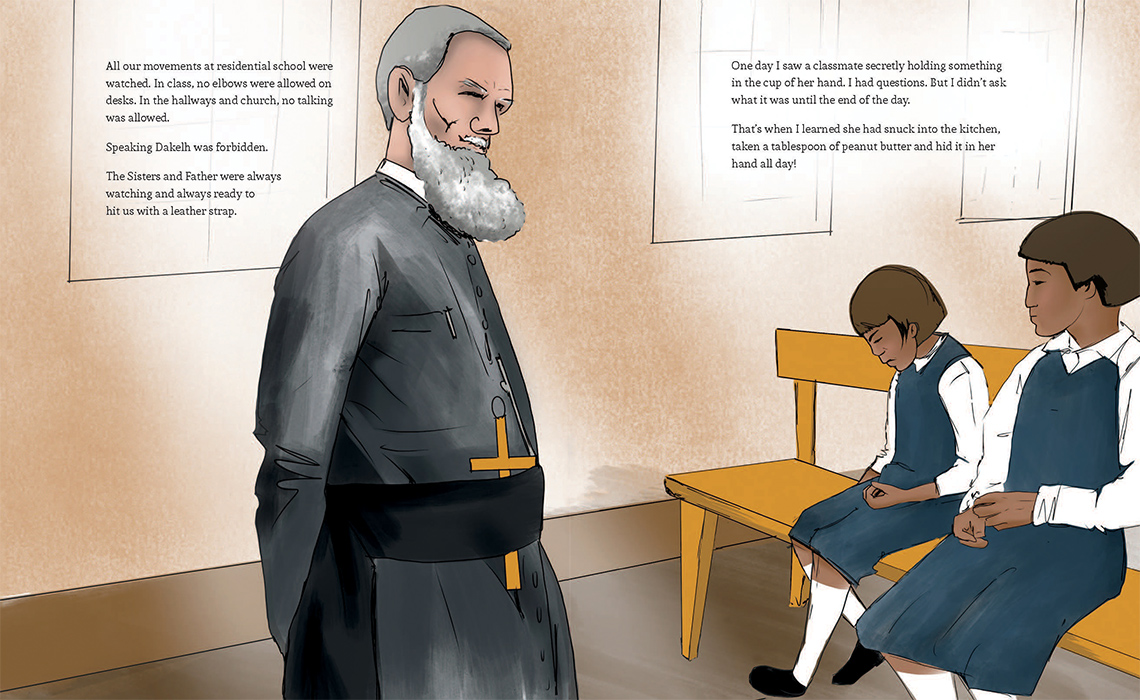
All of our movements at residential school were watched. In the class, no
elbows were allowed on desks. In the hallways and church, no talking was
allowed.
Speaking Dakehl was forbidden.
The Sisters and Father were always watching and always ready to hit us with a
leather strap.
One day I saw a classmate secretly holding something in the cup of her hand.
I had questions. But I didn’t ask what it was until the end of the day.
That’s when I learned she had snuck into the kitchen, taken a tablespoon of
peanut butter and hid it in her hand all day!
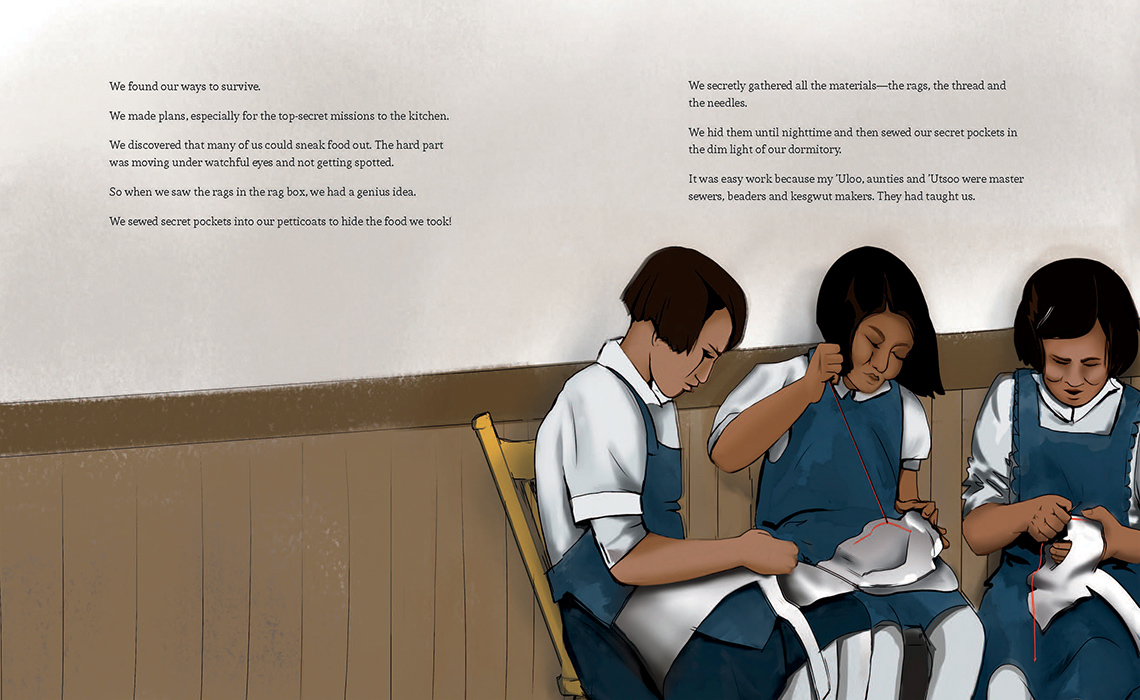
We found our ways to survive.
We made plans, especially for the top-secret missions to the kitchen.
We discovered that many of us could sneak food out. The hard part was moving
under watchful eyes and not getting spotted.
So when we saw the rags in the rag box, we had a genius idea.
We sewed secret pockets into our petticoats to hide the food we took!
We secretly gathered all the materials – the rags, the thread and the
needles.
We hid them until nighttime and then sewed our secret pockets in the dim
light of our dormitory.
It was easy work because my ‘Uloo, aunties and ‘Utsoo were master sewers,
beaders and kesgwut makers. They had taught us.
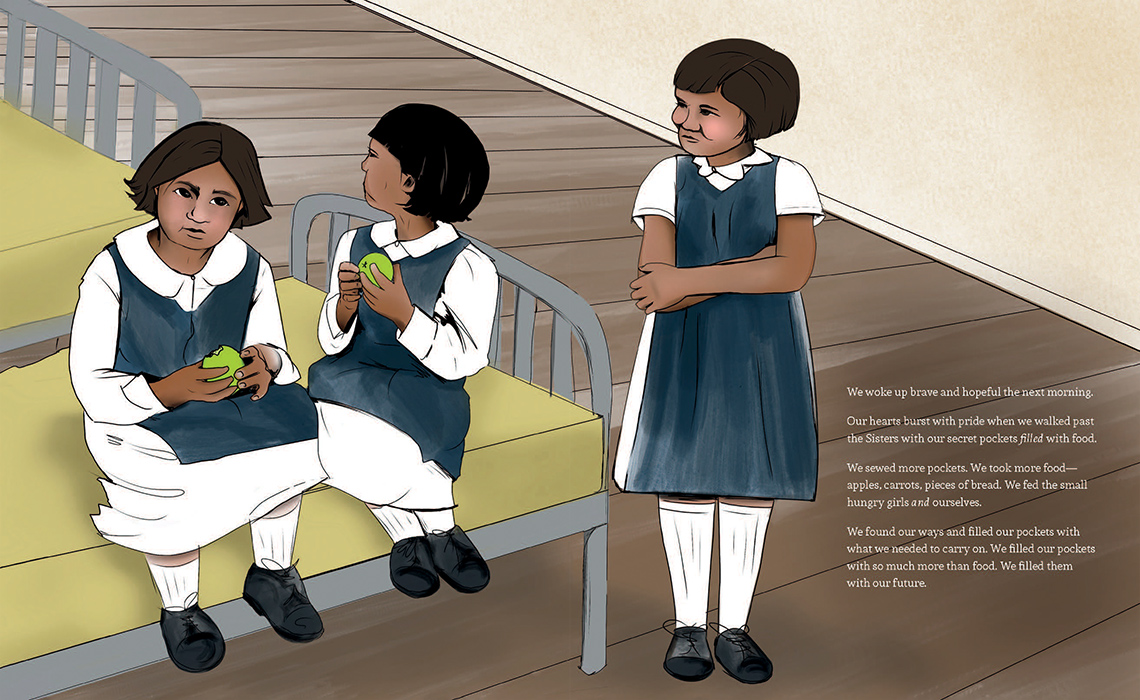
We woke up brave and hopeful the next morning.
Our hearts burst with pride when we walked past the Sisters with our secret
pockets filled with food.
We sewed more pockets. We took more food – apples, carrots, pieces of bread.
We fed the small hungry girls and ourselves.
We found our ways and filled our pockets with what we needed to carry on. We
filled our pockets with so much more than food. We filled them with our
future.
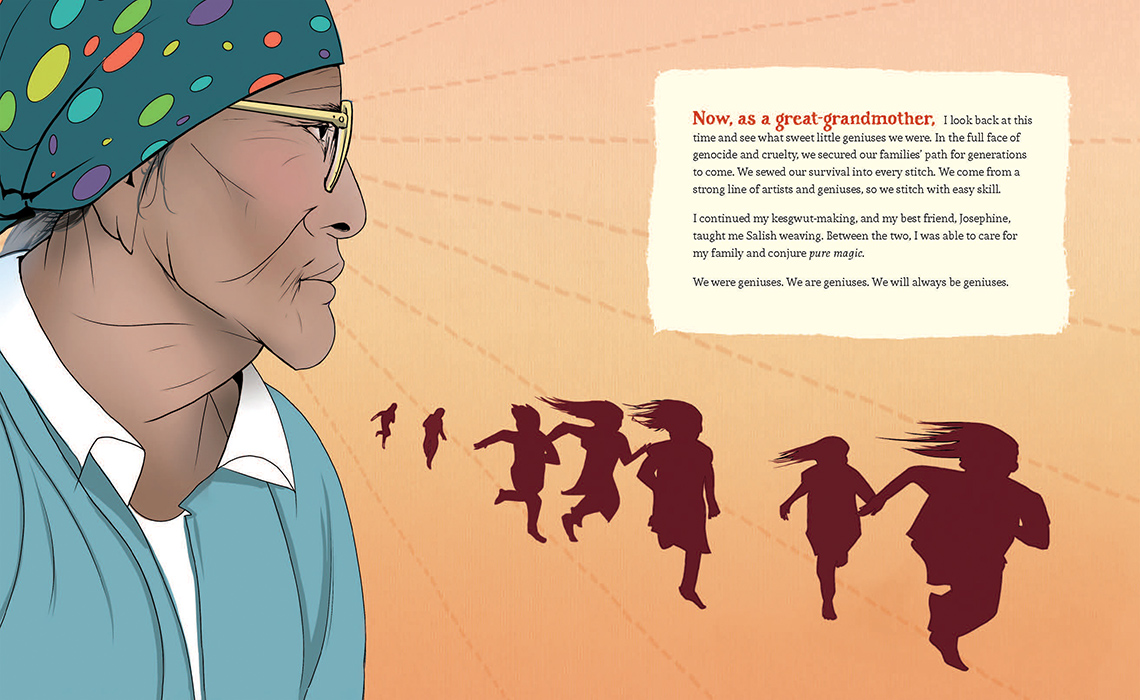
Now, as a great-grandmother, I look back at this time and see what sweet
little geniuses we were. In the full face of genocide and cruelty, we
secured our families’ path for generations to come. We sewed our survival
into every stitch. We come from a strong line of artists and geniuses, so we
stitch with easy skill.
I continued my kesgwut-making, and my best friend, Josephine, taught me
Salish weaving. Between the two, I was able to care for my family and
conjure pure magic.
We were geniuses. We are geniuses. We will always be geniuses.
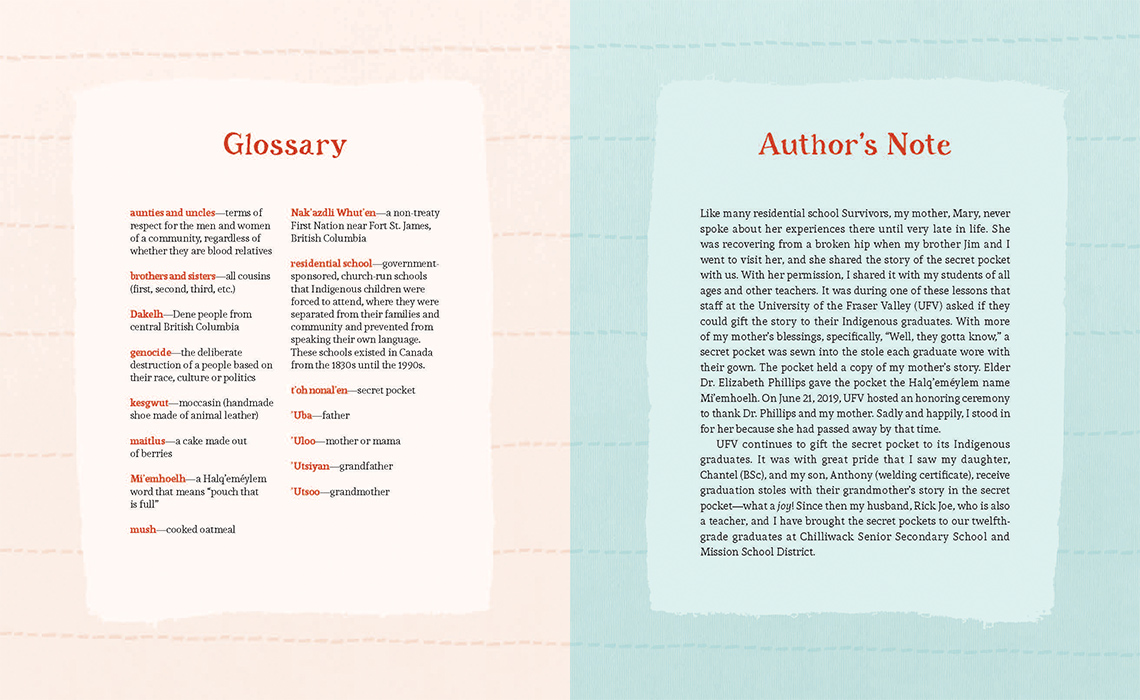
Glossary
aunties and uncles – terms of respect for men and women of a community,
regardless of whther they are blood relatives
brothers and sisters – all cousins (first, second, third, etc.)
Dakehl – Dene people from central British Columbia
genocide – the deliberate destruction of a people based on their race,
culture or politics
kesgwut – moccasin (handmade shoe made of animal leather)
maitlus – a cake made out of berries
Mi’emhoelh – a Halq’eméylem word that means “pouch that is full”
mush – cooked oatmeal
Nak’azdli Whut’en – a non-treaty First Nation near Fort St. James, British
Columbia
residential school – government-sponsored, church-run schools that Indigenous
children were forced to attend, where they were separated from their
families and community and prevented from speaking their own language. These
schools existed in Canada from the 1830s until the 1990s
t’oh nonal’en – secret pocket
‘Uba – father
‘Uloo – mother or mama
‘Utsiyan – grandfather
‘Utsoo – grandmother
Author’s Note
Like many residential school Survivors, my mother, Mary, never spoke about
her experiences there until very late in life. She was recovering from a
broken hip when my brother Jim and I went to visit her, and she shared the
story of the secret pocket with us. With her permission, I shared it with my
students of all ages and other teachers. It was during one of these lessons
that staff at the University of Fraser Valley (UFV) asked if they could gift
the story to their Indigenous graduates. With more of my mother’s blessings,
specifically, “Well, they gotta know,” a secret pocket was sewn into the
stole each graduate wore with their gown. The pocket held a copy of my
mother’s story. Elder Dr. Elizabeth Phillips gave the pocket the
Halq’eméylem name Mi’emhoelh. On June 21, 2019, UFV hosted an honoring
ceremony to thank Dr. Phillips and my mother. Sadly and happily, I stood in
for her because she had passed away by that time.
UFV continues to gift the secret pocket to its Indigenous graduates. It was
with great pride that I saw my daughter, Chantel (BSc), and my son, Anthony
(welding certificate), receive graduation stoles with their grandmother’s
story in the secret pocket – what a joy! Since then my husband,
Rick Joe, who is also a teacher, and I have brought the secret pockets to
our twelfth-grade graduates at Chilliwack Senior Secondary School and
Mission School District.
To all past, present and future matriarchs. To my wee family, Chantel, Layla,
Anthony and especially my beloved Rick joe, Snachailya for saying I should
write a book!
Text copyright © Margaret “Peggy” Janicki 2023
Illustrations copyright © Carrielynn Victor 2023
Published in Canada and the United States in 2023 by Orca Book Publishers.
Orcabook.com
All rights are reserved, including those for text and data mining, AI
training and similar technologies. No part of this publication may be
reproduced or transmitted in any form or by anu means, electronic or
mechanical, including photocopying, recording or by any information storage
and retrieval system now known or to be invented, without permission in
writing from the publisher.
Library and Archives of Canada Cataloguing in Publication
Title: The secret pocket / Peggy Janicki; Carrielynn Victor.
Names: Janicki, Peggy, author.| Victor, Carrielynn, 1982 – illustrator.
Identifiers: Canadiana (print) 20220245916 | Canadiana (ebook) 20220246068|
ISBN 9781459833722 (hardcover) | ISBN 9781459833739 (PDF) | ISBN
9781459833746 (EPUB)
Subjects: CSH: Indigenous peoples-Canada-Residential schools-Juvenile
literature. |
CSH: Indigenous students-Canada-Social conditions-Juvenile literature. |
LCGFT: Picture books.
Classification: LCC J36 2023 | DCC j371.829/97071-dc23
Library of Congress Control Number: 2022938343
Summary: This illustrated nonfiction picture book tells the true story of how
a resilient group of girls at a residential school sewed secret pockets into
their clothes to hide food.
Orca Book Publishers is committed to reducing the consumption of nonrenewable
resources in the production of our books. We make every effort to use
materials that support a sustainable future.
Orca Book Publishers gratefully acknowledges the support for its publishing
programs provided by the following agencies: the Government of Canada, the
Canada Council for the Arts and the Province of British Columbia through the
BC Arts Council and the Book Publishing Tax Credit.
Artwork created through digital illustration
Cover and interior artwork by Carrielynn Victor
Design by Dahlia Yuen
Edited by Kirstie Hudson
Printed and bound in South Korea.
27 26 25 24 . 3 4 5 6
Peggy Janicki is an award-winning Dakehl teacher from the Nak’azdli Whut’en
First Nation. She holds a master of education in Indigenous
knowledges/Indigenous pedagogies from the University of British Columbia.
Peggy has worked for decades to reveal the hidden stories and histories of
Indigenous Peoples, as featured in UBC’s Massive Open Online Course (MOOC)
“Reconciliation through Indigenous Education.” When her mother shared a
secret story that changed all their lives and highlighted the impacts of
colonication, Peggy also became a storyteller. She lives in Chilliwack,
British Columbia.
Eastern Fraser Valley-based artist Carrielynn Victor is a descendant of Coast
Salish ancestors that have been sustained by S’olh Temexw (their land) since
time immemorial and Western European ancestors that settled around Nothern
Turtle Island beginning in the 1600s. Along with owning and operating an art
practice, Carrielynn maintains a communal role as a plant practitioner, and
is the Manager of Cheam First Nation’s Environmental Consultancy. The
philosophy and responsibilities of these land-based communal roles are
fundamental for informing the story, style and details of her artwork. With
ancient and modern design principles combined, Carrielynn’s professional
artistic practice takes the form of murals, canvas paintings, drums, paddles
and, in recent years, illustrations for scientific reports and children’s
books. She lives in Chilliwack, British Columbia.
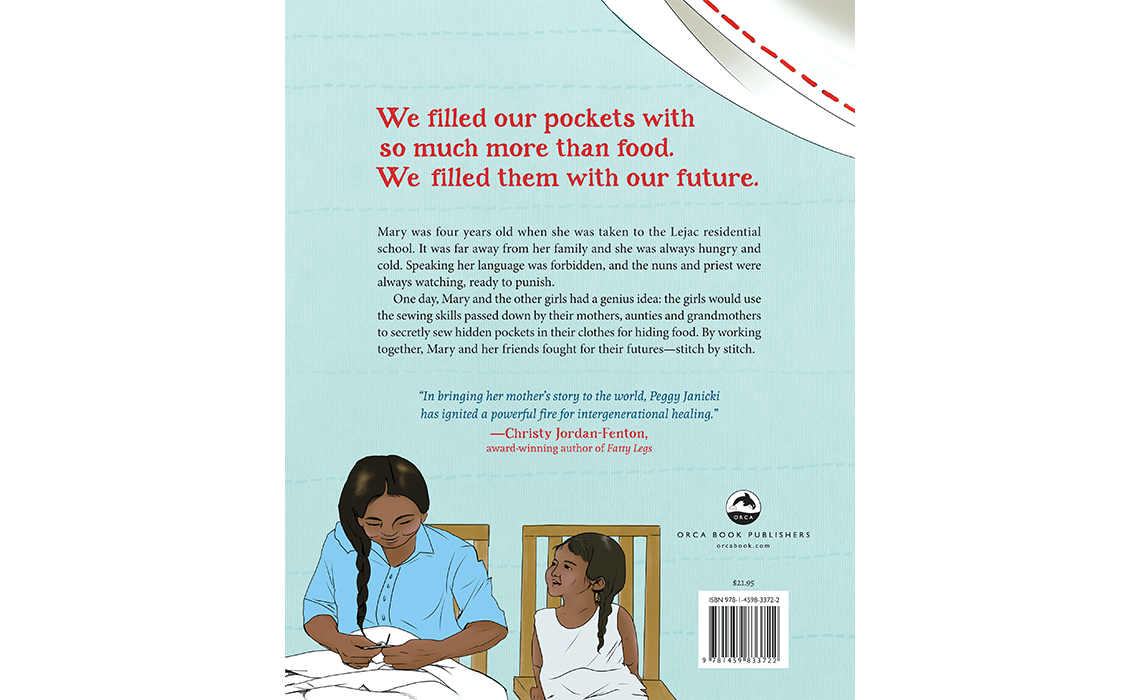
We filled out pockets with so much more than food. We filled them with our
future.
Mary was four years old when she was taken to the Lejac residential school.
It was far away from her family and she was always hungry and cold. Speaking
her language was forbidden, and the nuns and priest were always watching,
ready to punish.
One day, Mary and the other girls had a genius idea: the girls would use the
sewing skills passed down by their mothers, aunties and grandmothers to
secretly sew hidden pockets in their clothes for hiding food, By working
together, Mary and her friends fought for their futures – stitch by stitch.
“In bringing her mother’s story to the world, Peggy Janicki has ignited a
powerful fire for intergenerational healing.” – Christy Jordan-Fention,
award-winning author of Fatty Legs
Orca Book Publishers
Orcabook.com
You have done a lot of thinking about residential schools’ experiences. Now is a great time to
take a break before we turn to check your understanding of what you’ve read.

Student Wellness
Take a break!
Time for a body break! If possible, stretch your body and move around your space.
Reflecting on the story
Now, let’s reflect on the story you read in the book The Secret Pocket.
Post-reading
Check your understanding of the story by answering questions
in a notebook or you can use another method of your choice. If you find a question challenging,
try rereading the book to clarify your understanding. When you are done, press Sample
Answer to check a suggested response for each question.
- Setting: What are the two settings of the story?
- Conflict: What challenges did Mary have at school?
- Theme: How does the book show the theme of resilience?
- Message: Why is it important to know and keep in mind Lejac Residential
School?
Sample Answer
- The first setting is Nak’ azdli Whuten and the second is the Lejac Residential
School.
- Mary had many challenges at school. For one, not having enough food to eat and being
cold in school. She also worried she would not go home for winter break.
- Resilience means that someone can withstand difficult things or recover from tough
events in their life. As a child, Mary showed resilience when Betsy shared how to
eat toothpaste. As an adult and an elder, Mary showed resilience by sharing her
story and celebrating the strength of the girls.
- It is important to keep in mind Lejac Residential School because it was one of
many residential schools across Canada. Also, it helps us
understand Indigenous People's call for truth, justice and fair treatment.
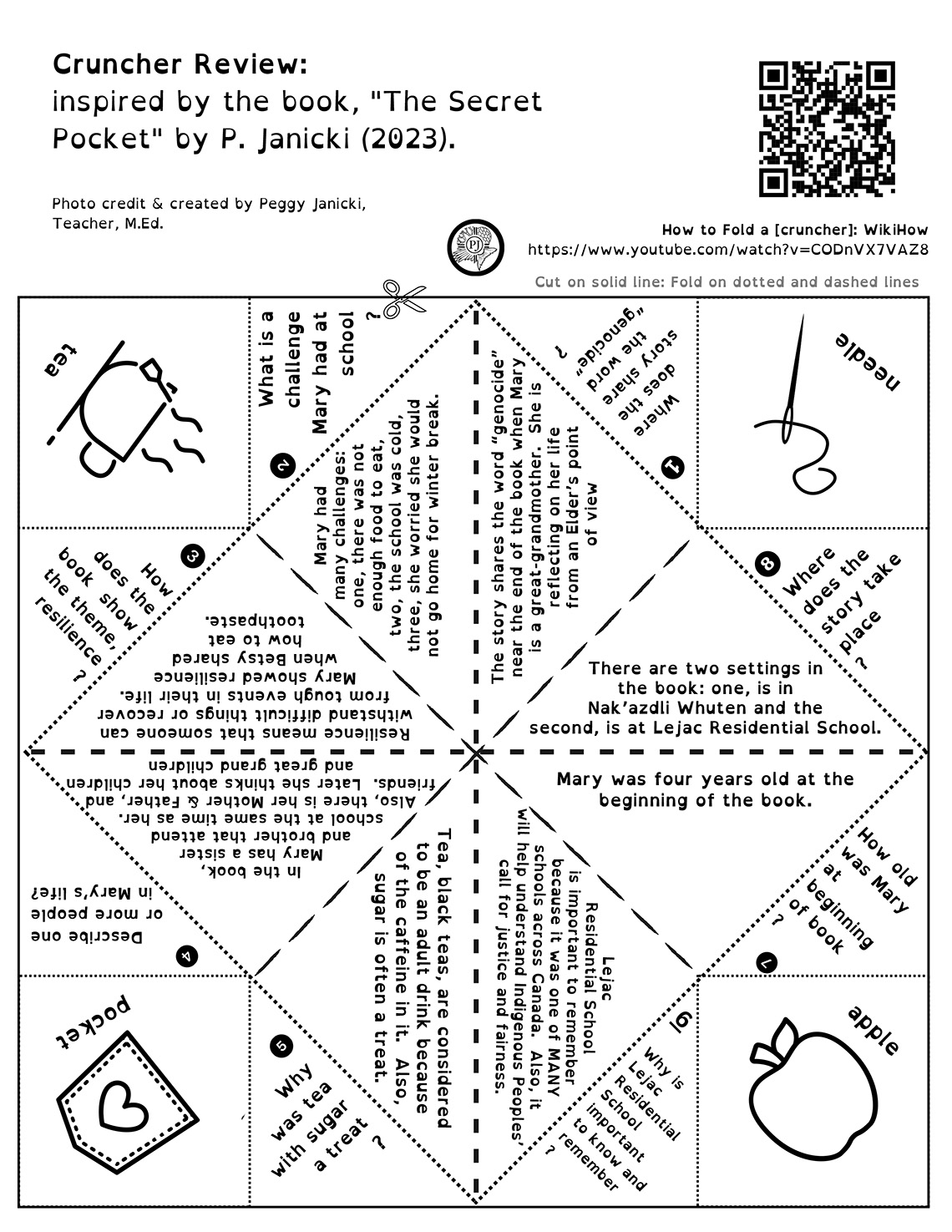
Alternatively, if you have a partner and access to a printer, you can print out and then cut out
the following paper cruncher game. This will let you review by playing a game with a partner.
Access the following Cruncher Review to print the game.
Now, review the following quote from the book The Secret Pocket by Peggy Janicki.
“Now, as a great-grandmother, I look back at this time and see what sweet little geniuses we
were. In the full face of genocide and cruelty, we secured our families’ path for
generations to come. We sewed our survival into every stitch. We come from a strong line of
artists and geniuses, so we stitch with easy skill.
I continued my kesgwut-making, and my
best friend, Josephine, taught me
Salish weaving. Between the two, I was able to care for my family and conjure pure
magic.
We were geniuses. We are geniuses. We will always be geniuses.”
In your own words, explain how “We sewed our survival into every stitch” represents the main idea
of the story. Record your thinking in a notebook or using another method of your choice.
An interview with the author
Mary and some of the girls at Lejac used traditional skills passed down by their family and
members of their communities to help them survive residential school. By telling their stories,
they help the next generations. Let’s hear from the author why this story is so important.
Before listening, consider the following question: Why do you think stories such as Mary’s are
important?
Listen to the following audio clip of an interview between journalist Shelagh Rogers and author
Peggy Janicki. As you listen, take note of Peggy’s message about why it is important to share
stories such as her mother Mary’s.

Did You Know?
Did You Know?
What is the Truth and Reconciliation Commission?
The Truth and Reconciliation Commission of Canada was created by survivors to tell
all Canadians about what happened in residential schools. It gathered the stories of
Indigenous Peoples who went to these schools, their families, and others affected.
This included First Nations, Inuit, and Métis residential school survivors, their
families, communities, church workers, government officials, and other Canadians.
Through her work as an author, storyteller, and weaver, Peggy celebrates the genius and
excellence of Indigenous Peoples and helps heal generational trauma.
In a notebook or using another method of your choice, apply what you have learned from Peggy’s
message in the interview and answer the following question in your own words: What role do
stories from the past have in the process of
reconciliation today?
When you are done, press the Possible Answer button to preview a sample answer
to some of the questions.
Possible Answer
It is important to know the truth of Canada before reconciliation. We have to keep
telling the stories and make sure that each generation of children understands the need
for reconciliation and can help dismantle systems of racism.
Pause and Reflect
Pause and reflect
How does hearing the author’s words impact your experience with the book?
Vocabulary time

Vocabulary routine
Let’s review some of the new vocabulary words used in this learning activity so far.
For each term, select the corresponding meaning.