Personal Pride and Growth Mindset
Learning goals
We are learning to…
- reflect on our own thinking and learning (metacognition)
- read poems for meaning
- write self-reflection journals
Success criteria
I am able to…
- identify what growth mindset is, and how it could apply to different subjects and to everyday life
- interpret the meaning and message of a poem
- write a self-reflection journal that expresses my thoughts and feelings about growth mindset, and makes connections to my own lived experiences

Caption this!
Examine the following images. Based on the picture, what might each of the children be thinking? Putting yourself in their shoes, create a “thought bubble“ sentence for each image that captures their internal dialogue. In other words, what do you think each child is saying to themselves in that moment?
In other words, what do you think each child is saying to themselves in that moment?



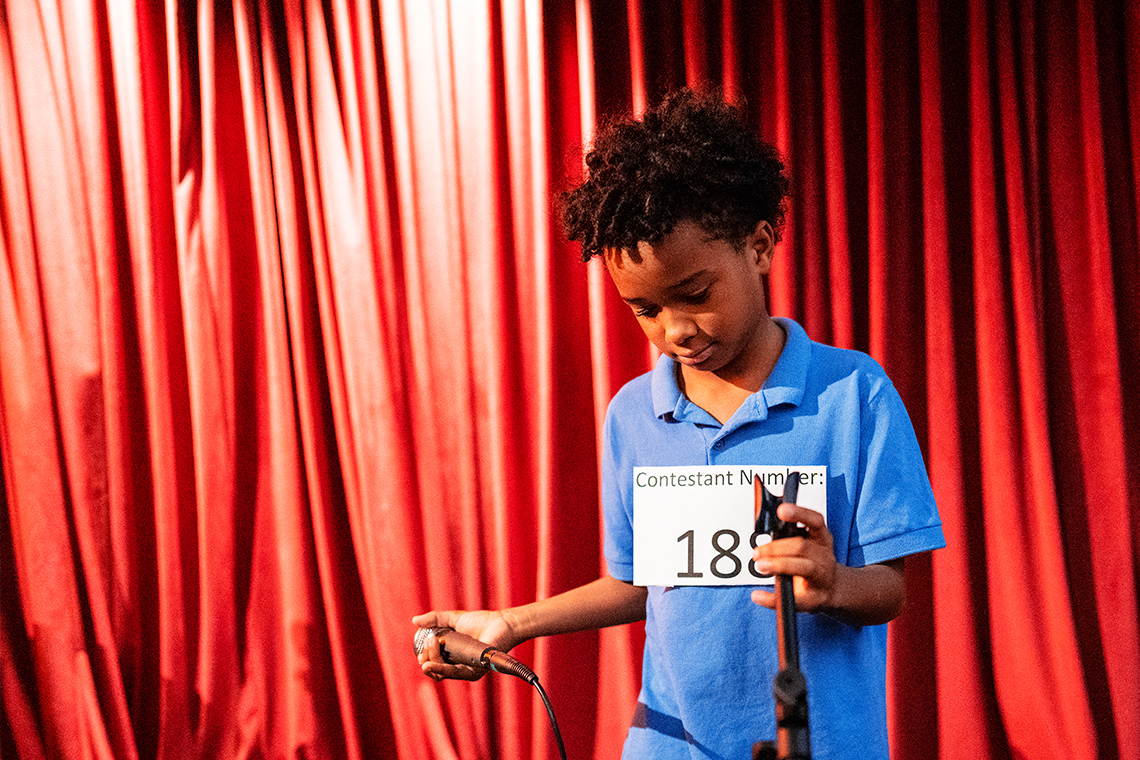
Reflect on the phrases you wrote for each image.
- Do the words you selected reflect a positive message, or a negative message?
- Do they focus on what each child fears they can’t do, or what their next steps will be?
The way we talk to ourselves reflects either a growth mindset or a fixed mindset. Our mindset and attitude towards our challenges affect our success, our mental health, and our self-image.
In this learning activity, you will learn the difference between a growth mindset and a fixed mindset, learn about people who embody a growth mindset, and practise applying this habit in your own life.

Having a growth mindset
When you face a challenge, your thoughts about yourself and your abilities affect your success.
Experts refer to this as having a growth mindset. A growth mindset means that you believe your intelligence, abilities, and talents can grow, change, and improve with effort and persistence.
A growth mindset sounds like this: “I might not be able to do this yet, but I can learn.”
The opposite of a growth mindset is called a fixed mindset. A fixed mindset means that you believe that your intelligence, abilities, and talents are fixed and cannot change.
A fixed mindset sounds like this: “I can’t do this, and I never will.”
Examine the following image showing the differences between growth mindset and fixed mindset.
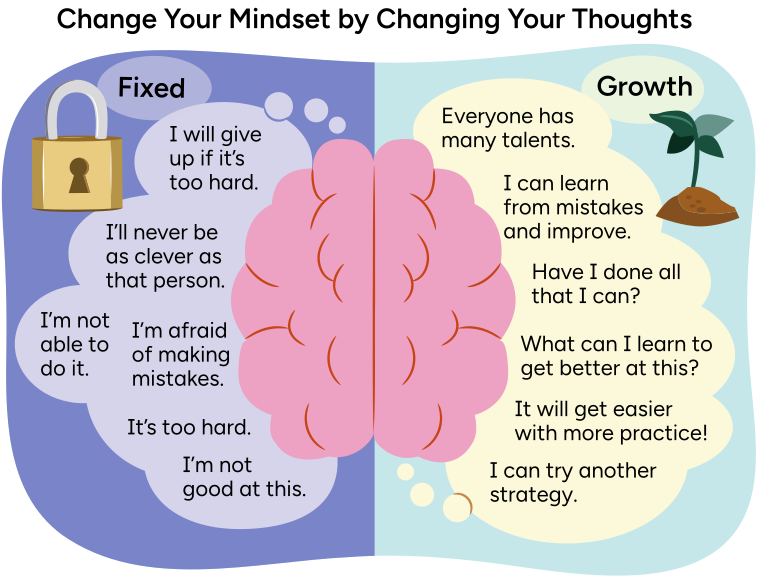
Infographic showing examples of thoughts that show a fixed mindset and examples of thoughts that reflect a growth mindset. The text: "Change your mindset by changing your thoughts" is placed at the top section of the infographic.
On the left side of the infographic, representing the fixed mindset, we have the following text: "I'll never be as clever as that person," "I'm not able to do it," "It's too had," "I'm not good at this," "I'm afraid of making mistakes," " I will give up if it's too hard." On the right side of the infographic, that representing the growth mindset, we have the following text: "Everyone has many talents," "I can try another strategy," "What can I learn to get better at this?," " It will get easier with more practice!," "I can learn from mistakes and improve," "Have I done all that I can?"
Now, let’s explore the following dialogue.
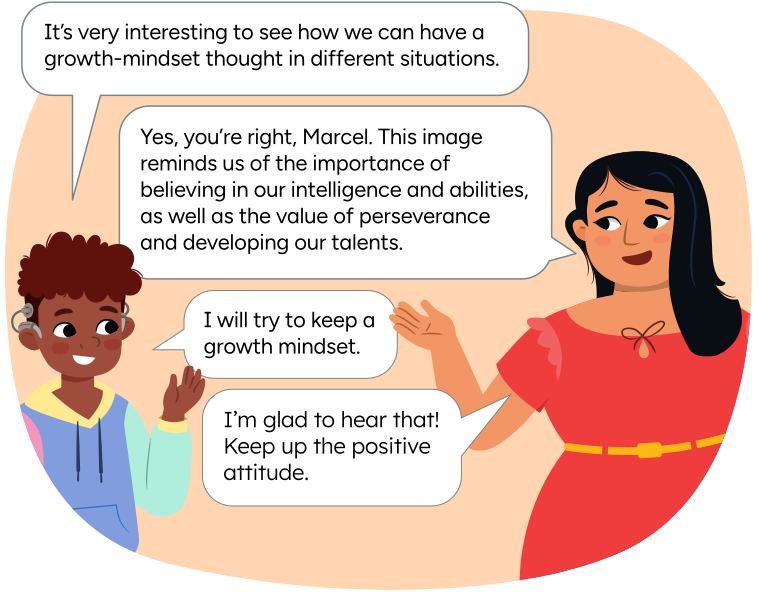
A conversation between Teacher Chiara and Marcel.
Marcel: "It's very interesting to see how we can have a growth-mindset thought in different situations.
Teacher Chiara: "Yes, you're right, Marcel. This image reminds us of the importance of believing in our intelligence and abilities, as well as the value of perseverance and developing our talents."
Marcel: "I will try to keep a growth mindset."
Teacher Chiara: "I'm glad to hear that! Keep up the positive attitude."
Let’s practise!
Can you spot the difference between a growth mindset and a fixed mindset? Sort the following statements into the column where they belong.
Place the cards into categories that best match by pressing the category in which you want to locate each card. Use the arrow buttons to navigate between cards.
Reflect...
Examine the sentences and comments that relate to either a fixed mindset or a growth mindset. Does your internal dialogue lean more towards a fixed mindset or a growth mindset? How could the statements that lead towards a growth mindset help you set goals and stay motivated when you are working through something challenging?
Write your reflections in a notebook of your choice.
The benefits of a growth mindset
Research has proven that a growth mindset benefits us in many ways! A growth mindset helps people:
- have better self-esteem
- feel less stress
- cope with change
- learn new skills
- grow with constructive feedback
- achieve higher results
Feeling proud

Do you feel proud of yourself?
Part of a growth mindset is feeling proud of yourself, no matter where you are in your progress. You can practise feeling proud of yourself. It may feel hard at first, but it is a skill that improves the more we work at it.
Practice is an important theme in the following poem by Laura Hershey.
About the author

Laura Hershey
Laura Hershey (1962-2010) was an activist who fought for the civil rights of people with disabilities and the 2SLGBTQ+ community. Hershey was born with a condition known as Spinal Muscular Atrophy (SMA) that causes muscles to continually weaken. Throughout her life, she fought for people with disabilities to be seen as full citizens with rights and capable of meaningfully participating in society. She was part of the movement to make all public spaces accessible, which led to the creation of the Americans with Disabilities Act (ADA).
As a writer, Hershey encouraged children and adults facing struggles to feel proud of themselves and to perseverein meeting their goals.

Did You Know?
Did you know?
2SLGBTQ is an acronym that stands for two-spirit, lesbian, Gay, bisexual, trans, queer, and all others who are sexually and gender diverse. 2SLGBTQ+ communities are complex and ever-changing, and although we provide some context to the acronym here, terms and identities may mean different things to different people.
Listen to the following audio recording to hear the pronunciation of this acronym.
2SLGBTQ+
Poem
As you read the poem, “You Get Proud by Practicing,” notice the following:
- How does the poem reflect a growth mindset?
- Are there any personal connections you can make to the ideas expressed in this poem?
Access the document You Get Proud by Practicing to complete the activity.
Complete You Get Proud by Practicing in your notebook or using the following fillable and printable document.
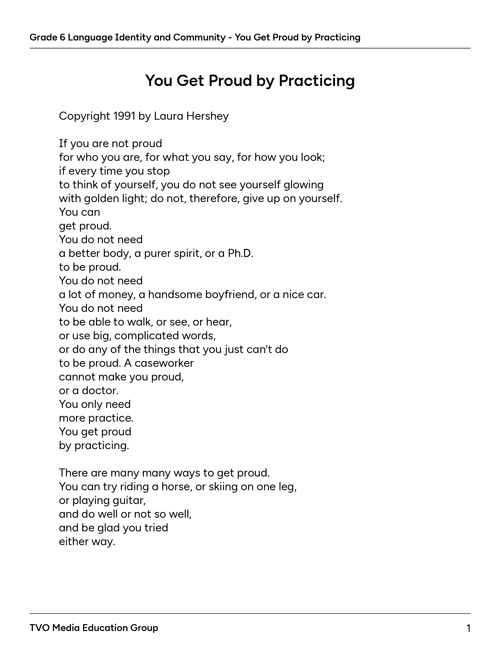
Listen to the following audio recording to hear the poem.
You Get Proud by Practicing
Source: From the Archives: Old Poem, “You Get Proud by Practicing.” (2010, June 19). Laura Hershey: Writer, Poet, Activist, Consultant. http://www.laurahershey.com/?p=340
Did You Know?
Did you notice?
Did you notice that the word “practice/practise” has two different spellings?
Look at the two sentences and try to figure out the rule:
- I have to go to my soccer practice.
- I practise piano every night.
When “practice” is a noun (for example, a soccer practice), it is spelled with a “c”.
When “practise” is a verb (for example, I practise piano), it is spelled with an “s”.
This is the rule for Canadian and British spelling. American spelling is always with a “c.”
In this learning activity, we will use the official Canadian and British spelling rules, but you may have noticed that “practice” is always spelled with a “c” in the poem, and that is because it was written by an American poet.
It is important to note that while this is the official spelling rule, many Canadians tend to use the American rule for this word, so you will often see it spelled with a “c” as a verb in Canada.
What are your thoughts on the poem? Now, let’s link your reflections about the poem to some of the themes of this learning activity.

Pause and Reflect
Post-reading questions
Answer the following questions about the poem in your notebook or using the method of your choice:
- In the poem, the author mentions superficial things people mistakenly think they need in order to feel good about themselves. What are some of them?
- The author suggests some things you can do or practise in order to feel pride. What are some of them? What are some of the things that you are proud of doing?
- According to the poem, how will practising being proud benefit you?
- How does this poem encourage a growth mindset?
When you have finished, press Sample Answers to check your understanding.
- The poem reminds people that they do not need to have possessions like money or a fancy car, or even abilities like walking, seeing, or hearing to feel proud of themselves.
- The author suggests different ways of taking smaller risks, such as riding a horse, skiing on one leg, playing a guitar, sharing something you have made with another person, saying what you think, or finding someone who will listen to you.
- The author says that all of these different practices will make you feel powerful, and feeling powerful makes you feel proud.
- The author believes that practising can make you proud and is an important part of a growth mindset.

Reading fluency practice
Select one section of the poem that feels important or meaningful to you. Practise reading it aloud with a focus on fluency. Use a mirror, recording device, or ask a partner to give feedback on your oral and non-verbal speaking strategies such as volume, pacing, facial expressions, and body language.
Let’s check!
Choose the option that best summarizes the main idea of this poem. Select the correct answer, then press Check Answer to see how you did.
The Accessibility for Ontarians with Disabilities Act
The author of the poem, Laura Hershey, was part of the movement in the United States that helped to create the anti-discriminatory laws outlined in the Americans with Disabilities Act (ADA). In Ontario, the Accessibility for Ontarians with Disabilities Act (AODA) is the document that ensures the rights, equal access, and freedom of persons with disabilities.
Check out this short video to understand the purpose of the AODA in Ontario.
Pause and Reflect
Post-viewing question
In your notebook or using another method of your choice, record your thoughts on the following question:
What is the goal of the Accessibility for Ontarians with Disabilities Act (AODA)?
When you have finished, press Sample Answer to check your understanding.
The goal of the AODA is to make Ontario accessible by 2025 by removing barriers so that people with disabilities can participate more fully in communities.
You have just done a lot of work on growth mindset and personal pride. Now is a great time to take a break before we turn to grammar!

Student Wellness
Take a break!
Time for a body break! If possible, stretch your body and move around your space.
Grammar time!

Active and passive voice
Many sentences in English can be written in either the active or the passive voice.
The active voice means that the subject of each sentence or phrase does the action of the verb. The emphasis is on the subject that is doing the action.
For example: “The cat chases the mouse.”
In this example, the cat is the subject and it is chasing the mouse (the object).
The passive voice means that the subject of the sentence is receiving the action.
For example: “The mouse is being chased by the cat.”
In this example, the mouse is the subject, and it is receiving the action (being chased by the cat).
Now, watch this short video to better understand the difference between active and passive sentences.
In general, the active voice is considered a clearer and more direct way of writing. The passive voice can be useful when you want to highlight the receiver of the action.
Let’s examine some examples written in both the active and passive voice. You’ll see that the object in the active sentence becomes the subject in the passive sentence. Note too how the verb changes.
| Active voice | Passive voice |
|---|---|
| Farshad is reading the book. | The book is being read by Farshad. |
| The dog is eating the bone. | The bone is being eaten by the dog. |
| Charlotte drives the car. | The car is driven by Charlotte. |
Your turn!
Look at the following sentences. Are they written in the active or the passive voice? Sort them into the correct category.
Place the cards into categories that best match. Use the arrow buttons to navigate between cards.

Growth mindset thinking
Revisit the captions you created for the images in the Minds On section. For each image, rewrite the caption to reflect a growth mindset.
Putting it all together
A growth mindset has many benefits. It gives us the courage to keep trying when we meet obstacles, as well as the ability to feel pride and optimism even when we are not yet experiencing success.
Consider...
Do you have a growth mindset? Perhaps you are in the very beginning stages of learning about growth mindset. Or maybe, you practise a growth mindset in some areas and are ready to expand into other areas. Reflect about yourself and the how a growth mindset works for you.
Growth mindset reflection journal
Use the following journal prompts to write a reflection journal entry about yourself, your successes, your struggles, and how a growth mindset shows up in your life. Use as many of the journal prompts as you feel are helpful.
- Do you think you generally have more of a growth mindset or a fixed mindset? Why?
- Write about a mistake you made in the past and the lessons you learned from it. Did the mistake shape who you are today?
- Consider a habit or skill that you have now that you would like to change or improve on. Why do you want to improve it? What steps could you take to make it happen?
- Think about a time when you worked to do something you felt was difficult. What did you learn about perseverance and growth mindset in that situation?
- Review the statements that encourage a growth mindset. Choose two that you can add to your
internal dialogue. Write the two statements in your journal and explain why they will be
helpful to you:
- Practice makes progress.
- I can always improve, so I’ll keep trying.
- Mistakes are a chance to learn.
- Is this my best work? How can I make it better?
- OK. I got it wrong. How can I fix it?
- Everyone is talented in many ways.
- I can try a different strategy.
- What can I learn to get better at this?
- With more practice, it will get easier!
- I can learn from mistakes and get better.
- Let’s try another way.
When you have finished writing in your journal, use the following success criteria to assess your work.
Source: Growth Mindset Writing Prompts for Students. (n.d.). The Daring English Teacher. https://thedaringenglishteacher.com/growth-mindset-writing-prompts-for/#:~:text=Growth%20Mindset%20Writing%20Prompts%20for%20the%20Classroom.&text=Write%20about%20one%20of%20the,didn't%20think%20you%20could. 5 Fun Growth Mindset Writing Activities Students and Teachers Love. (2020, December 8). Literacy Ideas. https://literacyideas.com/2020-12-9-growth-mindset-writing-activities/

Checklist: Success criteria for reflection journals
Reflection
As you read through these descriptions, which sentence best describes how you are feeling about your understanding of this learning activity? Press the button that is beside this sentence.

I feel...
Now, record your ideas using a voice recorder, speech-to-text, or writing tool.