Learning goals
We are learning to…
- understand the lived experiences of a diversity of individuals by applying critical thinking in literacy
- demonstrate an understanding of a variety of vocabulary
- draft and revise narrative texts
Success criteria
I am able to…
- analyze texts to explain ways of supporting inclusion and diversity for students with ADHD
- work with explicitly taught vocabulary in a variety of ways such as in a vocabulary notebook
- write in role using detailed text supports and make revisions to improve my writing
Thinking about neurodiversity

Student Success
Think
What is your understanding of the word diversity? How about neurodiversity?

Pause for a moment to share your current understanding of these two terms. You may record your thinking in a notebook or using another method of your choice. If possible, share your thoughts with a partner.
The word “neurodiversity” contains the prefix neuro, which is a Greek word that means “nerve” and is used in terms related to our brains or the nervous system. The base word diversity means “different” or “various.”
neuro (brain) + diversity (differences) = the many different ways that people’s brains work.
How many other words can you think of that contain the prefix neuro?
In this learning activity, we’ll explore one type of neurodivergence: attention deficit hyperactivity disorder (ADHD). You will learn what it is, some of the ways that ADHD impacts students at school, and how to create inclusive environments that support and encourage diverse identities.

Neurodiversity
Neurodiversity relates to accepting and including many kinds of minds and people, both neurotypical and neurodivergent. It means understanding that people experience and interact with the world in many ways and that there is no one correct way of thinking or being.
Explore some of this new vocabulary by matching the term to its corresponding definition.
Neurodiversity is a broad term that includes a wide range of brains. It includes people with learning disabilities, developmental disabilities, developmental disorders, mental illness, and more. You can be born with some types of neurodiversity, and some can result from a lived experience. Some types are related to physical health conditions, and some are related to mental health conditions.
Neurodiversity is a part of being human. It needs to be supported, celebrated, and normalized to make communities, schools, and workplaces safe and inclusive for all identities.
Exploring the neurodivergence of ADHD
As discussed, the term neurodivergent describes someone whose brain works differently from what society considers typical or standard. One example of a neurodivergence is ADHD.
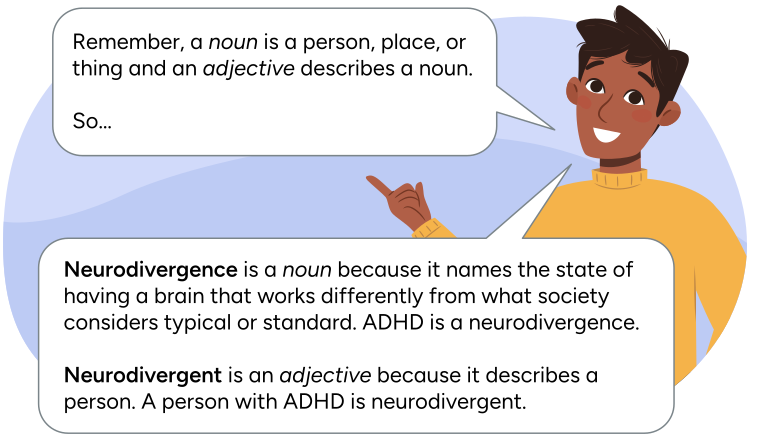
A teacher is speaking.
The teacher says, remember, a noun is a person, place, or thing and an adjective describes a noun. So…
Neurodivergence is a noun because it names the state of having a brain that works differently from what society considers typical or standard. ADHD is a neurodivergence.
Neurodivergent is an adjective because it describes a person. A person with ADHD is neurodivergent.
The term ADHD stands for attention deficit hyperactivity disorder. The word disorder in ADHD can give us a clue about what this term means. By adding the prefix “dis” to the word “order,” we change the meaning to “not in order” or “out of typical order.”
ADHD can look different for every person who is diagnosed with it. In general, people with ADHD struggle to regulate (or control) their levels of attention, activity, impulses, and emotions.
Press the following tabs to explore some more information about ADHD.
- ADHD is a disorder of the brain.
- ADHD occurs in both children and adults.
- ADHD can present differently in individuals, and its symptoms can vary in different genders.
- ADHD is not the result of laziness or not trying hard enough.
- ADHD is not something that is outgrown.
- ADHD is not something that everyone “has a little bit of.”
The strengths of ADHD
Advocates for ADHD are concerned that the word deficit can create negative stereotypes about people with ADHD.

Try it
Try it!
What does the word deficit mean? How might you find the meaning of the word?
You could:
- use context clues in the text
- try to break down the word (if possible) into bases, prefixes, and suffixes
- make connections to how you’ve seen the word used in other texts or other subjects
- use a reference tool like a dictionary or thesaurus to find its definition or synonyms
Deficit means having less of something than you need or expect. Because of the definition of this word, the neurodivergence ADHD can inaccurately be connected to negative characteristics.
Just as ADHD brings challenges, it also brings strengths. Here are some of the strengths that individuals with ADHD might have.
- curiosity
- creativity
- perseverance
- attention to detail
- innovation
- passion about interests
Building vocabulary
Many vocabulary/key terms have been used in this learning activity so far. Whether you’ve heard these terms before or not, working with important vocabulary or “key terms” is a very useful tool in building our understanding of new topics and texts.
To understand a new word or term, it’s not enough for us to just read a definition. To really understand, our brains need to think about it in different ways.
Vocabulary: Key terms
Choose one of the following graphic organizers, or another method of your choice, to record the following vocabulary terms and explore more about their meanings:
- neurodiversity
- neurotypical
- neurodivergent
- neurodivergence
- disorder
- deficit
Feel free to add any other terms that you come across that you would like to understand better.
Complete the fillable and printable Graphic Organizer 1: Personal Dictionary or Graphic Organizer 2: Frayer Model in your notebook or using the following documents. If you would like, you can use speech-to-text or audio recording tools to record your thoughts.
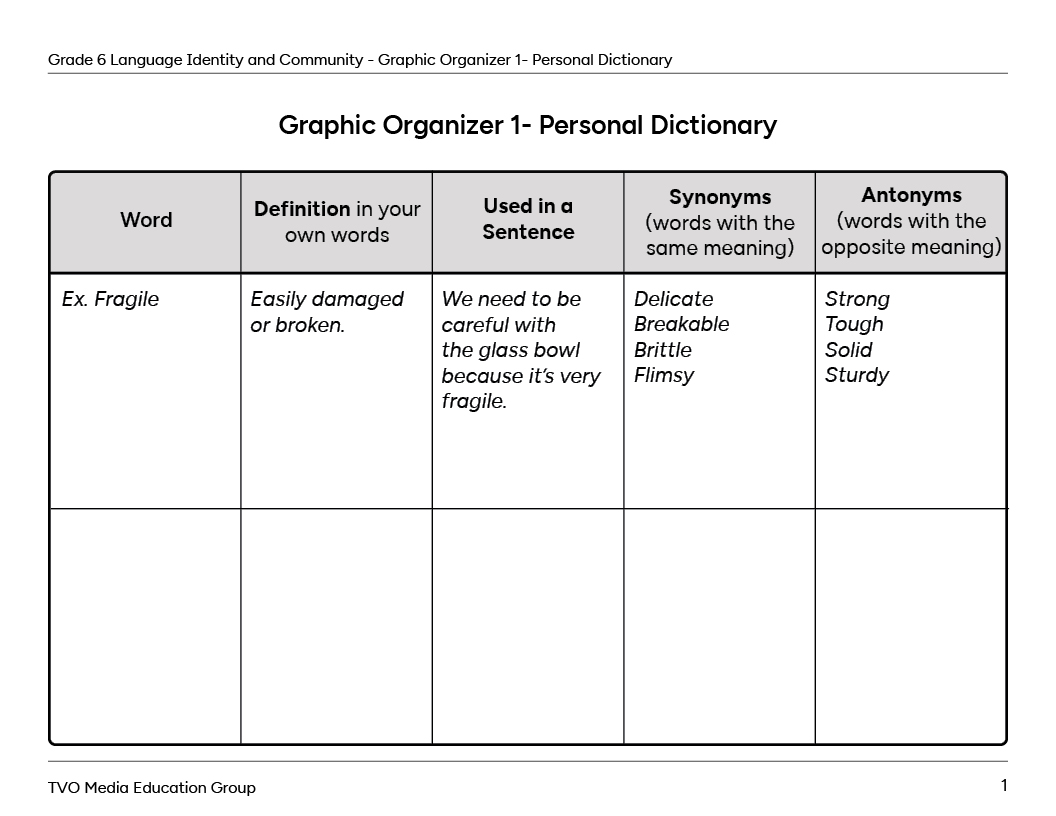
Press the Activity button to access the Graphic Organizer 1: Personal Dictionary.
Activity(Opens in a new tab)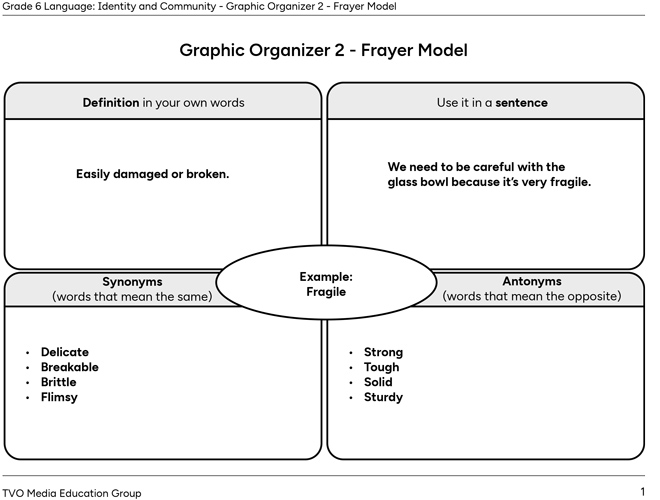
Press the Activity button to access the Graphic Organizer 2: Frayer Model.
Activity(Opens in a new tab)What is it like to have ADHD?
Read the following CBC Kids article titled “FIRST PERSON – How I’m Managing High School While Having ADHD.” In this profile, Rian shares his experiences of managing high school with ADHD as well as a learning disability. As you read, consider adding words that are new to you to your vocabulary notebook.
Access the document FIRST PERSON – How I’m Managing High School While Having ADHD.
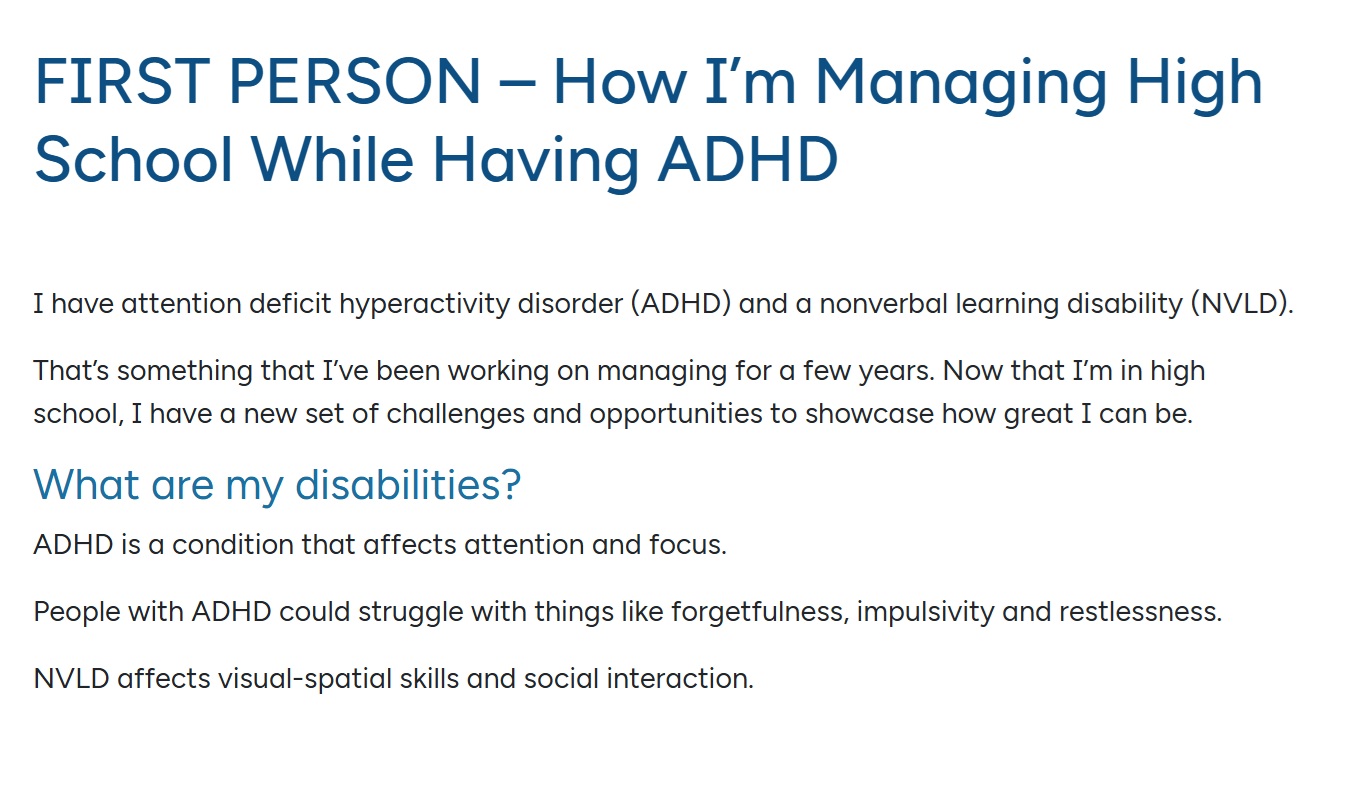
Press the Activity button to access the FIRST PERSON – How I’m Managing High School While Having ADHD.
Activity(Opens in a new tab)
Pause and Reflect
Post-reading questions
In a notebook or using another method of your choice, answer the following questions. If possible, share your thoughts with a partner.
- What are some of the challenges Rian faces in school?
- What are some strategies that help him experience success in school?
- This article is written from Rian’s point of view, which is a first-person perspective. With a first-person perspective, the narrator recounts their personal experiences, opinions, and feelings using words like I, me and my. Why is it important that this article is written from a first-person perspective?
You have just done a lot of work on neurodiversity and ADHD. Now is a great time to take a break before we turn to review narrative texts from a book!

Student Welness
Take a break!
Time for a body break! If possible, stretch your body and move around your space.
Literary focus: Jude saves the world
It’s important to remember that identity is a combination of all of the things that make someone who they are. No single part of identity is the whole story of who someone is. Having ADHD is just one part of an individual’s identity.
In the book Jude Saves the World by Ronnie Riley, the protagonist Jude is a non-binary kid in grade seven navigating middle school friendships, family, and ADHD. Jude uses they/them/their pronouns.
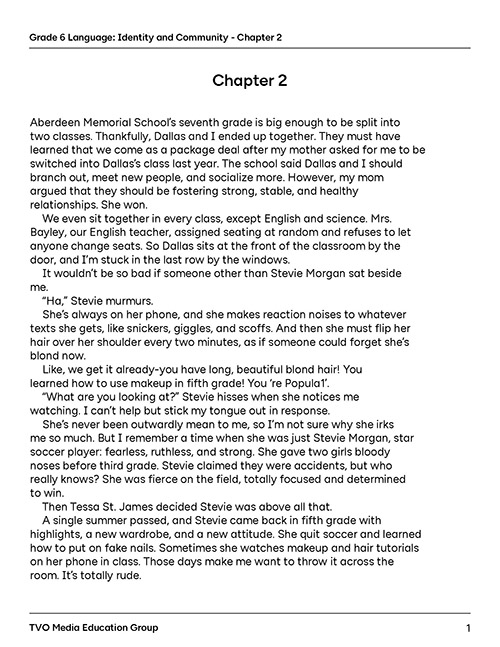
Chapter 2
In Chapter 2 of the book, we are introduced to Jude and their best friend Dallas, as well as some of the ”popular” kids in school. As you read this chapter, ask yourself how Jude’s ADHD impacts their experiences in class.
Access Chapter 2 to complete the activity.
Source: Jude Saves the World. (2023, April 18). Scholastic Canada. https://www.scholastic.ca/our-books/book/jude-saves-the-world-9781338855876

Did You Know?
Did you notice?
This chapter contained the idiom “Her phone is blowing up with messages.” An idiom is an expression that means something very different from the literal meaning of the words. For example, saying that something is “a piece of cake” means that it is very easy. Saying something “costs an arm and a leg” is a way of saying it's very expensive.
What does the idiom “a person’s phone is blowing up” mean?
Write down your answer, or record it using the method of your choice. Then press Sample Answer to check your thinking.
The idiom “blowing up your phone” means that a person is receiving lots of messages or notifications on their phone.
What are your thoughts after reading this chapter?
Pause and Reflect
After reading
In a notebook or using another method of your choice, respond to the following prompts. If possible, share your thoughts with a partner.
- Provide 1-2 key details about each of the following characters: Jude, Dallas, Stevie, and Tessa.
- Before Jude mentions they have ADHD, what clues in the text suggest this fact?
- Provide 2 pieces of evidence from the text that show how Jude feels about their ADHD diagnosis.
- Describe something you learned about Jude’s ADHD in this chapter.

Fluency routine
When reading aloud, it is important to adjust your expression and intonation to match the purpose of reading. When reading dialogue, you can try to match your expression to what you know about the character such as their mood, motivation, thoughts, and feelings.
Let's try!
Re-read the end of chapter 2 where Dallas and Jude speak after class.
Next, read the same conversation out loud and try to adjust your expression and intonation to communicate the different dialogue for each character.
If possible, complete this task with a partner.

Let’s check!
Let’s check your understanding of ADHD and neurodiversity. Start by completing the following multiple-choice questions about ADHD. Select the correct answer, then press Check Answer to see how you did.
Now, think about the importance of being aware of different types of neurodivergence.
Student Success
What’s your opinion?
In a notebook or using another method of your choice, reflect on the following:
Why is it important for people to be aware of and know about different types of neurodivergence?
Putting it all together
Using a method of your choice, write a first-person journal or diary entry. Take on the role of a friend of someone with ADHD. Recount a scenario where you helped your friend advocate for their needs or inclusion. Consider using specific examples from Rian’s account or from the book Jude Saves the World of supports that were needed or challenges that were faced.
To explore some suggestions on building your character’s perspective, press Tips.
When considering characterization on a deeper level, you can think about:
- what a character thinks or feels
- what a character says
- what a character does
- what other characters think of the character, or how they respond to the character
- who or what influences and motivates the character
- the names of traits that best fit this character or the values they represent
Write a first draft, then work on revising your writing.
Revising is different from editing. In the editing stage, we make corrections to our writing. In the revising stage, we change or make improvements to our writing. The acronym ARMS can help us remember the steps involved in revising. Check out the following image that explains the acronym ARMS.
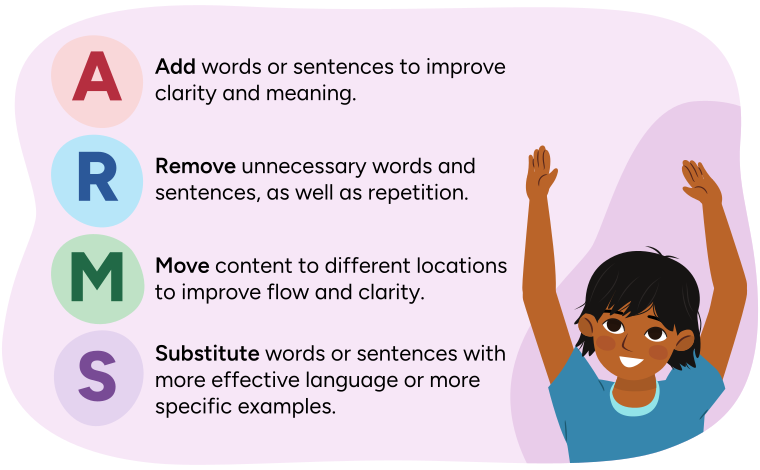
Illustration explaining the ARMS acronym.
A, add words or sentences to improve clarity and meaning.
R, remove unnecessary words and sentences, as well as repetition.
M, move content to different locations to improve flow and clarity.
S, substitute words or sentences with more advanced language or more specific examples.
After you have done a first pass of revising your own work, if possible, have someone else read it and make suggestions. Getting someone else’s opinions and perspectives can help you grow and develop your skills as a writer.
Reflection
As you read through these descriptions, which sentence best describes how you are feeling about your understanding of this learning activity? Press the button that is beside this sentence.

I feel...
Now, record your ideas using a voice recorder, speech-to-text, or writing tool.