Learning goals
We are learning to…
- demonstrate an understanding of the historical contexts, contributions, lived experiences, and perspectives of a diversity of individuals and communities, including those in Canada, by exploring and analyzing the concepts of identity, self, and sense of belonging in a variety of culturally responsive and relevant texts
- analyze themes explored in First Nations, Métis, and Inuit cultures to demonstrate an understanding of the varied identities, perspectives, relationships, legacies, truths, and ways of knowing, being, and doing
- read, listen to, and view various forms of texts by diverse First Nations, Métis, and Inuit creators to make meaning through Indigenous Storywork about First Nations, Métis, and Inuit histories, cultures, relationships, communities, groups, nations, and lived experiences
- draft complex texts of various forms and genres, including narrative, expository, and informational texts, using a variety of media, tools, and strategies
Success criteria
I am able to…
- explore the historical context of Indigenous peoples and colonizers and make connections when exploring texts created by Indigenous authors
- analyze themes, such as ways of knowing, being, and doing, and caring for the land, when engaging with Indigenous texts, and respond to reflection questions while making connections between the two texts
- draft a piece of writing (choice of three) – essay, personal reflection, creative story- about Indigenous ways of caring for the land
- analyze the importance of reading texts by Indigenous authors that reflect historical contexts and lived experiences

What do you know?
Wilfred Buck is an Indigenous Knowledge Keeper of the Opaskwayak Cree Nation in Northern Manitoba. He is the author of two books about Cree star Knowledge and perspectives.
Begin by exploring the following video by Wildfred Buck about the importance of Indigenous Knowledge.

Pause and Reflect
Pause and reflect
- Reflecting on Wilfred Buck’s words, why is it important to learn from Indigenous ways of knowing, being, and doing?
- What was the main message Wilfred Buck was conveying?
Record your ideas in a method of your choice.
Exploring historical contexts
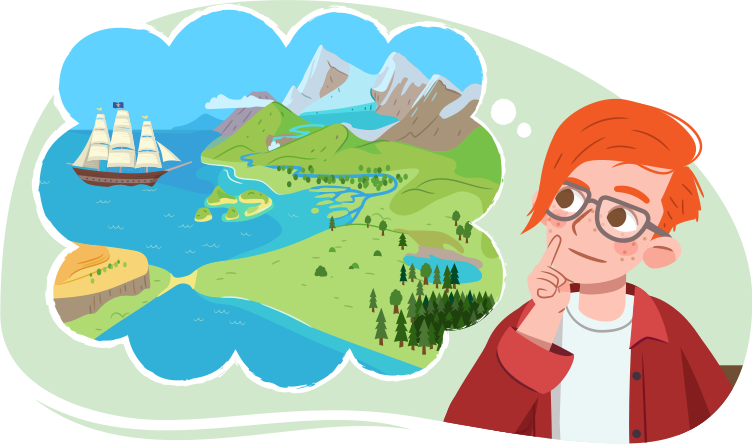
Since time immemorial, Indigenous Peoples have lived on the land that we know today as Canada. Connection with the land is foundational to Indigenous Peoples, and each Nation or community holds unique worldviews, knowledge, and stories connected to their environment and territories.
While it is hard to address a complex history in a matter of a few sentences, it is helpful to have some understanding of the history of colonization to understand how it has impacted Indigenous Peoples and their complex knowledge systems.
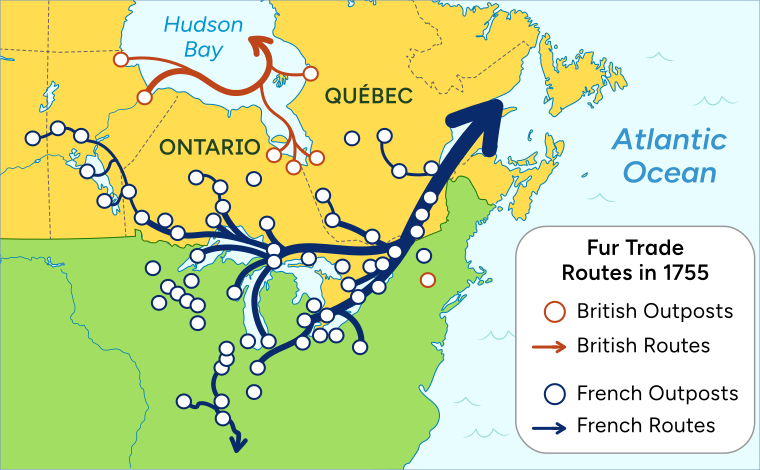
Beginning in the 1600s, people from other places in the world, predominantly from Europe, travelled to what is now commonly referred to as North America hoping to find natural resources, trade routes and partners, and a better way to live. These people were called settlers.
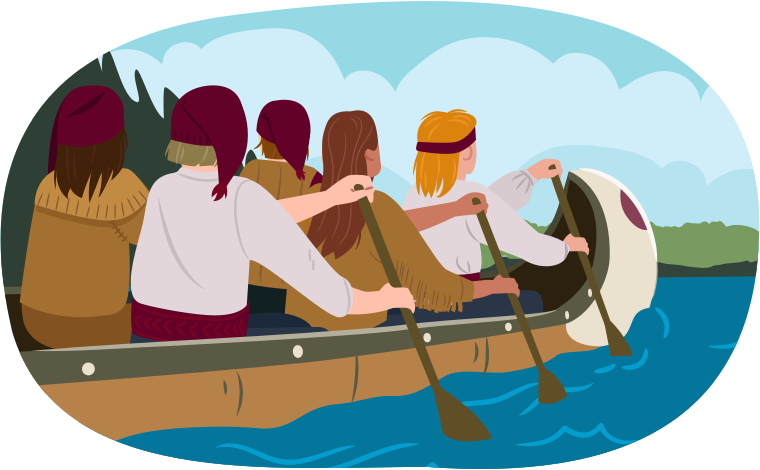
As settlers arrived in Canada, they relied heavily on the experiences and expertise of Indigenous Peoples, including their knowledge of the land. Indigenous Peoples taught them how to live off the land including how to hunt, fish, navigate the land and waterways, and even survive in the harsh winters.
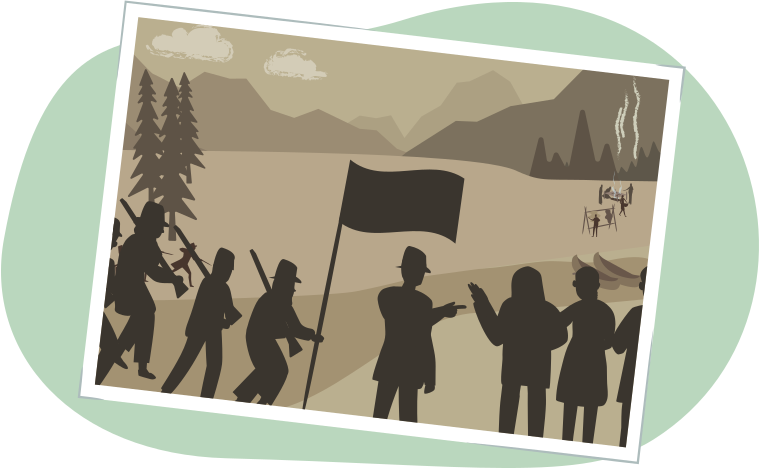
Many Indigenous Peoples died from diseases contracted from contact with settlers and so their communities were weakened. Over time, settlers began to claim the land as their own, taking it and its resources away from Indigenous communities, forcing them to relocate, and then making the lands look more like their own in Europe. This process is called colonization.
In 1876, the Indian Act was created. This legislation (law) determines First Nations identity, rights, and governance in Canada to this day. Included in the Indian Act was the ruling that Indigenous children were to be removed from their communities to attend residential schools and learn only through a western education system. This disrupted Indigenous traditions of passing down knowledge and ways of being and doing from generation to generation.
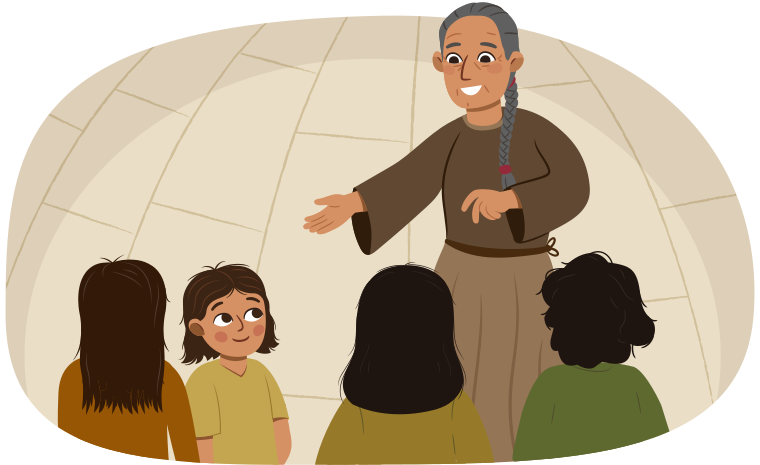
Relationships and connections to the land are critical in Indigenous ways of knowing, being, and doing. Indigenous knowledge systems teach the importance of showing gratitude and reciprocity to the land for what it provides, help each individual understand their roles and responsibilities towards the land and to their communities, and is crucial for current and future generations. Colonization disrupted this process for generations of Indigenous Peoples and their communities.

Student Success
Let’s check!
In a notebook, or using another method of your choice, complete the following summary:
- In your own words, summarize some of the impacts of colonization on Indigenous Peoples in Canada.
Exploring texts by Indigenous authors
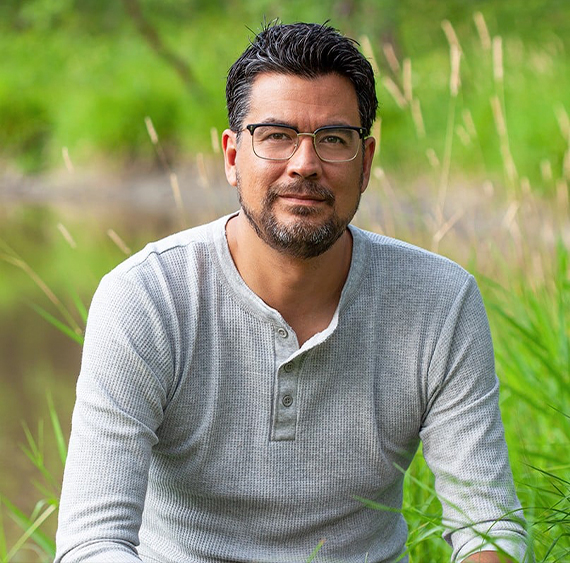
David A. Robertson
David A. Robertson is a member of Norway House Cree Nation and lives in Winnipeg, Manitoba. He is a podcaster, public speaker, social advocate, and an award-winning author of more than 25 books for children and adults, as well as several short stories.
His writing reflects Indigenous cultures, histories, and communities, and covers real-life topics such as the residential school system, mental health, and environmental sustainability.
Explore the following quote from a Raven Reads video featuring author David A. Robertson:
“…It’s my hope that the books I write, help others understand Indigenous people; what we have been through, what we are going through, and how proud, strong, and resilient we are.
I write about the land. It’s the blood that flows through my work and gives it life. It’s
become another home to me, like it was to my father. It’s become a place I want to
protect and honour. To remind us of the way things used to be, and how to reclaim what
we lost. Writing stories, reading stories is an act of reclamation…”
- David A. Robertson
Pre-reading: The Barren Grounds
David A. Robertson’s book The Barren Grounds is the first book in The Misewa Saga series.
Begin by exploring the cover of the book and the publisher’s summary of it. What do you notice, what do you wonder?
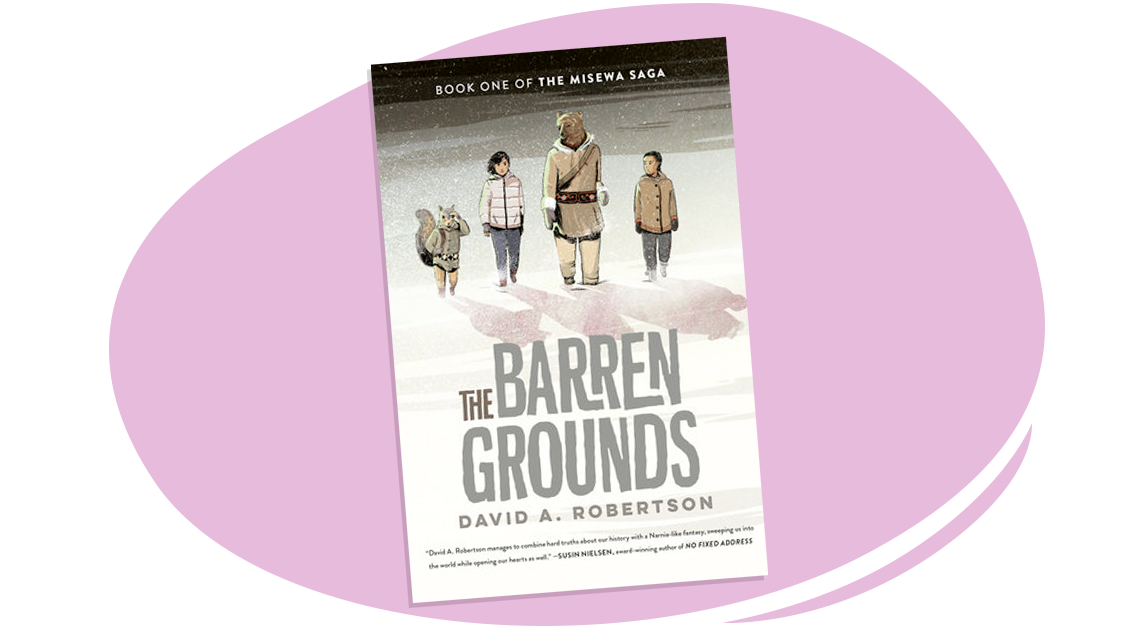
“Morgan and Eli, two Indigenous children forced away from their families and communities,
are brought together in a foster home in Winnipeg, Manitoba. They each feel disconnected,
from their culture and each other, and struggle to fit in at school and at their new home
– until they find a secret place, walled off in an unfinished attic bedroom. A portal
opens to another reality, Askí, bringing them onto frozen, barren grounds, where they meet
Ochek (Fisher). The only hunter supporting his starving community, Misewa, Ochek welcomes
the human children, teaching them traditional ways to survive. But as the need for food
becomes desperate, they embark on a dangerous mission. Accompanied by Arik, a sassy Squirrel
they catch stealing from the trapline, they try to save Misewa before the icy grip of winter
freezes everything – including them.”
Based on the book cover and the summary of the story, make three predictions about this book. Record your predictions in a notebook or using another method of your choice. You may use the following prompts to guide your thinking.
- Why do you think the term barren grounds means and why is it so significant to the story that the author used it as the title of the book?
- Why do you think the mission that they go on would be described as dangerous? What do you think might happen on this mission?
- How do you think Morgan and Eli will be impacted personally by their journey in the alternate reality of Aski?

New vocabulary
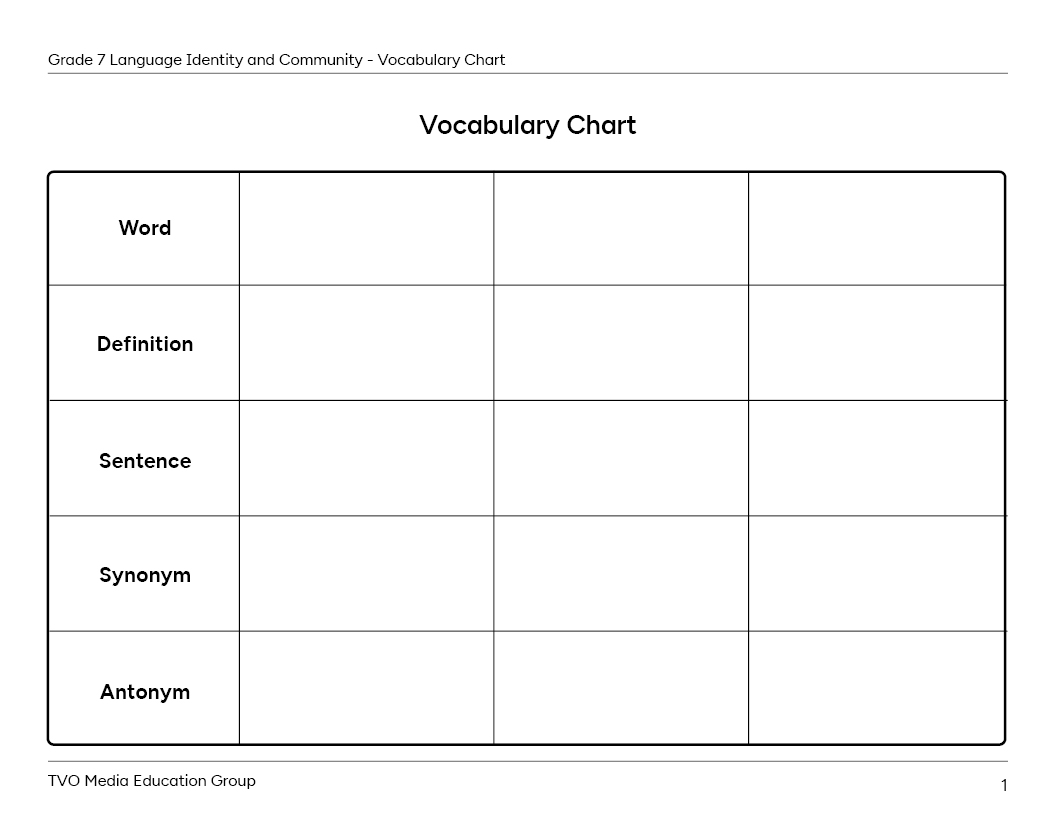
Before you explore the text, review the following list of vocabulary words that you will come across. Choose three words from the list and complete the vocabulary chart in your notebook or using the graphic organizer provided. For each word, you need to include:
- A definition for the word.
- A sentence that uses the word correctly.
- Two synonyms for the word (words that mean the same).
- One antonym for the word (word that means the opposite).
Word list:
- barren
- arduous
- plentiful
- snare
- forage
- gaunt
- dwindle
- shuttered
Complete the Vocabulary Chart in your notebook or using the following fillable and printable document. If you would like, you can use speech-to-text or audio recording tools to record your thoughts.
Exploring and connecting with The Barren Grounds
As you explore the following excerpt from the book The Barren Grounds, think about how it connects to the historical context that you reviewed at the beginning of the Action section. Up to this point in the book, Morgan and Eli have opened a portal to Aski, and Ocheck has saved them from the barren grounds.
Read chapter 12 of The Barren Grounds by David A. Robertson.
Access the following Chapter 12 Excerpt from The Barren Grounds to complete the activity.
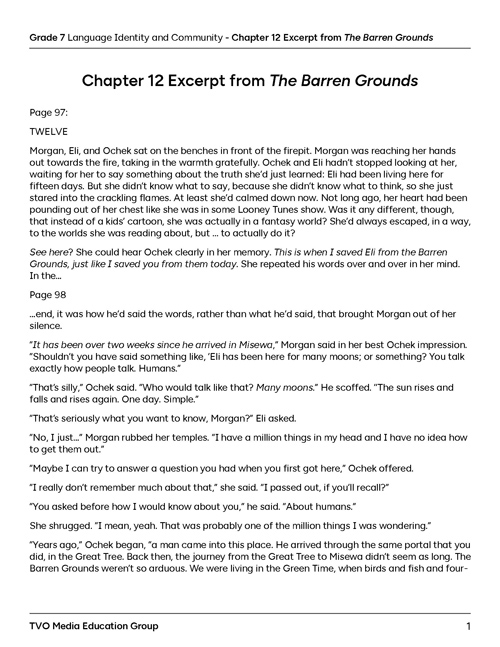
Press the Activity button to access the Chapter 12 Excerpt from The Barren Grounds.
Activity(Opens in a new tab)
Pause and Reflect
Post-reading: Analyzing the text
Respond to the following reflection questions in your notebook or using another method of your choice. If possible, discuss your ideas with a partner.
- How does the novel showcase the relationship between Indigenous Peoples and the land?
- How does the novel depict the struggle to preserve Indigenous ways of knowing, being, and doing, in the face of colonization?
- How can reading The Barren Grounds change or deepen someone’s understanding of Indigenous experiences and perspectives?
- Why is it important that authors like David A. Robertson reclaim Indigenous knowledge systems and feature them in their books? What impact could this have for young Indigenous readers, and all readers, alike?
On several occasions, The Barren Grounds highlights the importance of taking care of the land. Read the following quote from the book.
“The land provides everything that anybody would need. If you take only what you need,
the land renews itself so that it can provide more. Medicines, water, plants, meat. In
exchange, because we don’t really have anything the land wants, we honor it for what it
gives us … when you take more than the land can provide, it stops giving. It can’t
give.”
- The Barren Grounds - by David A. Robertson, pg. 190
Robertson, D. (2024). The Barren Grounds. Thorndike Press, a part of Gale, a Cengage company. pp. 190.
Answer the following questions:
- What do you think this quote means?
- Why is it important?
Record your ideas orally, in your notebook, or using another method of your choice.
Press the Hint button to learn more.
Throughout the novel, David A. Robertson centers the theme of the importance of taking care of the land and respecting the natural world. The novel emphasizes the interconnectedness of humans, animals, and the land, highlighting the belief that all living things are part of a larger ecosystem. In the novel, Indigenous characters possess traditional knowledge that is passed down through generations, including the understanding of seasonal cycles, harmony with nature, and resource management (not taking more than you need). This is a key component of Indigenous ways of knowing, being, and doing.
Braiding Sweetgrass for Young Adults
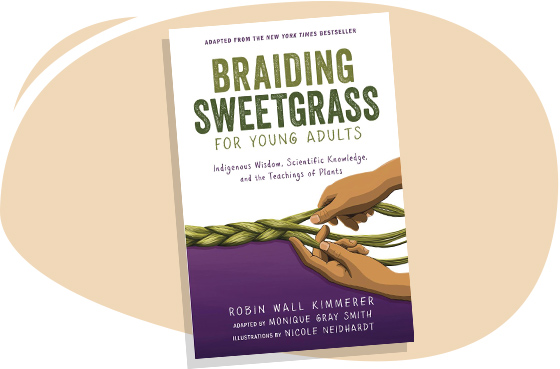
Braiding Sweetgrass for Young Adults is a book written by Anishinaabe scientist, author, and professor Robin Wall Kimmerer, who is a member of the Citizen Potawatomi Nation. The text combines Indigenous wisdom and scientific knowledge to highlight the importance of connections with the land, the plants, and the environment.
Explore the following excerpt from the section of the book called “Picking Sweetgrass: The Honourable Harvest”. In this section, the author shares Indigenous teachings for harvesting from the land.
Picking Sweetgrass: The Honourable Harvest
The Principles
The Indigenous canon of principles and practices that I’ve been taught and that govern the exchange of life for life is known as the Honorable Harvest. They are rules of sorts that we follow so that the world might be rich for the seventh generation as it is for our own. The Honorable Harvest governs our taking, shapes our relationships with the natural world, and reins in our tendency to consume.
While the details might be different in various cultures and ecosystems, the fundamental principles are nearly universal among people who live close to the land. The guidelines for the Honorable Harvest are not written down or even consistently spoken of as a whole- they are reinforced in small acts of daily life.
But if you were to list them, they might look something like this:
Know the ways of the ones who take care of you, so that you may take care of them.
Introduce yourself. Be accountable as the one who comes asking for life.
Ask permission before taking. Abide by the answer.
Never take the first. Never take the last.
Take only what you need.
Take only which is given.
Never take more than half. Leave some for others.
Harvest in a way that minimizes harm.
Use the harvest respectfully. Never waste what you have taken.
Share.
Give thanks for what you have been given.
Give a gift in reciprocity for what you have taken.
Sustain the ones who sustain you and the earth will last forever.
- Braiding Sweetgrass for Young Adults by Robin Wall Kimmerer, pg 155-156
What do you think?
Respond to the following reflection questions using a method of your choice.
- What guideline(s) speaks to you the most? Why?
- How do you think the guidelines for “the Honorable Harvest” connect with themes or content in The Barren Grounds?
- How do both books connect with and help restore Indigenous knowledge systems?

Focus on Grammar: Appositives
An appositive is a second noun, phrase or clause placed beside another noun to explain it more fully.
Rule: When an appositive is essential to the meaning of the noun it belongs to, don’t use commas. When the noun preceding the appositive provides sufficient identification on its own, use commas around the appositive.
Explore some examples in the following carousel.
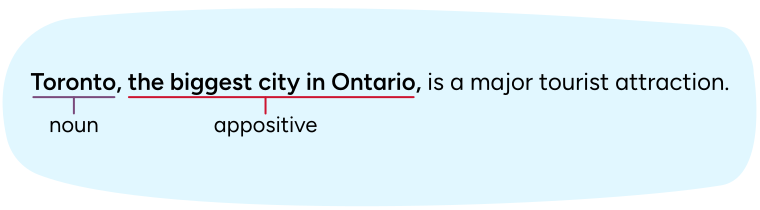
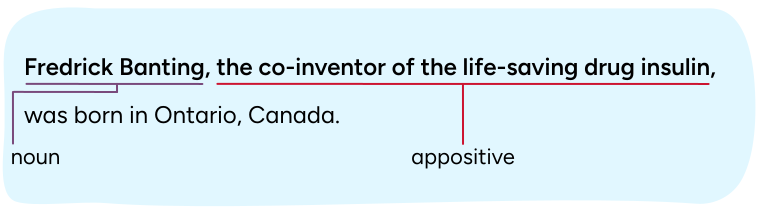
| Dos of Using Appositives | Don’ts of Using Appositives |
|---|---|
|
Example: |
Using The Barren Grounds as your source of information, match the following words with the appositive that describes it.
Choose two of the appositives you’ve just identified and turn them into complete sentences about the book, The Barren Grounds. Don’t forget to use your commas to set off the appositive!
When you’re done, press the Possible Answers button to review some modeled responses.
- Morgan, a brave Indigenous girl in foster care, was unsure about her journey in Misewa.
- Ochek, a determined Fisher, knew that they had to retrieve the summer birds to save Misewa.
- The Council, an owl, a bear, and a turtle, gave them permission to go on the journey.
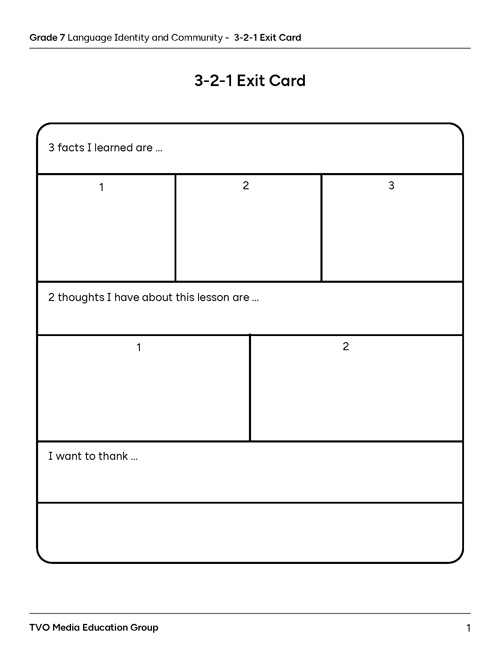
Putting it all together
Begin by reflecting on your learning. You will be responding to the following prompts:
- 3 facts I learned are …
- 2 thoughts I have about this lesson are…
- 1 question I still have is …
Use the fillable and printable 3-2-1 Exit Card document, or your notebook. If you would like, you can use speech-to-text or audio recording tools to record your thoughts.
Reflecting on the land
Reflect on what you’ve learned from examining the historical context of colonization, and importance of texts like The Barren Grounds, and Braiding Sweetgrass for Young Adults at restoring Indigenous knowledge systems. Choose one of the following writing activities to complete in your notebook or digitally. Press the following tabs to explore your choices.
Write a letter to one of the authors and explain why their work is important to restoring Indigenous knowledge systems and reclaiming Indigenous identity.
Write a poem or person reflection that explores your own connection with land and nature and how you might take action to protect the land for future generations.
Write an informational essay that explores Indigenous ways of knowing, being, and doing in regard to environmental stewardship and traditional knowledge that guides environmental practices and help solve climate change. You may want to conduct additional research.
Reflect
Respond to the following reflection questions in a method of your choice.
- Why do you think it is important to learn from texts written by Indigenous authors?
- How did understanding the historical context of Indigenous Peoples and colonization help you better understand and make connections when reading the text?
- According to Indigenous ways of knowing, being, and doing, what relationships should humans have with the land? How can we take care of the land? Use evidence from both texts that supports your answer.
Reflection
As you read the following descriptions, select the one that best describes your current understanding of the learning in this activity. Press the corresponding button once you have made your choice.

I feel...
Now, expand on your ideas by recording your thoughts using a voice recorder, speech-to-text, or writing tool.
When you review your notes on this learning activity later, reflect on whether you would select a different description based on your further review of the material in this learning activity.