Learning goals
We are learning to…
- demonstrate an understanding of how to navigate online environments safely, manage privacy, personal data, and security, and interact in a way that supports well-being for self and that of others, including seeking appropriate permission
- identify the purpose and audience for speaking, and create an oral presentation focusing on speaking strategies, verbal and non-verbal communication, and word choice and voice
- analyze text patterns, such as cause and effect in an expository text, and text features, such as a bibliography and accessible fonts, associated with various text forms, including cultural texts, and explain how they help readers, listeners, and viewers understand the meaning
- classify and sequence ideas and collected information, using appropriate strategies and tools, and identify and organize relevant content, taking into account the chosen text form, genre, and medium
Success criteria
I am able to…
- understand the impacts of cyberbullying and ways that I can help if someone I know is being cyberbullied, if I witness cyberbullying, or if I am being cyberbullied
- analyze texts on cyberbullying to provide advice on next steps for those experiencing cyberbullying
- create an awareness campaign (oral presentation and media piece) to educate others about cyberbullying
- create a personal plan for cyberbullying and a blog post to share my knowledge

Statistics about cyberbullying

In this learning activity, you are going to be exploring cyberbullying, which refers to the specific type of bullying that occurs online. Bullying includes any effort to hurt, embarrass, mock, or threaten another person, so when this kind of harassment takes place on the Internet, it can be extremely complicated and difficult to resolve the situation without a certain amount of digital literacy.
Let’s begin by exploring the following statistics about cyberbullying in Canada.
- 25% of youth, aged 12-17, report being cyberbullied in the past year.
- 15-35% of youth confront their cyberbullies and ask them to stop.
- Nearly 75% of parents say cyberbullying stopped after they took action.
- 20% of cyberbullying incidents are reported to the police.
Of these statistics, what surprised you the most? Why?
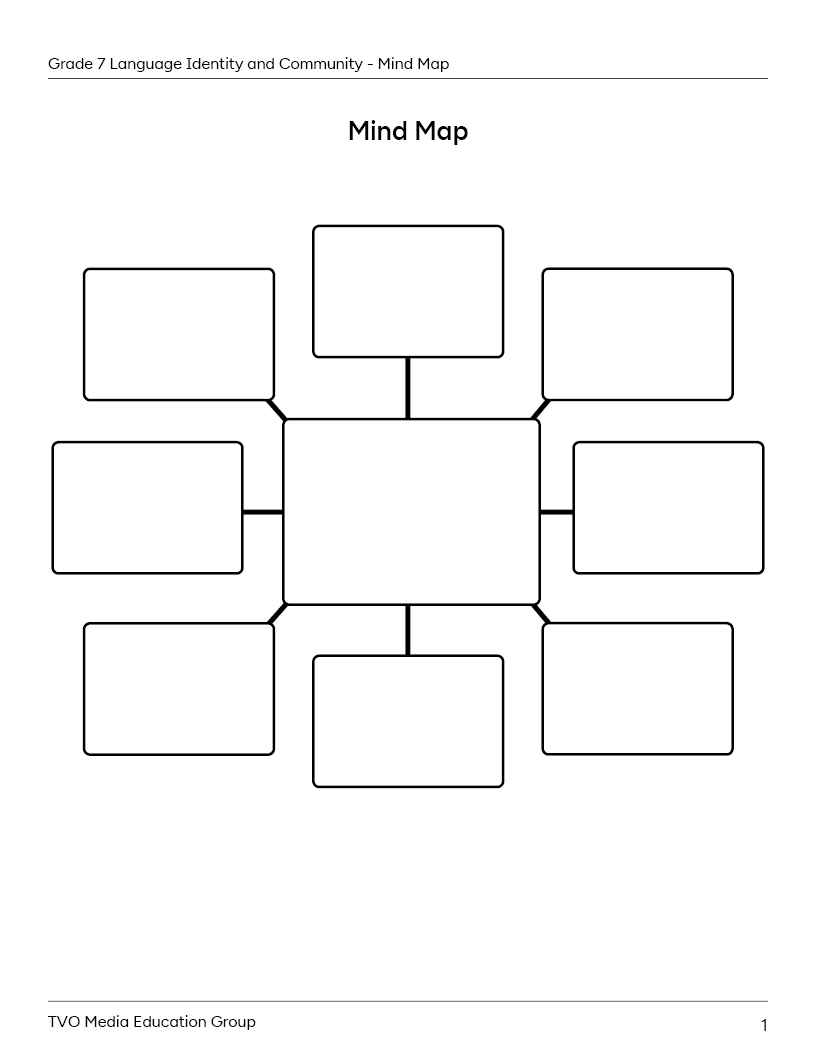
How do you think cyberbullying might affect someone? Record your ideas using the mind map provided, or in another method of your choice.
Complete the fillable and printable Mind Map in your notebook or using the following document. If you would like, you can use speech-to-text or audio recording tools to record your thoughts.

Cyberbullying: impact and prevention
Cyberbullying is the use of technology to harass, threaten, embarrass, or target another person. This includes text messages, emails, social media apps, and much more.
Cyberbullying can take many forms, including:
- spreading rumours
- threatening someone
- creating fake accounts
- sharing private information
- posting hurtful comments
- excluding someone from online groups or chats on purpose
Let’s begin by exploring an infographic about bullying and cyberbullying.
Press Infographic Definition button to review what an infographic is.
An infographic is a “visual representation of data that is intended to make the data easy to understand and typically includes a combination of charts, diagrams, illustrations, and text, along with graphic design elements.”
Infographics contain several different text features to help viewers understand and find important information. Explore some examples of text features in the following interactive.
You may wish to record these text features in your notebook.
Next, you will be exploring an infographic on bullying. As you explore, consider what text features you notice and how they help you find important information and better understand the content.
Access the following Bullying Infographic to learn more.
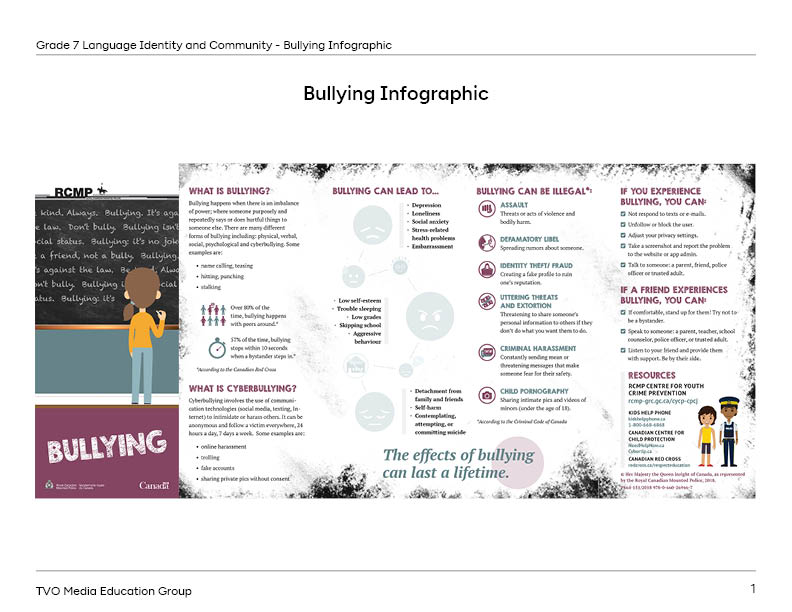
Based on the infographic, respond to the following true or false questions. Select the correct answer, then press Check Answer to see how you did.

Pause and Reflect
Pause and reflect
Respond to the following reflection questions in a method of your choice.
- What stands out to you the most on the infographic? Why do you think this stands
out to you the most?
- How can the bolded, capitalized, purple headings help you easily locate information?
- What resources were consulted when making this infographic? How do you know?
Often, cyberbullying is easier to commit because the person who is bullying does not have to confront their target face to face. Online, a lot of the emotions are taken out of the situation as both people or groups of people cannot see each other, and so cannot see the emotional reaction to things.
Check out the following video to learn more.
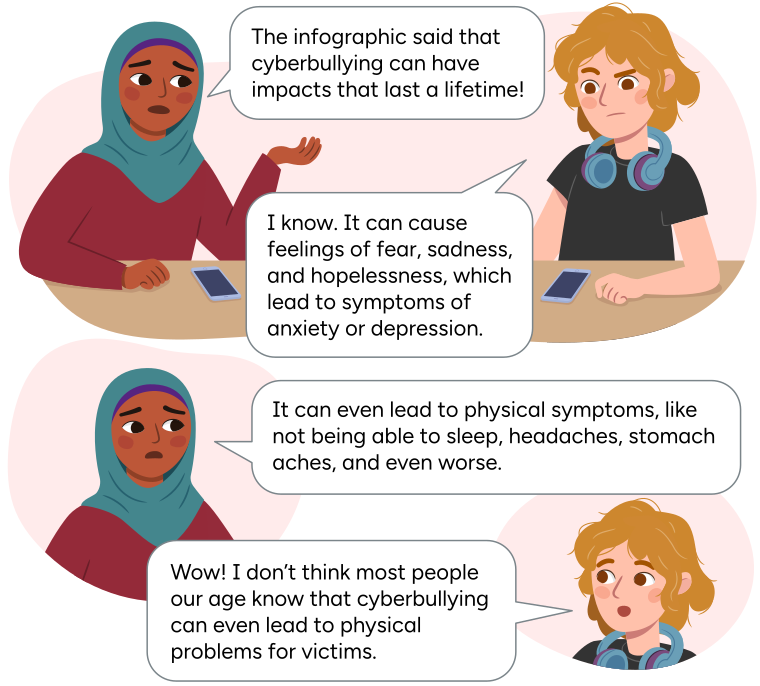
Esma and Ryan talking.
Esma has a concerned expression and says: The infographic said that cyberbullying can have impacts that last a lifetime!
Ryan says: I know. It can cause feelings of fear, sadness, and hopelessness, which lead to symptoms of anxiety or depression.
Esma says: It can even lead to physical symptoms, like not being able to sleep, headaches, stomach aches, and even worse.
Ryan has a surprised expression and says: Wow! I don't think most people our age know that cyberbullying can even lead to physical problems for victims.
Addressing the problem
Read the following article titled, Diverse Youth Voices Matter, to find out more about cyberbullying.
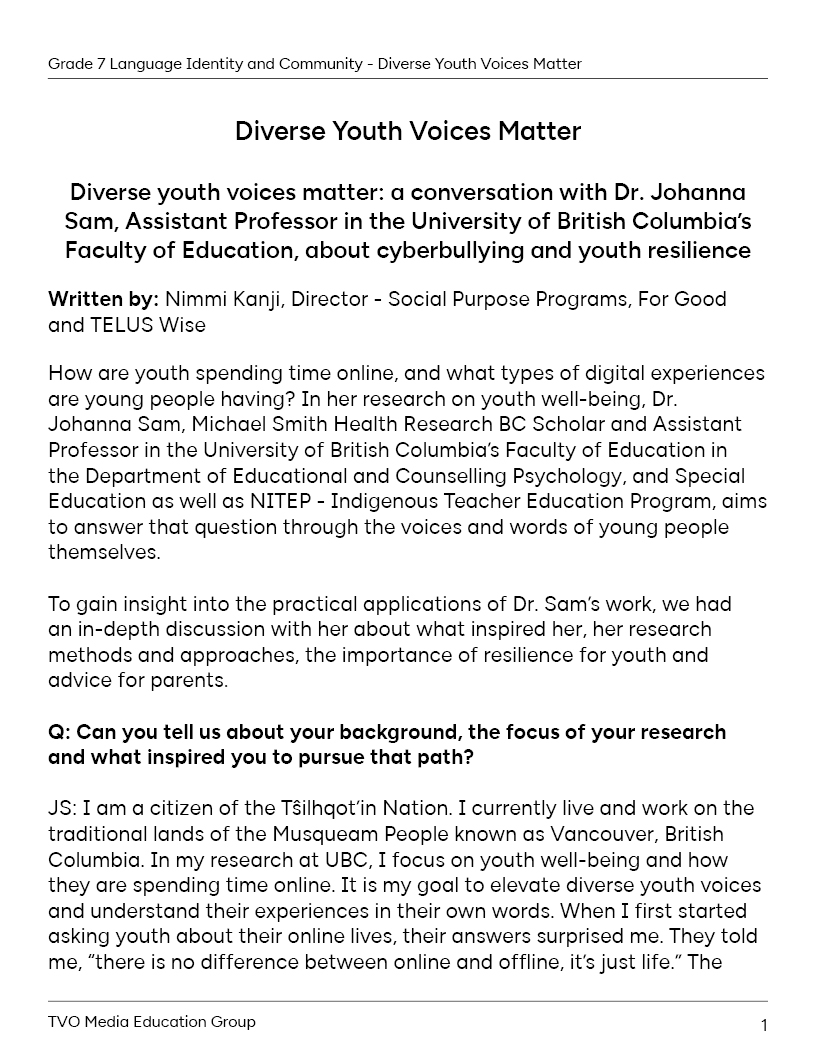
Complete Diverse youth voices matter in your notebook or using the following fillable and printable document.
Press the Activity button to access the Diverse youth voices matter.

Brainstorm
Brainstorm
Based on what you’ve learned so far, brainstorm some ideas about what can be done to help someone who has been bullied or to prevent cyberbullying. Think of how your unique ideas and perspectives can help solve this complex issue. Use a method of your choice to record your ideas.
Great ideas! Let’s learn about ways that you can help if you, or someone you know, is experiencing cyberbullying. Press the following tabs to find out more.
It is important that educational opportunities are provided for children, and even parents, educators, and community members, about the impacts of cyberbullying and the importance of promoting positive online behaviour. One thing you can do is raise awareness about the impact of cyberbullying and the importance of preventing it within schools and communities. Consider ways that you could educate your peers about this topic.
If you, or someone you know, is experiencing cyberbullying, it is important to talk to someone that you trust and seek help. Take care of your own well-being by talking to someone you trust, practising self-care, and seeking support from professionals, such as counselors or mental health professionals if necessary.
Who could you talk to if you or someone you know needs help with cyberbullying?
There are actions that you can take to protect yourself online. These include:
- Creating unique passwords that are not easy for someone else to guess and prevent people from accessing your account.
- Not sharing personal information or photos/videos that you wouldn’t want others to view.
- Remembering that once you’ve posted something or sent a message, it cannot be deleted permanently.
- Being cautious when positing online or responding to messages.
You can encourage positive online behaviour, such as kindness, empathy, and respect, through initiatives and discussions around your school or community. When communicating online you should foster a supportive and inclusive environment where everyone feels safe and respected. This can be done by encouraging uplifting and positive communication, supporting each other, and leading by example. It also can be done by standing up against all forms of cyberbullying when you feel safe to do. Before you post, consider if it is something you would say to someone’s face / in person, and how it might impact someone else.
If you experience or witness cyberbullying online, be an upstander. An upstander is someone who speaks or acts in support of an individual or cause, particularly someone who intervenes on behalf of a person being attacked of bullied. You can be an upstander by:
- offering words of support and encouragement to victims if you witness cyberbullying happening and let them know that you are there to listen and help
- ignoring bullies to take their power away, even though it isn’t always easy to do
- taking breaks from social media as needed to give you time and space to figure out what your next steps can be, including getting help from an adult
If you witness or are subject to cyberbullying there are few support services you can seek.
- Reporting the bullying to the online platform. Social media sites take it seriously when people post unkind things or set up fake accounts. If users report abuse, the site administrator can block the user.
- It is important to report the bullying to someone that you trust. If you’re not sure, you can even seek support through anonymous services like Kids Help Phone.
- Some instances of cyberbullying should be reported to the police. If you're not sure, ask a trusted adult to help you make this decision.
My personal plan
Based on the information that you’ve just explored, your task is to create a personal plan for cyberbullying. This is a plan on what you will do if you are experiencing cyberbullying or witness cyberbullying online. It could also include what you would do if a friend confides in you about being cyberbullied.
Your personal plan can be recorded in any method of your choice. Use the following checklist when completing your plan.
Personal plan criteria
Your plan should include the following:
Educating others
You have been asked to complete an awareness campaign about cyberbullying. Your awareness campaign needs to share what cyberbullying is, how it impacts people, and what can be done if you or someone you know is experiencing cyberbullying.
Your awareness campaign must include TWO components – an oral component and a media element.
Oral presentation
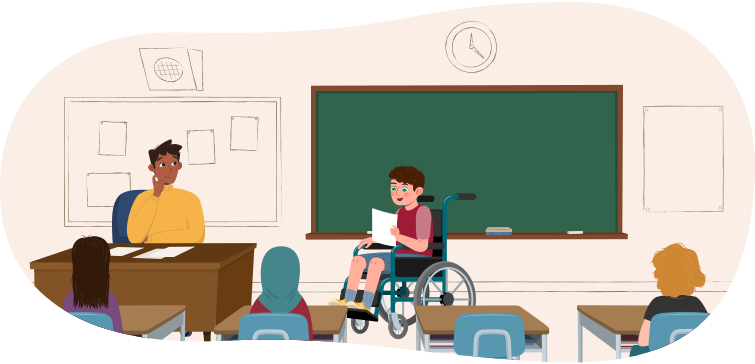
Let’s first plan out your oral component. When sharing information orally, it is important to consider:
- the purpose for speaking
- speaking strategies
- verbal and non-verbal communication strategies
- word choice and voice in your presentation
Begin by exploring these concepts in the accordion below. As you explore each concept, record your answers to the questions in a method of your choice, or use the graphic organizer to help you plan.
Complete the fillable and printable Oral Presentation Graphic Organizer in your notebook or using the following document. If you would like, you can use speech-to-text or audio recording tools to record your thoughts.
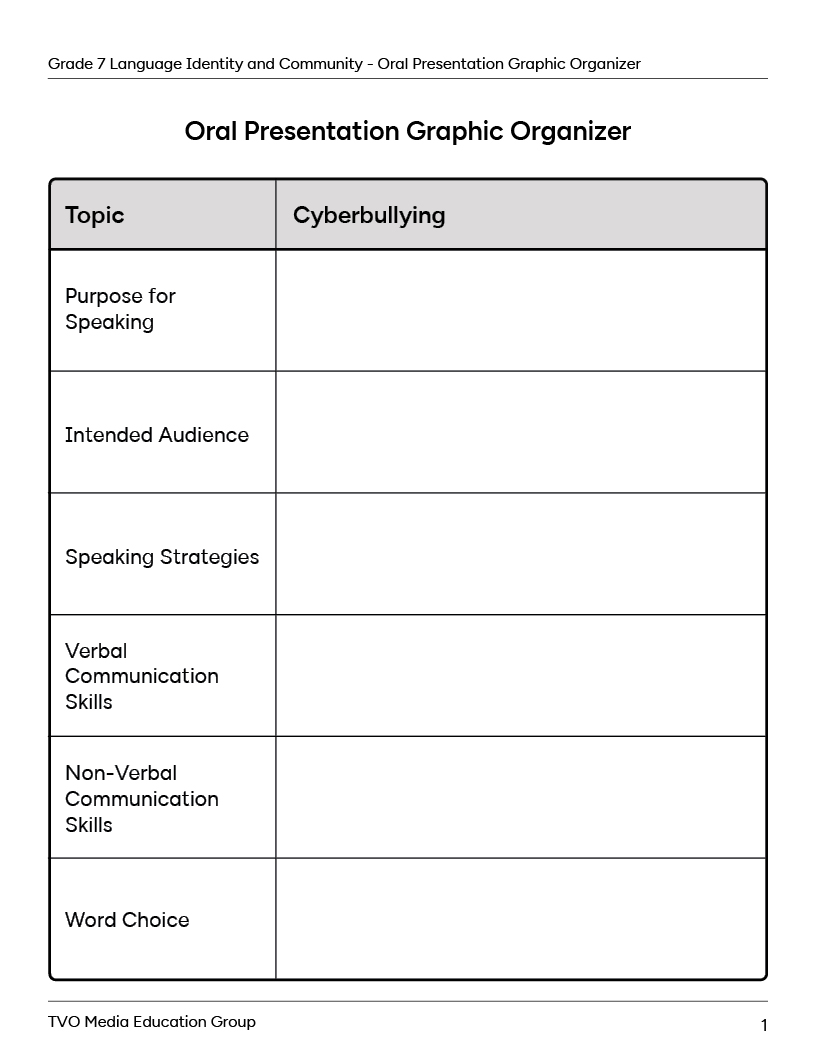
Press the Activity button to access the Oral Presentation Graphic Organizer.
Activity(Opens in a new tab)Press the following tabs to find out more.
Having a clear purpose and a realistic understanding of your audience are essential parts of effective communication.
The purpose is what you want to achieve through your speech. For example, to inform, persuade, entertain, inspire, provoke thought, etc. Having a clear purpose helps you structure your oral presentation and choose appropriate language and delivery techniques to achieve that goal.
Understanding your audience involves knowing who they are, what they may already know, and their interests and experiences. This knowledge will help you fit your messages to resonate with them, capture their attention, and engage the effectively. You may need to change your language to meet your audience and make sure your message is being understood.
Answer the following question in your graphic organizer, or in another method of your choice.
What is your purpose for speaking? Who do you want to be your intended audience?
Hint: Your audience could be peers in a younger grade or your grade; it could also be community members, teachers, or parents.
There are several speaking strategies that can be used for an oral presentation.
- Know your material – be knowledgeable
- Organize your thoughts – structure your presentation logically with a clear introduction, body, and conclusion
- Practice your oral presentation several times, focusing on fluency
- Use visual aids like slides, images, videos, charts, etc., to reinforce your message
- Engage your audience by making eye contact, asking questions, varying your tone and pace, and using gestures to keep your audience interested and involved
Answer the following question in your graphic organizer, or in another method of your choice.
What speaking strategies will you use for your oral presentation?
Oral communication refers to the expression of thoughts, ideas, and feelings through spoken or written language.
Examples include:
- speak loud and clear for everyone to hear
- practice difficult words so you pronounce them properly
- speak at a moderate pace, not too fast or too slow
- use appropriate language and vocabulary for your audience
Non-verbal communication refers to other methods, such as body language. This may include facial expressions, gestures, and other body movements.
Examples include:
- using hand or facial expressions to emphasize key points
- maintaining eye contact with your audience
- standing or sitting straight with good body posture
Answer the following question in your graphic organizer, or in another method of your choice.
What verbal and non-verbal communication strategies will you use?
Word choice is the careful selection of words used to communicate a message or establish a particular voice or writing style. Word choice plays a key role in establishing correctness, clearness, or effectiveness. You want to ensure that the words you are using clearly communicate your overall message.
Here are some tips for word choice:
- Use precise words – active verbs, concrete nouns, specific adjectives – to help your readers and listeners understand your sentences
- Use words that convey your main ideas clearly
- Use words that are not too vague or too complicated
- Don’t use words that are too repetitive
- Vary your sentence types
Answer the following question in your graphic organizer, or in another method of your choice.
What specific words or language do you want to include in your presentation?
There are two types of “voices” that can be used in both writing and speaking:
- Active: the subject performs that action (verb) on the object
Subject + verb + object
Example: Jennifer decorated the cake.
- Passive: the subject is being acted upon
Object + verb + subject
Example: The cake was decorated by Jennifer.
Explore this further in the video clip below.
Check out the following video to learn more about the active and passive voice.
Check your understanding by sorting the following oral and non-verbal strategies. Place the cards into categories that best match. Use the arrow buttons to navigate between cards.
Now it’s time to write your oral presentation! Write your oral presentation in a method of your choice and then practice it with the reading fluency routine.
Media element
Along with your oral presentation, your awareness campaign needs to contain a media element. Consider a piece of media that you want to share with your audience – this could something you create or find online.

Some examples include:
- a poster
- video
- slideshow
- podcast
- image
- infographic
Next, you will be practicing your oral presentation and working on your fluency.

Fluency
Fluency is the ability to identify words correctly and read a text at an appropriate rate with ease, pace, automaticity, and expression. With proper phrasing and a focus on punctuation the reader will gain more meaning and possibly value from the text.
Use the checklist provided to self-assess your own fluency when practicing your oral presentation. If possible, share your oral presentation with someone else and ask them to provide feedback on your fluency.
Fluency checklist
Based on the checklist, choose one area of fluency to focus on and set a goal for yourself. What strategies could you use to help you achieve this goal?

Social Emotional Learning
Social emotional

Great work so far! Take a break before continuing onto the next part.

Direct and indirect objects
An indirect object is a word or phrase that receives the direct object. A direct object is the noun that receives the action of the verb.

Student Tips
Student tips
Indirect objects often answer the question of “to whom” or “for whom” in relation to the verb and the direct object.
Indirect objects can only be placed directly after the verb or before the direct object.
Let’s explore a few examples in the sentences below.
Description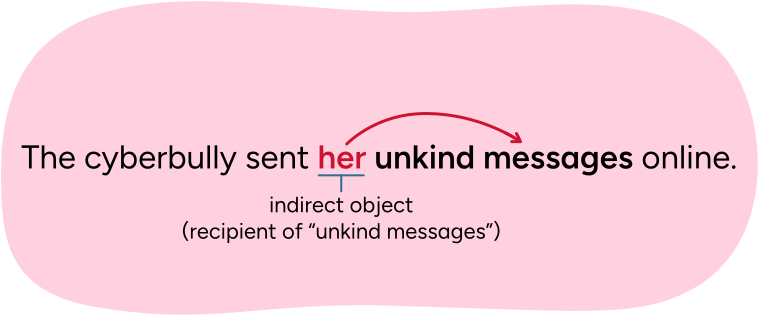
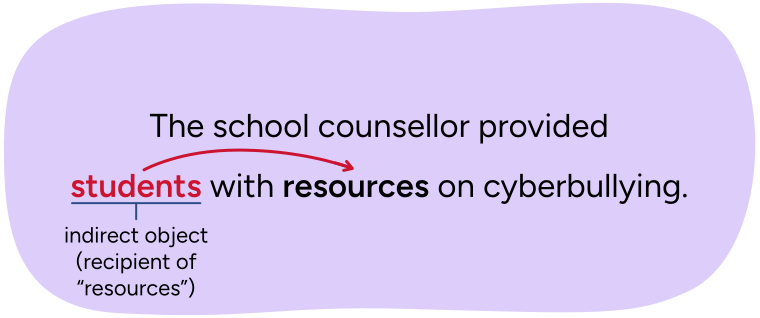
Image 1: The sentence "The cyberbully sent her unkind messages," with the indirect object and the direct object it receives indicated. The indirect object "her" is the recipient of "unkind messages."
Image 2: The sentence "The school counsellor provided students with resources on cyberbullying," with the indirect object and the direct object it receives indicated. The indirect object "students" is the recipient of "resources."
Can you identify the indirect object in the following sentences? Record your answers in a method of your choice.
- The community center hosted seminars to teach parents about monitoring online activities.
- The school policies protect students from cyberbullying.
- The cyberbully hacked into his email account and sent unkind emails to other people.
Press the Answers button to learn more.
- parents
- students
- his

Writing a blog post
Your task is to create a 500-word blog post about cyberbullying. What do you think is the most important information to share with others about cyberbullying?
Record your blog post in a method of your choice.
My personal goals

Create three personal goals that you have regarding cyberbullying. This could be what you will do to create a positive online community or avoid cyberbullying. It could also be a goal you have if you witness or experience cyberbullying.
Record your ideas in a method of your choice.
Reflection
As you read the following descriptions, select the one that best describes your current understanding of the learning in this activity. Press the corresponding button once you have made your choice.

I feel...
Now, expand on your ideas by recording your thoughts using a voice recorder, speech-to-text, or writing tool.
When you review your notes on this learning activity later, reflect on whether you would select a different description based on your further review of the material in this learning activity.