Learning goals
We are learning to…
- demonstrate an understanding of the historical contexts, contributions, lived experiences, and perspectives of a diversity of individuals and communities, including those in Canada, by exploring and analyzing the concepts of identity, self, and sense of belonging in a variety of culturally responsive and relevant texts
- read and comprehend various complex texts, using knowledge of words, grammar, cohesive ties, sentence structures, and background knowledge
- select suitable strategies, such as visualizing, reading ahead, asking questions, and consulting references and other texts or sources of information, to monitor and confirm their understanding of various texts and solve comprehension problems
- generate and develop ideas and details about various topics, such as topics related to diversity, equity, and inclusion and to other subject areas, using a variety of strategies, and drawing on various resources, including lived experiences
Success criteria
I am able to…
- identify and explain how texts act as windows, mirrors, and doors
- read an excerpt from a short story with a focus on identity and community, responding to a series of comprehension questions
- create a book design and idea based on personal identity, as well as consider oral speaking skills that would be beneficial in sharing their design
Your identity
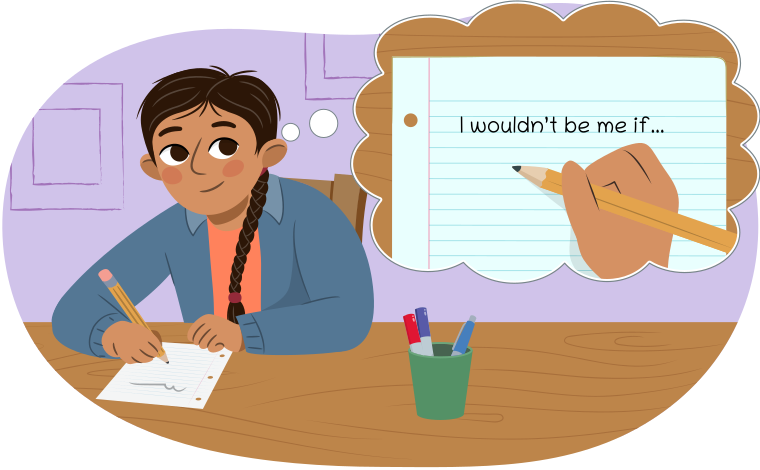
Begin by completing the following sentence stem to create a proper sentence. Record your ideas orally, digitally, in your notebook, or in another method of your choice.
I wouldn’t be me if …
Press the Examples button to learn more.
I wouldn’t be me if I wasn’t 13-years-old.
I wouldn’t be me if I was unkind.
This question is designed to get you thinking about your own identity. Your identity comes from your cultural identity, ethnicity, nationality, language(s), religion, gender identity, family background, personal values and beliefs, hobbies and interests, physical appearance, and others.

Student Success
Think!
- What parts of your identity do you think are most important to you?
- Do you think your identity is something you are born with or something that’s created over time?
Record your ideas in a method of your choice.

Mirrors, windows, and doors

Reading a variety of texts gives you more opportunities to see yourself portrayed. Your physical appearance, personal interests, values, and lived experiences, can all help you connect to the texts you are reading and see yourself reflected in your learning. At the same time, they can also provide you with a glimpse into the world of someone else who might be different than you, which promotes empathy and understanding.
Books can be so much more than entertainment! Rudine Sims Bishop, a Black American scholar and professor emerita at Ohio State University, uses the analogy of "Mirrors, Windows, and Sliding Glass Doors" to highlight the importance of diversity in books and the authors who write them.
Press the following tabs to find out more.
Books can be like a mirror because they can be a place where we can see ourselves, celebrate and connect with our identity and remind us to feel proud of who we are.
Books can be like windows because they can be a place that encourages us to take a closer look at the outside world, teaching us about lives and experiences that different than our own.
Books can be like doors because they can be an invitation to step into another world created by the author in which we feel connected to the characters and their experiences.
Student Success
Think!
Consider one book (or more) that you’ve read in the past. Do you think this book was a window, mirror, or door? Explain why. Record your ideas in a method of your choice.
Press the Sentence Starters button to learn more.
- The book was a mirror of my life because …
- The book was a mirror because it connected to my identity by …
- The book was a window into someone else’s life, … because …
- The book … was a door because I felt like I entered …’s world …
Identity in texts
In this section of the learning activity, you will be exploring an excerpt from a text. As you explore, consider how the text connects to the theme of identity and community, and how you may see the text as a mirror, window, and/or door.
Names/Nombres by Julia Alvarez
Let’s explore “Names/Nombres” by Julia Alvarez, a short story that explores the themes of identity, language, and cultural assimilation.

Vocabulary in Names/Nombres
Before you begin, let’s explore some of the vocabulary words you will encounter that may be new to you.
“Say your name in Spanish, oh, please say it!” I had made mouths drop one day by rattling off my full name, which, according to the Dominican custom, included my middle names, Mother’s and Father’s surnames for four generations back. “Julia Altagracia María Teresa Álverez Tavares Perello Espaillat Julia Pérez Rochet González.” I pronounced it slowly, a name as chaotic with sounds as a Middle Eastern bazaar or market day in a South American village.
My Dominican heritage was never more apparent than when my extended family attended school occasions. For my graduation, they all came, the whole lot of aunts and uncles and the many little cousins who snuck in without tickets. They sat in the first row in order to better understand the Americans’ fast-spoken English. But how could they listen when they were constantly speaking among themselves in florid-sounding phrases, rococo consonants, rich, rhyming vowel? Introducing them to my friends was a further trial to me.
Source: Alvarez, J. Names/Nombres [PDF]. Frontier Central School District. https://www.frontiercsd.org/cms/lib/NY19000265/Centricity/Domain/114/names-nombres-full%20text.pdf
Let’s check!
Now that you’ve finished reading the excerpt from Names/Nombres by Julia Alvarez, begin by answering the following multiple-choice questions to check your understanding.
Select the correct answer, then press Check Answer to see how you did.
Respond to the following reflection questions in your notebook or another method of your choice.
- How do Julia’s experiences with her name reflect broader themes of identity, self-expression, and community?
- How does Julia’s experience serve as a mirror for her, a window for the immigrant experience, and a door to open up conversations about cultural diversity, language, and identity?
- How does Julia’s perspective either challenge or expand your understanding of identity and belonging?
Book proposal

Now that you’ve had a chance to explore the theme of identity and community within the texts, you are now going to consider your own identity.

Brainstorm
Brainstorm
What are some pieces of your own identity that you would like to see mirror in a new book? Brainstorm your ideas in a method of your choice.
Press the Hint button to learn more.
You may wish to consider your:
- cultural identity
- ethnicity
- nationality
- language(s)
- religion
- gender identity
- family background
- personal values and beliefs
- hobbies and interests
- physical appearance
Creating your proposal
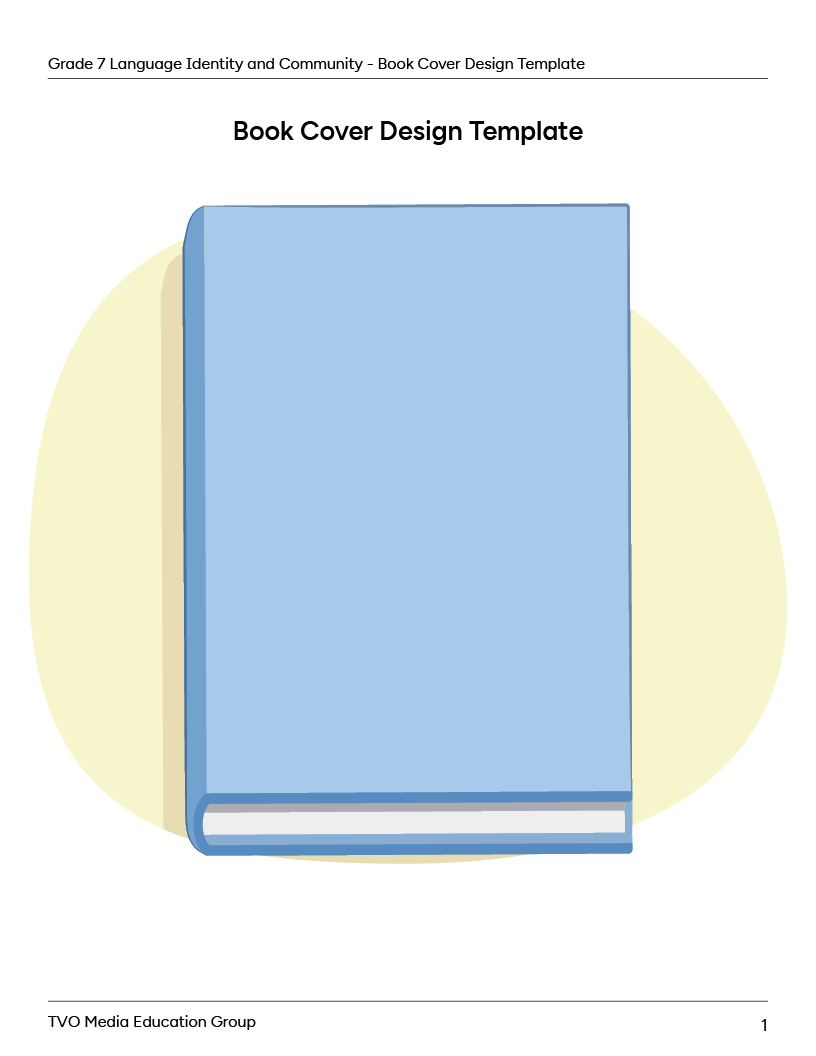
Now that you have brainstormed ideas about your own identity, you will be creating your book proposal. You will be proposing a book of your choice that you feel acts like a mirror, window, or door to your personal identity. You will need to design a book cover and write a short synopsis of the book, highlighting the connections it has to your identity and community.
Use the following checklist to guide your planning.
Planning checklist
To complete your design cover, complete the fillable and printable Book Cover Design Template in your notebook or using the following document. If you would like, you can use speech-to-text or audio recording tools to record your thoughts.
Sharing your proposal
Now that you’ve created your book design and synopsis, your task is to plan how you would share your design. If possible, share your proposal with someone else.
- What oral and non-verbal communication strategies would you use (in other words, expression, gestures, body language)?
- How will these strategies support understanding?
Record your ideas in a method of your choice.

Social Emotional Learning
Social emotional

Great work! Take a break before continuing onto the next part.

Participles
Teacher Chelsea saying: A participle is a form of a verb that is used either as an adjective or a part of certain tenses. There are two types, the present participle and the past participle, and participles used as adjectives that can form a longer phrase.
Participles have two functions:
- Turn a verb into an adjective to modify a noun
- Connect with auxiliary verbs to create different tenses
Press the following tabs to explore these functions of participles in more detail.
In this example, a participle (form of a verb) functions as an adjective that modifies the noun.
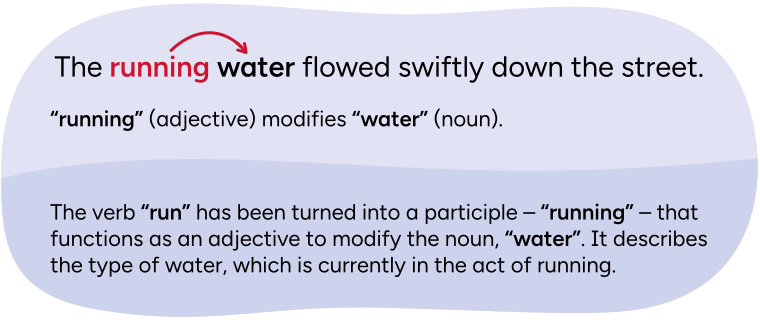
The sentence "The running water flowed swiftly down the street," with the adjective and the noun it modifies indicated. The adjective "running" modifies the noun "water."
The verb "run" has been turned into a participle - "running" - that functions as an adjective to modify the noun, "water". It describes the type of water, which is currently in the act of running.
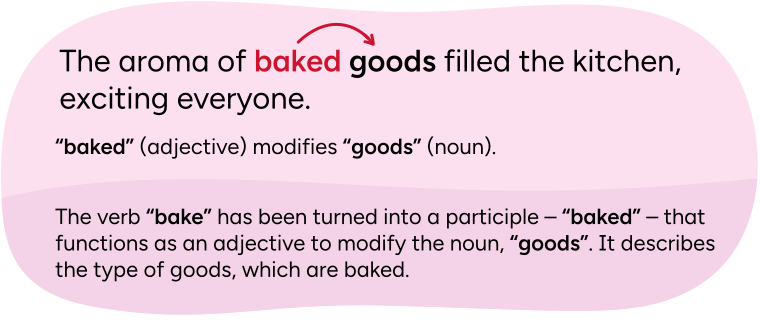
The sentence "The aroma of baked goods filled the kitchen, exciting everyone," with the adjective and the noun it modifies indicated. The adjective "baked" modifies the noun "goods."
The verb "bake" has been turned into a participle - "baked" - that functions as an adjective to modify the noun, "goods". It describes the type of goods, which are baked.
Note: It’s important that you do not confuse participles with infinitives, which is another form of a verb that can modify nouns. Infinitives usually have the word “to” at the beginning.
a refreshing drink (participle)
a drink to refresh (infinitive)
In this example, the participle is used to create different verb tenses. Let’s begin by exploring the present participle.
A present participle is used as an adjective describing an action that is currently taking place. Let’s check out some examples!
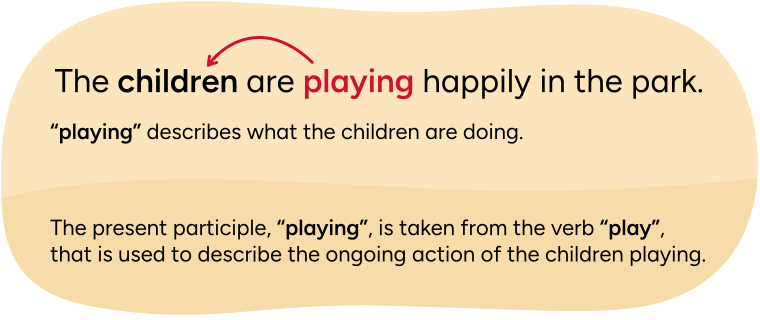
The sentence "The children are playing happily in the park," with the participle and the noun it describes indicated. The participle "playing" describes what the children are doing.
The present participle, "playing", is taken from the verb "play", that is used to describe the ongoing action of the children playing.
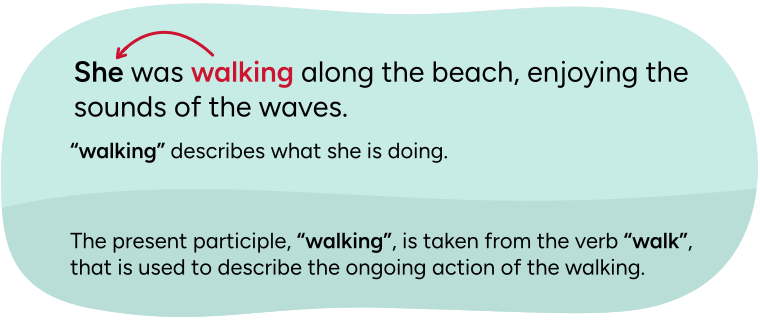
The sentence "She was walking along the beach, enjoying the sounds of the waves," with the participle and the noun it describes indicated. The participle "walking" describes what she is doing.
The present participle, "walking", is taken from the verb "walk", that is used to describe the ongoing action of the walking.
Note: For most verbs, you form the present participle by adding -ing to the end of the verb.
Next, let’s explore how the participle is used to create different past tenses.
The past participle is used as an adjective to describe an action that has already been completed. Let’s check out some examples!
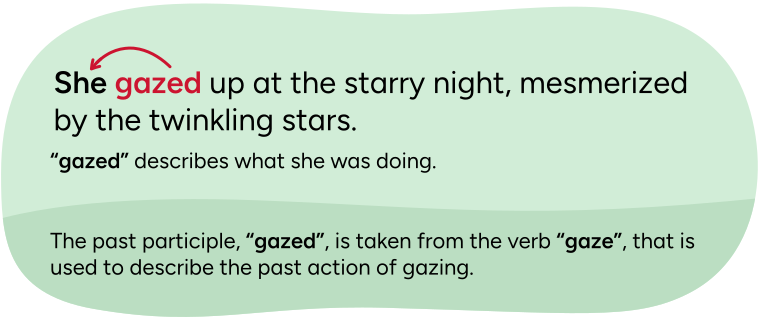
The sentence "She gazed up at the starry night, mesmerized by the twinkling stars," with the participle and the noun it describes indicated. The participle "gazed" describes what she was doing.
The past participle, "gazed", is taken from the verb "gaze", that is used to describe the past action of gazing.
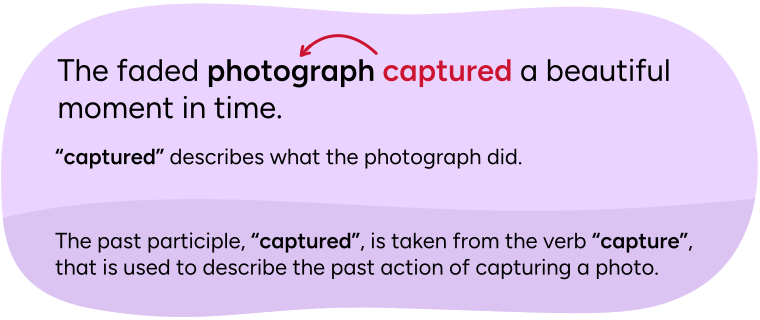
The sentence "The faded photograph captured a beautiful moment in time," with the participle and the noun it describes indicated. The participle "captured" describes what the photograph did.
The past participle, "captured", is taken from the verb "capture", that is used to describe the past action of capturing a photo.
Note: For most verbs, you form the past participle by adding -ed to the end of the verb.
Let’s check!
Check your understanding of particles by completing the following multiple-choice questions. Select the correct answer, then press Check Answer to see how you did.

Let’s check!
As you explored the excerpt from the text in this learning activity, you encountered several vocabulary words. Check your understanding of those words by completing the fill-in-the-blanks activity below.
Use the word bank to help you. Note that not all words have been used.
Word bank:
- Roccoco
- Bazaar
- Heritage
- Customs
- Generation
- Extended family
- Florid
- Trial
- Chaotic
For each sentence, select the missing word from the drop-down menu. Press Check Answer to see how you did.
Final reflection
Respond to the following reflection questions in a method of your choice.
- Consider yourself, and your own identity. What similarities or differences do you have to the character in the excerpt from Names/Nombres by Julia Alvarez or to characters you may have read about in other texts? Record your ideas in a method of your choice.
- What do you think is the most important part of your identity? Why?
Reflection
As you read the following descriptions, select the one that best describes your current understanding of the learning in this activity. Press the corresponding button once you have made your choice.

I feel...
Now, expand on your ideas by recording your thoughts using a voice recorder, speech-to-text, or writing tool.
When you review your notes on this learning activity later, reflect on whether you would select a different description based on your further review of the material in this learning activity.