Learning goals
We are learning to…
- analyze and explain how transferable skills can be used to support communication in various cultural, social, linguistic, and domain-specific contexts, and apply them when reading, listening to, viewing, and creating texts of various forms
- describe literary devices, including foreshadowing, allegory, and symbolism, in a variety of texts, and explain how they help create meaning and are appropriate for the intended purpose and audience
- generate and develop ideas and details about various topics, such as topics related to diversity, equity, and inclusion and to other subject areas, using a variety of strategies, and drawing on various resources, including their own lived experiences
- draft complex texts of various forms and genres, including narrative, expository, and informational texts, using a variety of media, tools, and strategies
Success criteria
I am able to…
- learn about literary devices and identify them in texts and using them in my own writing
- explore two poems about identity, identifying literary devices and the overall theme
- generate ideas for and write a poem about my personal identity
- reflect on my poem, using a self-assessment tool, and reflect on my learning through a series of questions

My identity
Begin by watching this short video clip to learn more about identity.
What was mentioned in the video as something that contributes to your identity? Record your ideas in a method of your choice.
Press the Answer button to learn more.
The video mentioned:
- where you come from
- your ethnicity
- your religion
- your language
- what you like
- your hobbies
- your unique personality
Can you think of any other ideas? Add them to the list!
Press the Hint button to learn more.
Oher things that contribute to your identity are:
- your family
- relationships
- cultural background
- personal experiences
- values and beliefs
- social environment
- education
Identity iceberg
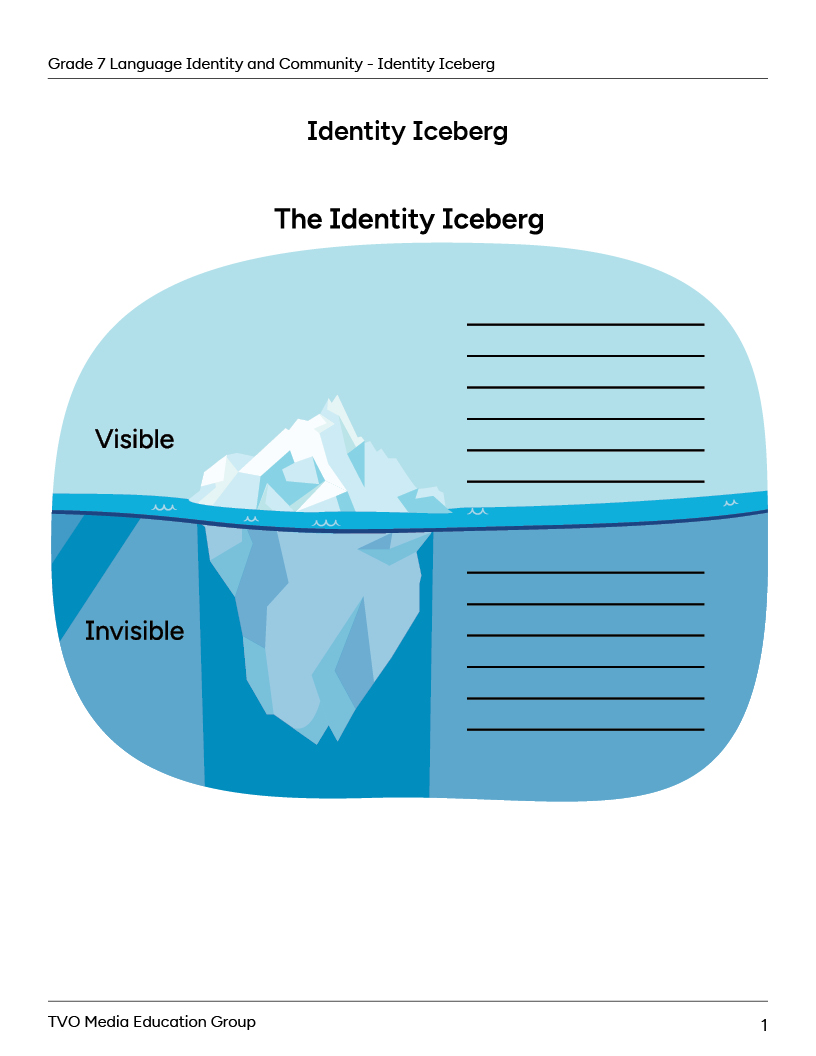
Based on these ideas of what contributes to your identity, create an identity iceberg. On the top of the iceberg, list or draw anything that is visible to other people about your identity. This might include your skin colour, hair colour, gender identity and other factors. Then below the water, on the bottom of the iceberg, record anything that contributes to your identity that is not visible to others.
Complete the fillable and printable Iceberg Template in your notebook or using the following document. If you would like, you can use speech-to-text or audio recording tools to record your thoughts.

Literary devices
Literary devices are a particular pattern of words, figure of speech, or technique used in literature to produce a specific effect. Literary devices can help the writer enhance their story beyond the literal meaning of the words on the page.
Let’s explore some common literary devices that you may encounter in this learning activity. Press the following tabs to find out more.
An author can make a moment come alive by creating a vivid and engaging image in the reader’s mind. Using a wide range of vocabulary, descriptive language can stimulate the senses (smell, touch, sight, taste, and sound) and create vivid mental images. Overall, this makes the writing “come to life”, which makes it more engaging and memorable.
Example:
“A host, of golden daffodils;
Beside the lake, beneath the trees,
Fluttering and dancing in the breeze.”
Source: Wordsworth W. (1807). I Wandered Lonely as a Cloud.
In these lines, imagery is used to create a visual image of daffodils fluttering and dancing in the breeze beside the lake. The reader can easily visualize this as it appeals to the sense of sight.
There are three types of irony you may notice in a text.
- Verbal irony – may be something that is said, but the opposite is actually meant, like sarcasm
- Dramatic irony – happens when the story reveals something that was originally hidden from the reader
- Situational irony – is when two elements contradict each other
A metaphor is used to draw comparisons between two seemingly unrelated ideas by stating that one thing is another. Metaphors are used to create vivid imagery, convey complex ideas, and evoke emotional responses in a reader or listener.
Example:
"Hope is the thing with feathers
That perches in the soul,
And sings the tune without the words,
And never stops at all,"
Source: Dickinson, E. (1891). "Hope" is the thing with feathers.
In these lines hope is metaphorically compared to a bird (“the thing with feathers”) that perches in the soul and sings continuously. This comparison adds depth and imagery to the concept of hope.
Personification uses figurative language to give recognizable human-like qualities to inanimate or non-human entities.
Example:
“The rain wept down the window,
The wind screamed through the branches.”
In these lines the rain weeps and the wind screams, which are both things that a human could do, but not the weather.
Repetition, repeating the same words or lines, is used to emphasize a specific part or message in the story.
One example is Edgar Allen Poe’s “The Raven” in which the words “nothing more” and “nevermore” are repeated at the end of each stanza.
Symbolism is the act of using a person, place, or object to convey a larger, more abstract idea. Symbolism could also be used in the setting, for example, a rising sun, to symbolize a new beginning.
Example:
"Two roads diverged in a yellow wood,
And sorry I could not travel both
And be one traveler, long I stood
And looked down one as far as I could
To where it bent in the undergrowth;"
Source: Frost, R. (1916). Mountain Interval. Henry Holt and Company.
In this poem, the road symbolizes choices and decisions in life with the author trying to choose between two roads.
Literary devices can be used in all types of writing and even media text forms. Let’s explore a poem and highlight the literary devices within it. Use this one as an example for the next activity where you will be asked to analyze poems about identity.
The poem “Hope” is a thing with feathers was written by Emily Dickinson. Emily Dickinson was one of America’s greatest and most original poets of all time.
Access the following Annotation of Emily Dickinson’s Poem to learn more.
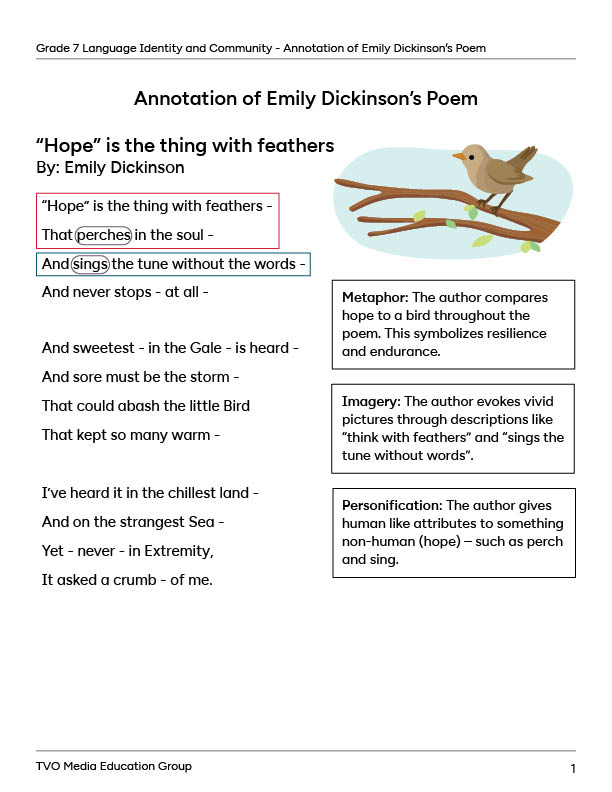
Press the Activity button to access the Annotation of Emily Dickinson’s Poem.
Activity(Opens in a new tab)
Ellipses and dashes
Sometimes poems use ellipses or dashes to show an admission, a pause, or a break. These can be used in other types of writing too!
An ellipses (…) are three (or more) dots all in a row that can be used for a few reasons. Review the following uses of ellipses in the following flashcards.
A dash (-) is a single line, like in the poem you just read, that can be used for several reasons. Review the following uses of dashes in the following flashcards.
Let’s check!
Rewrite the following sentences using proper ellipses or dashes.
- Rachel loves dogs all kinds of dogs.
- She recently got a promotion I can see why.
- I don’t, I don’t think that’s possible!
- I don’t mind as long as you’re back by midnight.
- The other day, I, never mind.
Press the Answers button to learn more.
- Rachel loves dogs- all kinds of dogs.
- She recently got a promotion- I can see why.
- I don’t … I don’t think that’s possible!
- I don’t mind- as long as you’re back by midnight.
- The other day … I … never mind.
Analyzing identity poems
In the Minds On section of this learning activity you explored the concepts of identity and poetry. In this section of the learning activity, you are going to analyze poems that explore the theme of identity. As you explore, your task is to identify any literary devices within the poem.
Press the List of Literary Devices button for review.
- imagery
- irony
- metaphor
- personification
- repetition
- symbolism
Identity by Julio Noboa Polanco
Julio Noboa Polanco, born to Puerto Rican parents in the Bronx, New York City, is a poet, writer, and teacher who advocates for Hispanic rights. He wrote the poem in 1963, and it was published in 1973.
Begin by reading the poem.
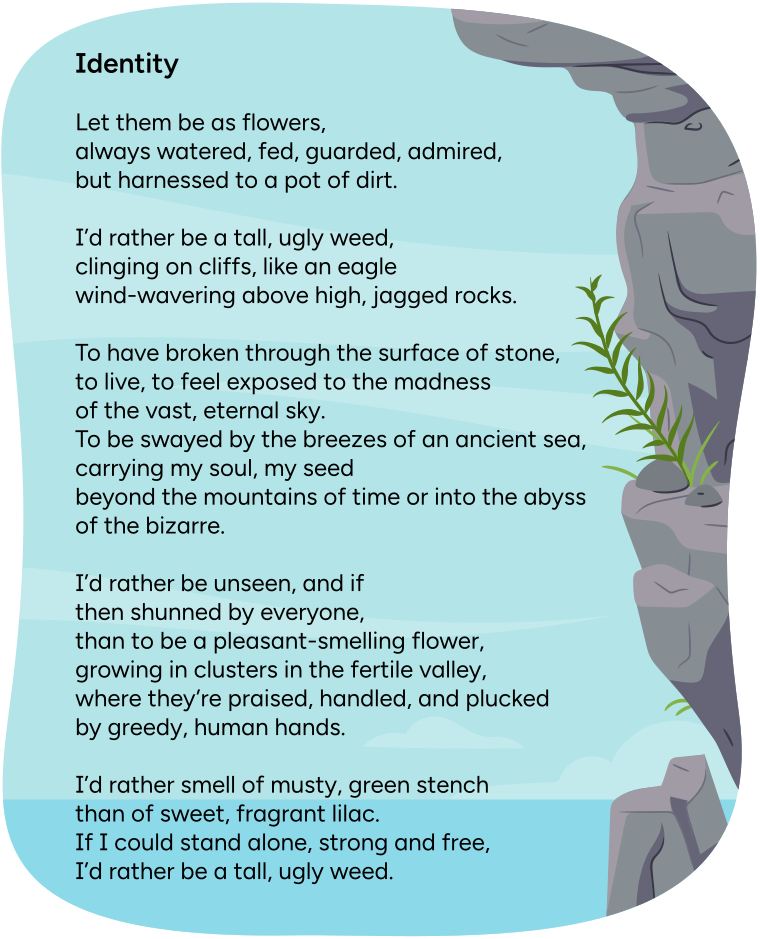
Identity by Julio Noboa Polanco
Let them be as flowers,
always watered, fed, guarded, admired,
but harnessed to a pot of dirt.
I'd rather be a tall, ugly weed,
clinging on cliffs, like an eagle
wind-wavering above high, jagged rocks.
To have broken through the surface of stone,
to live, to feel exposed to the madness
of the vast, eternal sky.
To be swayed by the breezes of an ancient sea,
carrying my soul, my seed
beyond the mountains of time or into the abyss
of the bizarre.
I'd rather be unseen, and if
then shunned by everyone,
than to be a pleasant-smelling flower,
growing in clusters in the fertile valley,
where they're praised, handled, and plucked
by greedy, human hands.
I'd rather smell of musty, green stench
than of sweet, fragrant lilac.
If I could stand alone, strong and free,
I'd rather be a tall, ugly weed.
Now that you’ve had a chance to explore the poem, annotate the poem in a method of your choice. You may choose to record notes in your notebook, discuss the poem, or print the poem and add your thoughts. In your annotation, include responses to the following prompts:
- What do you think specific lines or stanzas are referring to? What connections can you make?
- What literary devices do you notice in the poem? How do they contribute to the meaning?
- How does this poem discuss the theme of identity?
Access the following Identity to print the poem.
When you have finished, discuss your ideas with someone else if possible, and compare them to the following answer.
Access the following Identity Annotations to compare your annotations
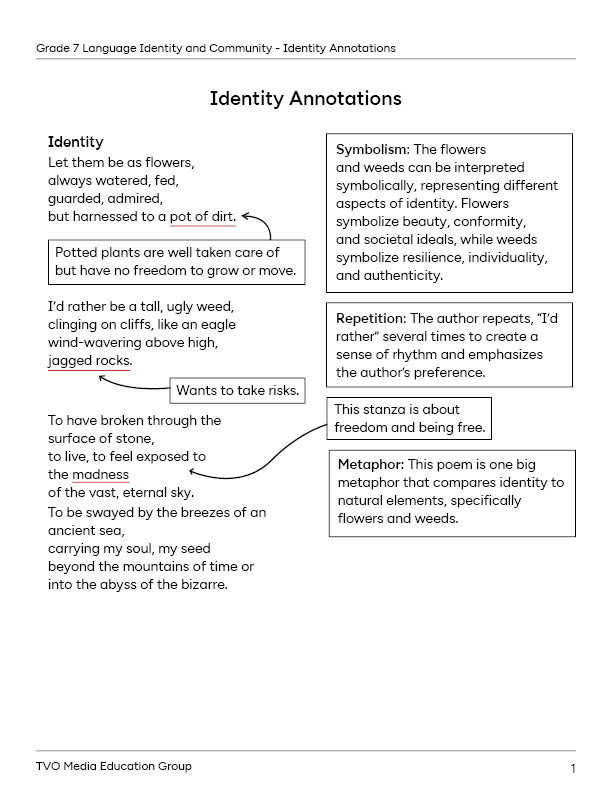
This poem uses several literary devices to convey the poet’s message about identity and embracing one’s true self, even if it means being different. The poem celebrates individuality, uniqueness, and the power of following your heart and dreams.
My Heart Soars by Chief Dan George
Chief Dan George of the Tsleil-Waututh Nation located in North Vancouver, British Columbia, was an actor, poet, and public speaker. He is remembered as a talented actor and Indigenous spokesperson. Throughout his career he wrote various poems and books, including “My Heart Soars” which was published in 1974.
Begin by exploring the poem.
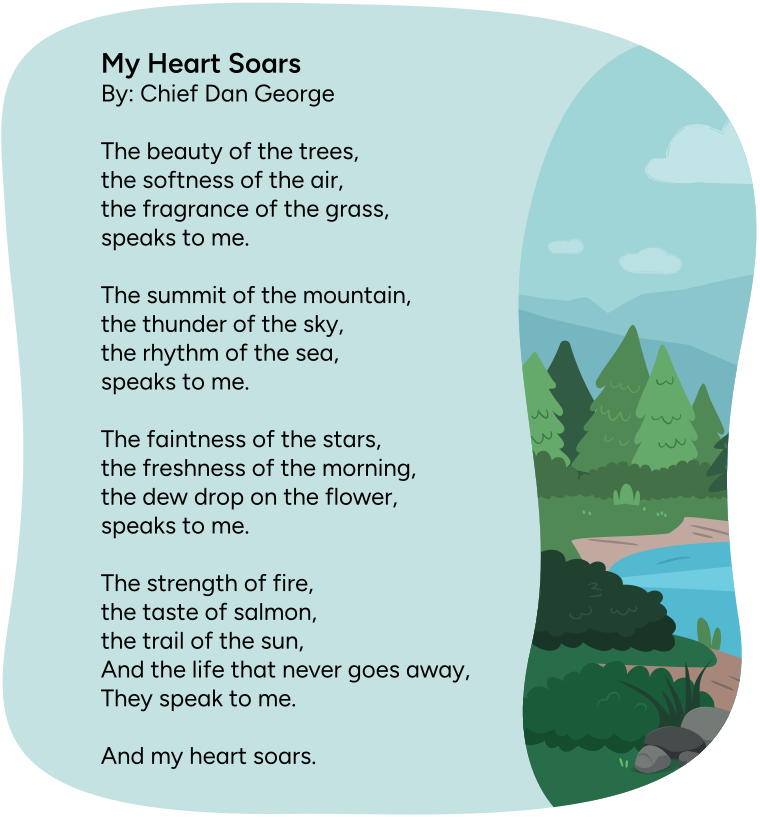
My Heart Soars by Chief Dan George
The beauty of the trees,
the softness of the air,
the fragrance of the grass,
speaks to me.
The summit of the mountain,
the thunder of the sky,
the rhythm of the sea,
speaks to me.
The faintness of the stars,
the freshness of the morning,
the dew drop on the flower,
speaks to me.
The strength of fire,
the taste of salmon,
the trail of the sun,
And the life that never goes away,
They speak to me.
And my heart soars.
Now that you’ve had a chance to explore the poem, annotate the poem in a method of your choice. You may choose to record notes in your notebook, discuss the poem, or print the poem and add your thoughts. Use the following prompts to help guide your thinking.
- What do you think specific lines or stanzas are referring to? What connections can you make?
- What literary devices do you notice in the poem? How do they contribute to the meaning?
- How does this poem discuss the theme of identity?
Access the following My Heart Soars to print the poem.
When you have finished, discuss your ideas with someone else if possible, and compare them to the following answer.
Access the following My Heart Soars Annotation to compare your annotations.
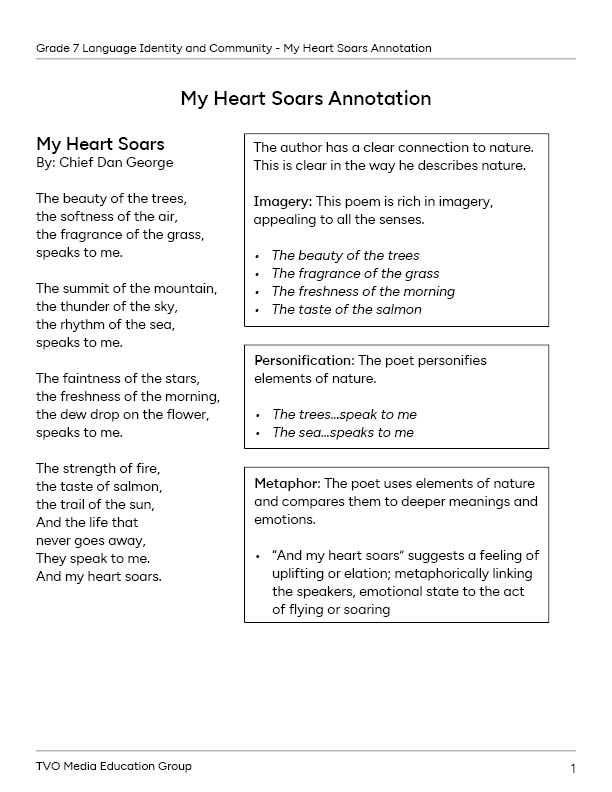
“My Heart Soars” demonstrates a theme of identity through the poet’s deep connection to his identity as a member of the Tsleil-Waututh Nation and to the land of his people. He talks about how many elements of nature speak to him personally, and he expresses a strong sense of belonging, connection and understanding.
Creating an identity poem

In the Minds On section of this learning activity, you were asked to brainstorm about your own identity. Your task is now to create your own identity poem, that reflects your personal experiences, beliefs, and values, and incorporates more than one literary device.
Use the following checklist to help plan your poem.
Poem criteria
Complete the fillable and printable Poem Brainstorming in your notebook or using the following document. If you would like, you can use speech-to-text or audio recording tools to record your thoughts.
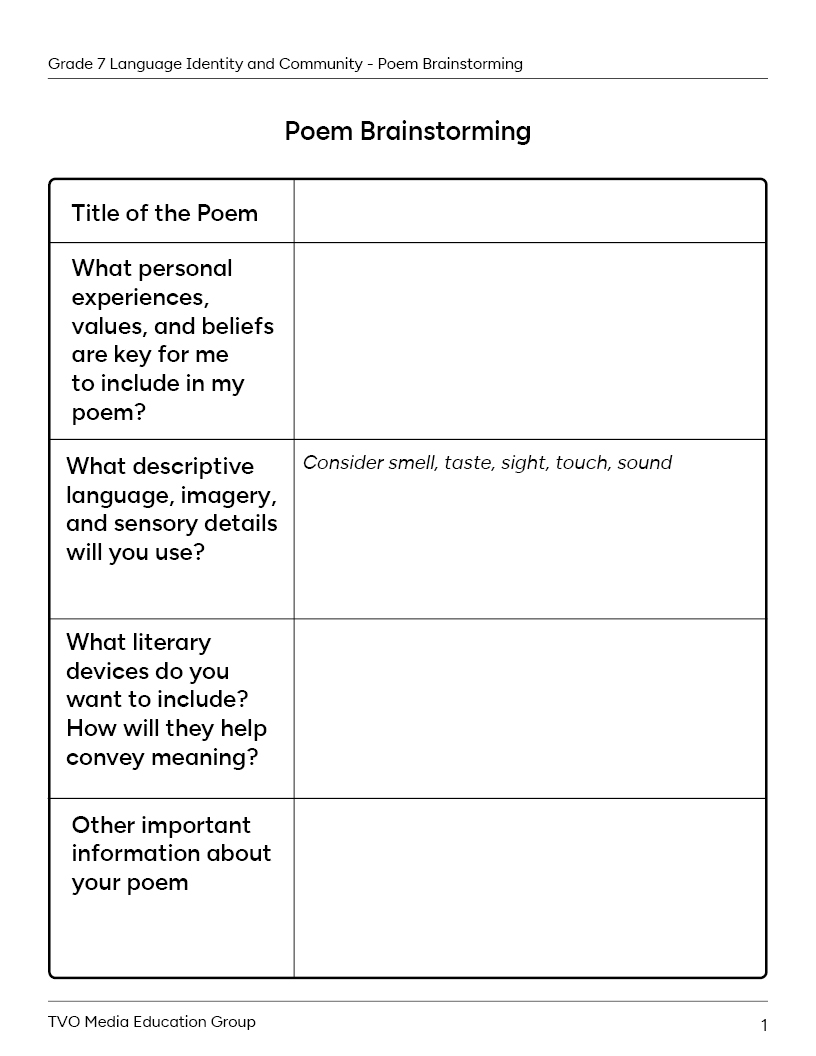
Now that you’ve finished brainstorming, it’s time to write your poem! You can write your poem in your notebook, digitally, or in another method of your choice. Make sure to use ellipses and dashes in your poem when asking your reader to pause. Review the following tips to write out your poem in cursive or type it out.
Cursive practice
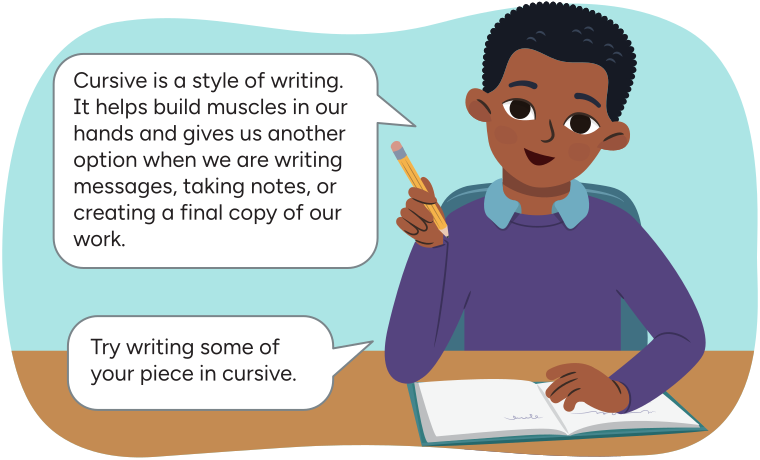
Arthur saying: Cursive is a style of writing. It helps build muscles in our hands and gives us another option when we are writing messages, taking notes, or creating a final copy of our work. Try writing some of your piece in cursive.
Let’s review cursive writing!
Check out the following animation of how the word “identity” is written in cursive, then review the tips for cursive writing provided.
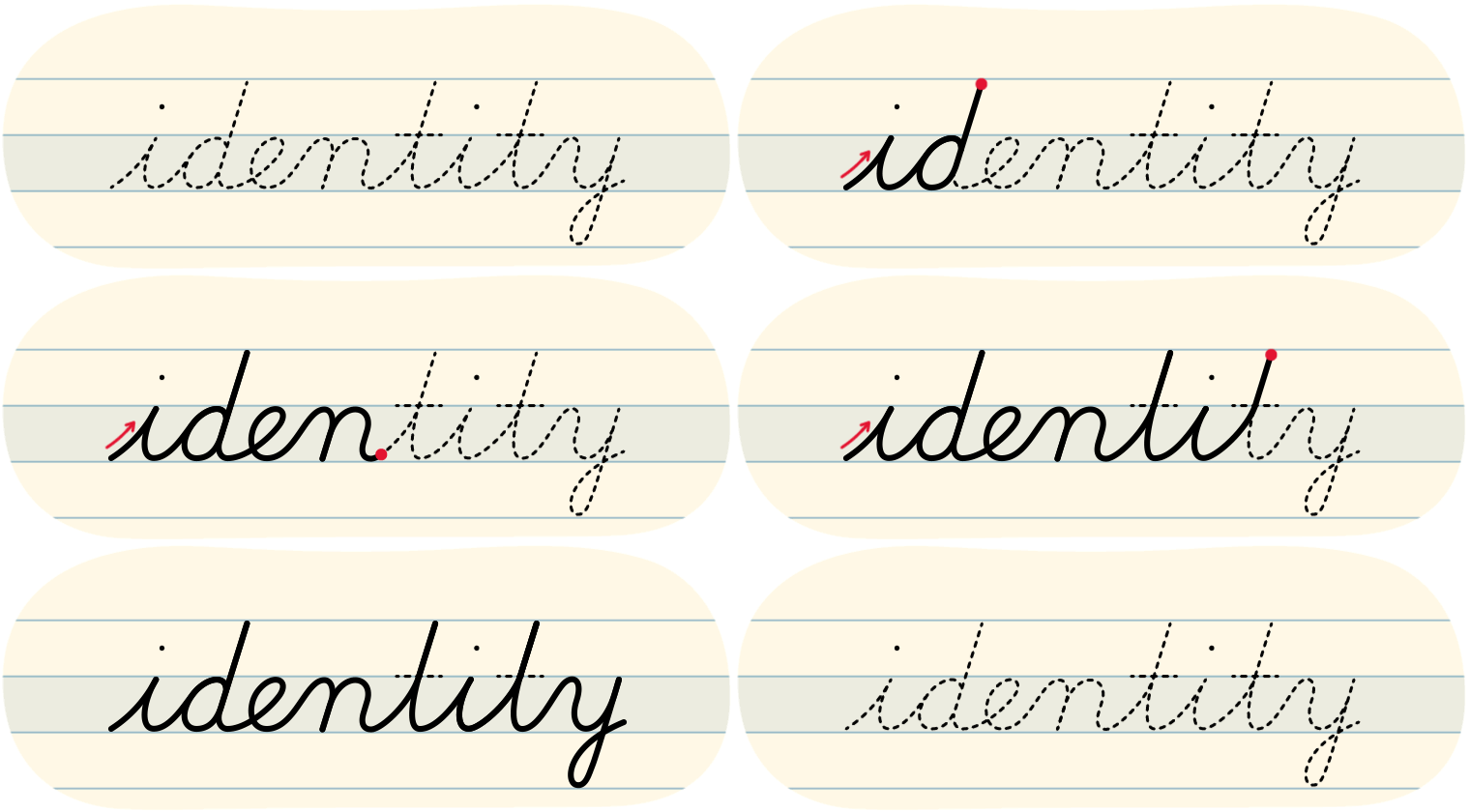
Tips for cursive letters
- When we write in lowercase, we always begin at the bottom.
- When we write in uppercase we can start from the top or the bottom.
- Try to keep the pencil on the page until you are done the word.
- Try to press gently as you write so that your hand can move easily across the page.
- Take your time to make sure that you are writing clearly and evenly.
Left-handed tips for cursive writing

Explore the video on Left-Handed Tips to learn more.

Typing practice
Typing is a great skill to develop! When we need to use a computer or tablet keyboard, knowing how to type helps us:
- take notes
- respond to messages
- create final drafts of our work.
Explore the following image to see what fingers are used to type each letter or number.
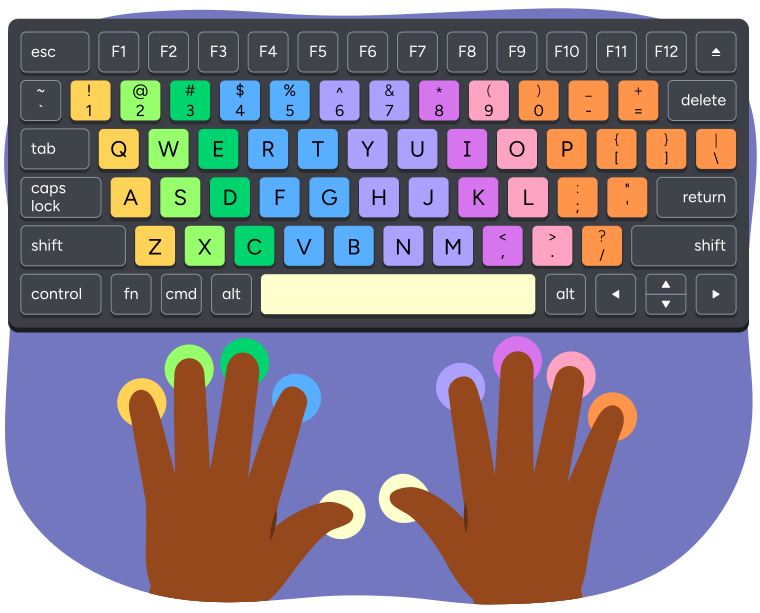
A keyboard and hands showing which fingers are used to press each key when typing.
The left pinky finger presses the keys 1, Q, A, and Z.
The left ring finger presses the keys 2, W, S, and X.
The left middle finger presses the keys 3, E, D, and C.
The left index finger presses the keys 4, 5, R, T, F, G, V, and B.
The left or right thumb presses the space bar.
The right index finger presses the keys 6, 7, Y, U, H, J, N, and M.
The right middle finger presses the keys 8, I, K, and comma.
The right ring finger presses the keys 9, O, L, and period.
The right pinky finger presses the keys 0, minus, equal, P, open bracket, closed bracket, backslash, semicolon, apostrophe, and forward slash.
We use specific muscles in our hands to type! It’s important to practice so that it becomes easier to type correctly without putting too much pressure on our hands and our wrist.

Fluency
Now that you’ve created a poem, practice reading it with a focus on fluency.
Fluency is the ability to identify words correctly and read a text at an appropriate rate with ease, pace, automaticity, and expression. With proper phrasing and a focus on punctuation the reader will gain more meaning from the text.
Re-read your poem several times, focusing on the criteria outlined next. Alternatively, you could also choose one of the stanzas you explored in this learning activity.
Use the checklist provided to self-assess your own fluency. If possible, share your poem with someone else and ask them to provide feedback on your fluency.
Fluency checklist
Based on the checklist, choose one area of fluency to focus on and set a goal for yourself. What strategies could you use to help you achieve this goal?

Social Emotional Learning
Social emotional
Great work! Take a break before continuing onto the next part!
Let’s check!
Check your understanding of literary devices by matching the literary device with its definition. For each term select the corresponding definition.

Self-assessing your writing
Reflect on the poem that you created and use the following checklist to self-assess your poem.
Self-assessment checklist
Now, respond to the following questions in a method of your choice.
- What are two things that you did well?
- What is one thing that you want to improve on?
Writing and poetry reflection
Respond to the following reflection questions in your notebook, or in another method of your choice.
- Did you notice any similarities or differences between the poems you explored today and the poem that you created? What was similar? What was different?
- How do literary devices contribute to the effectiveness of a poem, and help you comprehend a poem better?
- In what ways can your own experiences or personal identity shape the way you interpret a poem?
- How did your perspective influence the poem you created?
Reflection
As you read the following descriptions, select the one that best describes your current understanding of the learning in this activity. Press the corresponding button once you have made your choice.

I feel...
Now, expand on your ideas by recording your thoughts using a voice recorder, speech-to-text, or writing tool.
When you review your notes on this learning activity later, reflect on whether you would select a different description based on your further review of the material in this learning activity.