Learning goals
We are learning to…
- understand historical contexts, contributions, and First Nations and Inuit identities, perspectives, and ways of knowing
- research and organize content for creating texts
- analyze cultural elements of texts and new vocabulary in context
- create texts of various forms
Success criteria
I am able to…
- gather and record information on a food with a long Indigenous history
- identify aspects of texts that represent the cultural experiences of Indigenous Peoples
- use information in text and video to understand vocabulary words connected to my learning
- draft a procedural, informational, or narrative text that makes connections to a food or recipe connected to my own cultural identity or lived experiences

Food and culture
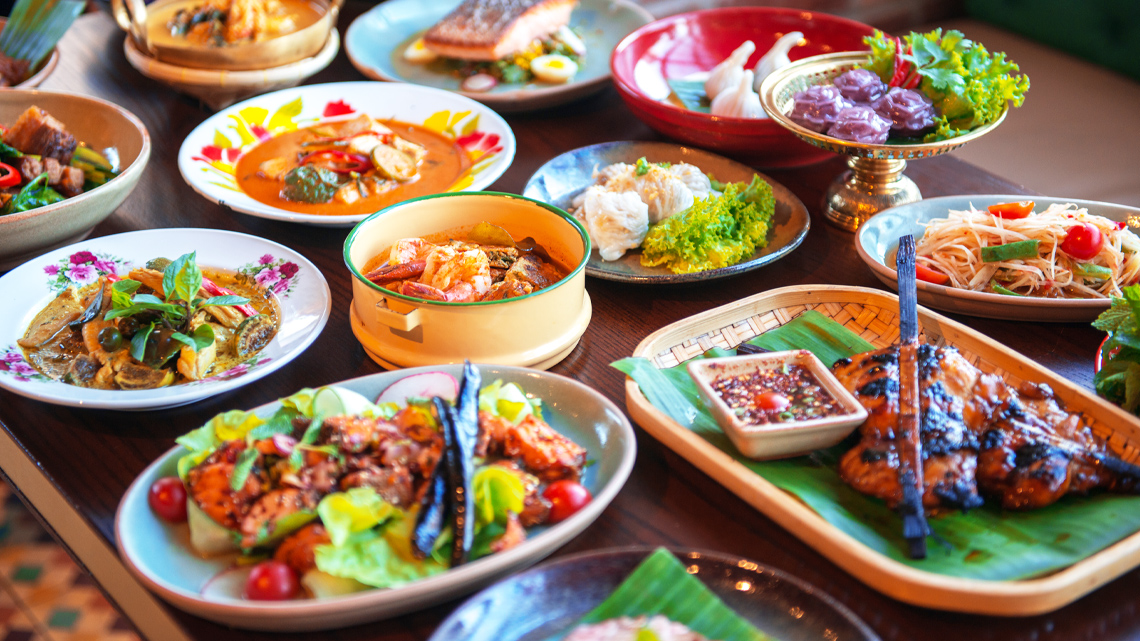
Let’s consider the connections between food, culture, and identity.
Many communities and cultures have specific cuisines that connect directly to their cultural identities.

Did You Know?
Did you know?
A cuisine is a type of food and cooking style from a certain geographical place or culture. Most societies have a cuisine based on the foods traditionally available in the area where they are from and have eaten that way for a long time. A community’s cuisine is an important part of their cultural identity.
Consider the following questions:

Brainstorm
Brainstorm
- Are there any foods that you can connect to your community, or what you consider your cultural identity?
- What cultural cuisines are you familiar with or have you tried before?
- Do you know of any specific ingredients (ex. a spice or a vegetable) that are often featured in a specific cultural cuisine?
- Do you know the origins of any of these ingredients? (i.e. Where do they come from? Where were they first grown?)
Record your thinking using a method of your choice. If possible, share your thoughts with a partner.
Food can connect people, communities, and cultures and contribute to identity. Many foods, and especially ingredients, have their own histories that not many people are aware of.
Explore the following video clip featuring Joseph Shawana, Odawa, part of the Three Fires Confederacy from Wiikwemkoong Unceded Territory and chef at ddcx Indigenous Kitchen on Manitoulin Island, Ontario. What information does Joseph share about the connections of Indigenous Peoples in North America to ingredients known in cuisines throughout the world?
In this learning activity, we will explore the historical contexts of some ingredients featured in different cultural foods. We will consider different perspectives and contributions of different groups of people, particularly Indigenous Peoples, to the cuisines of the world, and make connections to our own experiences.

Cultural exchange through food
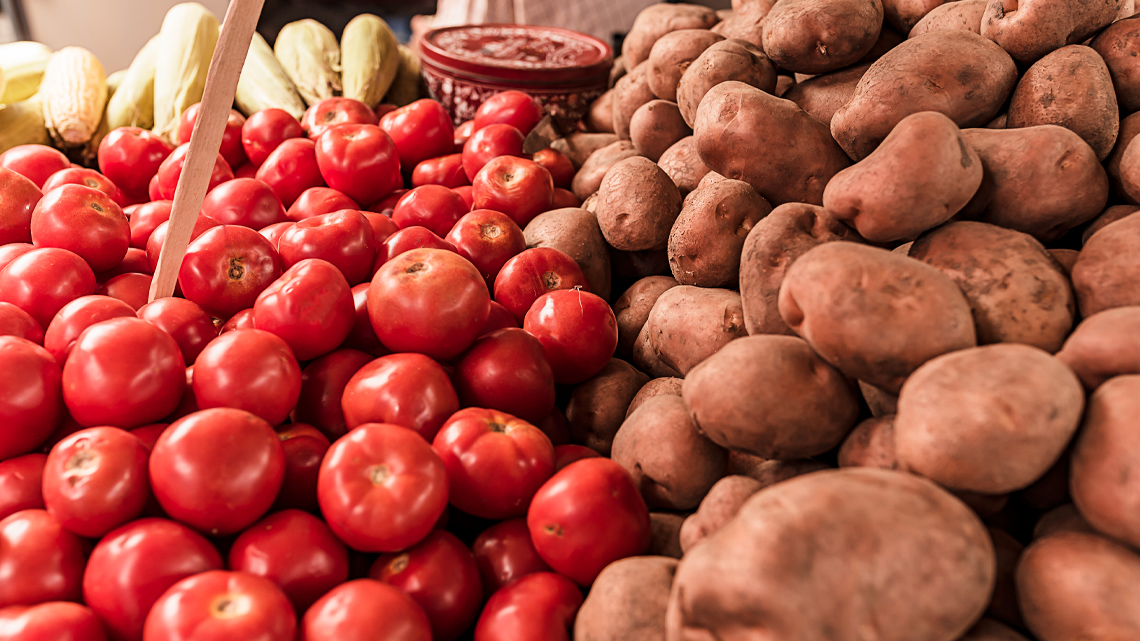
In the Minds On section, we learned from chef Joseph Shawana of ddcx Indigenous Kitchen, that foods, such as tomatoes and potatoes that were traditionally grown and harvested by Indigenous Peoples throughout North and South America, were traded during the time of European exploration and taken to different parts of the world to become essential ingredients in cuisines of other cultures.
Food was a large part of the early interactions between Indigenous Peoples and European settlers. For example:
- European settlers came to the land we now know as Canada for resources such as furs and fish.
- Indigenous Knowledges shared with Europeans about local foods and resources helped settlers survive in the natural environment.
Both Indigenous Peoples and European settlers had traditional foods and ingredients that they exchanged with one another. Bannock is one example of this.
Bannock is a type of flat bread that is sometimes called “fry bread” or “scone”. The version of bannock that is mostly known today, was brought to North America by Scottish explorers in the 18th century and has a long history with Indigenous Peoples of North America. Bannock is considered a comfort food for many Indigenous communities.
Explore the following video to learn more about bannock from Carl Beaver of Alderville First Nation near Cobourg, Ontario and one of the ways that it can be prepared.
Short answer questions
Let’s practice answering short answer questions about what we’ve learned so far that include proper sentences and cite evidence from the text in the response.
Before we begin, use the following checklist to review how to format short answer questions.
Short answer questions format
Now, answer the following question using the criteria in the short answer format checklist.
- How is bannock an example of a food that represents cultural exchange?
Consider writing in cursive to record your short answer response. Check out the following cursive writing tips before you get started.
Tips for cursive letters
- When we write in lowercase, we always begin at the bottom
- When we write in uppercase we can start from the top or the bottom
- Try to keep the pencil on the page until you are done the word
- Create a finger space before you continue to the next word
- Try to press gently as you write so that your hand can move easily across the page
- Take your time to make sure that you are writing clearly and evenly
When you are finished drafting your response, press the Sample Answer button to compare your answer to a sample response that models the formatting outlined in the short answer checklist.
Exploring foods with Indigenous connections

There are many foods that have long histories with Indigenous Peoples, and many have come to be part of cuisines around the world. Let’s explore a few examples of foods that have long histories with the Indigenous Peoples in Canada. Do you recognize any of them?
Explore the following foods and the resources provided for each to begin your research on the Indigenous connections to each food item. Record a summary of what each food is, who it was significant (important) to and why, and at least one other fact or detail about the food item.
Watch the following video to learn from First Nations Knowledge Keeper Patrick Nadjowin about pemmican and its significance historically as well as today.
Arctic char has a particular significance to the Inuit.
Read the following excerpt from the Indigenous Peoples Atlas of Canada: Inuit to learn more.
Arctic Char — Iqaluk (tariurmiutaq)
Arctic char, the northernmost freshwater fish, has been an important and healthy food resource to Inuit for centuries. Char is eaten raw, frozen (referred to as quak), dried (referred to as pipsi), smoked, aged or cooked. Char meat, head and eggs are excellent sources of protein and B vitamins. Arctic char contains omega‐3 fatty acids, which may help prevent heart disease and cancer. The skin and head of char provide a source of calcium, especially when the soft bones are eaten. Arctic char not only provides the nutrients to repair tissues, but also helps in the development and growth of body tissues and muscles. Highly nutritious, abundant and relatively easy to catch, Arctic char is indispensable to the Inuit lifestyle. In some instances, skins from char were made into waterproof coats and the bones of char were made into sewing needles along with pouches that carried the sewing equipment. (“Inuit: Wildlife,” n.d.)
In many Indigenous communities, the “Three Sisters” (corn, beans and squash) have been grown together because Indigenous Knowledges have long known the benefits of growing these plants together, as a unit.
Explore the following video clip from the show Raven’s Quest, from the episode entitled “Hope” to learn about an 11-year-old Ojibwe girl from the Three Fires Confederacy in Wiikwemkoong Unceded Territory in Manitoulin Island, Ontario and her Three Sisters garden.
Inuit: Wildlife. (n.d.). In Indigenous Peoples Atlas of Canada. Retrieved August 29, 2024, from https://indigenouspeoplesatlasofcanada.ca/article/wildlife/
These are just a small sample of foods with long histories with Indigenous Peoples. There are many more. A few more examples include berries, bison, and maple syrup.
Tips for researching
- You may consider doing some research to learn about more examples of foods, or maybe you need (or would like) some more information on one of the foods listed in this learning activity.
- Consider using a search term such as “Indigenous history of (food name)”.
- Remember that when researching information related to Indigenous Peoples to try and find sources that are from Indigenous communities or Indigenous authors to make sure you are getting first-hand information.
Explore the following guidelines before you begin doing research.
Research safety
When doing research on the Internet, it is important to stay safe and stay focused. You can use the acronym T.R.U.S.T. to help guide you as you do your research.
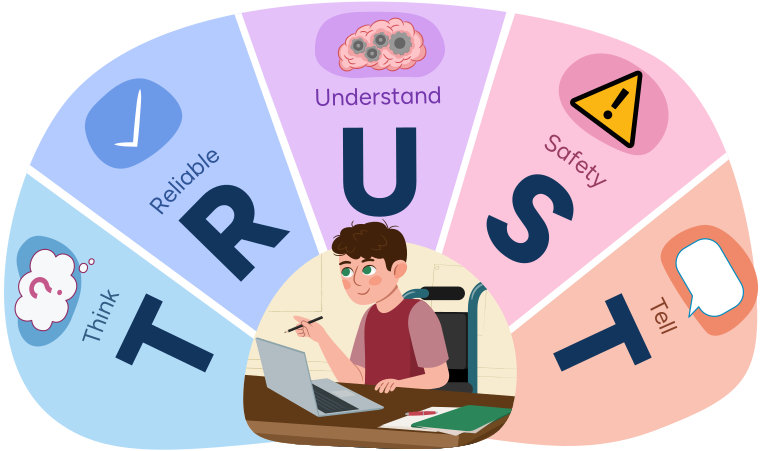
Press the following tabs to explore some research safety tips.
Think about your topic and develop specific questions to get better research results.
For example, if you’re working on the topic of recycling, you might start with a general question and make it more specific before beginning your research.
- General question: Why is recycling good for the environment?
- Specific question: How does recycling help protect marine wildlife?
Be patient while doing your research, and use the following tips:
- Go through each website carefully.
- Take notes using a graphic organizer, or notebook.
- Record the websites used for specific information – it’s important to give credit to the creator of the content.
- Consult more than one resource to help you determine if the information you gather is accurate and true.
Remember, research can take time. It helps to be focused and calm! Taking a break can help refresh our thinking and process new information.
It’s important to use reliable sources so that you can put together accurate and up-to-date information about your topic.
Websites ending with .com, .org, and .net can be purchased and used by any person.
The ending .org is usually used by non-profit organizations which may be trying to persuade rather than educate.
Websites ending in .edu are reserved for colleges and universities. Canadian websites have a .ca ending.
Consider the following questions when you are doing your reliability check. You might also ask a trusted adult or a peer for help if you are uncertain about a website.
- When was the resource published? (This might help you determine if the information is current.)
- Who created the resource/website? What is their educational background or work experience?
- Who is the intended audience?
- Who benefits from this information being shared?
- Whose perspectives are represented? Whose perspectives are missing?
- Do you understand all the words on the site? Can you decode their meaning?
- Does what you’re reading make sense?
If not, it’s okay. Consider trying a different source. It’s important for you to understand the information that you read so that you can put it in your own words.
It’s important to stay safe while doing online research. If a website asks you for any personal information, close it and try a different website.
Personal information could include asking for your full name, email address, phone number, home address, photos or school name. Do not provide any personal information and close the website.
Does the site have pop-up windows? These windows usually ask the user to click to “win a prize” or “check out information”. Do not click on the pop-ups and close the website.
Throughout the research process, feel free to check in with a peer or trusted adult.
If there is anything specific that makes you feel uncomfortable or worried while you are doing your research:
- pause and take a break
- speak to a trusted adult
Reclaiming Indigenous foods
While European explorers traded with Indigenous Peoples for survival, European settlers intentionally tried to strip Indigenous Peoples of their culture and identity and force them to assimilate. Removing and limiting access to Indigenous foods was a part of this process and has had negative impacts on Indigenous health.
Many Indigenous communities continue to assert their Indigenous ways of knowing, being, and doing through such forms as exerting their sovereignty (nationhood), identity, and cultural expression, despite pressures to conform to a Canadian identity. Many movements around the world emphasize the importance of reclaiming and celebrating Indigenous identities and ways of knowing, being, and doing.
Today, new generations of Indigenous chefs are honouring and reclaiming traditional foods and recipes of their people and communities.
Watch the following clip where chef Johl Whiteduck Ringuette, Anishnawbe and Algonquin, a descendant of Nipissing First Nation and from the Mink Clan, speaks about his restaurant, Nishdish, and his efforts towards the reclamation of Indigenous foods.

Reviewing vocabulary
After viewing the video, what do you think the word reclamation means?
What clues from the video or other sections of this learning activity could you use to explain the meaning of this word?
In a notebook, or using another method of your choice, record your thinking.
When you are finished, press the Definition button below to learn the meaning of the word reclamation.
Reclamation means returning something to the way it used to be.

Grammar glimpses: Complex sentences
You are now going to be exploring complex sentences with adverbial clauses, adjective or relative clauses, and prepositional clauses.
Grammar vocabulary review
First, let’s take a moment to review the following flashcards of some key vocabulary needed for this activity.
Types of complex sentences
Press the following tabs to explore different types of complex sentences.
An adverbial clause is a dependent clause that modifies a verb, adjective, or adverb in a sentence. They make sentences more complex by adding more detail.
Adverbial clauses can be longer or shorter and can occur at any point of the sentence.
Explore several different types of adverbial clauses in the following table! As you explore them, record ideas in your notebook, or another method of your choice.
| Type of adverbial clause | Example |
|---|---|
| Adverbial clauses of manner describe how a specific action is taking place. | He explored the news article as if he were the ultimate bias detector. |
| Adverbial clauses of place describe where the action is taking place. | In the overcrowded and busy newsroom, the news anchor prepared his story. |
| Adverbial clauses of condition describe the condition related to the verb, adverb, or adjective. | If you use the checklist provided, you will be more successful detecting bias in the media. |
| Adverbial clauses of reason describe the reason the action is taking place. | He was very keen at detecting bias in the media because he spent his youth working at a media outlet. |
| Adverbial clauses of time describe when the action is taking place. | Before she believed the news article, she re-read it and verified the facts. |
Adjective clauses, also known as relative clauses, are a type of dependent clause that describes or modifies nouns, just like individual adjectives do. Adjective clauses can improve your writing by offering the reader more detail and describing a noun.
Explore the difference between the use of just an adjective versus an adjective clause in the following table.
| Adjective | Adjective clause |
|---|---|
| The company installed gigantic floating solar panels. | The company installed floating solar panels, which were gigantic. |
Explore the rules you need to consider when creating adjective clauses in the following table.
| Adjective Clause Rule | Example |
|---|---|
| Adjective clauses start with relative pronouns – that, which, who, where, when, or whose. | I took my friend, who has never seen a garden, to the largest rooftop garden in the city. |
| Adjective clauses need a subject and a verb. | I took (verb) my friend (subject), who has never seen a garden, to the largest rooftop garden in the city. |
| Adjective clauses are connected to independent clauses. |
I took my friend, who has never seen a garden, to the largest rooftop garden in the city. Independent clause: I took my friend to the largest rooftop garden in the city. |
| Adjective clauses are always related to a noun outside of the adjective clause. | I took my friend (noun), who has never seen a garden, to the largest rooftop garden in the city. |
| Adjective clauses come after the noun. | I took my friend (noun), who has never seen a garden, to the largest rooftop garden in the city. |
A prepositional clause is a group of words consisting of a preposition (a word that precedes a noun of pronoun), its object, and any words that modify the object.
Explore the following images of examples of complex sentences with prepositional clauses.
Description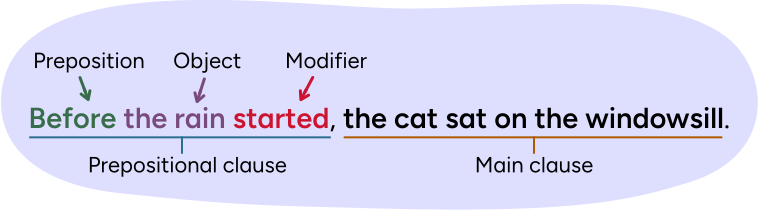
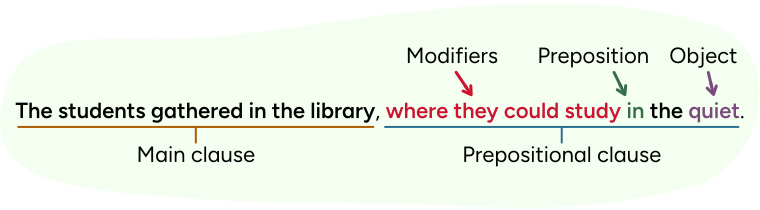
Image 1
The preposition "Before," the object "the rain," and the modifier "started" form the prepositional clause "Before the rain started," which is joined to the main clause "the cat sat on the windowsill."
Image 2
The main clause "The students gathered in the library," is joined to the prepositional clause "where they could study in the quiet," which is formed by the modifier "where they could study," the preposition "in," and the object "the quiet."
By using complex sentences with prepositional clauses in your writing, you can provide additional details, clarify relationships between ideas, and enhance the richness and complexity of your writing.
Let’s check!
Let's check your understanding of complex sentences by completing the following matching and multiple choice activities.
For each complex sentence, match the type of clause.
Answer the following multiple-choice questions. Select the correct answer, then press Check Answer to see how you did.

Let’s check!
Let’s review some key vocabulary featured in this learning activity. Match the word to its definition.
Putting it all together

In this learning activity, you explored how food is an important part of community and identity and have learned about some of the cultural exchange of foods that happened between Indigenous Peoples of North America and settlers and explorers.
To connect the learning to your lived experiences, your community, and your identity, you will explore a recipe or food that has a personal, family, community, or cultural significance to you.
Press the following tabs to learn about the three different options for this activity. Choose one option to complete.
Find the steps for a recipe that has special meaning to you, your family, or your community.
- Learn about the recipe by interviewing a trusted adult or find it online.
- Outline the general steps and ingredients needed to make the recipe.
- Use complex sentences to explain what it is and its significance to you/your community.
- Use language and word choices that makes the recipe itself understandable to your age group.
Find the history or story of a food that has meaning to you, your family, or your community.
- Learn about the food by interviewing trusted adults or research it online.
- Use complex sentences to write factual information such as what it is and where it is from.
- Explain the significance of the food to you, your family, or community.
- Use language and word choices that makes the history or story clear and relatable to your age group.
Write a journal entry or story about a special memory or connection you have to a food or recipe.
- You may choose to write a fictional or true story. Conduct research for your story by interviewing trusted adults or researching online.
- Use complex sentences, strong descriptive language, and specific details to communicate the significance of the food.
- Use language and word choices that make the story clear and relatable to your age group.
What option will you choose and what format will you choose to present your work in? Consider completing your work in cursive. If possible, share the finished product with a partner.
Student success: Interviewing tips
Each of the task options contains the possibility of interviewing someone as part of your research.
Before you conduct any interviews, explore the following carousel of a teacher and student discussing tips and listening strategies for successful interviewing.
Description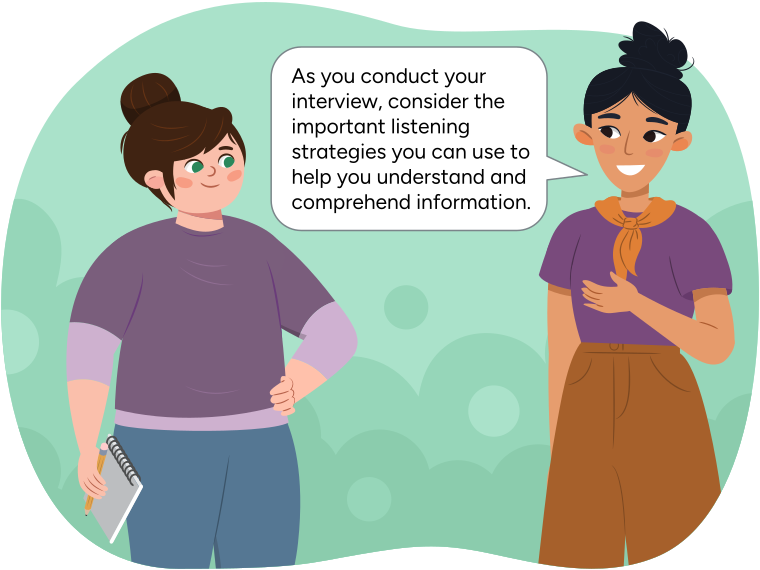
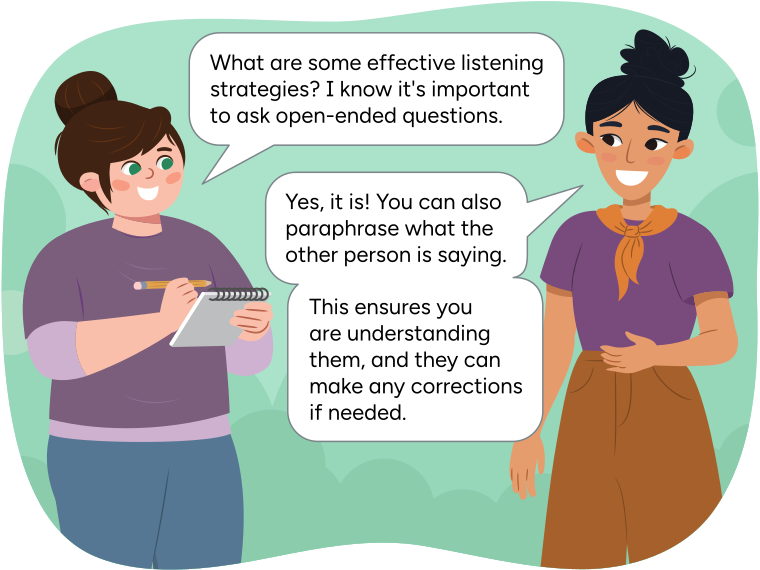
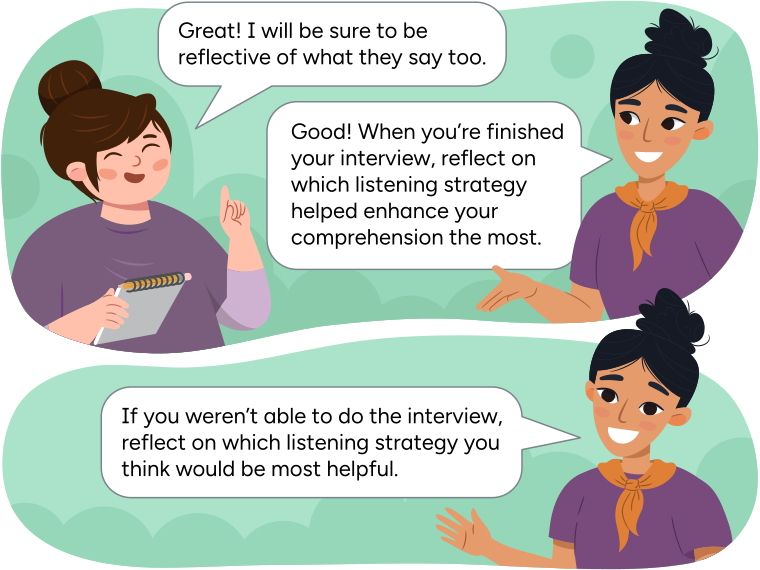
Image 1
Teacher Chelsea says to Student Sam: As you conduct your interview, consider the important listening strategies you can use to help you understand and comprehend information.
Image 2
Student Sam asks: What are some effective listening strategies. I know it's important to ask open-ended questions.
Teacher Chelsea responds: Yes, it is! You can also paraphrase what the other person is saying. This ensures you are understanding them, and they can make any corrections if needed.
Image 3
Student Sam says: Great! I will be sure to be reflective of what they say too.
Teacher Chelsea responds: Good! When you're finished your interview, reflect on which listening strategy helped enhance your comprehension the most.
If you weren't able to do the interview, reflect on which listening strategy you think would be most helpful.

Pause and Reflect
Pause and reflect
In a notebook or using another method of your choice, answer the following questions:
- Why is reclamation of Indigenous foods and culture important?
- Why is it important to learn about Indigenous histories, identities, perspectives, and truths?
- Consider the following sentence starter: “It’s important to learn about the histories of the cultural exchange of foods because…”. How would you complete the sentence?
- Based on what you learned from your interviews, research, or final task work, in what ways do you think your own cultural heritage impacts your identity?
Reflection
As you read the following descriptions, select the one that best describes your current understanding of the learning in this activity. Press the corresponding button once you have made your choice.

I feel...
Now, expand on your ideas by recording your thoughts using a voice recorder, speech-to-text, or writing tool.
When you review your notes on this learning activity later, reflect on whether you would select a different description based on your further review of the material in this learning activity.