Learning goals
We are learning to…
- analyze and explain how transferable skills can be used to support communication in various cultural, social, linguistic, and domain-specific contexts, and apply them when reading, listening to, viewing, and creating texts of various forms
- select and use a variety of listening strategies before, during, and after listening to analyze and comprehend information communicated orally and non-verbally, seek clarification, and identify relevant evidence to support a response appropriate to the context
- use precise and descriptive word choice, including domain-specific vocabulary from various subjects, and cohesive and coherent sentences during formal and informal communication, to support audience comprehension
- read and comprehend various complex texts, using knowledge of words, grammar, cohesive ties, sentence structures, and background knowledge
Success criteria
I am able to…
- explore the difference between community and individual choices and how they shape identity
- respond to comprehension questions after exploring texts about identity
- prepare and practice for a debate using appropriate speaking and listening strategies
- share my own personal reflection on individual choices and community and how they shape my own identity
What is community?

Your community includes your family, friends, school, and neighbourhood. It provides the social environment and cultural background that affect your values, beliefs, traditions, and behaviour.

Pause and Reflect
Pause and reflect
Based on this definition, write a short reflection on what community you belong to and how it shapes your identity.
In this learning activity you are going to be asked to debate on the following topic: What has more influence on identity: community or individual choices? As you explore, be sure to keep this topic in mind.
Exploring identity
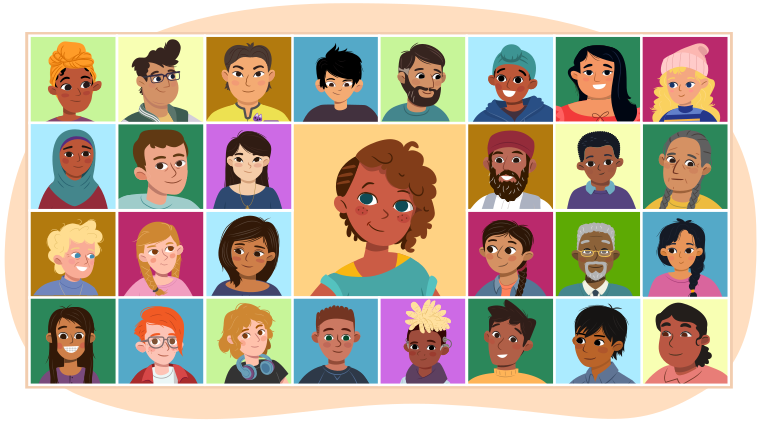
Identity is all about what makes you unique! It is like a big puzzle made up of different pieces that include your name, family, culture, interests, community, and even your personality. When you think about identity, think about how you see yourself and how others see you. It can be shaped by where you come from, the things you do, and the values you believe in. Understanding your identity helps you know yourself better.

Brainstorm
Brainstorm
What do you think contributes to each person’s individual identity? Brainstorm a list of ideas in a method of your choice.
Press Possible Answers button to compare your list of ideas with the suggested answers.
You likely brainstormed some of the following ideas: family, upbringing, culture, ethnicity, personal interests, hobbies, friends, social circles, languages, school, extra curriculars, beliefs, values, physical appearance, and much more.
The reality is, there are so many different pieces that fit together to form your identity! Your identity is also always changing and developing as you grow older and as your experiences change. Some parts of your identity might stay the same, but other parts might change.
What influences identity?
When it comes to shaping your identity, both community and personal choices play significant roles, but which of these two factors do you feel has more influence?
People can feel a strong connection to a certain community, but it is common for individuals to belong to more than just one. Your communities can include friends, schoolmates and teachers, people in your neighbourhood, or biological family members. A person’s experiences in a community or different communities can affect that person’s values, beliefs, traditions, and behaviours.

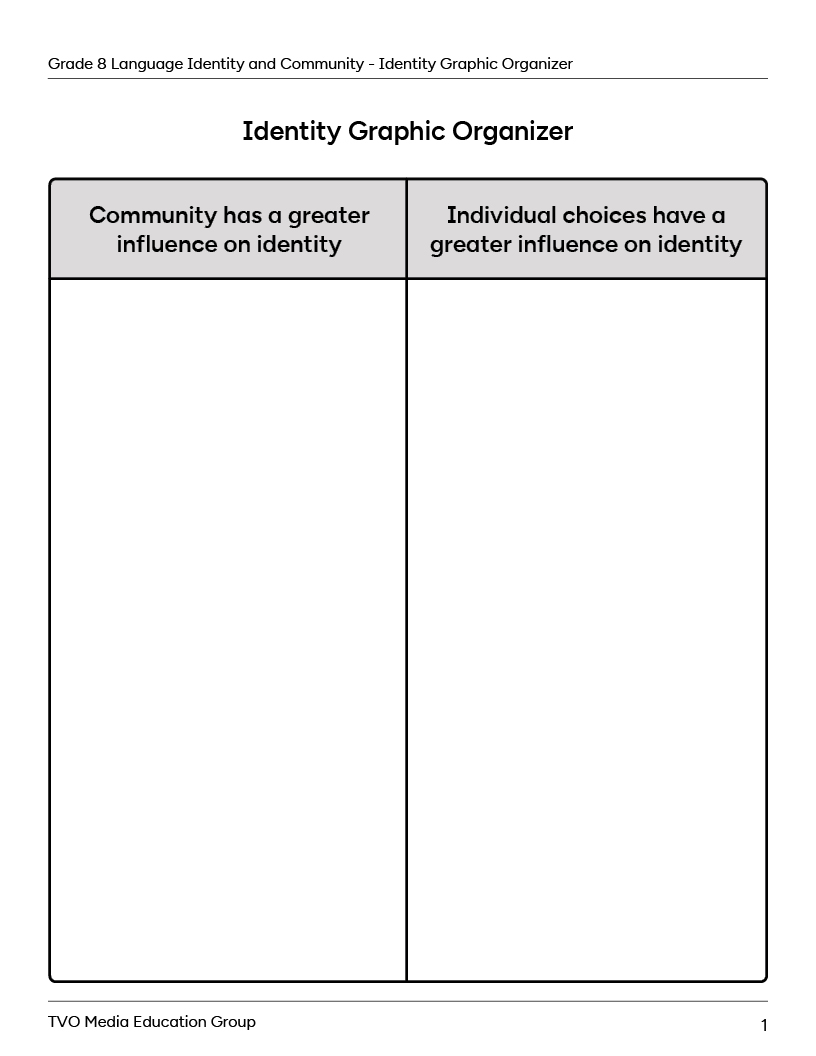
Later in the learning activity, you’ll be planning and participating in a debate. To help you prepare, organize the information and examples from this learning activity into two categories:
- Community has a greater influence on identity.
- Individual choices have a greater influence on identity.
You can use the following graphic organizer, or another method of your choice, to record your ideas and organize the content.
Complete the fillable and printable Identity Graphic Organizer in your notebook or using the following document. If you would like, you can use speech-to-text or audio recording tools to record your thoughts.
Identity and community
Community is a complex term that has many layers to it, but it ultimately has to do with the people within it.
Shared experiences with the people that surround us, or people that make up our community, create bonds, build a sense of belonging, and shape/influence the people that we are. In other words, these relationships and experiences help strengthen our identity.

Let’s explore a few text selections from the novel, The House on Mango Street by Sandra Cisneros. The House on Mango Street tells the story of a young Latina girl, Esperanza, who grows up in Chicago. She shares stories of her childhood and self-discovery.
As you explore the following excerpts from the text, consider how the main character’s identity is shaped by the people, places, and experiences that surround her – her community.
Read the following Selections from The House on Mango Street to find out more.

Press the Activity button to access the Selections from The House on Mango Street.
Activity(Opens in a new tab)Check your comprehension of the story by completing the following true or false questions.
Select the correct answer, then press Check Answer to see how you did.
Pause and Reflect
Pause and reflect
Take a moment to reflect on the chapters that you read and make connections between Esperanza’s community and her identity.
- What people, places, or experiences described in the text do you think might shape or give clues about who Esperanza is, or her identity?
Record your answers in a notebook or using another method of your choice. If possible, share your thoughts with a partner.
Preparing for a debate
Now that you’ve learned more about how individual choices and community impact identity, your task is to choose which of these two you think has a greater influence on identity. With this, you are going to prepare for a debate.
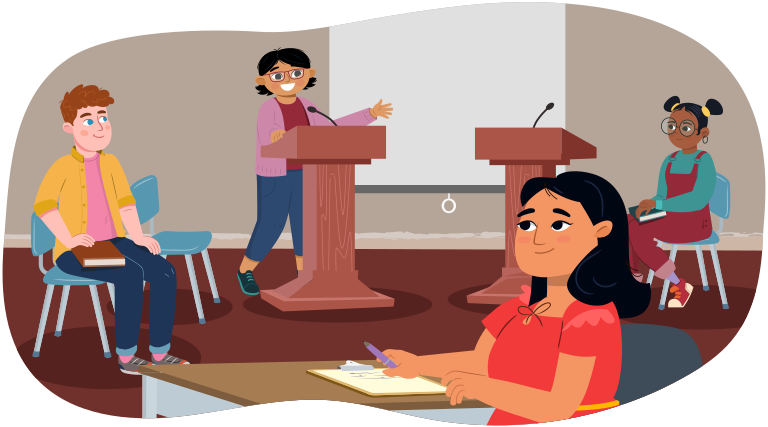
Debates are a structured conversation about a specific topic. Typically, two people or two groups of people present opposing views on a topic with each side trying to be the most convincing.
Before you begin your preparation, you will need to consider some speaking and listening strategies that are important for a debate. Let’s explore these concepts in the following section.
Strategies for a debate
Listening strategies for comprehension
When you are listening to information that is communicated orally, it is important to consider the listening strategies you can use before, during, and after listening to help you understand information and identify relevant information to support an appropriate response.
Press the following tabs to find out more.
- Research the topic so that you understand key terms, concepts, and relevant background information.
- Predict possible arguments from both sides.
- Set listening goals such as determining the main argument and supporting evidence.
- Prepare questions for the opposing side.
- Focus on the speaker without distractions, including making eye contact.
- Take notes with key arguments and evidence.
- Assess the credibility of the information being shared and be aware of bias.
- Stay neutral by keeping an open mind.
- Go over your notes and highlight key points.
- Reflect on how the debate changed or reinforced your understanding of the topic.
- Brainstorm responses to questions, questions to ask, and rebuttals.
Speaking purpose and strategies
Before speaking in both informal and formal contexts, it is important to consider your speaking purpose, audience, and strategies.
Press the following tabs to find out more.
Your speaking purpose is often to inform, persuade, or entertain the audience. What do you want to achieve? You should also consider the context. For example, a debate would be a more formal context that requires a certain structure.
Then, you should analyze the audience by considering the age, demographic or background, and interest of your audience. By adjusting your language and predicting how the audience may react, you can make your argument stronger and more convincing.
Lastly, by selecting appropriate speaking strategies for the context, you can ensure that your audience understands your arguments. Explore the following chart to learn more about appropriate speaking strategies for formal and informal contexts.
| Informal contexts | Formal contexts |
|---|---|
|
|
Brainstorm
Brainstorm
How do you think you can adapt speaking strategies during a debate to communicate clearly and coherently?
Press Possible Answers button to learn more.
Be sure to monitor audience reactions and feedback and adjust your tone and pace. Be sure to take the time to clarify if the audience appears confused. Be sure to manage your time.
Word choice, syntax, and grammar
In a debate, it’s very important to use clear, accurate, and descriptive words and to connect your sentences well to support audience comprehension. Debates can sometimes involve complicated topics, so being clear is essential to make sure your audience understands you.
By using descriptive word choice, you help to create a clear picture in your audience’s head, which makes your argument more interesting. Use descriptive adjectives and adverbs that add detail, and use words specific to the topic to communicate your ideas. Arrange your sentences in a logical order and use transitional words to connect phrases. It can be helpful to use “domain-specific vocabulary” (words that are specific to a field of study or to the topic) to show your knowledge and to make complicated ideas easier to understand.
Pause and Reflect
Pause and reflect
Based on what you just learned, what speaking and listening strategies do you feel will be most helpful for your debating? Record your ideas in a method of your choice.
Planning for the debate
Now it’s time to plan for the debate. Remember, the topic is “Does community or personal choice have more influence on identity?”
Your debate will include:
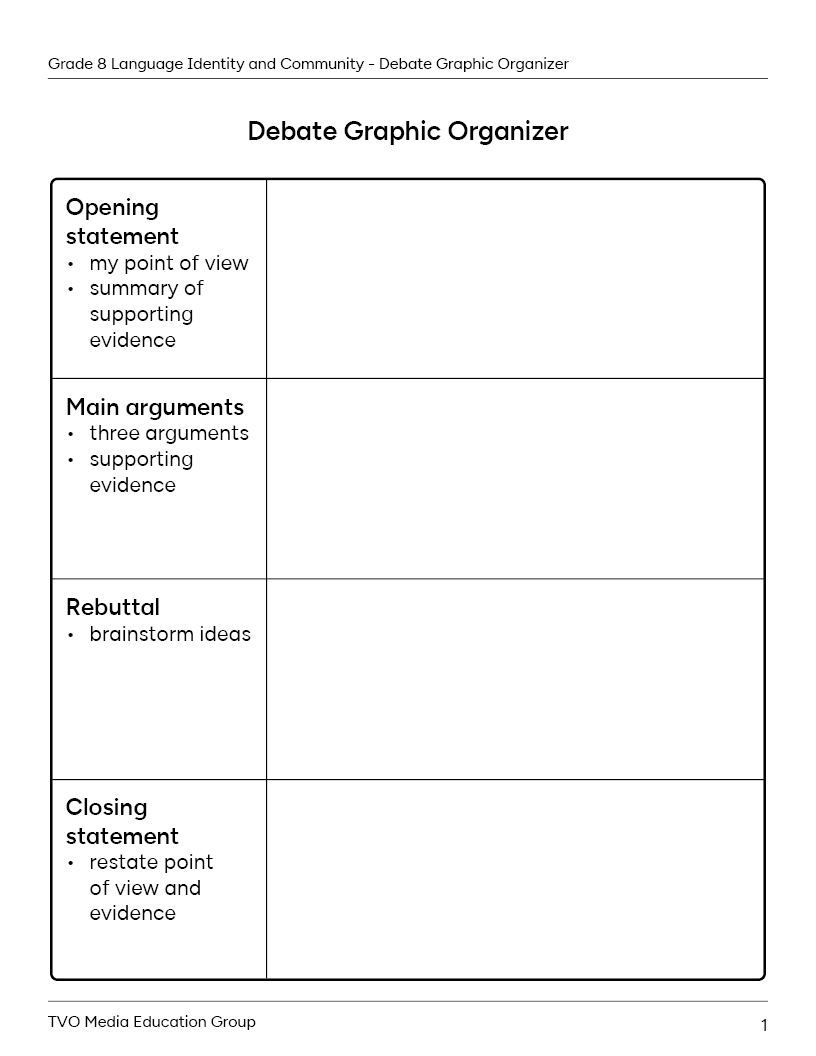
- an opening statement that presents your side and supporting argument (2 minutes)
- main arguments that include evidence (usually three arguments) (5 minutes each)
- rebuttal (respond to the other team’s arguments) (3 minutes)
- closing statement that recaps your argument and main points (2 minutes)
You can use the following graphic organizer, or another method of your choice, to organize your ideas. Be sure to reflect back on notes taken throughout the learning activity to inform your thinking.
Complete the fillable and printable Debate Graphic Organizer in your notebook or using the following document. If you would like, you can use speech-to-text or audio recording tools to record your thoughts.

Reading fluency
Now it’s time to practice your debate! When debating, especially for your opening argument, it is important that you practice and speak fluently.

Fluency is the ability to identify words correctly and read a text at an appropriate rate with ease, pace, automaticity, and expression. With proper phrasing and a focus on punctuation, the reader will gain more meaning from the text.
Re-read your opening argument several times, focusing on the following criteria.
Use the checklist provided to self-assess your own fluency. If possible, share your opening argument with someone else and ask them to provide feedback on your fluency.
Fluency checklist
Pause and Reflect
Pause and reflect
Based on the checklist, choose one area of fluency to focus on and set a goal for yourself. What strategies could you use to help you achieve this goal?

Social Emotional Learning
Social emotional

You’ve just explored how to prepare for a debate. Take a break before continuing onto the next part!

Verbs
Let’s learn all about verbs! A verb is a word that expresses an action, occurrence, or state of being. In this grammar routine, you will explore interrogative verbs, imperative verbs, forms of the verb “to be”, and linking verbs.
Press the following tabs to learn more about these concepts.
Interrogative verbs are used to ask questions. They are often used with auxiliary verbs (i.e., do, have, be) to form questions and often come at the beginning of a sentence or after question words (who, what, where, when, why).
Interrogative verbs are usually included in yes or no questions, such as “Did you go to the store?”, or in open-ended questions, such as “Where are you going?”.
Other examples include:
- Are your shoes on?
- Was the move enjoyable?
- Did the children get to school on time?
Check your understanding!
What is the interrogative verb in the following sentences?
- Are you aware of how your background influences your identity?
- Do you believe personal choices influence identity?
Press Answer button to check your answer.
- “Are”
- “Do”
Imperative verbs are used to create an imperative sentence. Often, but not always, it is found at the beginning of a sentence and gives an action that the speaker or writer wants someone else to do. The action might include issuing a command, giving directions or instructions, making a request, giving advice, or warning someone.
Imperative verbs are usually affirmative or negative. For example, “Close the door” is an affirmative verb and “Don’t leave the door open” is a negative one.
Other examples include:
- Please make sure you create strong passwords for online accounts. (affirmative)
- Don’t forget to check your privacy settings online. (negative)
- Pay attention to your online etiquette and well-being. (affirmative)
Check your understanding!
What is the imperative verb in the following sentences?
- Explore your interests and discover who you really are.
- Reflect on your experiences as part of your identity.
Press Answer button to check your answer.
- “Explore”
- “Reflect”
The verb “to be” has eight different forms. Let's explore this in the following visual below.
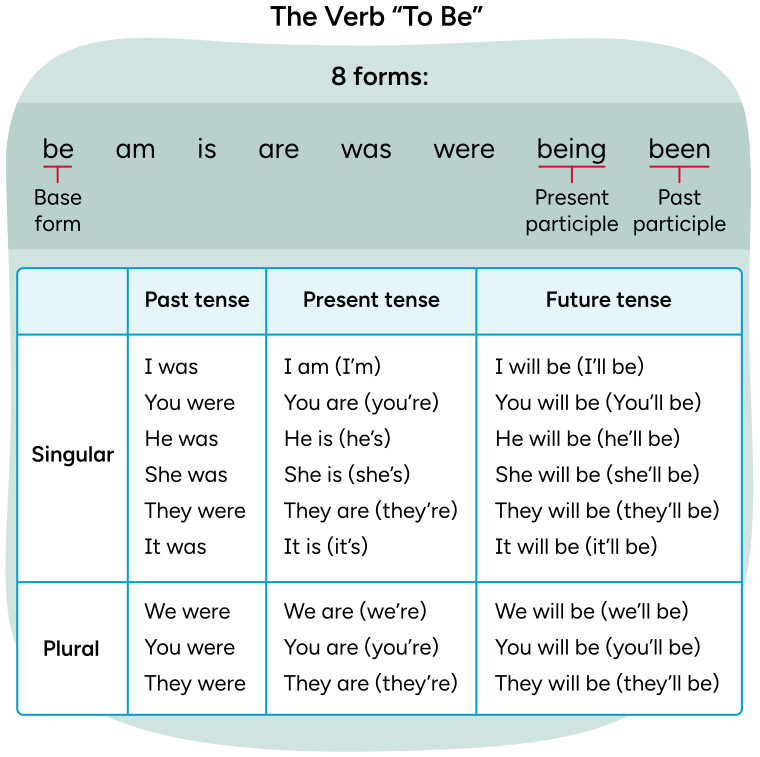
The Verb "To Be" has 8 forms: be (base form), am, is, are, was, were, being (present participle), and been (past participle). The Singular Past tense forms are: I was, You were, He was, She was, They were, and It was. The Plural Past tense forms are: We were, You were, and They were. The Singular Present tense forms are: I am (I'm), You are (you're), He is (he's), She is (she's), They are (they're), and It is (it's).The Plural Present tense forms are: We are (we're), You are (you're), and They are (they're). The Singular Future tense forms are: I will be (I'll be), You will be (You'll be), He will be (He'll be), She will be (she'll be), They will be (they'll be), and It will be (it'll be). The Plural Future tense forms are: We will be (we'll be), You will be (you'll be), and They will be (they'll be).
Check your understanding!
What form of the verb “to be” can be found in the following sentences?
- Identity is a blend of personal beliefs and cultural influences.
- Our sense of self was shaped by our childhood experiences.
- Understanding who you are helps in shaping your identity.
Press Answer button to check your answer.
- “is”
- “was”
- “you are”
Linking verbs are verbs that connect the subject of a sentence with an adjective, noun, or descriptive phrase. Unlike action verbs (that show an action), linking verbs describe a state of being or a relationship between the subject and the verb.
Examples of linking verbs are:
- appear
- look
- seem
- indicates
- go
- stay
- remain
- smell
- taste
- feel
- sound
- get
- come
- act
- is/was/will be
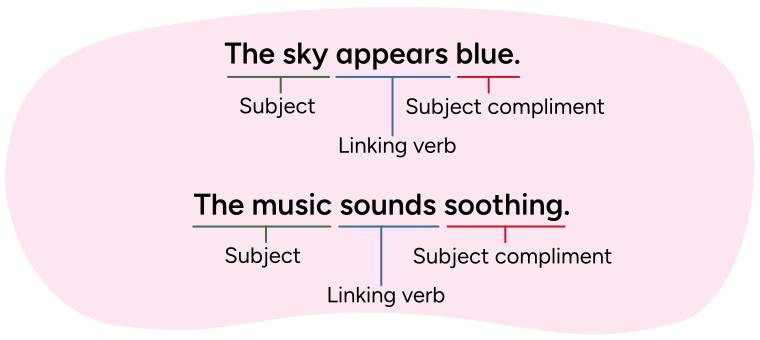
The linking verb falls between the subject, which is the person or object (thing) that the sentence is about, and the subject compliment, which is the word or phrase that identifies or describes the subject. Examine the following sentence structure to learn more.
How to use linking verbs in a sentence:
Subject + Linking verb + Subject compliment
Explore the following examples of how linking verbs are used in a sentence.
Check your understanding!
What is the linking verb in the following sentence?
- Your choices and values indicate who you are and contribute to your identity.
Press Answer button to check your answer.
“Indicate” is the linking verb.
Let’s check!
For each definition, select the corresponding verb form.
Putting it all together
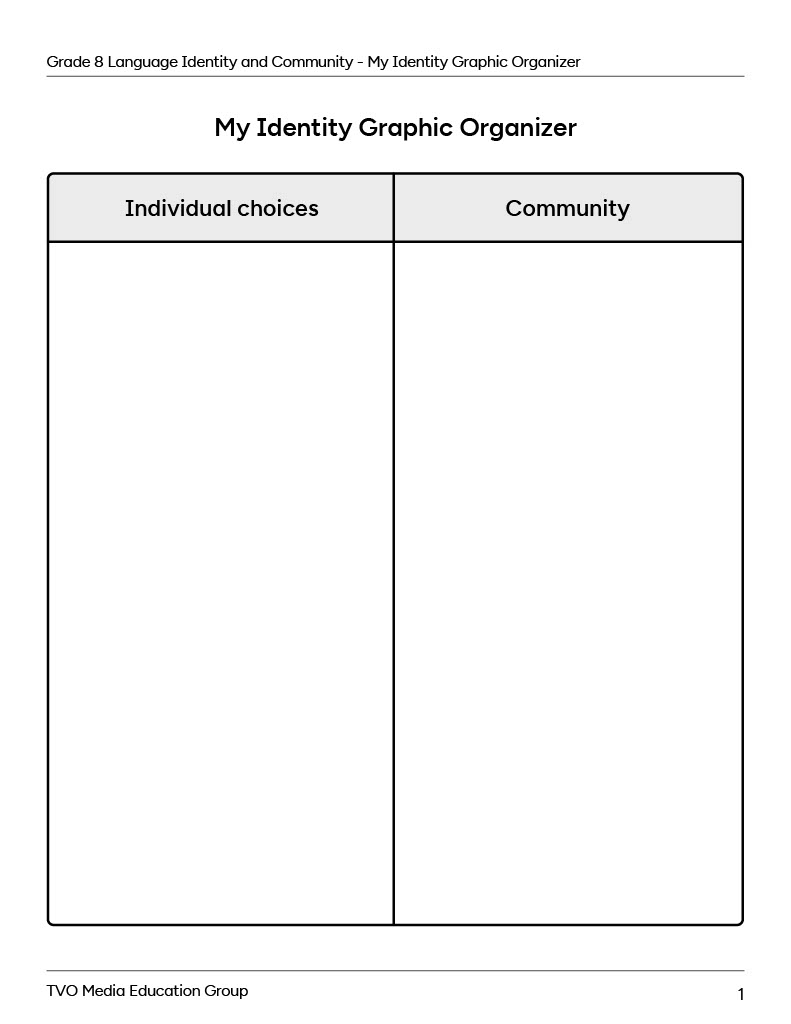
Consider your own identity. What individual choices and characteristics of your community are reflected in your identity? Record your ideas in the graphic organizer provided, or another method of your choice.
Complete the fillable and printable My Identity Graphic Organizer in your notebook or using the following document. If you would like, you can use speech-to-text or audio recording tools to record your thoughts.
Based on these lists, which do you think has a greater influence on your identity? Why?
Reflection
As you read the following descriptions, select the one that best describes your current understanding of the learning in this activity. Press the corresponding button once you have made your choice.

I feel...
Now, expand on your ideas by recording your thoughts using a voice recorder, speech-to-text, or writing tool.
When you review your notes on this learning activity later, reflect on whether you would select a different description based on your further review of the material in this learning activity.
Press Discover More to extend your skills.
Discover MoreIf possible, try the debate that you prepared for!
Once you have completed the debate, write a short reflection on what you learned from the debate. Use the following questions to guide your reflection:
- What did you learn?
- Did your opinion change at all?
- How did you feel about your performance in the debate?
- What listening and speaking strategies did you find most helpful? What would you like to try next time?