Learning goals
We are learning to…
- demonstrate an understanding of how to navigate online environments safely, manage our privacy, personal data, and security, and interact in a way that supports our well-being and that of others, including seeking appropriate permission
- connect, compare, and contrast the ideas expressed in texts and our knowledge and lived experiences, the ideas in other texts, and the world around u
- explain the explicit and implicit points of view, perspectives, and bias conveyed in texts, evaluate how various audiences might respond, and suggest ways to acknowledge other perspectives
- produce final texts using appropriate techniques and tools, including digital design and production tools, to achieve the intended effect
Success criteria
I am able to…
- identify how advertisements make me feel, and analyze how identities are shaped by the media, including recognizing stereotypes
- read and comprehend a text about social media and it’s influence on identity, making connections
- choose one of three options to create a project about media and identity and reflect on my own message, bias, and audience reaction
- give advice to a peer about navigating the internet safely and to recognize how the media influences our identities
How do advertisements make us feel?
Check out the following two videos of advertisements and consider who is represented, who is being targeted, and how the advertisements make you feel.

Pause and Reflect
Pause and reflect
After exploring the videos, consider the following questions. Record your answers in a notebook or using another method of your choice.
- What identities are represented in these pieces of media?
- Are there any stereotypes that are represented? If so, how might this influence the audience’s self-perception or identity?
- Whose perspectives are missing from this media?
- What connections can you make with either of these advertisements? Consider text-to-self, text-to-text, or text-to-world connections.
If possible, share your thoughts with a partner.
Identity and media
Media is used to pass information along to many people in society. The information shared is typically used to inform, persuade, or entertain people.

Brainstorm
Brainstorm
What types of media can you think of?
Press Possible Answers button to compare your answers with list provided.
Different forms of media include television, radio, print advertisements, newspapers, magazines, YouTube, social media, digital advertisements, and much more.
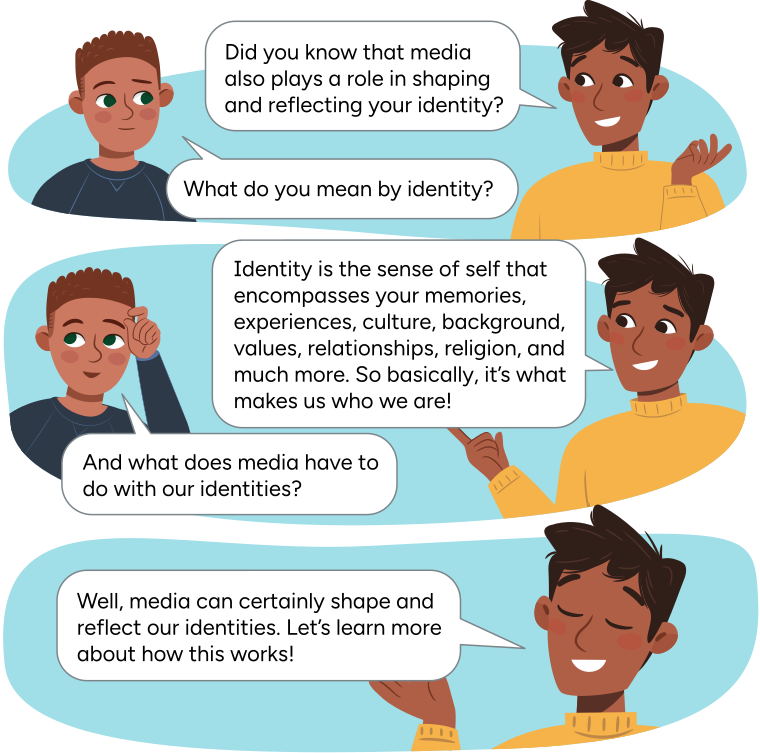
A teacher and student having a conversation.
Teacher: Did you know that media also plays a role in shaping and reflecting your identity?
Student: What do you mean by identity?
Teacher: Identity is the sense of self that encompasses your memories, experiences, culture, background, values, relationships, religion, and much more. So basically, it’s what makes us who we are!
Student: And what does media have to do with our identities?
Teacher: Well, media can certainly shape and reflect our identities. Let’s learn more about how this works!
Check out the following video to learn more about how media shapes the way we view the world.
Based on this video, how does media influence identity?
Media can build identities, determine behaviours, and forge our dreams. When our brains see the same information over and over, it will impact how we view the world and make meaning from what we’ve seen.
Let’s explore different ways that media shapes identity in the following carousel of images.

Media influences identity through self-perception (how we see ourselves). It sets a standard for beauty, success, and behaviour that influences the way people think about themselves. Sometimes these standards influence self-esteem and self-worth.
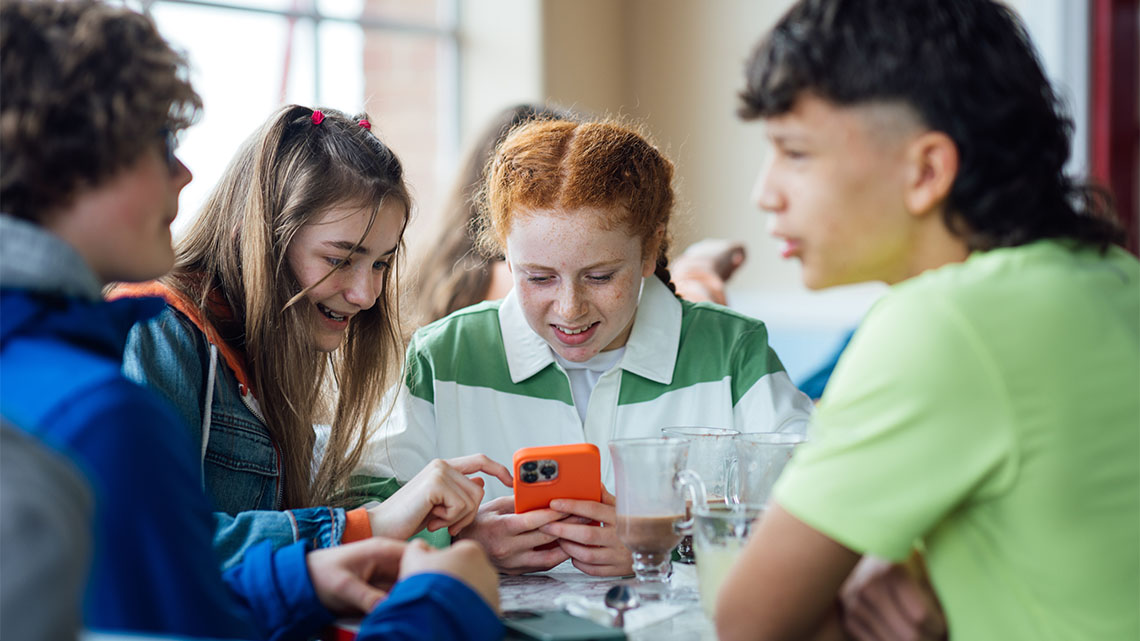
Media portrays norms and values that are accepted in society, and these portrayals can influence a person’s beliefs or behaviours, shaping their identity.

Media can promote cultural heritage and traditions and can help people learn about different cultures. It can also spread cultural stereotypes and bias, which can affect how people see themselves and others.

Media may perpetuate stereotypes about gender, race, ethnicity, and other social categories. These can influence how individuals view themselves, shaping identity.
Next, let’s explore an article about social media and identity adapted from the journal Current Psychology. The original article was written by Vanesa Pérez-Torres and titled Social media: a digital social mirror for identity development during adolescence (2024). As you explore, make jot notes about how identity and social media are connected.
Press Student Tips button to learn more about making jot notes.
A jot note is a brief, informal sketch or note that is made quickly when reading. Jot notes should be brief and concise and highlight key information.
Access the following Social Media and Identity article to complete the activity.
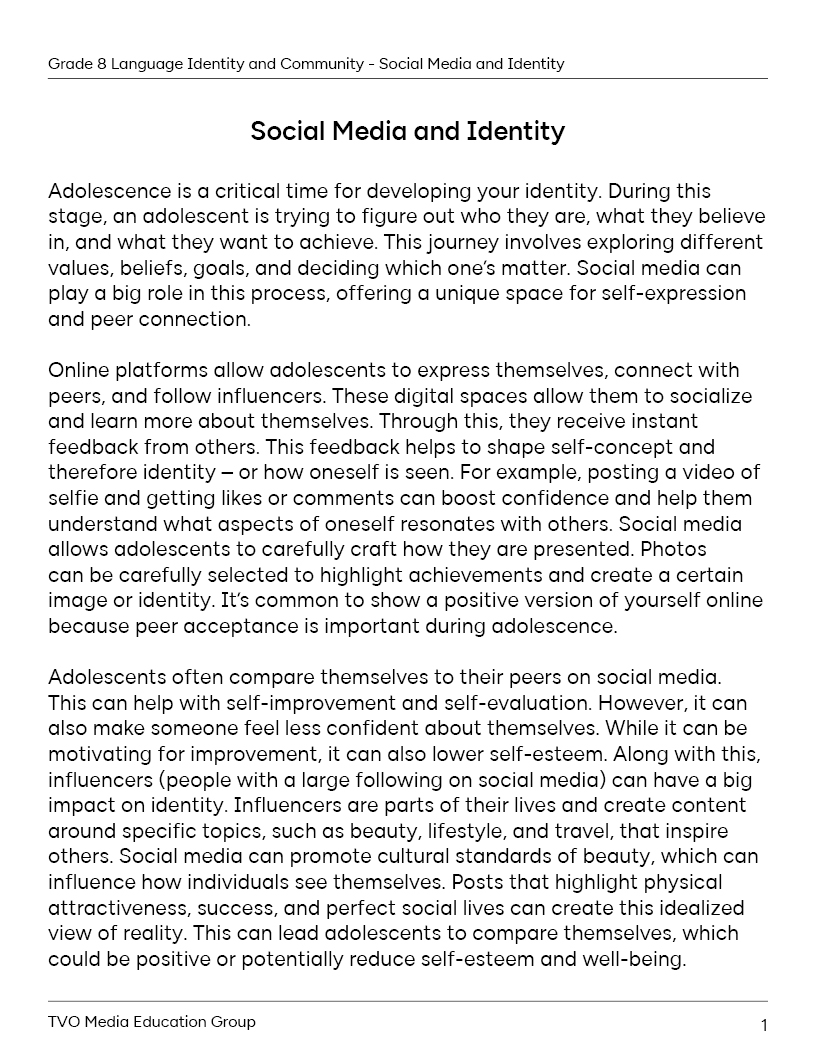
Check your understanding of the article you just read by completing the following true or false questions.
Select the correct answer, then press Check Answer to see how you did.
Let’s analyze the article further! Respond to the following short answer questions in a method of your choice.
- What connections can you make with this article? Consider your own use of social media and how you feel it impacts your identity.
- Create a list of how social media can negatively and positively impact your identity. Begin with ideas from the article and add your own ideas as well.
Press Student Tips button for additional tips on how to answer these questions, and to learn more about what it means to make connections with the text you read.
Making connections is a comprehension strategy that allows you to better understand the text you are exploring. When making connections, it is important to draw on your prior knowledge and experiences to better understand what you are reading and viewing. There are three types of connections you can make:
- Text-to-self connections: can you connect anything you’ve read with your own personal life and experiences?
- Text-to-text connections: can you connect the text with another text you’ve explored?
- Text-to-world connections: can you connect the text with something you’ve learned about in the past or something going on in the world?
Writing assignment
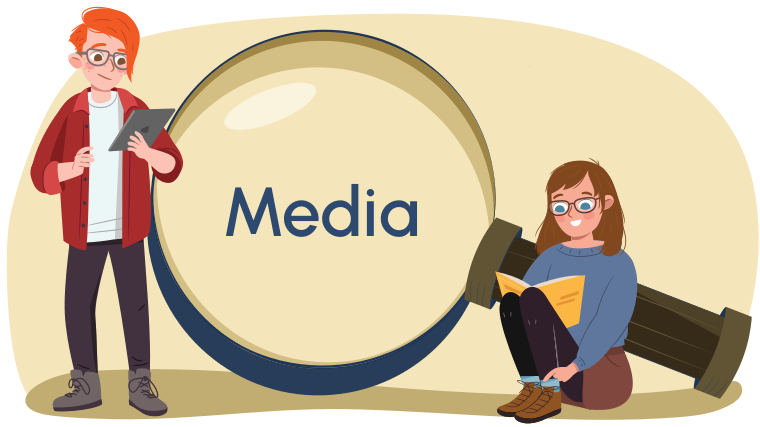
For this writing assignment, you will create a media-based writing piece that explores identity and media. Then you will evaluate your own work for bias, point of view, and perspective.
This assignment has four steps, which are provided in the following section. As you work through the steps, you can complete your work in the graphic organizer provided, or another method of your choice.
Complete the fillable and printable Graphic Organizer in your notebook or using the following document. If you would like, you can use speech-to-text or audio recording tools to record your thoughts.
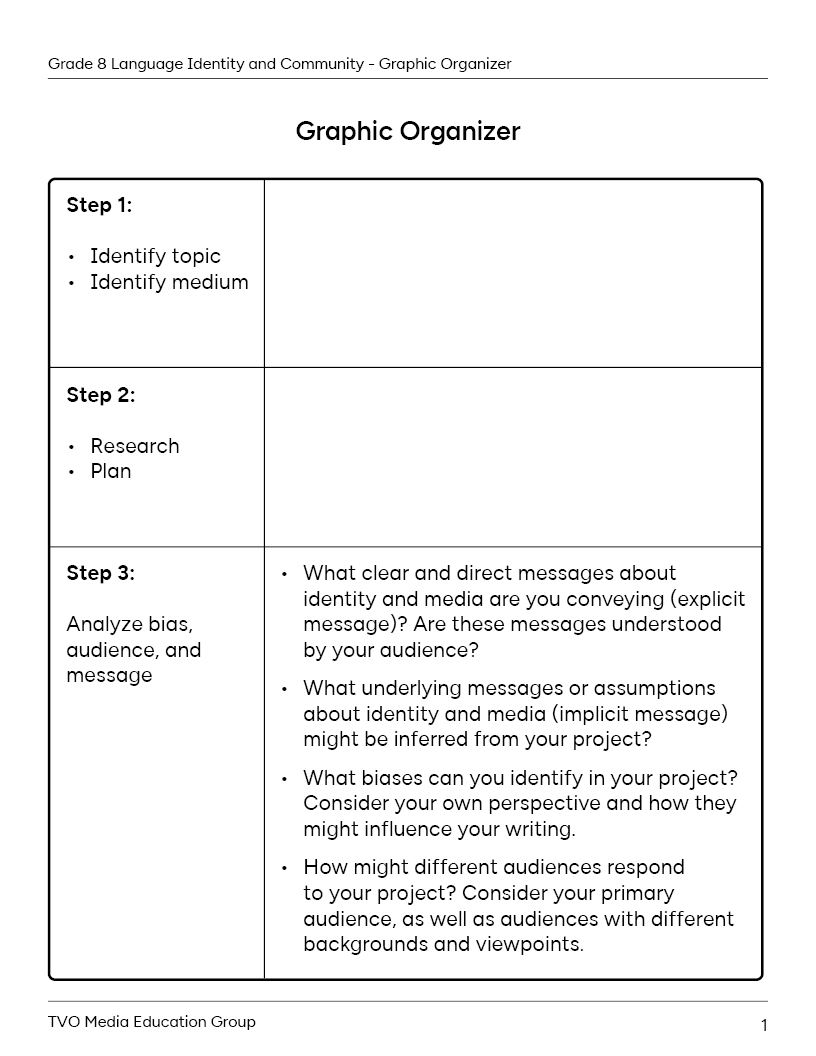
Press the following tabs to access the step-by-step instructions for this assignment.
Choose one of the following topics, or another topic related to media and identity, that you will create your piece on:
- How does social media impact identity?
- How are different identities represented in media?
- How can media influence cultural identity?
- What personal experiences do you have with media shaping your identity?
Choose a medium for your topic. Choose one of the following, or another method of your choice:
- Essay: write a traditional five paragraph essay about your chosen topic
- Personal narrative: write a story or reflection of your own life related to the topic
- Multimedia project: create a video, blog post, podcast, or slideshow that address your topic
Use information that you’ve learned through this learning activity, and additional research if you wish, to gather information and examples related to your topic. Organize your ideas so that they can follow the structure of the medium you’ve created.
For example, consider what subheadings or themes you may have for each paragraph or section in your writing piece.
Create your project! Be sure to express your ideas about identity and media clearly and use specific examples to support your thinking. Consider how you represent different identities and perspectives.
After completing your project, you are going to analyze implicit and explicit messages, bias, and audience response. Use the following questions to guide your thinking.
- What clear and direct messages about identity and media are you conveying (explicit message)? Are these messages understood by your audience?
- What underlying messages or assumptions about identity and media (implicit message) might be inferred from your project?
- What biases can you identify in your project? Consider your own perspective and how they might influence your writing.
- How might different audiences respond to your project? Consider your primary audience, as well as audiences with different backgrounds and viewpoints.
Press Bias Definition button to learn more about what the word “bias” means.
Bias means an opinion, preference, prejudice, or inclination that limits an individual’s or group’s ability to make fair, objective, or accurate judgements. Bias may occur in any text.
Explicit bias refers to attitudes and opinions that are consciously held and conveyed in texts. Implicit bias refers to unconscious attitudes or stereotypes conveyed in texts that may influence an audience’s thoughts, feelings, and behaviour.

Media and identity vocabulary
Throughout this learning activity, there were new vocabulary words used. Using the clues from the text, record what you think each of the following words might mean in a method of your choice.
Once you have recorded your own answer, press the flip button to reveal the definition on the other side of the card, and add it to your vocabulary notebook, personal dictionary, portfolio, or another spot of your choice.
Use the arrow keys to navigate between cards. Press on the audio button to hear the accompanying audio.

Social Emotional Learning
Social emotional learning

You’ve just explored ideas and vocabulary related to media and identity. Take a break before continuing onto the next part!

Pronouns
Let’s explore pronouns in this learning activity. A pronoun is a word that replaces a noun. You are going to be exploring relative pronouns, intensive pronouns, and reflexive pronouns in the following section.
Press the following tabs to find out more about each type of pronoun.
Relative pronouns link independent and dependent clauses. There are a few relative pronouns in the English language that can be used for different things.
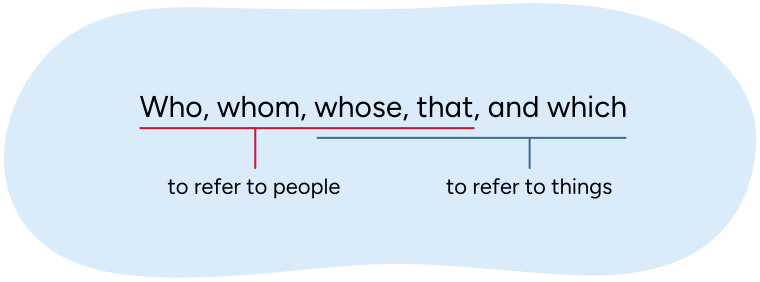
An intensive pronoun intensifies the subject of a sentence. For example:
- Many teenagers themselves find that their identities are influenced by the media they consume.
- The media itself often portrays unrealistic standards that people might strive to emulate.
A reflexive pronoun reflects directly back onto the subject of the sentence. For example:
- Many people find themselves questioning their identities after comparing themselves to images seen on social media.
- We often define ourselves by the standards set by media, which can sometimes distort our true sense of identity.
Let’s take a moment to practice what we have learned by completing the following fill-in-the-blank activity!
Which relative pronoun do you think belongs in each of the following sentences? For each sentence, select the missing word from the drop-down menu. Press Check Answer to see how you did.
Which intensive pronoun do you think belongs in each of the following sentences? For each sentence, select the missing word from the drop-down menu. Press Check Answer to see how you did.
Which reflexive pronoun do you think belongs in each of the following sentences? For each sentence, select the missing word from the drop-down menu. Press Check Answer to see how you did.
Let’s check!
Check your understanding of the grammar routine by completing the following sorting activity. Sort the following sentences into relative, intensive, and reflexive based on the pronouns used.
Place the cards into categories that best match. Use the arrow buttons to navigate between cards.
Putting it all together

As your final task, you will be selecting a media piece of your choice, such as a television show, movie, advertisement, commercial, social media post, and the like, for analysis.
Once you’ve selected a media piece, respond to the following questions in a method of your choice.
- What identities are represented in this media?
- Are there any stereotypes or biases that are represented?
- How may this influence the audience’s self-perception or identity?
- What are the explicit (clear and direct) and implicit (underlying messages) in your media piece?
- How do you think different audiences would react to the media piece?
- Whose perspectives are missing from this media?
Include a reflection, using the following questions to guide your response. Make sure to use text evidence to support your response.
- What advice would you give a peer regarding social media and identity?
- How do you think navigating online environments safely would help maintain a positive identity?
Reflection
As you read the following descriptions, select the one that best describes your current understanding of the learning in this activity. Press the corresponding button once you have made your choice.

I feel...
Now, expand on your ideas by recording your thoughts using a voice recorder, speech-to-text, or writing tool.
When you review your notes on this learning activity later, reflect on whether you would select a different description based on your further review of the material in this learning activity.