Learning goals
We are learning to…
- show an understanding of the forms, conventions, and techniques of a variety of media texts
- use effective listening skills by expressing interest, asking a variety of questions, and restating what we heard
- identify ways in which specific design choices share meaning in a variety of texts
- identify perspectives in texts through examples and describe how these perspectives could influence an audience
- share my thoughts and feelings about ideas in texts about difference, sense of belonging, and removing barriers
- brainstorm using simple strategies and develop ideas about various topics using resources, our own learning, and our own experiences
Success criteria
I am able to…
- explore and describe the ways that advertisers create advertisements in different forms to catch their audience’s attention
- use effective listening skills while watching a video advertisement and answer questions about the advertisement
- identify ways in which specific design choices share meaning in advertisements
- identify how an advertiser might create an advertisement to convince their chosen audience to buy their product
- explore and share my thoughts about different breakfast dishes around the world
- brainstorm and develop ideas to create my own advertisement
What’s the message?
Explore the following advertisement.
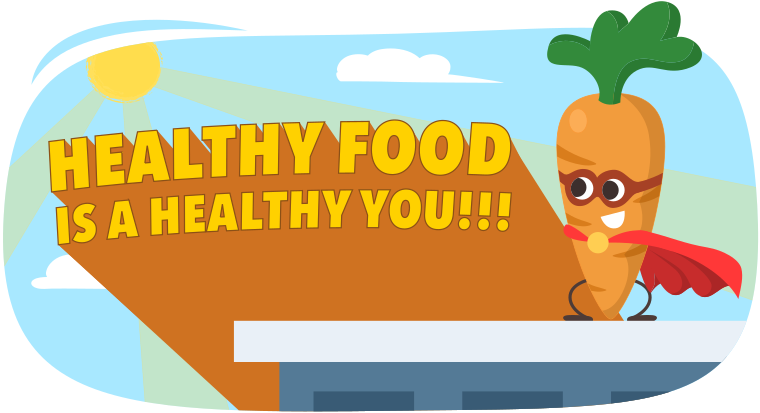
An advertisement that shows a cartoon carrot dressed like a superhero, wearing a mask and a cape, standing on top of a tall building. In the background there is a blue sky with a few clouds and a bright, shining sun. Next to the carrot character are the words "HEALTHY FOOD IS A HEALTHY YOU!!" The words are in big, bold letters.
Press Advertisement to access a definition.
Advertisements are information which tells people about products, services, or events that are happening. Advertisements can be shared using different kinds of media, such as:
- print media
- broadcast media
- digital media
- out-of-home media
Advertisements can also be called ads.
What do you notice about the previous advertisement?
What kind of message do you think it shares?
Advertisements
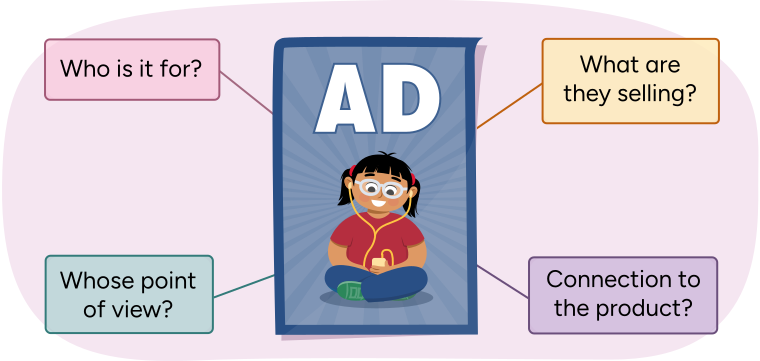
A poster with the word "AD" and a child sitting with headphones on. Next to the poster are four questions: Who is it for? What are they selling? Connection to the product? Whose point of view?
The main purpose of advertisements is to grab people’s attention to buy a product, to attend an event, or to learn something new.
Advertisements can be found in different kinds of media, such as:
- print media (such as magazines)
- broadcast media (such as television and radio)
- digital media (such as websites and podcasts)
- out-of-home media (such as billboards and posters)
Most media texts use one or more of the following to share a message:
- words
- sounds
- images
- shapes
Advertisements use different ways to try to get us to buy their product.
One way is to tell a story that gets the viewer to feel a certain emotion.
For example, an advertisement might make someone feel excited or happy. Explore the following carousel of students expressing excitement.



Advertisements try to make us feel emotions like excitement or happiness so we’ll want to buy the product they’re selling!
Have you ever felt an emotion after seeing an advertisement?
Record your thoughts or share with a partner, if possible.
Let’s explore ads!
Let’s take another look at the advertisement from Minds On.
The purpose of this advertisement is to sell a product.
The following image shows how the advertiser used many ways to catch the attention of the viewer.
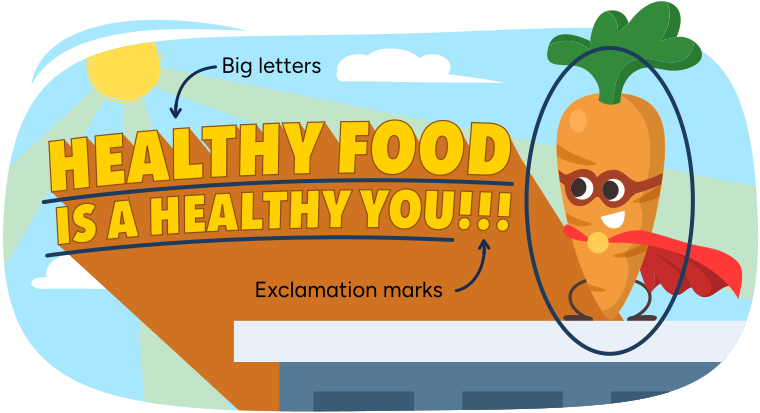
An advertisement that shows a cartoon carrot dressed like a superhero, wearing a mask and a cape, standing on top of a tall building. In the background there is a blue sky with a few clouds and a bright, shining sun. Next to the carrot character are the words "HEALTHY FOOD IS A HEALTHY YOU!!" in big, bold letters. The advertisement is marked up to emphasize certain elements. The carrot character is circled, and the words are underlined. An arrow connects the words to the label "Big letters". A second arrow connects the exclamation marks at the end of the phrase to the label "Exclamation marks"
This advertisement uses images, words, and shapes.
It has:
- big bold letters
- exclamation marks to show that their message is important
- a catchy or interesting phrase
- a cartoon showing how you can become a superhero if you eat healthy food
- lots of colours
Have you seen an advertisement before? If so, what kind of media was it?
Was it for a product, service or event?
Press Reveal to find out more about products, services, and events.
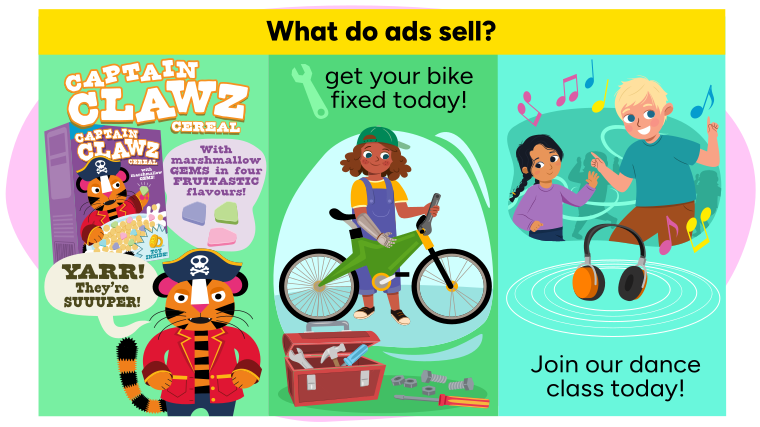
Three advertisements appear below the question "What do ads
sell?"
The first ad has the words CAPTAIN CLAWZ CEREAL in big, crooked letters
at the top. Below the words, there is a cereal box with CAPTAIN CLAWZ
CEREAL at the top, and a cartoon tiger dressed as a pirate. The tiger is
holding up a gem-shaped marshmallow and there is a bowl of brightly
coloured cereal in front in front of it. The words "Toy Inside!" appear
in the bottom corner of the box. Next to the cereal box are three
differently coloured gem-shaped marshmallows and the words "With
marshmallow GEMS in four FRUITASTIC flavours!" At the bottom of the ad,
the same cartoon tiger dressed as a pirate is saying "YARR! They're
SUUUPER!"
The second ad has the sentence, "get your bike fixed today!" next to an
image of a wrench. Below the sentence is a child with a bike, holding a
wrench. There is a toolbox on the ground near the bike with tools inside
and some tools laying next to it. There is a wrench, a hammer, screw
drivers, and some nuts and bolts.
The third ad shows some kids dancing to music. There are music notes
around them, and they are smiling and moving their bodies. A pair of
headphones is shown above the sentence "Join our dance class today!"
Share your thoughts with a partner, if possible.
Who is the audience?
When an advertiser creates an advertisement, they think about:
- how to describe the product in an interesting way
- who the audience will be
- how to grab the audience’s attention
Comparative adjectives
An adjective is a word that describes something.
Explore the following carousel of examples of adjectives:

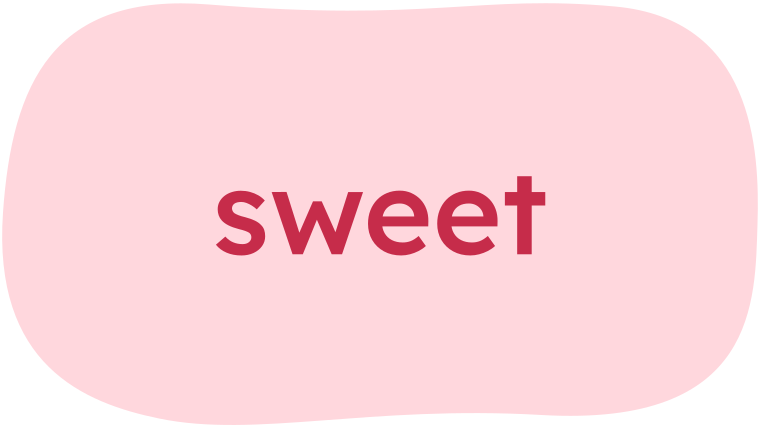
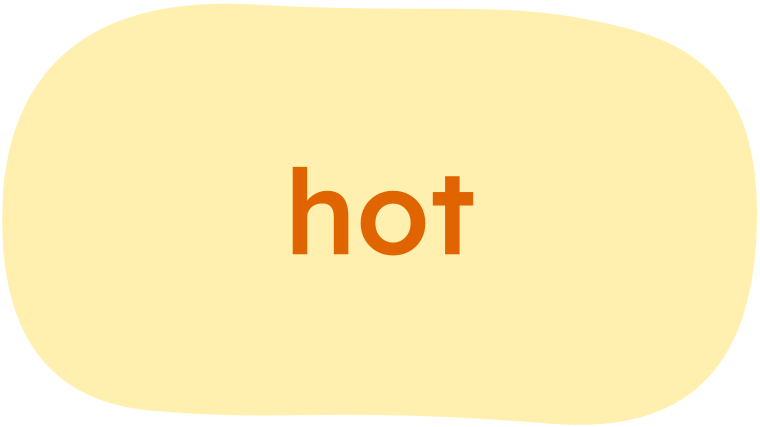

Comparative adjectives are adjectives that are used when you are comparing something to something else. To make an adjective comparative, we add ‘er’ to the end of the adjective.
Today is colder than yesterday.
This cereal is tastier than the other one.
Practice!
Let’s practice turning these adjectives into comparative adjectives!
Add an ‘er’ to the end of each word to turn it into a comparative adjective. Record these words in your personal dictionary.
- warm (Blank) (Blank)
- old (Blank) (Blank)
- great (Blank) (Blank)
- kind (Blank) (Blank)
- short (Blank) (Blank)
- bright (Blank) (Blank)
Now let's practice completing sentences by filling in the comparative adjective!
For each sentence, select the missing comparative adjective from the drop-down menu. Press Check Answer to see how you did.
Exploring more ads!
Let’s explore another advertisement!
Watch the following video to see an advertisement for Space Puffs Cereal.
What is the product that is being advertised?
Press Reveal to check your answer.
The product is Space Puffs cereal.
What are some of the ways the advertisement catches your attention?
Press Reveal to check your answer.
This advertisement uses images, sounds, words, and shapes.
It uses different colours and tells us that this cereal is special because it has space-shaped marshmallows.
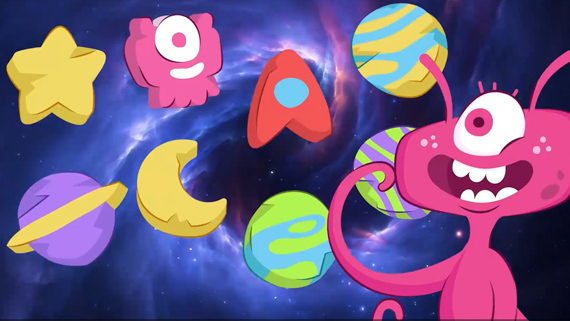

The advertisement uses words and images to tell us the cereal also comes with a free toy.
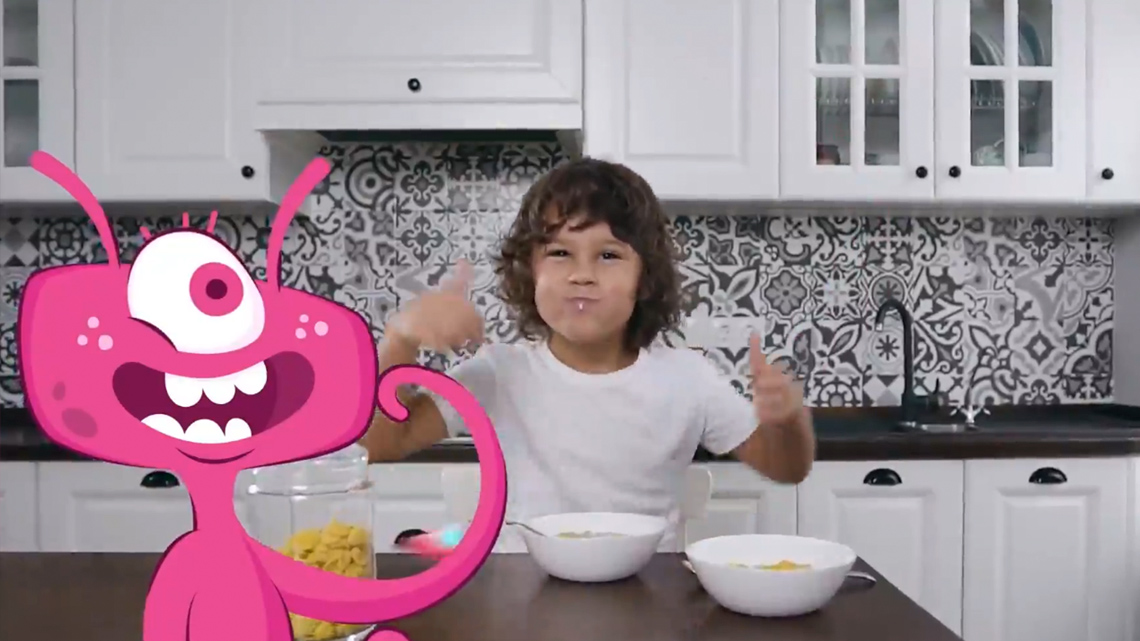
Who is the audience for this advertisement?
Press Reveal to check your answer.
I think this advertisement is for kids because there is a kid eating the cereal in the video. They give a thumbs up after trying it, which makes me think that they like it.

How did you feel while watching the advertisement?
Share your thoughts with a partner, if possible.
Breakfast around the world!
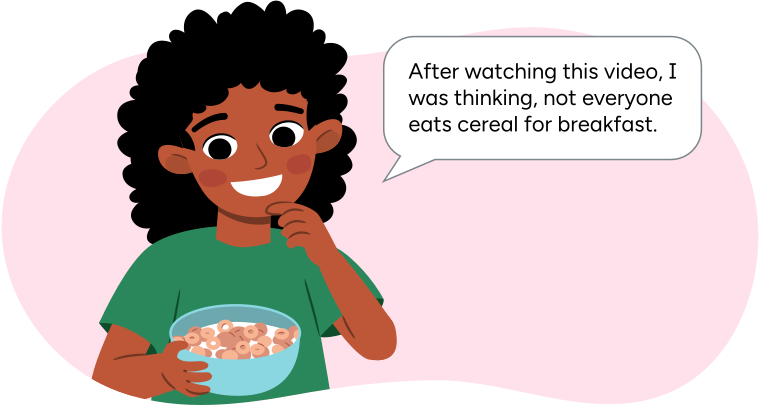
Sometimes when we see advertisements, they are not for everyone.
Ads may be talking about things only some people will like, or they may be trying to reach a certain group of people, like adults – or kids!
Let’s explore a few examples of foods that people eat for breakfast around the world!
What would be your best breakfast ever?
How would you describe the dish?
Share your thoughts with a partner, if possible.
Putting it all together

Select any dish eaten for breakfast in a country around the world. You may choose a dish we explored in Action or another dish of your choice.
Think about how you would advertise your chosen breakfast dish.
Which type of media would you create?
- print media (such as magazines)
- broadcast media (such as television and radio)
- digital media (such as websites and podcasts)
- out-of-home media (such as billboards and posters)
What would you use to share your message?
- words
- sounds
- images
- shapes
Complete the fillable and printable Breakfast Advertisement Template in your notebook or using the following document. If you would like, you can use speech-to-text or audio recording tools to record your thoughts.
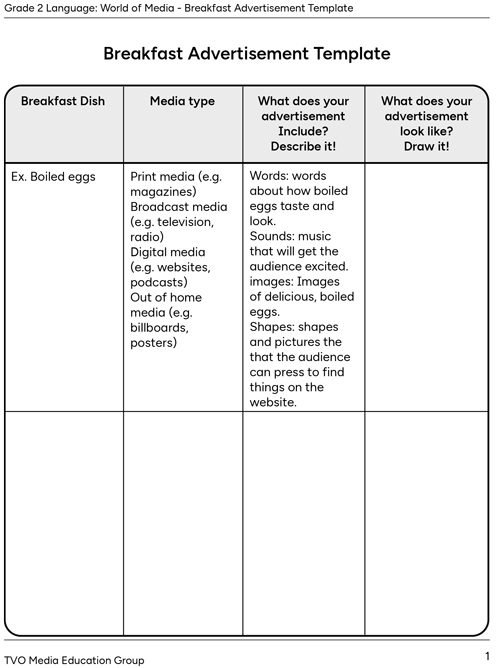
Press the Activity button to access the Breakfast Advertisement Template.
Activity(Opens in a new tab)Let’s review!
Now that we’ve explored some breakfast traditions from around the world, let’s review our learning!
For each breakfast dish, select the matching image.
Nichols, D. (2019, January 17). What Breakfast Looks Like in 49 Countries. The Daily Meal. https://www.thedailymeal.com/1362823/what-breakfast-looks-like-49-countries
Reflection
How do you feel about what you have learned in this activity? Which of the next four sentences best matches how you are feeling about your learning? Press the button that is beside this sentence.

I feel...
Now, record your ideas about your feelings using a voice recorder, speech-to-text, or writing tool.