Learning goals
We are learning to…
- understand the rights and responsibilities of digital citizenship
- navigate online environments safely in a way that respects the well-being of others
- use various comprehension strategies to read narrative text
- explore different literary devices
- communicate online in a safe, respectful, responsible, and inclusive manner
Success criteria
I am able to…
- explain in my own words what digital citizenship means to me
- identify potential online challenges and conflicts and identify appropriate etiquette for handling them
- make correct predictions, connections, and inferences about a narrative text
- explain how literary devices impact the tone and intended audience of a text
- model appropriate online communication through conversation, role-play, scripting, written responses, etc.
T.H.I.N.K.!
Do you know what an acrostic is? Acrostics are poems or pieces of writing where the first letter in each line of the text spells out a word.
The following acrostic offers advice about considering our words before we speak.
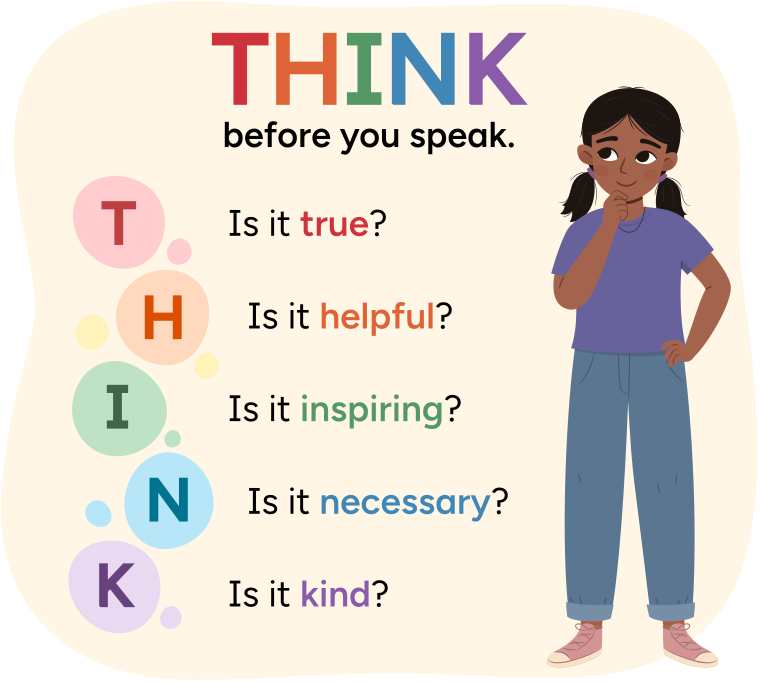
THINK before you speak. THINK is an acronym. It stands for:
T: Is it true?
H: Is it helpful?
I: Is it inspiring?
N: Is it necessary?
K: Is it kind?
Let’s take a closer look at the first reminder, T = “Is it true?” This reminds us that if we aren’t sure whether or not something is the truth, we shouldn’t say it or repeat it.

Try It
Try it
What meaning can you make of the other four reminders? In your own words, explain what each of them means to you. Record your answers in a notebook or using another method of your choice. If possible, share your thoughts with a partner.
Online actions like messaging, posting, sharing, commenting, liking/reacting, etc., are all forms of digital communication.
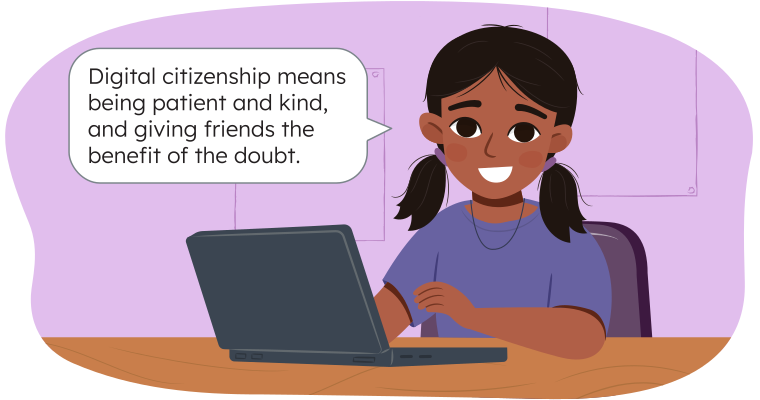
When interacting with others online, it is important to be safe, respectful, responsible, and inclusive. This is part of digital citizenship. Digital citizenship is the ability to navigate digital environments in a way that is safe, responsible, and respectful for ourselves and others.
Consider: How could the “T.H.I.N.K.” prompts apply to online communication?
Reread the acrostic again; this time, think about how each of the five prompts could help someone demonstrate good digital citizenship. Try and create one rule for good digital citizenship for each line of the “T.H.I.N.K.” acrostic.
Complete the fillable and printable List of Rules for Good Citizenship in your notebook or using the following document. If you would like, you can use speech-to-text or audio recording tools to record your thoughts.
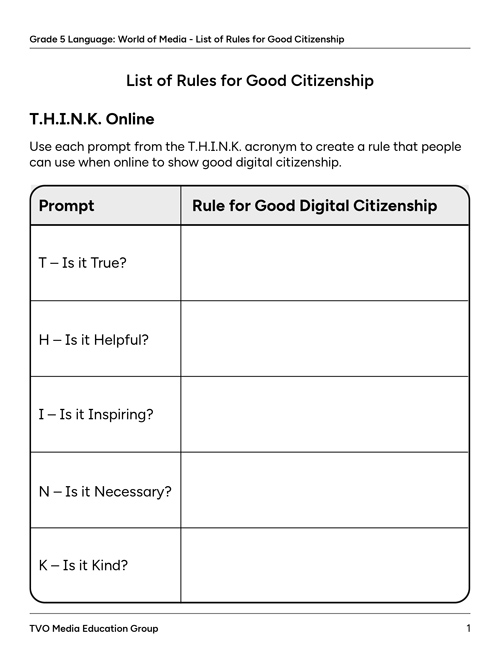
Press the Activity button to access the List of Rules for Good Citizenship.
Activity(Opens in a new tab)In this learning activity, you will develop digital citizenship strategies that you can apply in your everyday life.
Practicing digital citizenship: check your tone
Digital communication has lots of benefits and can be a lot of fun. It can also be tricky. When we communicate in person, our tone of voice, our facial expressions, and our body language help us to communicate our message clearly and effectively. But when we communicate digitally, our message can be easily misunderstood.

Pause and Reflect
Pause and reflect
Think about the following questions:
- Do you know someone who made a joke in a typed or written note, then second-guessed if the person who received the note got that it was just a joke?
- Do you know someone that has received a typed or written note and then worried that the person who sent it was mad at them?
Interpreting written messages can be challenging because words can be read with different tones and emotions. Changing where we place the emphasis in a sentence or phrase can completely change the message that gets delivered! We also can’t rely on visual cues, like body language or facial expressions, to help determine the tone or emotions of a message.
Check out the following video of the episode of Wacky Media Songs called Let’s Connect! and see if you can relate to any of the worries that Ava has.
Let’s reflect
- What challenge is Ava facing at the beginning of this video?
Press the Answer button to learn more.
Ava is not sure how to interpret her friend’s text message.
- Misunderstandings or hurt feelings can happen when people misinterpret the meaning of words and reply unkindly. What strategies does Ava use to avoid such conflicts?
Press the Answer button to learn more.
Ava logs out, cools down, and thinks twice before she replies.
Think twice before you post
When we create or share digital content, we might think that it can only be seen by the person we are sending it to. That is not the case. For example:
- The person receiving your message may be with other people in real life while reading it.
- A comment, like, or reaction shared online could be seen by friends-of-friends, or possibly everyone online, depending on the platform.
- Conversations that happen inside of a closed group or server could be captured in screenshots by someone in the group.
View the following video to learn more about unexpected audiences.
Explore the following video entitled Digital Media have Unexpected Audiences to learn more.
YouTube. (2018, May 31). Digital Media have Unexpected Audiences | digital literacy 101. YouTube. https://www.youtube.com/watch?si=SefFjMvNL_RQBWYS&v=ZsOTTBY5c9o&feature=youtu.be
Let’s check!
For each sentence, select the missing word from the drop-down menu to identify the main message of the video. Press Check Answer to see how you did.
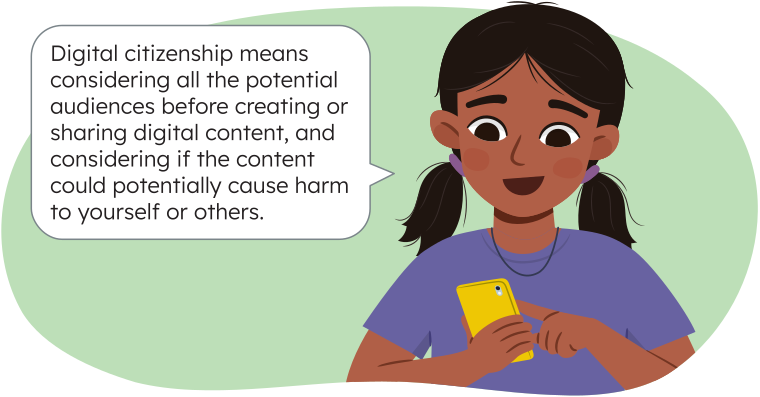
A learner saying, 'Digital citizenship means considering all the potential audiences before creating or sharing digital content, and considering if the content could potentially cause harm to yourself or others.'
Pause and Reflect
Pause and reflect
How can you apply the above digital citizenship reminders to your online behaviours?
Posted
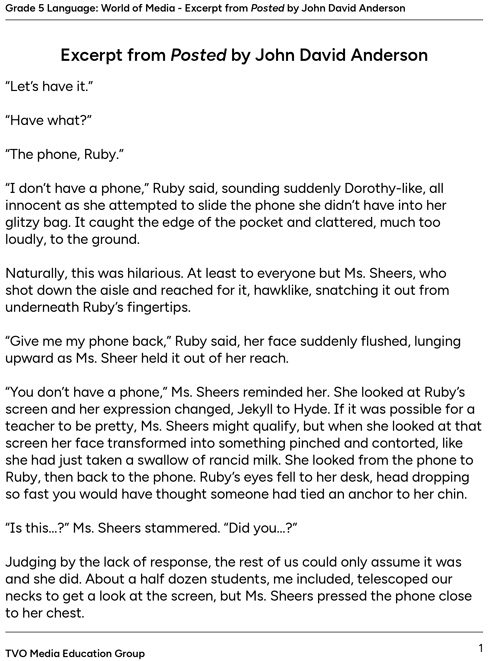
The following reading passage is taken from the book Posted by John David Anderson. In it, a group of middle school students learn valuable lessons about bullying, digital citizenship, and choices in the power of words to be cruel or kind.
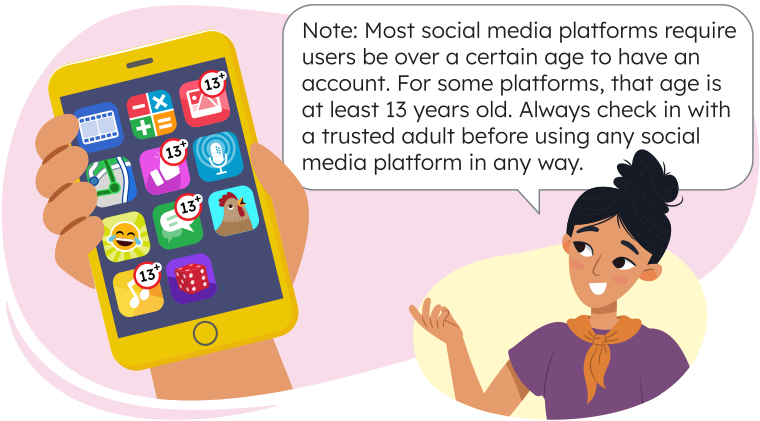
A teacher saying, Note: Most social media platforms require users be over a certain age to have an account. For some platforms, that age is at least 13 years old. Always check in with a trusted adult before using any social media platform in any way.

Previewing vocabulary
This reading passage contains vocabulary words that may be new to you.
Before you begin, explore the meaning of the following words using flashcards.

Reading accurately and fluently
- Read the following passage once from start to finish.
- Next, locate, take note of, and then reread any parts that were challenging to decode or understand.
Read the following excerpt from the book Posted to find out more about the text passage.
Press the Activity button to access the Excerpt from Posted by John David Anderson.
Activity(Opens in a new tab)Focus on literary devices
The author of the book Posted uses many literary devices to help tell the story. Let’s analyze a few parts of the text we just read to better understand their meaning and purpose.
Read each section of text. Try to explain what you think it means, and then press the flip button to reveal the other side of the card. Use the arrow keys to navigate between cards.
How do these examples of literary devices impact the text and who the target audience is intended to be? If possible, share your thoughts with a partner.
A teacher saying, Let’s take a minute and practice our reading fluency. Choose a portion of the text to read aloud. Aim for accurate pronunciation and fluent reading. Practice until you are able to read the passage in smooth groups of words, not word to word.

Social Emotional Learning
Social emotional
You’re doing great! It’s time for a short break!
Check your understanding
Consider the following comprehension questions. Record your responses in a notebook or using another method of your choice.
- Connecting: Based on your prior knowledge, what are some of the things a student might do on technology that would break a school rule?
- Predicting: What do you predict Ruby did on her phone? Use your own knowledge, as well as text evidence, to explain your answer.
- Inferring: How do Ms. Sheer’s reactions show us that Ruby’s actions were serious? Use examples from the text to explain your answer. Who do you suppose Mr. Wittingham is?
Read the following two excerpts of the book Posted to compare your predictions and inferences with what happens in the story.
Read the following excerpt from Posted to find out if your predictions were accurate!
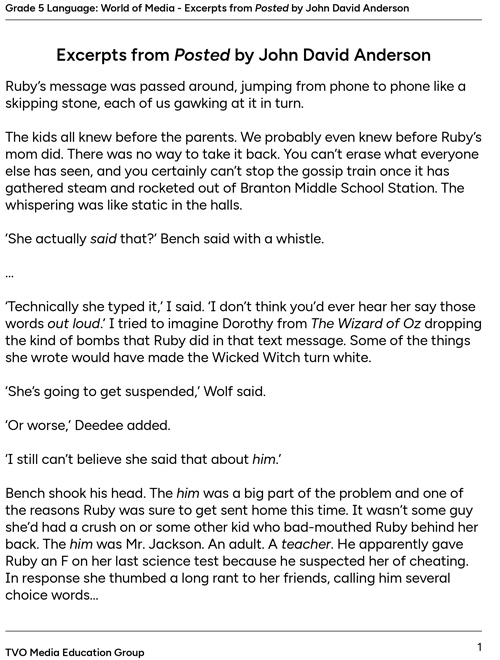
Press the Activity button to access the Excerpts from Posted by John David Anderson.
Activity(Opens in a new tab)Let’s review the acrostic T.H.I.N.K. from the Minds On section:
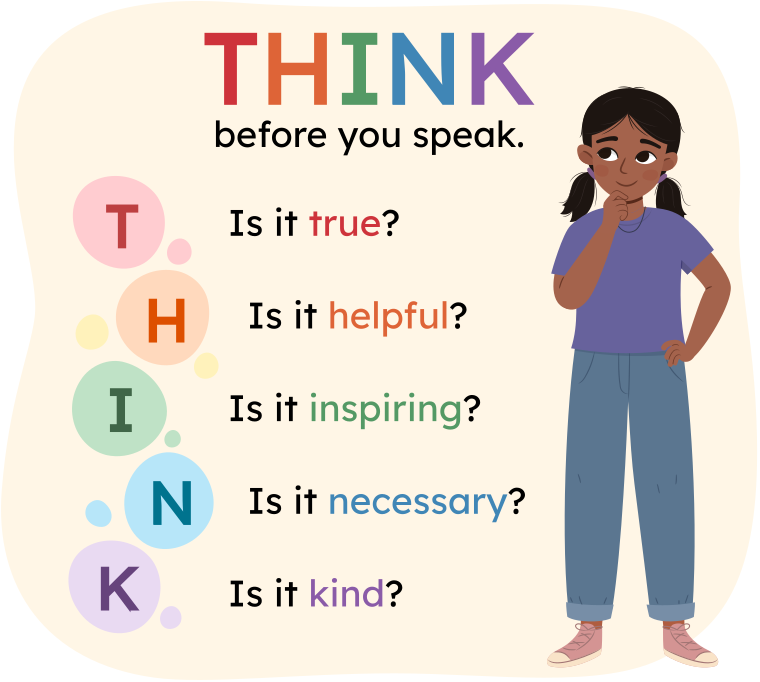
THINK before you speak. THINK is an acronym. It stands for:
T: Is it true?
H: Is it helpful?
I: Is it inspiring?
N: Is it necessary?
K: Is it kind?

Student Success
Let’s think!
In a notebook, or using another method of your choice, answer the following questions:
- Do you think Ruby followed these guidelines in the story?
- If you had been with Ruby before she hit send on her message, what advice would you have given her? Consider formatting your response to Ruby in the form of several text messages, or as a note or letter to her. Or, consider recording an audio or video response of what you would say to her.
- In your own words, what does it mean to practice digital citizenship when communicating online?
Putting it all together
In this learning activity, you have considered how online choices can impact yourself and others.
Review the following scenarios. Press the following tabs to find out more.
A group of friends takes a picture with everyone posing making silly faces. One person wants to share it online but not everyone is okay with that. If you were one of the people that wasn’t okay with posting the photo, what would you do?
At school, a group of students played practical jokes on other kids in their grade, took pictures while they did it, and posted the pictures online. They are now trying to get classmates to like and comment on the photos so that more people will see them online. If you were one of the students being asked to like or comment on the photos, what would you do in this situation?
A class is listening to a virtual guest speaker presenting to them about an upcoming cultural celebration that they are planning with their community. Students are sharing devices so they can ask and answer questions in the chat during the presentation. The person you’re sharing a device with is about to ask a question that is silly and could come across as disrespectful. What would you do in this situation?
Student Success
Let’s think!
For each of the scenarios, apply your digital citizenship skills to communicate how you would respond to them. Be sure to clearly explain what you would do in each situation and why. You could also explain the potential negative consequences that different choices could have.
To communicate your answers, you could:
- discuss the scenarios in an audio or video recording
- act them out in a skit
- write your responses as short paragraphs
- draw and write the scenarios as cartoon strips
Use the following checklist to self-assess your responses.
My responses:
Reflection
In a notebook, or using another method of your choice, reflect on what you have learned in this activity by answering the following questions:
- How confident are you in your ability to identify safe and responsible digital actions and reactions? Try to use a situation you have experienced, or what you would do in a fictional one, to support your answer.
- Rate your digital citizenship skills as “developing,” “developed,” or “well-developed,” and give examples as to why you chose the answer you did.
Reflection
As you read through these descriptions, which sentence best describes how you are feeling about your understanding of this learning activity? Press the button that is beside this sentence.

I feel...
Now, record your ideas using a voice recorder, speech-to-text, or writing tool.