Learning goals
We are learning to…
- understand different forms of audio media and their features
- identify sentence fragments and parts of complete sentences
- create media texts
Success criteria
I am able to…
- identify key differences between types of radio and podcasts
- differentiate between a complete sentence and a sentence fragment
- develop, create, and share a dramatic podcast scene

Sound effects, then and now
Do you know what a sound effect is or what context they are used in?
A sound effect is any sound, other than speech or music, that is added to make media (like television or movies) more exciting and realistic. For example, the sound of snow crunching under boots while someone walks.
Before television and movies, people listened to radio dramas (plays read out loud on the radio, also called radio plays) for entertainment. Sound effects played an important role in making radio dramas.
Check out the following video of the 1938 radio drama Back of the Mike, and notice what tools were used to create sound effects.
What tools did you notice being used in the radio drama?
Today, the art of recreating and performing everyday sound effects is called Foley, named after the sound effects artist Jack Foley. But not all sound effects used in media are created this way every time.
Check out the following video from the “Sound Editor/Sports Statistician” episode of the show When I Grown Up to learn some of the different ways sound effects are created for modern media.

Pause and Reflect
Pause and reflect
What similarities or differences did you notice between old time radio and more modern media sound effects?
Record your thinking in a notebook or using another method of your choice. If possible, share your thoughts with a partner.
Sound effects make media come alive! They are especially important in media forms that are sound-only. In this learning activity, you will explore different types of sound-only, or audio, media to learn about how the technology has evolved over time.

From radio waves to podcast files
Technology changes very quickly in our modern world. Let’s explore a few examples of how some audio media, or listening technologies, have evolved over time.
Radio then
Radio is a form of audio media whose purpose is to inform and entertain.

Did You Know?
Did you know?
The first known radio broadcast of audio was a concert. On December 24th, 1906, Canadian scientist and inventor Reginald Fessenden used radio technology to broadcast music and a poem to sailors on board ships at sea. After that, radio technology exploded, and forever changed the way the world received information and entertainment!
Radio was used to share news, speeches, musical performances, drama stories, and more! By 1936, about half of Canadian households regularly listened to the radio for information and entertainment in either English or French. It was very typical for many families to gather around a radio to listen to their favourite programs. Radio remained the main source of entertainment until the 1950s, when television took over.
Radio now
Radio is still an important form of communication today, with more than 900 radio stations in Canada. With so many stations to choose from, some radio stations specialize in one certain type of information or entertainment. For example:
- news
- traffic
- weather
- country music
- pop music
- classical music
Listening to the radio is free, and you can access it from a car, a computer, or a device at home or on the go, such as some phones or smart speakers. You do not have to pay to listen to traditional radio because radio stations play commercials, which are advertisements paid for by businesses, that cover the radio station’s costs.
You might have noticed that during a long car ride, your favourite radio station becomes staticky and no longer sounds clear. That is because traditional radio uses ground antennas to transmit sound. The farther you are from that radio tower, the less clear your radio station becomes. This does not happen with newer forms of radio: internet or satellite radio. Because they are digital, listeners can experience crystal-clear audio no matter where they are in the world.
Podcasts
Podcasts are a modern form of audio media that deliver news, information, and entertainment, just like radio does. The biggest difference between podcasts and radio, though, is that podcasts are listened to “on-demand,” meaning you can listen to them however and whenever you want.
Another special trait of podcasts is how varied their topics are. Some podcasts offer general daily or weekly news, but most focus on one specific theme or topic. You can listen to podcasts about:
- world news
- the lives of celebrities
- history
- science
- culture
- personal development
- goal setting
- storytelling
Podcasts might be hosted by a single person, or they might be hosted by two or more hosts. Some podcasts have a serious, informational tone, like someone reading the news, while others are more casual, like friends having a conversation or discussion together.
You can listen to many podcasts directly from websites or using specific apps on a phone or tablet. This is what makes them “on-demand”!
Most podcasts are free, but some podcasts require a subscription to access extra content, to get early access to new episodes, or to listen ad-free.
It’s important to note that just like television and movies, not all podcasts are appropriate for all ages and viewers. If you are new to podcasts, be sure to check with a trusted adult for guidance on which ones might be appropriate for your age group.
Pause and Reflect
Pause and reflect
Have you ever listened to a podcast?
- If yes, which one or what kind is your favourite?
- If you have never listened to a podcast before, what type of topic would you be most interested in listening to?
The Unexplainable Disappearance of Mars Patel
In the following listening activity, you will listen to the first episode of a serialized podcast. Serialized podcasts tell stories over multiple episodes, just like the chapters of a novel or the episodes of a television show. Each episode is one in a series of episodes; that’s where the term “serialized” comes from. Some even build storylines over multiple seasons.
Let’s check out an example of a fictional (not real), storytelling podcast from the podcast series The Unexplainable Disappearance of Mars Patel.
Check out this audio clip from Season 1, Episode 1 titled “Code Red”. As you listen, pay attention to how voice acting and sound effects create the mood of the story.
Mars Patel, Season 1 Episode 1
Let’s check!
Check your understanding by answering the following multiple choice questions. Select the correct answer, then press Check Answer to see how you did.
The podcast series The Unexplainable Disappearance of Mars Patel is a fictional, or made up, story. What are some possible reasons for students in this story disappearing? Suggest one reasonable explanation as well as one creative possibility! Record your ideas using a method of your choice.

Reading with fluency
You are now going to have the opportunity to practice reading the script of The Unexplainable Disappearance of Mars Patel podcast episode you listened to! Choose one of the following options to complete the task.
Option 1Read 3 pages of the script aloud (your choice which ones!) and practice creating a different voice for each character.
Option 2Read 3 pages of the script aloud (your choice which ones!). Work with partners and divide the roles equally.
As you read, change the pitch and expression in a way that fits the emotions of the words being spoken, or the action in the scene. For example, how can you make Mars’ voice communicate urgencyor fear?
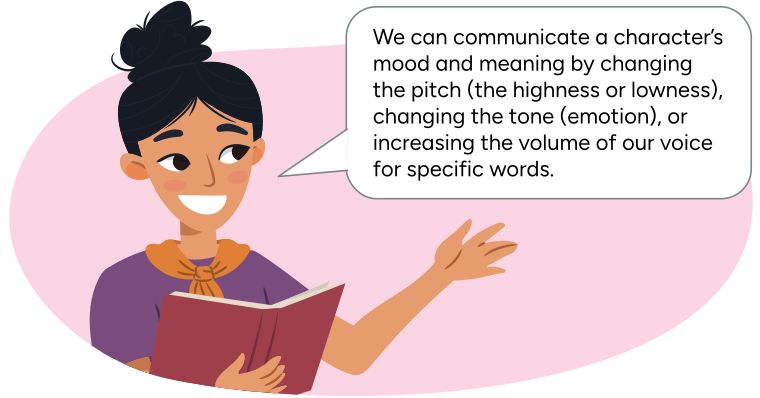
A teacher saying, "We can communicate a character’s mood and meaning by changing the pitch (the highness or lowness), changing the tone (emotion), or increasing the volume of our voice for specific words."

Student Success
Let’s think!
- Which character did you enjoy reading the most?
- Identify two or more locations in the script that would benefit from sound effects. Describe how you could create the sound effects using everyday objects that you have access to.
Record your ideas and reflections in your notebook or using another method of your choice.
Use the following checklist to self-assess your progress with adjusting expression and intonation.
Expression and intonation

Social Emotional Learning
Social emotional learning
You’re doing great! It’s time for a short break!


Sentence fragments
Let’s take a closer look at some of the sentences from the beginning of the script. What do you notice about them?
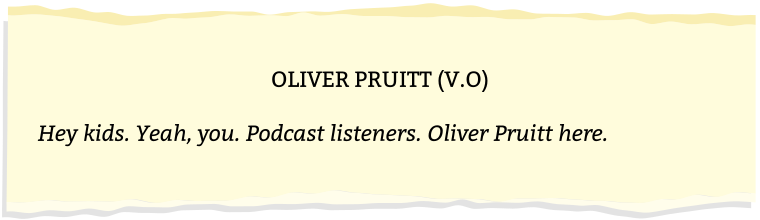
Did you notice that each sentence is super short and not actually a complete thought? We call these types of sentences sentence fragments because they are only part of a thought and are, therefore, incomplete sentences.
Check out the following video to learn more about sentence fragments.
It’s common to communicate using sentence fragments in spoken and written dialogue (conversation). For example, if someone asks you: "What are you doing?", you might reply: "Going for a walk." The reply is incomplete because it’s missing the subject of the sentence – you! To make it a complete sentence, you would need to say, “I’m going for a walk.”
Sentence fragments are okay to use for informal communication, like dialogue in a script, but not for formal communication, like a speech or letter. Explore some more examples of formal and informal writing in the following sorting activity.
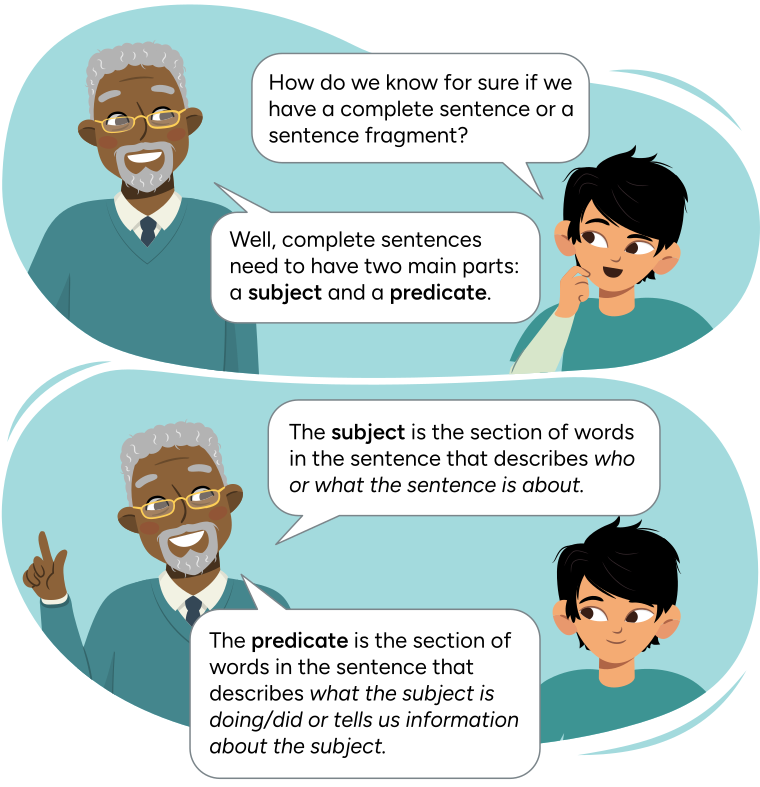
A conversation between teacher Wilfred and learner Tyler.
Tyler says, "How do we know for sure if we have a complete sentence or a sentence fragment?"
Teacher Wilfred says, "Well, complete sentences need to have two main parts: a subject and a predicate. The subject is the section of words in the sentence that describes who or what the sentence is about. The predicate is the section of words in the sentence that describes what the subject is doing/did or tells us information about the subject."
Check out the following example.
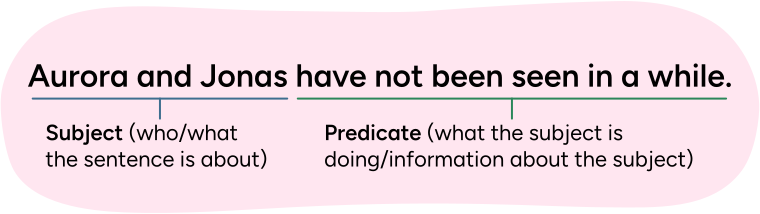
The following sentence is split into a subject and a predicate: "Aurora and Jonas have not been seen in a while." The subject is "Aurora and Jonas," and "have not been seen in a while" is the predicate.
Complete the following multiple-choice questions to practice identifying the two main parts of a complete sentence.
Select the correct answer, then press Check Answer to see how you did.
If a group of words doesn't have a subject or predicate it is not a complete sentence. It is a sentence fragment.
For example:
Ming and I
is a sentence fragment because it tells us who, but not what.
are going for a walk
is a sentence fragment because it tells us what, but not who.

Try It
Try it
Let’s practice identifying and editing sentence fragments to make them complete thoughts!
Using the following two dialogues, complete the following tasks in your notebook or using another method of your choice:
- Correct the sentence fragments in the dialogue by making them into complete sentences.
- For each corrected sentence, identify the subject and predicate by labelling,
underlining, circling, or hilighting each part.
Dialogue 1:
“How old will you be next year?”
“Twelve.”
Press the Answer button to learn more.
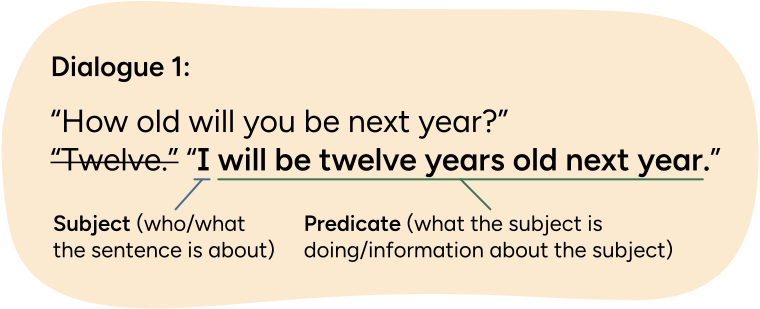
Dialogue 1:
"How old will you be next year?"
"Twelve" is crossed out. "I will be twelve years old next
year" is split into a subject and a predicate. The subject
is "I" and "will be twelve years old next year" is the
predicate.
Dialogue 2:
“What are you doing after school?”
“Park, playing, hanging with friends.”
Press the Answer button to learn more.
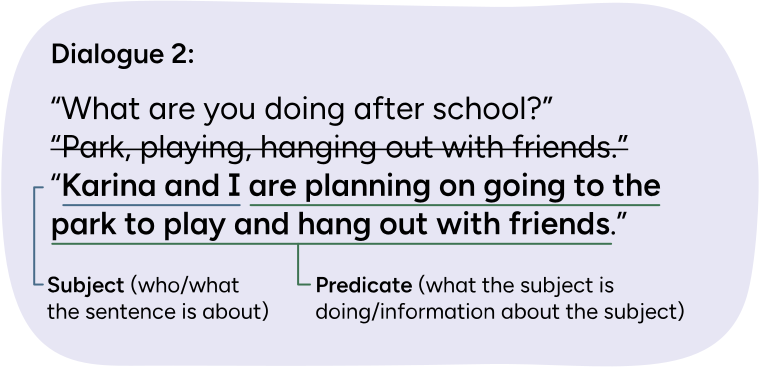
Dialogue 2:
"What are you doing after school?"
"Park, playing, hanging out with friends" is crossed out.
"Karina and I are planning on going to the park to play and
hang out with friends" is split into a subject and a
predicate. The subject is "Karina and I" and "are planning
on going to the park to play and hang out with friends" is
the predicate.

Let’s check
Test your skills! Are the following examples sentence fragments or complete sentences?
Select the correct answer, then press Check Answer to see how you did.
Putting it all together

To consolidate what you’ve learned, you will now create a short dramatic fictional podcast scene of your very own!
Before you begin, consider the purpose of your podcast (to entertain) and who your target audience is (kids your age). These pieces will impact the tone and delivery of your content.
Here are three possible options for your content:
- Act out 3 pages of the script from the podcast in this learning activity
- Use a scene from a fiction book of your choice and act out what happens
- Write your own original dramatic scene!
Your scene should be no more than 5 minutes recorded/performed.
In your recording/performance, be sure to include:
- Different types of character voices
- Sound effects
- Content and themes that your audience will enjoy
You can perform your podcast live or record it using a device that you have access to. Consult with your teacher or trusted adult about possible methods for recording your podcast scene.
Pause and Reflect
Pause and reflect
Consider the following questions. Answer them in a notebook or using another method of your choice. If possible, share your answers with a partner.
- What communication, planning, and technical skills did you use when creating your podcast performance?
- Which of those skills do you feel is your greatest area of strength and greatest area for growth?
- In what other school subjects could you apply these same skills?
Reflection
As you read through these descriptions, which sentence best describes how you are feeling about your understanding of this learning activity? Press the button that is beside this sentence.

I feel...
Now, record your ideas using a voice recorder, speech-to-text, or writing tool.