Learning goals
We are learning to…
- read informational texts for meaning
- use colons to introduce a list
- develop ideas and details about various topics
- reflect on new learning and apply it to every day life
Success criteria
I am able to…
- express my opinion on video gaming for young children using evidence from texts
- use a colon to introduce a list when writing about a personally relevant topic
- create a plan outlining the elements of a digital video game
- identify how concepts learned apply to my own life, experiences, and personal wellbeing

How do you feel about…?
The following is a list of statements related to video gaming. Read each statement out loud. Then, decide how you feel about each statement. Do you “strongly agree,” “agree,” “disagree,” or “strongly disagree” with each statement?
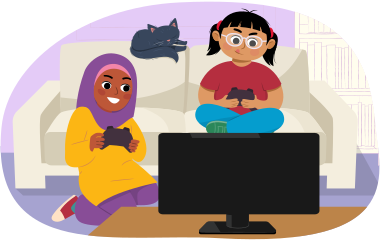
- Video games are an important part of my life.
- Video games should not be played by very young children.
- Video games can be dangerous.
- Video games are helpful.
- Video games are educational.
Record your answers to each statement in a notebook, or using another method of your choice. If you are able to work with a partner or a group, you could try reacting to each statement by moving around the room in a “four corners” style activity.
Press the Four Corners Option button to learn more.
Four corners instructions:
- Step 1: Assign each corner of a room one of the following labels: strongly agree, agree, disagree, and strongly disagree.
- Step 2: Have one person read each statement out loud, one at a time.
- Step 3: After a statement is read, move to the corner of the room that matches how you feel about the statement. For example, if the statement is “I love the feel of sunshine on my face,” you might move to the corner of the room labelled “strongly agree,” if that’s how you feel about it!

Pause and Reflect
Pause and reflect
Reflect on the answers that you provided.
Choose one of the statements to discuss in greater detail with a partner, if possible, or write/record a short journal entry explaining your thoughts and feelings about one of the statements.
In this learning activity, you will consider the pros and cons of video gaming, reflect on the role and influence that gaming might have in someone’s life, and design your very own game concept!

Cause and effect
When someone is trying to prove a point or convince others that their point of view is correct, one tool that they can use is a persuasive text. Persuasive texts often use very specific examples of an action or event followed by the result or consequence of that action/event to prove their point. This is called cause and effect. Check out the following examples of cause and effect:
- If ice cream is left out of the freezer, it is going to melt.
- We need to take care of our planet, or we won’t have the things we need to survive.
- When people spend too much time in front of a screen, their eyes will start to get blurry and dry.
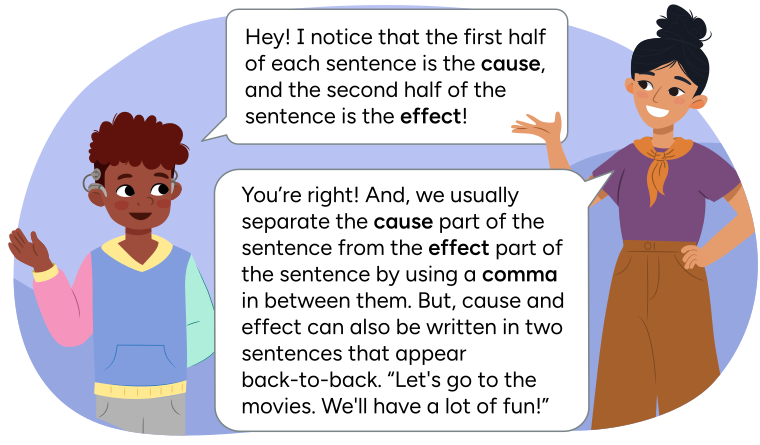
A conversation between a teacher and learner Marcel.
Marcel says, "Hey! I notice that the first half of each sentence is the cause, and the second half of the sentence is the effect!"
The teacher says, "You're right! And, we usually separate the cause part of the sentence from the effect part of the sentence by using a comma in between them. But, cause and effect can also be written in two sentences that appear back-to-back. 'Let's go to the movies. We'll have a lot of fun!'"
Let’s explore some persuasive texts by considering two sides of an argument: The Benefits of Video Gaming and The Risks of Video Gaming. As you explore, try and identify examples of cause and effect.
The benefits of video gaming
Many people know that video games can have negative side effects. But did you know that video games also have benefits? Experts believe that video games offer benefits to players: problem-solving, coordination and spatial sense, stress relief, social skills, and improved memory.
Let’s take a closer look at some of these benefits.
Press the following tabs to learn more about these benefits.
Video games require players to take in lots of information at once and to make decisions quickly and correctly. This is known as information processing and, like most skills, people can get better at it!
Many games require players to solve challenges in creative or innovative ways, and to figure out patterns or sequences, which use problem-solving and mathematical reasoning skills. When a game requires remembering the locations of objects or places and thinking about where they are in the game layout, players are using and developing their spatial sense skills! A lot of brain-based practice is happening when video games are played!
Psychologists believe that video games provide a positive opportunity for young people to interact with their peers. As one psychology professor states, “Video games can provide the necessary lifeline for many children who are seeking social experiences with their friends when they can’t interact with them in person.” There are many situations in which playing a game together online may be the best or only option for spending time together. Some examples could include:
- When a friend or family member lives far away
- When living in a setting or location where there are no peers nearby
- When people have daily schedules that don’t allow for in-person play with someone else
Networked video games (games where you connect and play with other players online) provide people with a way of connecting with current friends as well as making new friends. Connecting online could also help people who are shy or people who don’t find it easy to connect in person feel more confident when socializing.
Let’s check
Did you notice any examples of cause and effect in the text? Here is one example:
“When a game requires remembering the locations of objects or places, and thinking about where they are in the game layout, players are using and developing their spatial sense skills!”
- Cause: game requires remembering the locations of objects or places, and thinking about where they are in the game layout.
- Effect: players are using and developing their spatial sense skills!
Did you notice any other examples?

Pause for punctuation
Let’s pause here to learn about a new grammar structure. Check out the following line of text:
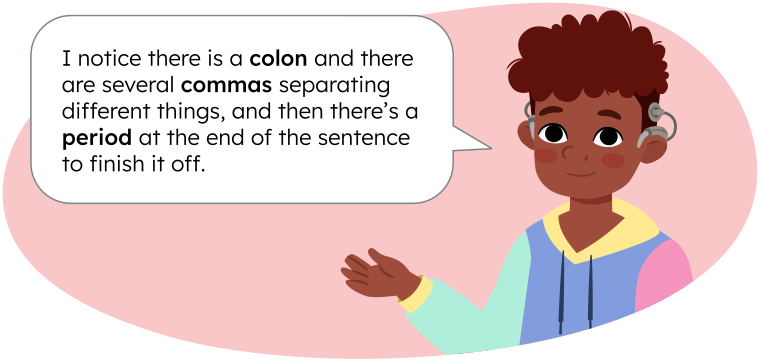
“Experts believe that video games offer benefits to players: problem-solving, coordination and spatial sense, stress relief, social skills, and improved memory.”
What do you notice about the punctuation in the text?
Check out the following video for a quick review of different punctuation marks.
Let’s explore the function of a colon ( : ).
One job of a colon is to introduce a list. To do this correctly, be sure that:
- the sentence before the colon is a complete sentence (an independent clause)
- the items in the list are separated by commas
- the list ends with a period
In a notebook, or using another method of your choice, practice using a colon to introduce a list. Use the example from the text as your model as well as the three rules you just reviewed. Here are some possible topics that you could use for your writing practice:
- favourite summer or after school activities
- favourite books or games to play
- favourite people or people you’d like to meet
- places you’d like to visit
The risks of video gaming
Have you ever heard the sayings “everything in moderation” or “too much of a good thing”? Both of these sayings mean that even things that are good for you could actually cause harm if enjoyed too much. So, although video games have benefits, there are also some very real risks connected to gaming too much (called excessivegaming). Press the following tabs to learn more about risks connected to gaming.
For starters, staying inside and playing video games can make it hard for people to get enough movement or exercise. To be healthy, people need a little bit of exercise every day! Scientific studies have shown that kids and teens with high levels of screen time are less likely to participate in active play, sports, and clubs. Higher levels of daily screen time also means people are exposed to more advertising for unhealthy snacks, sugary drinks, and junk food, and are more likely to then eat or drink these things. Doctors are concerned that the combination of sitting too much, plus too much screen time, and unhealthy dietary choices are contributing to kids being unhealthy and childhood obesity.
Video games can also become addictive because they trigger a big rush of the feel-good brain chemical called dopamine—more than peoples’ brains were designed for. This natural brain chemical is what makes people feel good and encourages them to do things again to get that feeling back! The problem with this is, when the brain gets used to a certain level of dopamine, it starts to crave a higher level of it. That means that people crave more and more of the thing that gives them the rush of good feelings, and they feel grumpy and irritable if they don’t get it.
Many hours spent looking at a screen can also strain the eyes, which can make them blurry and dry, or give people headaches. These are short-term side effects. Constant eye strain over time can damage the eyes and lead to serious long-term consequences. Screen time late in the evening can also affect sleep because the blue light from screens tricks the brain into thinking that it is daytime which makes it harder to fall asleep and sleep soundly.
Let’s check!
In your notebook, or using another method of your choice, try using cause and effect to explain why you should avoid looking at screens for at least one hour before bedtime. Include specific details and vocabulary from the text in your answer.
Finding a healthy balance
So, what exactly is considered a healthy amount of screen time for children? The Canadian Pediatric Society (CPS) recommends school-age children and teens focus on healthy practises and boundaries, instead of a specific number of hours. They define moderate screen use for children and teens as being anywhere from 2 to 4 hours a day.
Here are a few of the CPS’s recommendations for managing a healthy relationship with screens and digital platforms:

Set a plan for daily usage and place limits on the time spent on different types of content.

Avoid media multitasking (using more than one kind of media at a time), especially during homework.

Prioritize screen activities that are educational, active, and social.

Commit to daily “screen-free” time, especially when eating, or when connecting or hanging out with people in person.

Avoid screens for at least one hour before bedtime.

Social Emotional Learning
Social emotional learning

You’re doing great! It’s time for a short break!
Plan a game!
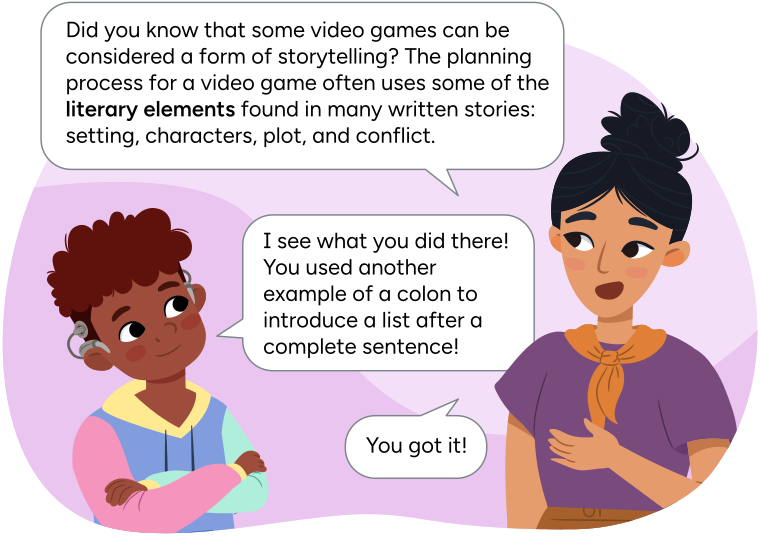
This is a conversation between a teacher and learner Marcel.
The teacher says, "Did you know that some video games can be considered a form of storytelling? The planning process for a video game often uses some of the literary elements found in many written stories: setting, characters, plot, and conflict."
Marcel says, "I see what you did there! You used another example of a colon to introduce a list after a complete sentence!"
Let’s use some literary elements to draft a plan for a game!
When planning your video game, use the following headings and the ideas under each to flush out your plan.
Press the following tabs to find out more.
What genre or type of game will it be? (e.g., adventure, puzzle, fantasy, strategy, sports, simulation, etc.)
What is the name for your game?
Who is your intended audience (ages)?
What’s your game about?
What’s the purpose of your game?
What is the player’s goal in your game?
How will players advance in the game – for example, by collecting points or completing levels?
What skills will your game allow players to use or practice?
Where does your game take place (location, time of day/year/in history)?
Describe the landscape or surroundings of a scene in your game.
Does your setting have any special features that make it unique?
What images or colours could you use to communicate the setting or mood of the game?
Who are the characters in the game?
Is there one main character or do players have a choice of characters that they play as?
Are there any nonhuman characters such as animals, mythical creatures, or supernatural forces?
Think about the story of your game, and list the steps (or levels) that a player must go through as they work towards the solution.
Who or what is the player battling against? (e.g., themselves, other people, nature, a society, or supernatural force?)
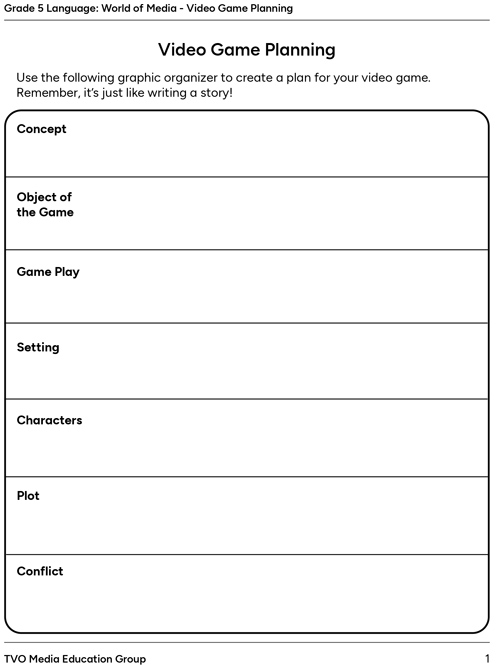
Create your video game plan in your notebook, digitally, or using a method of your choice. You may choose to use the following graphic organizer to help organize your ideas.
Complete the fillable and printable Video Game Planning Document in your notebook or using the following document. If you would like, you can use speech-to-text or audio recording tools to record your thoughts.

Student Success
Let’s think!
If you were to create a visual, like a poster or advertisement for your game, what might it look like? What would it include? One of the ways you could bring it to life visually is by creating a storyboard.
Check out the following video clip from the TVOkids show When I Grow Up episode called “Motion Capture Manager/Ice Cream Maker”.
If you decide to create a storyboard for your video game plan, check out some tips for how to do that by pressing the following button.
Press the Tips for Creating a Storyboard button to learn more.
Tips for Creating a Storyboard
Tips for creating a storyboard:
- You can create a storyboard by folding a piece of paper into columns or print a storyboard template found online and complete it by hand, or you can use a website or app that offers digital storyboard planning tools.
- Try to include important elements of your story in your storyboard: setting, characters, and some of the actions of the game.
- You do not need to plan or show every step on a story board, just the most important ones. If there are different settings or levels in your game, it is a good idea to show each of them at least once.

Putting it all together
Let’s review some of the new vocabulary introduced in this learning activity.
Match the vocabulary word to the definition.
Forming personal connections

After reading two different persuasive texts on video gaming, what’s your opinion?
In a notebook, or using another method of your choice, write a persuasive text that answers the following question.
Should kids as young as 5 years old be allowed to play video games?
In your answer, try to include specific examples: from the text, from your own personal experiences, or from the experiences of people you know.
Use the following checklist to self-assess your persuasive text.
Success Criteria
Reflection
As you read through these descriptions, which sentence best describes how you are feeling about your understanding of this learning activity? Press the button that is beside this sentence.

I feel...
Now, record your ideas using a voice recorder, speech-to-text, or writing tool.