Learning goals
We are learning to…
- navigate online forums safely
- understand the forms, techniques, and conventions of news media
- consider the validity and credibility of media texts
Success criteria
I am able to…
- use critical thinking to help me navigate online information
- identify trustworthy and untrustworthy media sources based on their techniques and conventions
- categorize different types of misinformation
Can you spot the fake?
With so much content on the internet and with all the digital design tools that now exist, like AI, how do we know when something is real or fake?
Examine each of the following images in the flashcards. Some of them are real photos, and some of them are not. Which images do you think are real, and which do you think are fake?
Sometimes, it’s hard to tell the truth from the fake. This is why it’s important to always use critical thinking when exploring new content!
In this learning activity, you are going to develop your critical thinking skills to help you spot fake news and navigate digital information in a way that is safe and informed.

Vocabulary routine!
Before we go further into our learning, pause to record the word fake news in your vocabulary notebook. You can add more detail (like a definition) as you work through this learning activity.
A vocabulary notebook is an important learner tool! If you are creating one for the first time, here are two possible way of recording word work.
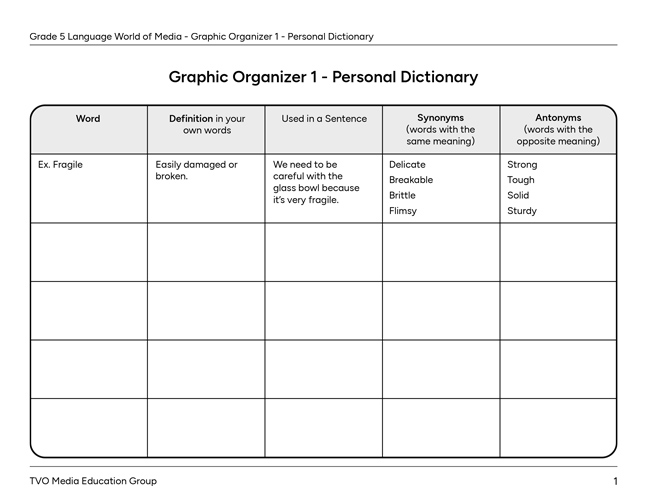
Press the Activity button to access the Graphic Organizer 1 - Personal Dictionary.
Activity(Opens in a new tab)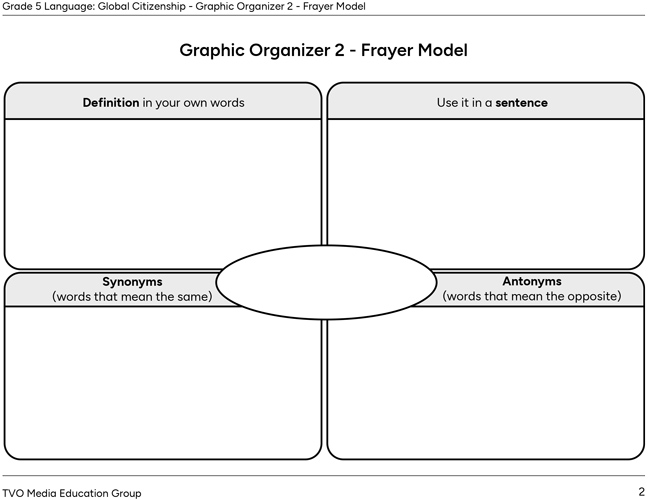
Press the Activity button to access the Graphic Organizer 2- Frayer Model.
Activity(Opens in a new tab)
Not all news is real
What is fake news? Fake news is false information intentionally made to look real. Fake news is fabricated (made up), and its purpose is to deceive people into thinking it is true.
Fake news is not just incorrect information. Even the best news sources sometimes make mistakes in what they publish. The difference is that those errors get corrected. Real news organizations have staff called fact-checkers who review content for errors and post corrections when inaccurate information gets published.
Fake news is completely different! Fake news is intentionally false, and its purpose is to get people to believe it. That is why fake news is often:
- shocking
- unexpected
- emotional
Creators of fake news know that when emotions are triggered, people don’t think critically. The more shocking or upsetting a headline is, the more tempted people are to click on it, react, and then share that misinformation before checking their facts.
 Description
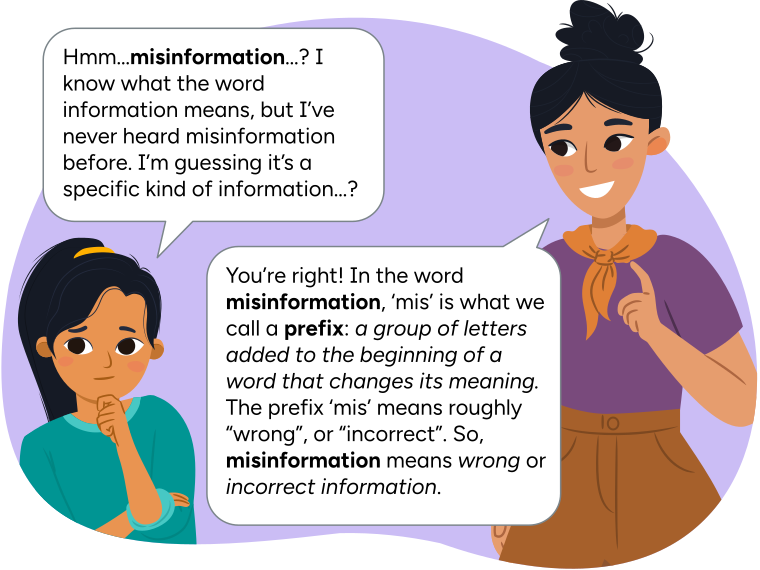
A conversation between a teacher and learner Sora.
Sora says, "Hmm…misinformation…? I know what the word information means, but I've never heard misinformation before. I'm guessing it's a specific kind of information…?"
The teacher says, "You're right! In the word misinformation, 'mis' is what we call a prefix: a group of letters added to the beginning of a word that changes its meaning. The prefix 'mis' means roughly 'wrong,' or 'incorrect.' So, misinformation means wrong or incorrect information."
Why does fake news, or misinformation, even exist?
People make fake news for all kinds of reasons. Sometimes it’s connected to politics, sometimes it’s because they want to push people to believe certain ideas, sometimes it’s connected to making money, and sometimes it’s just clickbait – shocking, emotional, deceiving, or misleading headlines or images specifically designed so people will click on a link to read more.
Vocabulary
This learning activity has featured the words fake news, fabricated, fact-checkers, misinformation, prefix, and clickbait. Let’s pause to make sure that we understand each of them, and then add them to our vocabulary notebook.
Check out the following steps to learn more.
First, try to record a definition using your own words. You may wish to go back and review where each term was introduced in the learning activity.
Next, check the accuracy of your definition using either a dictionary or the definitions given in the learning activity.
Lastly, record other information that will help deepen your understanding of these words, such as a real-world example, a synonym, or a diagram or sketch that represents the word.
Fake news can seem very real
With the use of digital technology, fake news can sometimes look very real.
Check out the following video and notice how real or fake it feels to you as you view it.

Pause and Reflect
Pause and reflect
- What parts of this video made it seem trustworthy?
- What parts of this video made you question if the information being presented to you was real?
Record your thoughts in a notebook or using another method of your choice. If possible, share your thoughts with a partner.
How to spot a fake
With so much fake news and misinformation out in the world, how does someone spot the real from the fake?
Check out the following video and take note of some ways of spotting fake news and any of our vocabulary terms being used.
Fake news is carefully designed to make it seem believable, but that does not mean we are powerless! Use the following tools to help you navigate information safely.
Language matters
Have you ever noticed when someone spreads gossip, they might say things like, “Well I wasn’t there, but I was told that…”? This is called a form of disclaimer . People use disclaimers when they want to share something that may be untrue without being responsible for the untruth.
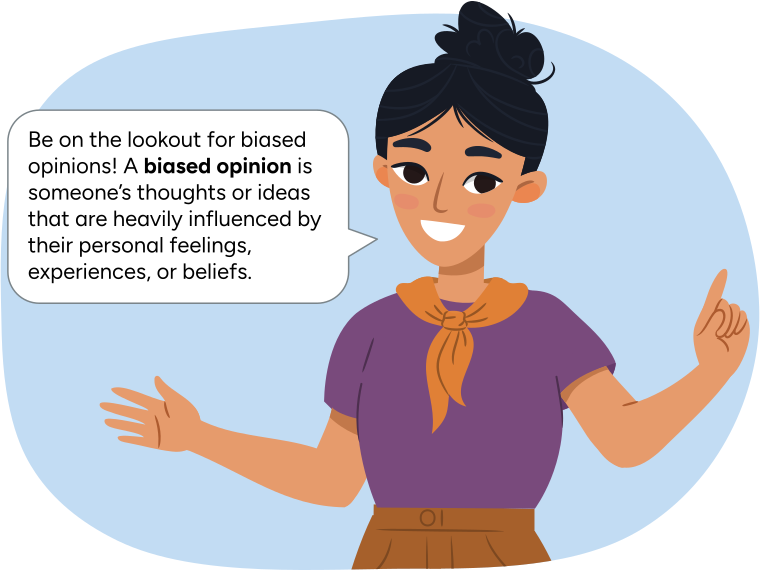
Some media sources can spread misinformation such as rumours, gossip, half-truths, guesses, and biased opinions without getting in trouble by using carefully placed words in their news. That way, they can claim, “we never said it was true!”
 Description
With so much information out in the world, how do we know what to look for to start telling fact from fiction?
Be a word detective! Read each of the following statements carefully, and decide which category it belongs in.
Press the Language to Lookout For button to learn more.
| Facts | Rumours | Guesses/opinions |
|---|---|---|
|
Sources confirmed that…
|
It is rumoured that…
|
I bet that…
|

Social Emotional Learning
Social emotional
You’re doing great! It’s time for a short break!
Let’s check!
Imagine that a bear gets lost and is roaming the downtown section of a city! People are concerned and want answers, but there is so much information being posted online that it is hard to know what to believe.
Let's examine a series of posts about the incident. As you do:
- Take note of the language being used in each post. This will help determine what is real information and what is not.
- Sort the posts into facts, rumors, and guesses based on the words used in each post.

Fluency
Now that you have correctly sorted the posts into news, rumours, and guesses, try reading them aloud with a tone suitable for each genre.
How might you change your tone to communicate to your audience that a post is a fact, rumour, or guess?
Try recording yourself and playing back each of your posts to analyze your use of tone. If possible, share with a partner and have them try to sort your spoken posts into the categories or fact, rumour, or guess/opinion.
Putting it all together
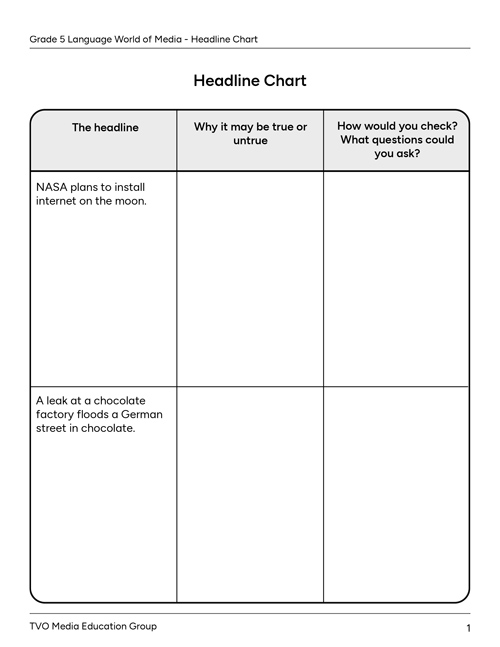
Imagine that you are presented with the following headlines. What questions could you ask or how could you check to determine if they are real or not?
- Headline 1: NASA plans to install internet on the moon.
- Headline 2: A leak at a chocolate factory floods a German street in chocolate.
Complete the fillable and printable Headline Chart Document, or record your answers in your notebook or using another method of your choice, or, if possible, discuss them with a learning partner. If you would like, you can use speech-to-text or audio recording tools to record your thoughts.
Guardian News and Media. (2021, February 4). Fake or real? the all-new NewsWise headlines quiz!. The Guardian. https://www.theguardian.com/newswise/2021/feb/04/fake-or-real-headlines-quiz-newswise-2021
Doing a search of the headlines shows that they are real because multiple trustworthy news sources reported on the same stories!
Creating headlines
It’s time to get creative and create some headlines!
Use the following image of planet Mars, or another image of your choice, and create two different headlines for it: one that is factual (based on real facts) and one that is fake news.
Use a digital tool of your choice to create your final products. What elements that you learned about in this learning activity could you include in your published product to help your audience decide which is the real headline and which is the fake?

When you are done, try to share your headlines with someone and see if they can spot the real one and the fake one!
Pause and Reflect
Pause and reflect
Throughout this learning activity you used a lot of critical thinking skills. How do these skills help you in your school work and in your everyday life?
Reflection
As you read through these descriptions, which sentence best describes how you are feeling about your understanding of this learning activity? Press the button that is beside this sentence.

I feel...
Now, record your ideas using a voice recorder, speech-to-text, or writing tool.