Learning goals
We are learning to…
- identify different forms of advertising
- think critically about media messages
- identify different text features and elements of style
- consolidate our knowledge of different types of adjectives
- create digital and/or media texts to suit a specific purpose and audience.
Success criteria
I am able to…
- locate examples of advertisements in my surroundings and everyday life
- exercise critical thinking when presented with persuasive media
- identify some common advertising tactics
- write persuasive ads using comparative or superlative adjectives
- create a media message for a specific audience

A typical day in advertising…
Advertising refers to all of the ways that a company or organization tries to sell people their product, service, or idea.
What are some of the possible types of advertisements that you might see throughout the day? Where would each of these advertisements be found or seen?
Advertising communicates messages. Those messages are not necessarily good or bad, but we need to know that they are there so we can think critically about the messages we are receiving.

Brainstorm
Brainstorm
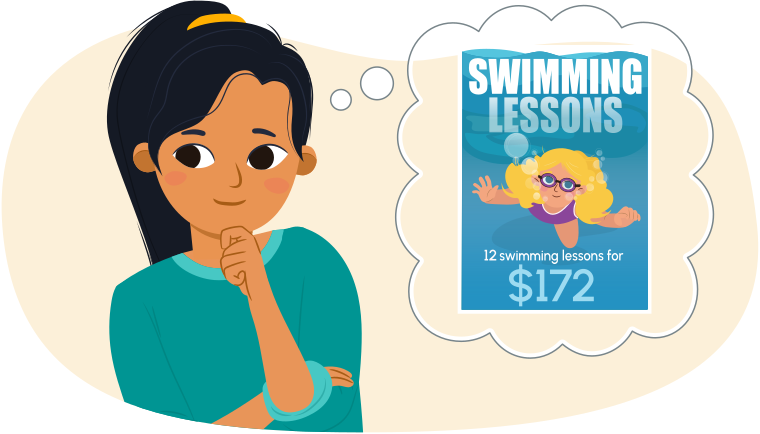
Think about an advertisement you have never forgotten or one that made an impact on you. It could be a radio, video, or print advertisement. In your notebook, or using another method, answer the following questions about the advertisement you chose:
- What was the product or service being advertised?
- What was it about the advertisement that caught your interest, that you connected with, or that made it memorable for you?
- What was the goal of the advertisement? Do you think it was effective?

Where can you spot advertising?
Advertising is a way for businesses to show people their products or services and to persuade them to buy or use them. Some types of advertising are more obvious than others.
Some examples include:
- On TV or streamed video content, there are commercial breaks or video advertisements that come up in between segments of the content.
- On the sides of cars or public transit buses, there are signs or stickers advertising products, services, or events like upcoming movie releases.
- Driving along highways or roads, signs and billboards alert people to nearby businesses or services.
Some advertising is not so obvious, and people may not even realize they are advertisements.
Some examples include:
- Logos on sports team jerseys
- Company names/info and logos on free items like pens, notepads, magnets
- Opportunities to win a prize in exchange for referring a friend to a business
Let's learn more about two types of advertising that are more subtle, and you might not recognize as advertising!
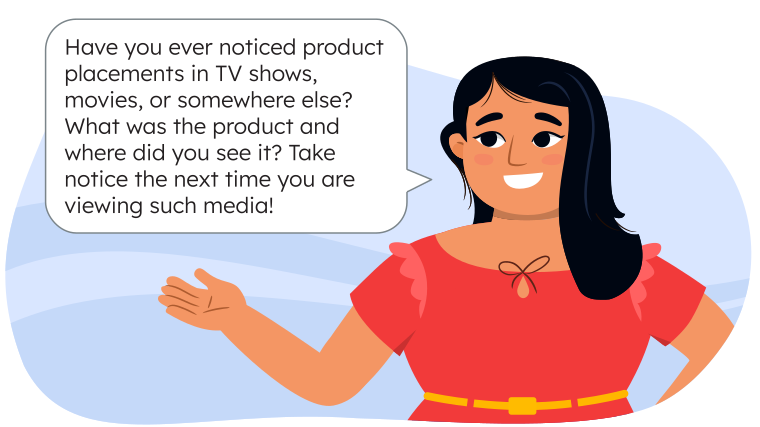
Subtle advertising 1: product placement
In a very digital world, one major way of advertising is called product placement.
What do you think that term might mean?
Check out the following video clip from The Wacky Word Show’s episode called “Ad Magicians” to learn more about product placement.
Subtle advertising 2: influencer marketing
On different video platforms, there are many people that feature unboxing videos or talk about their favourite items and then tell you that the link to buy is in their profile. These people are usually called influencers, and this technique is a form of marketing. Influencer marketing is a very effective form of advertising. Famous and even not-so-famous people are given free products in exchange for helping to influence others to buy those products. Sometimes, they even receive a percentage of every sale made through their personally assigned link (called an affiliate link). This kind of marketing is called affiliate marketing.
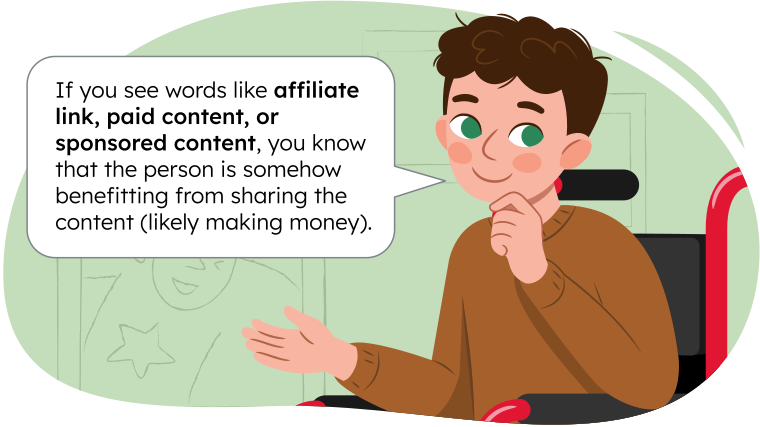
Check out the Wacky Media Songs episode titled “Just Another Influencer” to learn more about influencers and what to look out for.
Let’s check!
Let’s review some key ideas from the video.
For each sentence, select the missing word from the drop-down menu. Press Check Answer to see how you did.
How convincing!
Advertisers use persuasive tactics to influence or convince people to buy their products, services, or ideas.
Let’s explore a few common persuasive advertising tactics:
Can you spot the tactic?
The following are descriptions of real advertisements. Can you spot the persuasive tactic being used?
Match each example with the name of the advertising tactic being used.
Critical thinking
How does having an awareness of persuasive tactics support your ability to think critically about the texts you see?
To be a critical thinker, it’s also important to consider whose perspectives might be missing or not considered in a persuasive advertisement. It’s also important to think about if there is bias in an advertisement.
Bias is an opinion, preference, prejudice, or inclination that limits an individual’s or group’s ability to make fair, objective, or accurate judgements.

Try It
Try it
In each of the scenarios listed in the matching activity, whose perspectives might be missing or not considered? What biases might be present in the ads?
Words matter
Advertisers carefully choose words to communicate their desired message. To grab and keep peoples’ attention, ads should be short and catchy, so each word used in an ad must be intentional and powerful!
Check out the Wacky Media Songs episode titled “Words That Sell!” to learn more about the importance of words in advertising.

Social Emotional Learning
Social emotional learning

You’re doing great! It’s time for a short break!

Adjectives
Strong, descriptive language is a must for advertisements! Adjectives are words that describe people, places, things, or ideas, and they play a very important role in advertising.
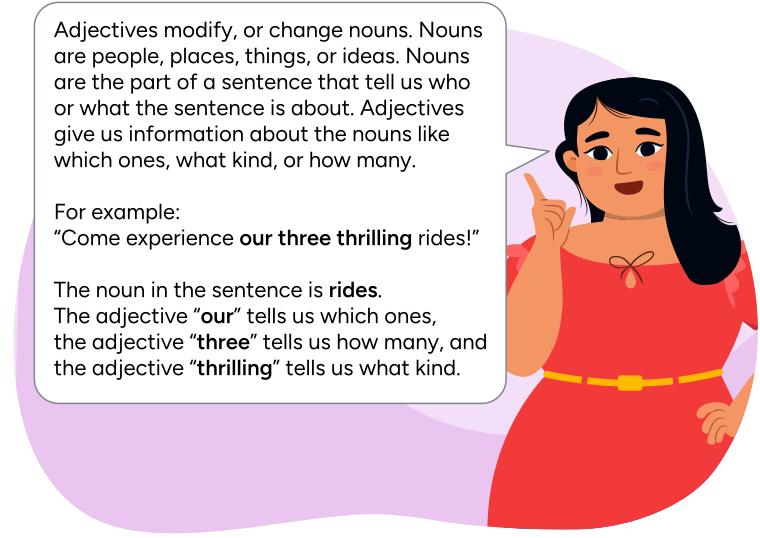
A teacher saying, "Adjectives modify, or change, nouns. Nouns are people, places, things, or ideas. Nouns are the part of a sentence that tell us who or what the sentence is about. Adjectives give us information about the nouns like which ones, what kind, or how many."
For example: 'Come experience our three thrilling rides!'
The noun in the sentence is rides. The adjective 'our' tells us which ones, the adjective 'three' tells us how many, and the adjective 'thrilling' tells us what kind."
Adjectives can also be used to compare one noun to another noun. Let’s review two types of adjectives.
Press the following tabs to find out more.
Comparative Adjectives:
- Compare two nouns
- Usually written by adding the suffix (ending) -er when the adjective has one syllable, or the word more or less before adjectives that have more than one syllable.
Examples:
- Using the adjective “tall” → Experience the stuffed animal that is taller than you!
- Using the adjective "colourful” → The tie dye paint that is more colourful than our competitor’s.
Superlative Adjectives:
- Compare three or more nouns
- Usually written by adding the suffix (ending) -est when the adjective has one syllable, or the word most or least before adjectives that have more than one syllable.
Examples:
- Using the adjective “bold” → The boldest coffee you’ll ever taste.
- Using the adjective “beautiful” → The most beautiful views in the world!
Let’s check!
Sort the following adjectives into the appropriate category: comparative or superlative.
Your turn: create an advertisement!
Imagine you are an advertiser creating a campaign for the items in the following images.

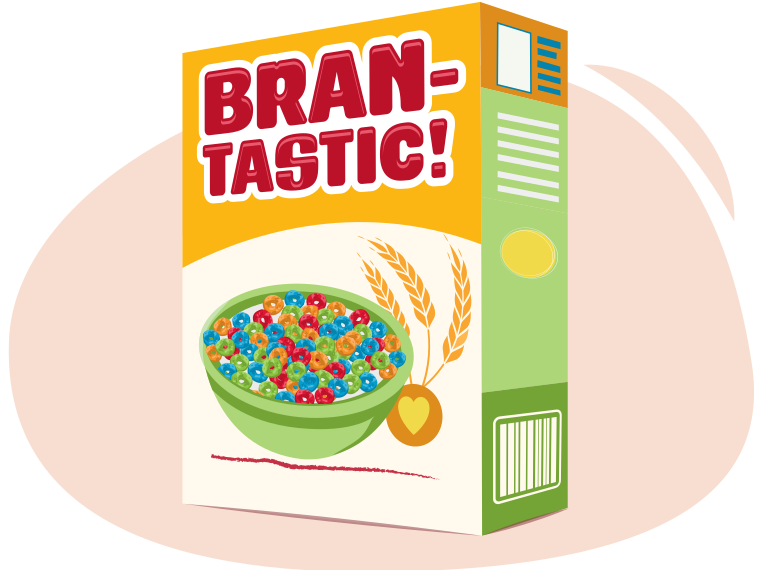

What comparative and superlative adjectives could you use to sell the features of each of these items? Record your answers in the fillable and printable chart. If you would like, you can use speech-to-text or audio recording tools to record your thoughts.
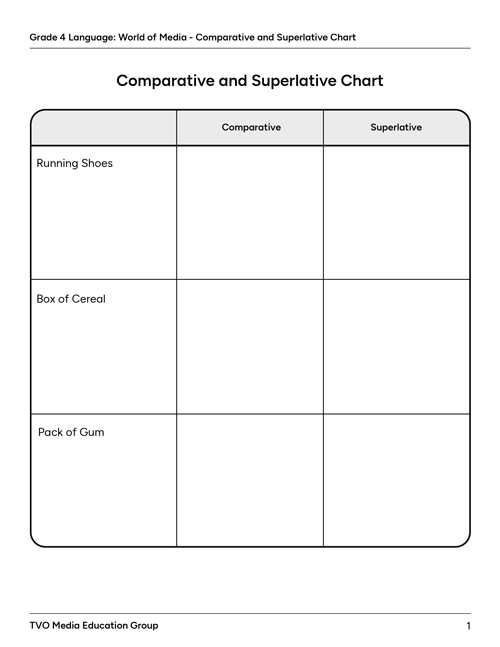
Press the Activity button to access the Comparative and Superlative Chart.
Activity(Opens in a new tab)
Putting it all together
You have learned about the locations and forms of different types of ads, the persuasive tactics used by advertisers, and how words can be used to promote an advertising message.
Now it is time for you to apply your knowledge in the following two tasks!
Task 1: analyze an advertisement
Check out the following commercial for “Space Puffs” cereal.
In your notebook, or using another method of your choice, answer the following questions about the Space Puffs advertisement:
- What product/service is it selling?
- Who is the target audience of this ad?
- What is its intended message?
- Are any persuasive tactics being used?
- Whose perspective is included?
- Whose perspective is missing?
- Is there any bias present?
- What other words could be used in this ad to persuade the audience? Make a list of both comparative and superlative adjectives that could be used.
Task 2: create an advertisement
Your task: choose a product idea and plan an advertising campaign for it.
Use the guiding questions/information in the following graphic organizer, or another method of your choice, to help you plan your advertisement. Note, you do not need to answer every guiding question given – they are just there to help you organize your thoughts and bring the vision for your advertisement to life!
|
Description |
|
|
My product idea |
What type of thing is it? |
|
What makes it unique |
What makes your product better or different from its competitors? |
|
Benefits / uses |
What problem(s) does your product solve for consumers? |
|
Target customer |
Who will use this product? Who will you advertise it to? |
|
Platform |
List the stores or platforms where customers can purchase your item. |
|
Price |
How much will your product cost? If your product costs more than similar products, make sure it has special features to justify the price difference. |
|
Advertising format |
What format will your ad be (e.g., print, video, audio, etc.)? Where is the best place to advertise to your target customer? |
|
Advertising message |
What message or feeling do you want customers to get from your ad? |
|
Advertising tactic |
What persuasive tactic will you use to achieve your desired message? |
|
Magic words |
What words or slogans will you use to communicate this message? |
|
Visuals |
What people, places, or things will you show in your ad? How will they help support or communicate your message? |
|
Special touches |
Will you use colour, sound, or other special effects in your advertisement? |
Complete in your notebook or using the following fillable and printable document.
Press the Activity button to access the Advertisement Guiding Questions Document.
Once you have created your plan, start drafting your actual advertisement!
Consider creating your advertisement using one of the following options:
- draw or digitally produce a print advertisement
- create a storyboard that shows the sequence of a video commercial
- use a digital animation or movie creation tool to create a video
- voice record the script for a radio commercial
- film yourself playing the role of an influencer
- write the script for an audio or digital commercial.
When you finish your advertisement, present it to a learning partner if possible.
Use the following success criteria to self-assess your progress.
Advertisement Success Criteria
Reflection
As you read through these descriptions, which sentence best describes how you are feeling about your understanding of this learning activity? Press the button that is beside this sentence.

I feel...
Now, record your ideas using a voice recorder, speech-to-text, or writing tool.