Learning goals
We are learning to…
- understand and use new, complex words related to digital literacy, including using prefixes to determine meaning
- identify various characteristics and techniques used in media texts and their impact on how the audience understands the content
- critically examine media texts to evaluate the reliability of the information presented
- identify the critical thinking skills that help analyze media texts and explain why they are effective
Success criteria
I am able to…
- use knowledge of prefixes to understand the difference between “misinformation” and “disinformation”
- describe the reliability of media texts by examining their credibility, validity, and accuracy
- critically examine elements of a media text, such as the date of publication, author, and sources, to determine the trustworthiness of the information
- identify the critical thinking skills that can be used as a media consumer, explain why they are effective, and determine the strategies that can be used regularly

The Internet: Pros and cons
The internet is an amazing source of entertainment and information. Many people enjoy playing games, communicating with others around the world, and researching facts quickly.

Pause and Reflect
How about you?
What are the reasons why you might use the internet regularly?
The internet can also be a challenging place to navigate. It is very difficult to control what people say or do on the internet because there is no single governing body that oversees and polices the content. This means that anyone can post information and interact online with limited rules or laws.

You be the detective!
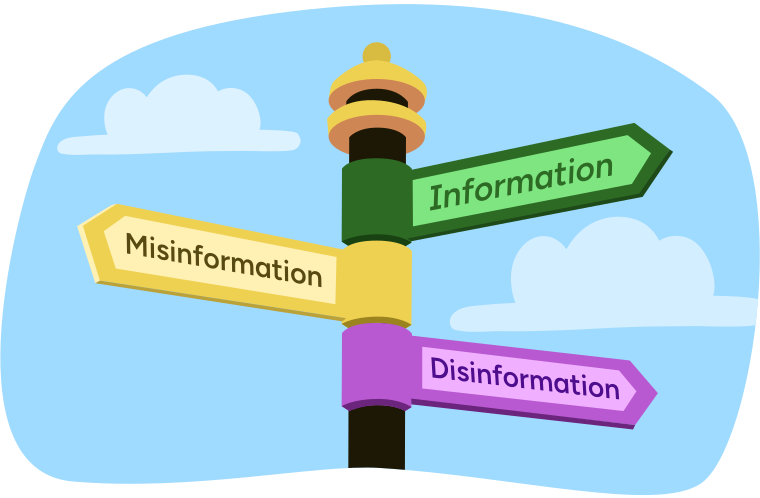
Examine the words misinformation and disinformation.
- How are these words similar? How are they different?
- What are the root words? What are the prefixes? Do the prefixes give you a clue about what the words mean?
In a notebook, or using another method of your choice, try to explain the meanings of the words “misinformation” and “disinformation.” If possible, share your thinking with a partner.
In the Action section, you’ll find out if you’re right about what these words mean!

Misinformation and disinformation
On the internet, both misinformation and disinformation can be found on sites with false information. But what’s the difference?
Consider the prefixes:
|
mis = bad or wrong |
misinformation = bad or wrong information |
|
dis = not or “opposite of” |
disinformation = the opposite of information |
With misinformation, the creator is not trying to give us the wrong information. They don’t realize that the information is false, or they have just made a mistake.
With disinformation, the creator is deliberately trying to fool us. They know the information is false. They have created bad information on purpose, perhaps to convince us of an opinion or to sell us something.
Your turn!
Are the following statements examples of disinformation or misinformation? Select the correct answer, then press Check Answer to see how you did.

Did You Know?
Fact-checkers
Trustworthy news sources have staff called fact-checkers who review content for errors and then post corrections when mistakes accidentally get published. News sites that are based on misinformation or disinformation do not go through this process.
These days, we all have to be fact-checkers. As the internet becomes more and more important in many people’s day-to-day lives, it is essential to develop critical thinking skills about the information that is available online. Learning how to fact-check for credibility, accuracy, and validity helps us evaluate media texts. This means that we must determine if websites are trustworthy, true, and logical in order to avoid believing misinformation or disinformation.
What are some things that people can do to feel safe and confident in the information that they read or watch on the Internet?
Examine the following information to learn how to evaluate online content credibility, accuracy, and validity.
Checklist: Credibility, accuracy, validity
Credibility: Determine if the website is trustworthy/credible.

Accuracy: Look at the facts the creator is presenting.
Validity: Decide if the content is valid or logical.
Video: An example of researching credibility
How would you research the credibility of an online claim? Watch the following video to see an example.
Checking out the claim
“Steve S” claims that the average American uses 25 plastic straws per day.

If the population of the United States is approximately 333 million, is this claim correct?
Not at all. The credible sources quoted in the video say that Americans use between 170 and 500 million straws per day, so the average would be between 0.5 and 1.5 straws per day.
Finally, consider how many plastic straws you use. Is it logical to think that the average American uses 25 plastic straws every day?
Check your understanding
To check your understanding of the video, try the following questions.
Are these statements true or false? Place each card in the right category. Use the arrow buttons to navigate between cards.
Does Steve S’s website contain disinformation or misinformation?
For each sentence, select the missing word from the drop-down menu.
Pause and Reflect
What do you think?
In your opinion, does Steve S’s website contain misinformation or disinformation?
Asking questions to evaluate online information
What questions can you ask yourself when you are analyzing a website?
It’s very useful to have a process to follow when you are evaluating a website or piece of online content. Access the following Evaluating Online Information document and consider printing or downloading a copy for reference. Are there any questions you would add to this list?
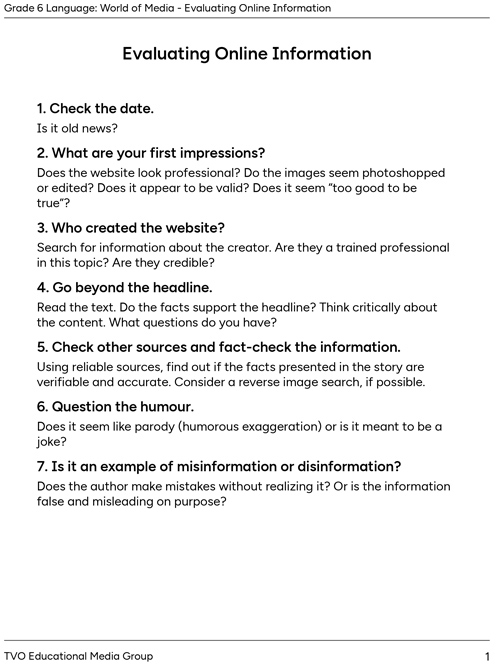
In the Consolidation section, you will practise using this document to evaluate an online article.

Why is it important to understand the difference between misinformation and disinformation? How can thinking about credibility, validity, and accuracy of information help you in other areas of your life?

Analyzing a website
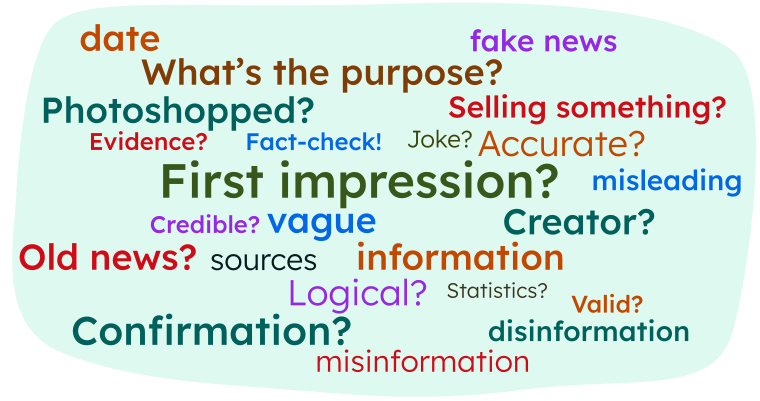
It’s time to put your critical thinking skills into action!
You are going to examine an article from a website and evaluate its credibility, accuracy, and validity. If you feel the article doesn’t present reliable information, you will determine whether it is an example of misinformation or disinformation.
Copy the following graphic organizer into a notebook, or complete the fillable and printable Organizer: Evaluating Online Information document. Take a moment to consider each question as you examine the article. If you would like, you can use speech-to-text or audio recording tools to record your thoughts.
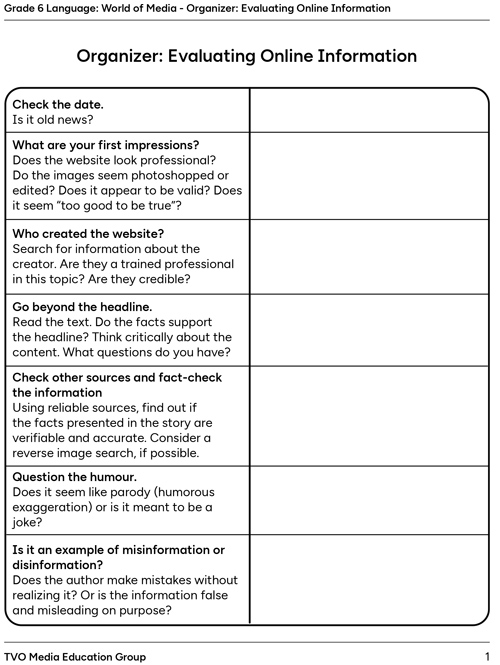
Press the Activity button to access the Organizer: Evaluating Online Information.
Activity(Opens in a new tab)Now read the following excerpt of “Pacific Northwest Tree Octopus,” an article from the website zapatopi.net.
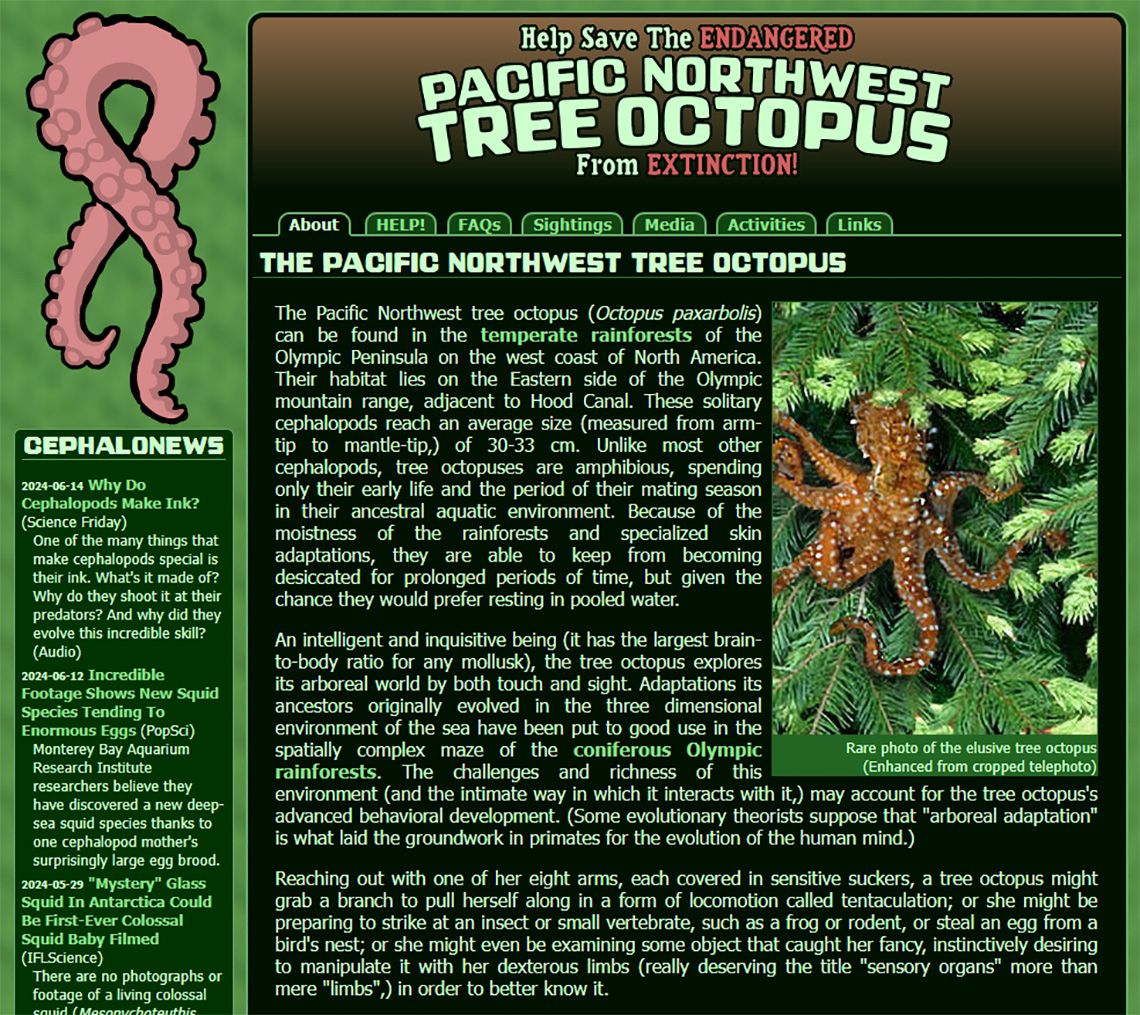
Screenshot of article entitled “Help save the endangered Pacific Northwest tree octopus from extinction.” There is a picture of an octopus in a coniferous tree, with the following caption: Rare photo of the elusive tree octopus (enhanced from cropped telephoto).
The article reads as follows: The Pacific Northwest tree octopus (Octopus paxarbolis) can be found in the temperate rainforests of the Olympic Peninsula on the west coast of North America. Their habitat lies on the Eastern side of the Olympic mountain range, adjacent to Hood Canal. These solitary cephalopods reach an average size (measured from arm-tip to mantle-tip) of 30 to 33 centimetres. Unlike most other cephalopods, tree octopuses are amphibious, spending only their early life and the period of their mating season in their ancestral aquatic environment. Because of the moistness of the rainforests and specialized skin adaptations, they are able to keep from becoming desiccated for prolonged periods of time, but given the chance they would prefer resting in pooled water.
An intelligent and inquisitive being (it has the largest brain-to-body ratio for any mollusk), the tree octopus explores its arboreal world by both touch and sight. Adaptations its ancestors originally evolved in the three-dimensional environment of the sea have been put to good use in the spatially complex maze of the coniferous Olympic rainforests. The challenges and richness of this environment (and the intimate way in which it interacts with it,) may account for the tree octopus’s advanced behavioural development. (Some evolutionary theorists suppose that “arboreal adaptation” is what laid the groundwork in primates for the evolution of the human mind.)
Reaching out with one of her eight arms, each covered in sensitive suckers, a tree octopus might grab a branch to pull herself along in a form of locomotion called tentaculation; or she might be preparing to strike at an insect or small vertebrate, such as a frog or rodent, or steal an egg from a bird’s nest; she might even be examining some object that caught her fancy, instinctively desiring to manipulate it with her dexterous limbs (really deserving the title “sensory organs” more than mere “limbs”,) in order to better know it.
A sidebar entitled “Cephalonews” reads as follows:
May 29, 2024: “Mystery” Glass Squid in Antarctica could be first-ever colossal squid baby filmed (IFLScience). There are no photographs or footage of a living colossal squid (Mesonychoteuthis hamiltoni) in its natural habitat. While a recent international research team didn’t find an adult, they have captured footage of a glass squid which could show either an unknown species, an adult Galiteuthis glacialis squid, or the first footage of a small juvenile colossal squid.
April 5, 2024: Rising ocean temperatures threaten octopus vision and survival (University of Adelaide). Climate change is causing an increase in the number of octopuses, but the warmer ocean temperatures could also harm their vision and put their survival at risk, according to a recent study.
Now read the following information about the author and the website. The following screenshot is taken from the bottom of the page:

The author of this article and its subsections is Lyle Zapato. This site is not associated with any school or educational organization, other than the Kelvinic University branch of the Wild Haggis Conservation Society. Not to be confused with the Pacific Northwest Octopus Tree.
Pause and Reflect
What’s your conclusion?
Once you have filled in the graphic organizer, think about your conclusion:
- Is this article fictitious (made up)?
- If so, is it an example of misinformation or disinformation?
Press Conclusion to check your answer, and to find out more about the website.
Yes, the article is fictitious. There is no such thing as an octopus that lives in a tree! The article is an example of disinformation, or information that is false on purpose. The website it is taken from was created to encourage critical thinking skills and make people laugh.
Was it easy to assess the validity, accuracy, and credibility of this website? What kinds of techniques does the website use to try to convince the reader that the content is true?

Reflect on the experience!
In a notebook or using another method of your choice, reflect on the strategies you used to evaluate whether the “tree octopus” article was credible, accurate, and valid.
- Which of these strategies did you find the most effective?
- How will these strategies change how you explore different media sources? For example, will you check the date or research other sources before you believe the content?
- Explain how these skills will help to make you a critical consumer of media.
If possible, discuss your ideas with a partner.
Reflection
As you read through these descriptions, which sentence best describes how you are feeling about your understanding of this learning activity? Press the button that is beside this sentence.

I feel...
Now, record your ideas using a voice recorder, speech-to-text, or writing tool.