Learning goals
We are learning to…
- understand forms of audio media and their features
- develop ideas and organize content for creating media texts
- draft narrative media texts using a variety of tools and strategies
- use capitalization and punctuation to communicate meaning clearly and coherently
Success criteria
I am able to…
- analyze and summarize the main parts of a podcast story
- generate ideas for a fictional story in a rapid writing brainstorm activity
- organize and outline my podcast story into structured sections
- draft a script for the beginning of a storytelling podcast using colons to separate the speaker and the dialogue
Does form change the language?
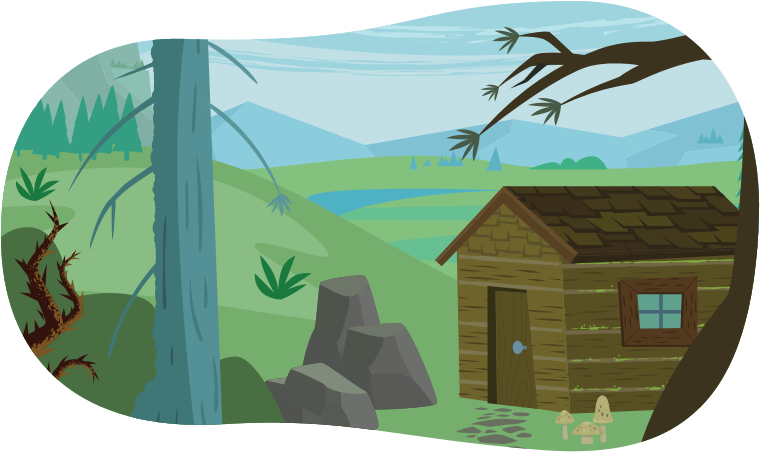
Take a moment to imagine the setting of your favourite story.
- Where does it take place?
- What does it look like?
- What words does the author use to help create a picture in the audience’s mind?
Now what if that story wasn’t written but was listened to instead, such as in the oral storytelling tradition in many Indigenous cultures, or in a digital media format like a podcast – would that change the words or the description that the author would use?

Brainstorm
Brainstorm
How is the experience of reading a story different from the experience of hearing a story?
Record your thinking in a notebook or using another method of your choice. If possible, share your thoughts with a partner.
In this learning activity, we will be exploring an audio form of fictional storytelling by exploring the podcast medium. We will analyze podcast stories to help us understand the elements of the form, to then be able to start creating our own!
Exploring podcasts
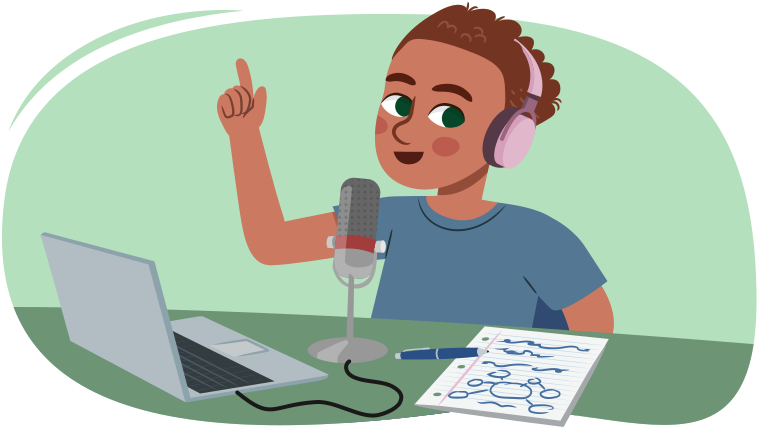
Podcasts are a form of audio media that deliver information and entertainment in an “on-demand” format. This means you can usually listen to them how and when you want to listen to them.
There are so many topics and themes covered in podcasts these days. Some of these include:
- arts (such as music, books)
- education (such as how-tos, courses, language learning)
- sports
- news and politics
- pop culture (such as fashion, celebrity lives)
- science and history
- personal development, health & fitness
- fiction (such as storytelling, comedy)
Many podcasts can be listened to directly from websites or using specific apps on phones or tablets. Most podcasts are free, but some podcasts require a subscription to access extra content, to get early access to new episodes, or to listen ad-free.

Safety tip: Not all podcasts are appropriate for all ages and listeners. It’s always a good idea to check with a trusted adult for guidance on which ones might be appropriate for you and your age group.
Storytelling through podcasts
In this learning activity, we are going to be exploring and analyzing podcasts as a format to tell a fictional story.
Good stories are stories that capture their audience’s attention and keep them wanting to know more! Authors often do this by sparking curiosity, building suspense or anticipation, revealing key information in a “big moment,” and finally bringing everything together, usually with some sort of conclusion.
This structure is sort of like the shape of a rollercoaster!
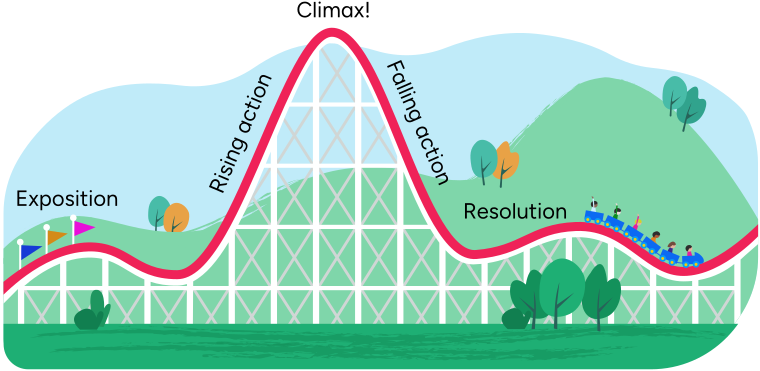
The structure of a story illustrated as a roller coaster. The beginning of the ride is the exposition. The rising action is where the ride begins to climb. The climax is the peak of the ride. The falling action is when the ride begins to fall. Finally, the resolution is the end of the ride.
Let’s break down the five parts that make up the structure of a story.

Let’s listen!
Let’s listen to an example of a fictional (not real) storytelling podcast and try to identify the different parts of the story we just reviewed.
As you listen to the podcast episode, use the following graphic organizer, or another method of your choice, to identify the different parts of the story.
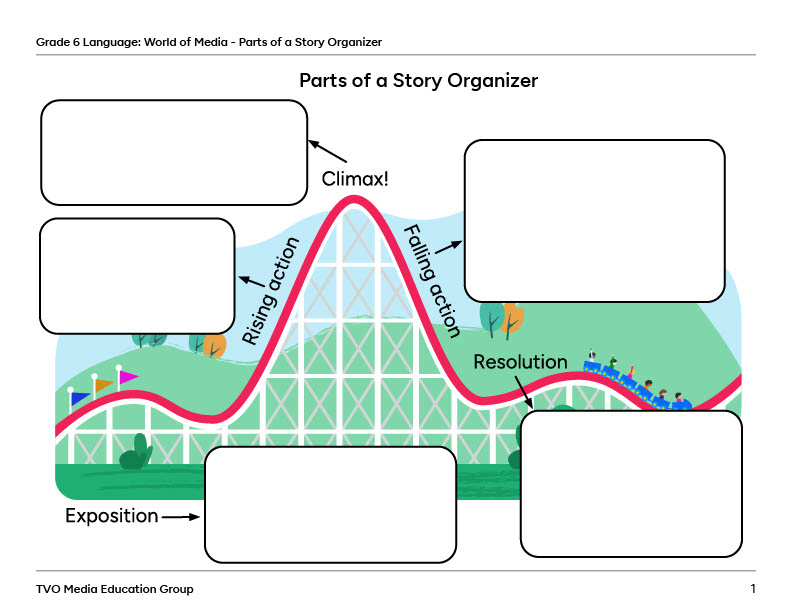
Access the following recording entitled Hansel and Gretel Podcast Episode.
Hansel and Gretel Podcast Episode
When you’re done identifying the different parts of the story, press the Sample Answer button to check your work.
| Part of a Story | Section of the Podcast |
|---|---|
| Exposition | The narrator sets the scene by describing the setting, the characters, and the possibility of what’s to come. |
| Rising Action | Hansel and Gretel explore the forest, leaving trails of items for themselves to be able to get back home. They get lost and happen upon a cottage made of candy where an old woman lives. |
| Climax | The woman turns out to be a witch that wants to eat them! Gretel devises a plan to trick her and trap her in the oven. |
| Falling Action | Hansel and Gretel escape but not before helping themselves to the witch’s gems. They finally find their way home and are reunited with their father. |
| Resolution | Thanks to the wealth that the witch’s gems have provided them Hansel, Gretel, and their father live happily ever after. |
A closer look at podcast structure
As discussed, podcasts are an audio media, which means they are a way of telling stories orally. But fictional storytelling podcasts usually need to be planned out and start in a written form as a script!
Let’s explore a sample of a podcast story titled “The Lion and the Mouse” written as a script.
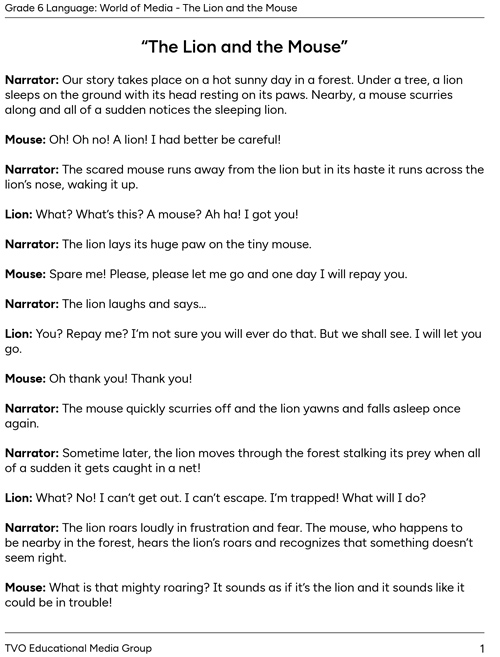
Identifying parts of the story
Can you identify the different parts of the story?
In the following activity, match the part of the story to the appropriate category of story structure.

The text of “The Lion and the Mouse” is an example of a script. When writing dialogue in scripts, we list each character’s name followed by a colon (:) and then what they say. This helps people reading the script know who is speaking and what each person says.
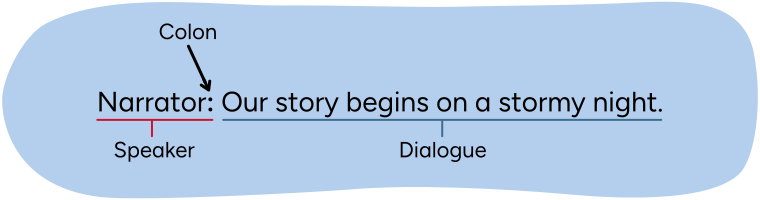
Format of a script dialogue. "Narrator: Our story begins on a stormy night." 'Narrator' is the speaker. A colon comes after the speaker. "Our story begins on a stormy night" is the dialogue.
Learning check!
In the following multiple-choice questions, identify the correct format for the dialogue.
Select the correct answer, then press Check Answer to see how you did.

Reading Time
Reading time
Because storytelling podcasts are a form of audio media, their scripts are a great tool to help practice reading fluency! Readers need to adjust the tone, expression, and intonation of their voices to help communicate the different characters in the oral story.
Use the script for “The Lion and the Mouse” to practice reading each of the different characters’ dialogue out loud. Adjust your speech to indicate when you’re switching from the Narrator, Mouse, and Lion.
For example, you might use a more serious tone for the Narrator, a higher-pitched voice for Mouse, or a deeper voice for Lion. Don’t forget about the emotions of the different characters and how you might change your voice to communicate how they are feeling in each of their lines!

Getting ready for writing!
Sometimes, writing can feel challenging. Coming up with new, creative ideas takes work. Like most skills, creative writing requires practice and “exercise.”
We are going to do a quick brainstorming activity to help generate different story ideas in a short amount of time and “exercise” our creative writing muscles!
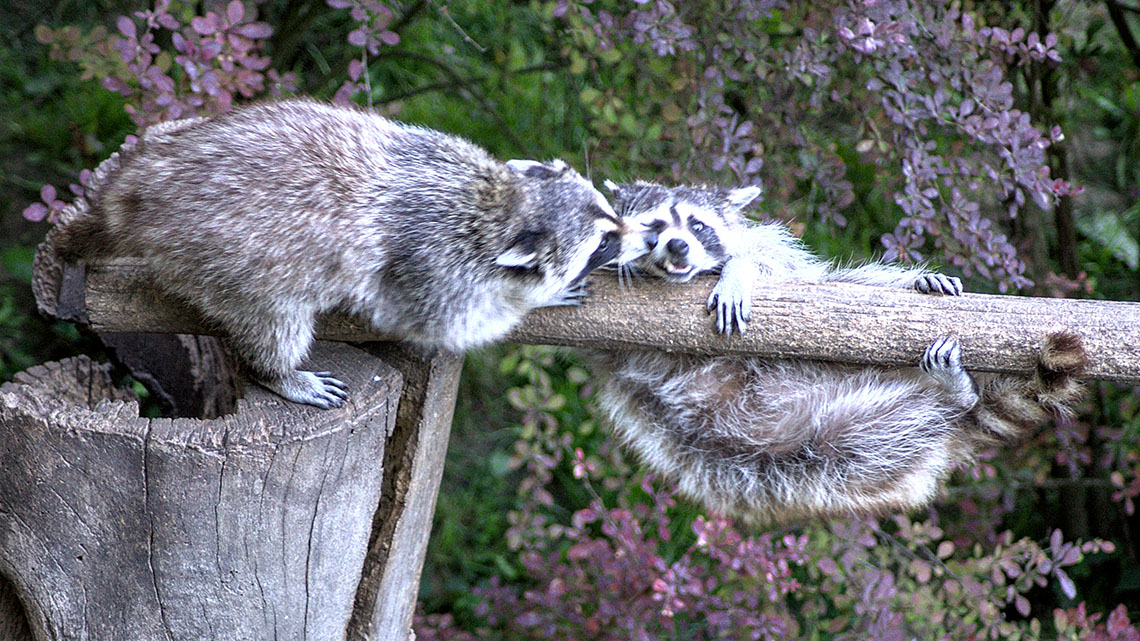
Examine the following images and, in a notebook or using another method of your choice, quickly jot down, draw, or sketch a story idea connected to each one. This is meant to be a quick brainstorm, so try not to spend more than 1-2 minutes brainstorming ideas per picture!
Get ready, get set, go!



Next, choose one of your ideas, or a new idea for a story that you may have, and try to build out the plot a little bit more by answering the following questions:
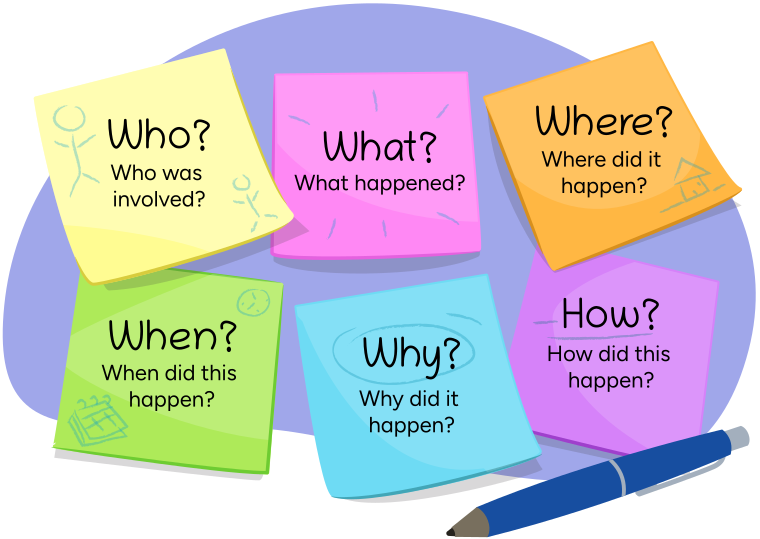
Who? Who was involved?
What? What happened?
Where? Where did it happen?
When? When did this happen?
Why? Why did it happen?
How? How did this happen?
When in the planning stages of writing, it’s very important to consider who your audience will be! The tone and language you use will change depending on the age of the audience you are trying to target. Will you write a story for very young children, for kids your age, or for older audiences like teens and adults? The target audience will impact the story that you tell!
Next, it’s time to start bringing your story to life by planning out the different parts of the story.
Use the following graphic organizer, or another method of your choice, to help you plan out the five different parts of your story. Remember, your story is going to be told in a podcast format, so you won’t have images or visuals to rely on to help tell your story. You’ll have to make sure your audience gets all the important details of your story through narration or dialogue!
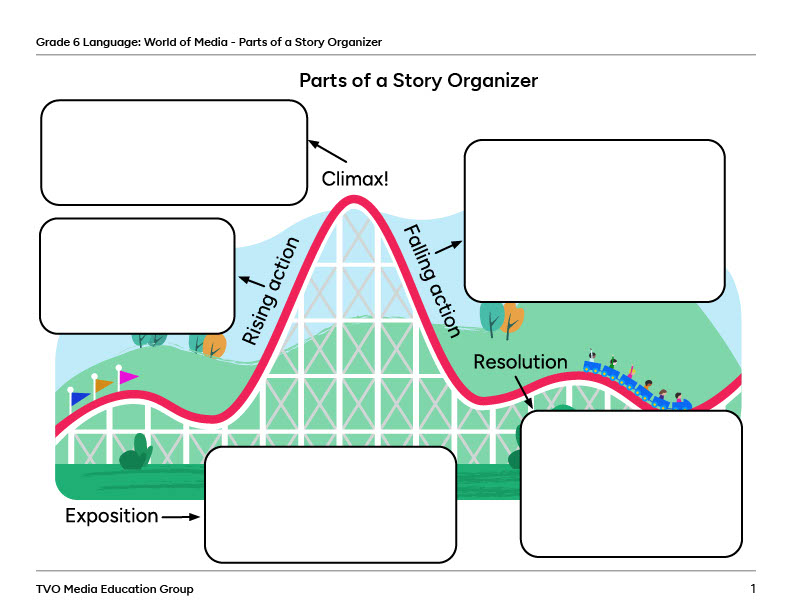
When you’re done, use the following checklist to self-assess your work.
My Story Plan…
Putting it all together
Test your skills of proper formatting for script dialogue by sorting the following examples into the correct or incorrect categories.
Place the cards into categories that best match. Use the arrow buttons to navigate between cards.
Now that you have learned about podcasting as a form of storytelling, explored how their scripts are formatted, and created an outline for your own podcast story, it’s time to put it all together!
Use the story plan that you created in the Action section to help you draft a script for the beginning of your podcast story. This could be just your exposition section, or you could choose to include some of your rising action too.
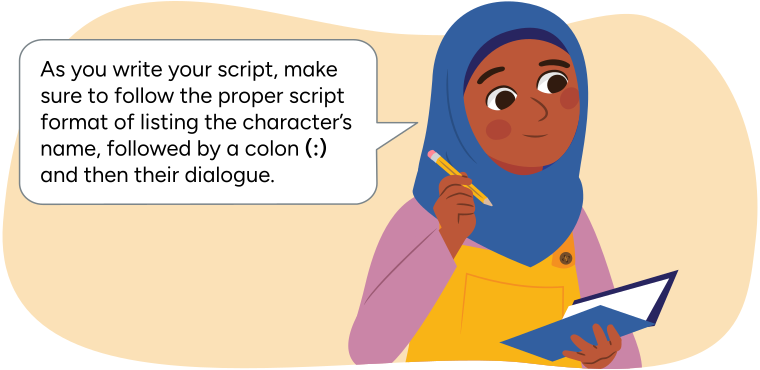
Press the Script Dialogue Example button to learn how to format your script.
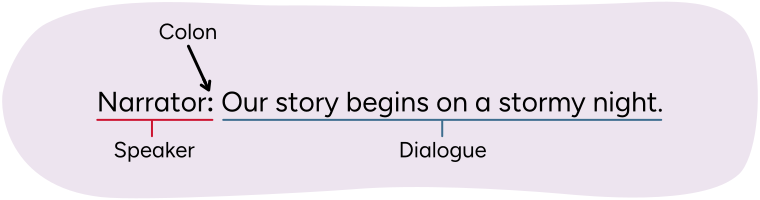
Format of a script dialogue. "Narrator: Our story begins on a stormy night." 'Narrator' is the speaker. A colon comes after the speaker. "Our story begins on a stormy night" is the dialogue.
When you’re done, consider recording the beginning of your podcast to help you further practice your reading fluency by adjusting the tone, expression, and intonation of your voice to help communicate the different characters in your story!
Reflection
As you read through these descriptions, which sentence best describes how you are feeling about your understanding of this learning activity? Press the button that is beside this sentence.

I feel...
Now, record your ideas using a voice recorder, speech-to-text, or writing tool.