Learning goals
We are learning to…
- navigate online environments safely and interact in a way that supports our well-being and that of others
- analyze texts by identifying main and supporting ideas
- demonstrate an understanding of features and elements of specific types of digital texts
- plan and develop ideas, and create digital and media texts
Success criteria
I am able to…
- identify examples of cyberbullying and explain ways to be positive and respectful online
- summarize the main messages of different media texts to show my understanding of their meaning
- identify the message, target audience, and poster features I intend to use in my poster about online safety and respect
- publish an online safety poster and analyze how each of its features supports my main message
Communication is a skill
Communicating with others is a skill that everyone needs to keep working on, no matter how old they are or what stage of life they are in.
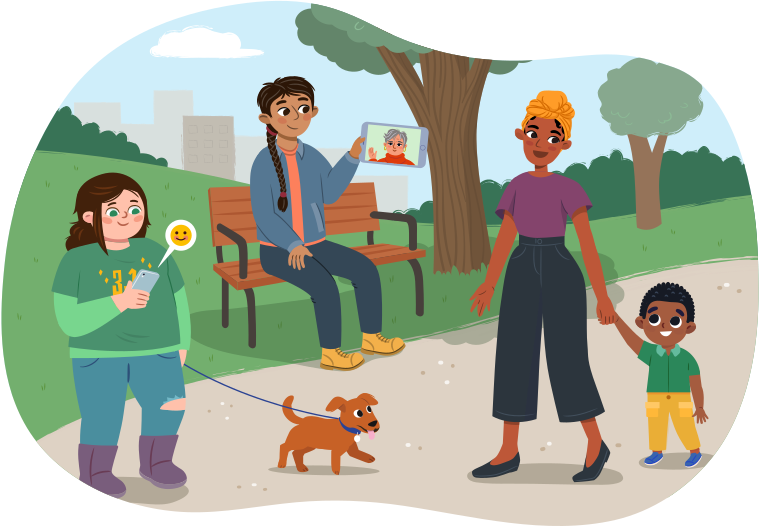
In our very digital world, we need to be especially aware of what we do and say online because we leave behind a digital footprint that can’t be erased.

Brainstorm
Digital communication
Using the method of your choice (such as paper, computer, or audio recording), brainstorm why you think people need to be careful about what they say and do online. What are some tips you might share with someone younger than you who is just learning to use digital/online environments?
If possible, brainstorm with a partner!
Throughout this learning activity, we will explore different ways to navigate digital spaces and communicate in a kind, safe, and respectful way. We will also use critical thinking to examine choices that we make when communicating and interacting online. This will help us avoid hurting others and getting hurt ourselves.

Communicating online
There are many ways that people communicate online. The following are some examples:
- on social media platforms
- texting or through group messaging apps
- through online gaming platforms
- on website or app chats/discussion forums
Do you think there is a difference between how people communicate online and face to face?
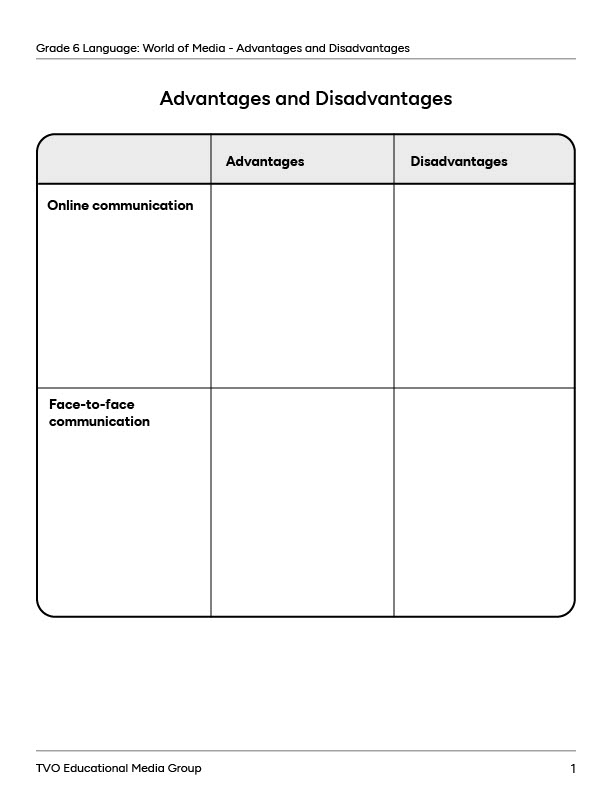
Let’s consider some of the advantages and disadvantages of online communication and face-to-face communication.
Complete Advantages and Disadvantages in your notebook or using the following fillable and printable document. You can also use another method of your choice to record your ideas (for example, you could use speech-to-text or audio recording tools).
Press Possible Answers to check your understanding.
| Advantages | Disadvantages | |
|---|---|---|
|
Online communication |
|
|
|
Face-to-face communication |
|
|
Online, every word matters
Online or digital communication has lots of benefits. However, we also need to think a bit more about how we express ourselves.
When we communicate in person, non-verbal communication helps us express our message clearly:
- tone of voice
- facial expressions
- body language
When we communicate digitally, we don’t have these supports. That means our words matter more in communicating the tone and meaning of our messages.
Finding the main idea
You are going to watch a video and identify its main idea. But first, what is a “main idea”? Teacher Chiara explains…

The main message in a text of any kind is the big idea that the author or creator is trying to communicate to us, the audience. It is the main point that they want their audience to know, feel, or do.
Video: Let’s connect
Now check out “Let’s Connect,” an episode of “Wacky Media Songs.” In this video, Ava gives us an example of how words matter when we communicate online.
Using a method of your choice, state what the main message of the video is. Then summarize two or three of the tips given in the video. If possible, share your thoughts with a partner.
Press Main Message to check your answer.
The main message of the video is that words matter when we are communicating online.
Some of the tips:
- Make sure you feel safe with friends online.
- Show respect to others online and always be kind.
- Keep a positive attitude.
Online safety
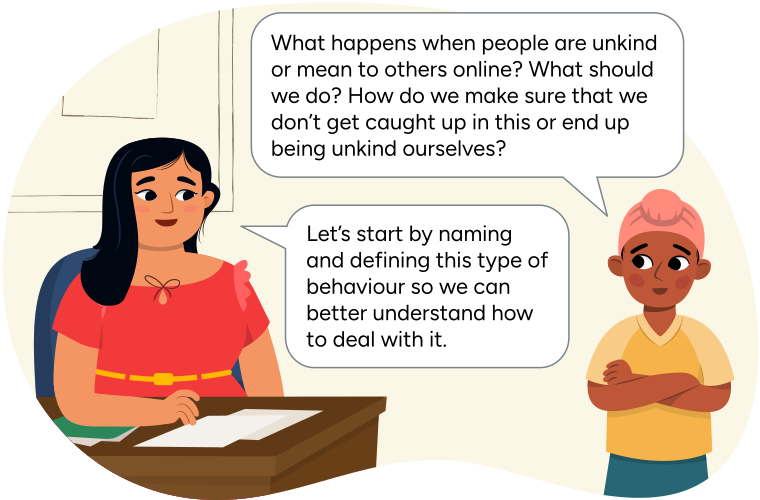
A conversation between Teacher Chiara and Savinder.
Savinder says, "What happens when people are unkind or mean to others
online? What should we do? How do we make sure that we don't get caught up in
this or end up being unkind ourselves?"
Teacher Chiara replies, "Let's start by naming and defining this type of
behaviour so we can better understand how to deal with it."
What is cyberbullying?
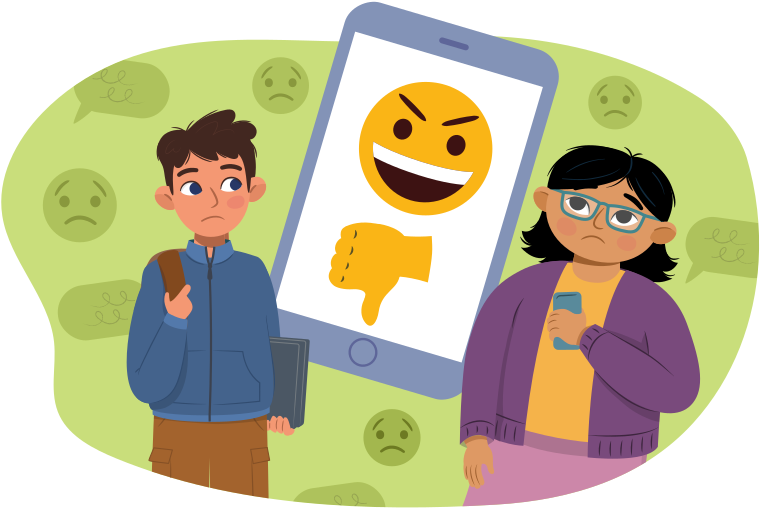
The word “cyberbullying” contains the word “bullying.” But what do these terms means?
Press the following tabs to find out.
Bullying is unwanted, aggressive behaviour. It is often a pattern of behaviour. That means that it’s repeated over time.
Cyberbullying is bullying that takes place in digital spaces and on digital platforms. It can include sending, posting, or sharing negative or hurtful information about someone that causes emotional harm, like embarrassment or sadness.
How serious is cyberbullying?
Because digital footprints last forever, forms of cyberbullying can be considered criminal behaviour and are taken very seriously.

Student Tips
Tips: Online safety
Think carefully before you post anything online. Remember that anything that is posted online can never be truly removed because there is no way of knowing who has downloaded, saved, or screenshared it. In other words, online content leaves a digital footprint that lasts forever.
Thinking critically: Online communication
Let’s think critically about how we communicate and interact in digital environments. We want to be sure we always act in a kind, positive way. It’s essential to respect and protect our own privacy and that of others.
Try this true-or-false question. Select the correct answer, then press Check Answer to see how you did.
Used responsibly, social media platforms have the potential to bring people together in a positive way, and many people use them that way. However, these spaces can also be misused in a way that leads to cyberbullying.
Statistics show that cyberbullying has become a major problem among children in Canada.
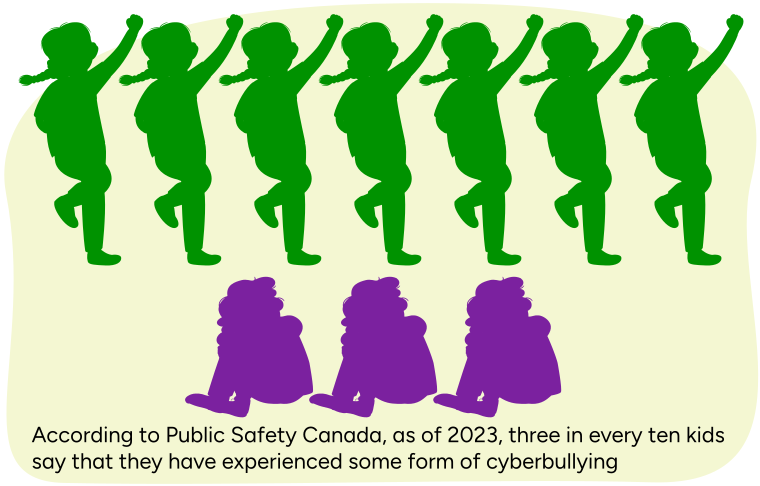
Source:
Public Safety Canada. Together we can stop cyberbullying. Government of Canada. https://www.canada.ca/en/public-safety-canada/campaigns/cyberbullying.html

Think
Ask yourself why
Why do you think cyberbullying has become a growing problem among teens?
Your turn: Is it cyberbullying?

Review each of the following scenarios and decide if it is an example of cyberbullying.
Select the correct answer, then press Check Answer to see how you did.
You may have noticed that all of the scenarios were examples of cyberbullying. Did any of the scenarios surprise you?
Cyberbullying can take many forms. We need to remember this, as it’s important to be kind and safe online.
Public Safety Canada
Public Safety Canada has many resources about cyberbullying and how to prevent it.
Video: Protecting your online reputation.
Check out the following video from Public Safety Canada to learn more about cyberbullying and protecting your online reputation.

Analyzing the video
Using the method of your choice, record your answers to the following questions:
- What is the main message of the video?
- How does the video use images to communicate its message? Is this use of images effective? Why or why not?
If possible, share your thoughts with a partner.
Dealing with difficult situations
Bullying can have many different effects on people. It can impact their emotions, thoughts, self-esteem, schoolwork, and more.
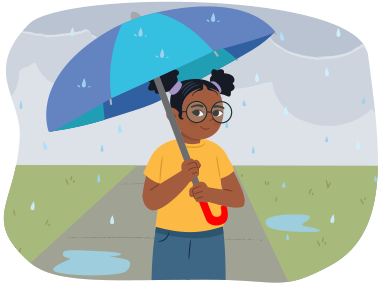
We can’t always control how we feel about things, but we can control how we react to them. In other words, we can practise self-regulation.
Self-regulation
Self-regulation is the ability to control the way we react to people and situations. How we react can lead to positive results or negative results. By choosing to react in a positive way, we can encourage positive results.
When we take responsibility for our actions, we take charge of our lives.
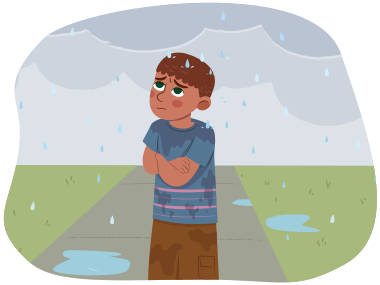
The three-step process
Let’s explore a simple way to approach difficult situations, whether they are online or in person. You follow three simple steps:
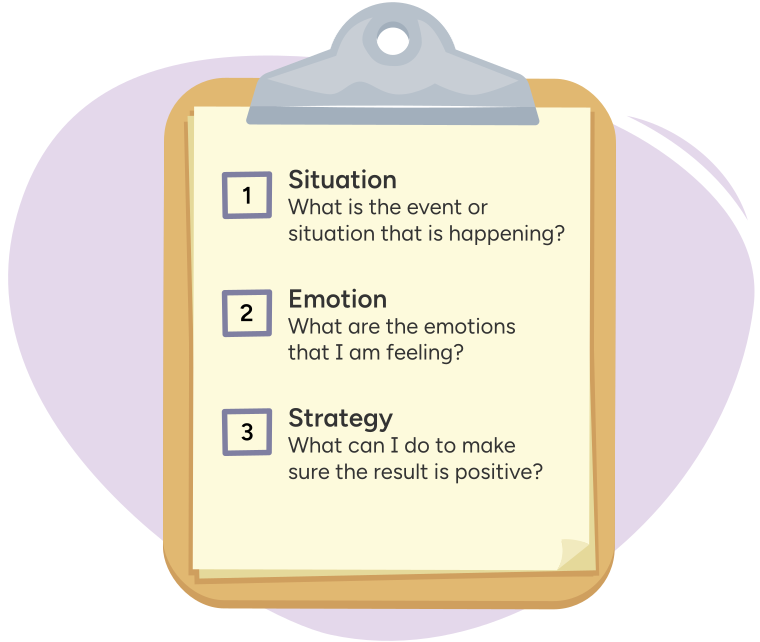
- Situation: What is the event or situation that is happening?
- Emotion: What are the emotions that I am feeling?
- Strategy: What can I do to make sure the result is positive?
Press the following tabs to learn more about each of the three steps.

Take a minute to think about and process the situation that is happening. Go over the details in your mind or say them out loud.
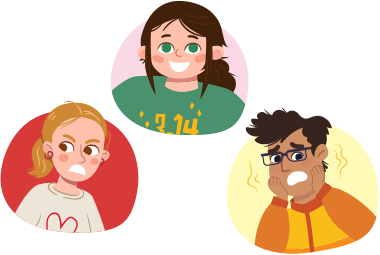
Try to name the emotions that this situation is bringing up in you. There may be many emotions to feel. Sometimes we feel more than one at a time. Recognizing and naming all of the emotions we feel can help us make sense of them before we react.
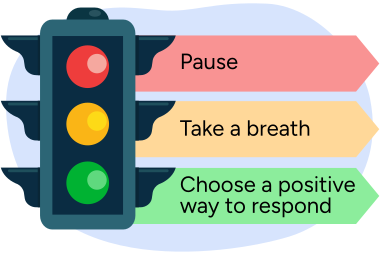
A stop light depicting a strategy to deal with a difficult
situation.
Red light: Pause.
Yellow light: Take a breath.
Green light: Choose a positive way to respond.
Once you have understood the situation and recognized your emotions, it’s time to deal with the situation by developing a strategy. Pause. Take a breath. Choose a way to respond that will resolve the situation in a positive way.
If you aren’t sure of how to choose a positive solution, ask! If you find yourself in a difficult situation (online or in person), speak to a trusted adult. There are also support agencies available to help by telephone or online, like Kids Help Phone.
Can you think of any situations or areas of your life where these three steps would help you process your feelings and find a positive outcome?
How to prevent cyberbullying
Now that we have explored different forms of cyberbullying, what actions can we take to prevent it or stop it from continuing? You are going to brainstorm some ideas.
Complete Stop Cyberbullying: Mind Map in your notebook or using the following fillable and printable document. If you prefer, use another method of your choice to record your ideas (for example, you could use speech-to-text or audio recording tools).
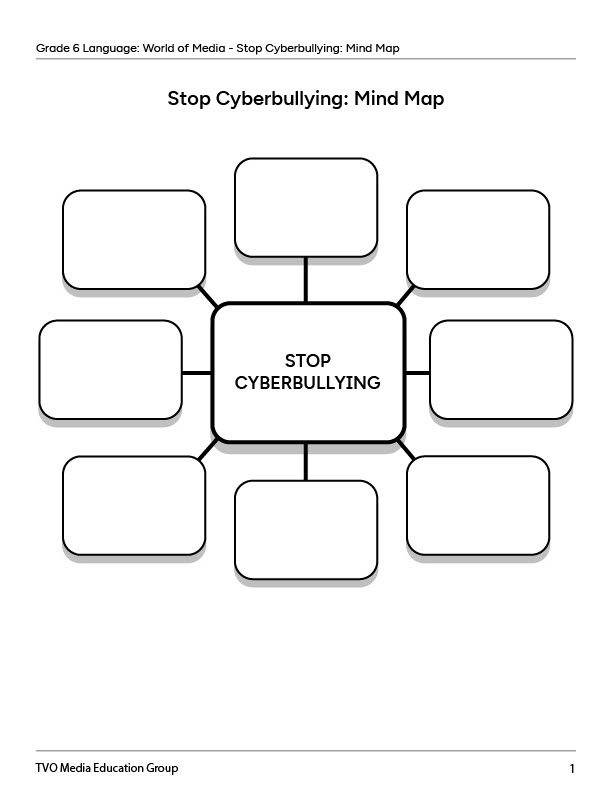
To see some of the ways we can fight cyberbullying, press Anti-Cyberbullying Actions.
Actions we can take against cyberbullying include the following:
- Block the person doing the bullying.
- Offer support to the person being bullied.
- Don’t “like” or share mean messages. That makes things worse.
- Tell a trusted adult that the bullying is happening.
- Collect evidence by taking a screenshot of the text message, post, or image and comments that go with it so that it can be shown to a trusted adult.
- Report to police. First discuss the situation with a trusted adult. If necessary, this adult will help you report them to the police.
Attitude is important
Beyond these practical steps, we can have compassion and empathy for others. This includes being kind and respectful towards others. People may have likes, opinions, identities, and cultural norms that are different from yours. However, we all need to show respect to others in order to build a diverse, equitable, and inclusive society.

Vocabulary routine!
You have just seen these three words: diverse, equitable, and inclusive.
To understand a new word or term, it’s not enough for us to just read a definition. To really understand, our brains need to think about it in different ways.
Choose one of the following graphic organizers, or another method of your choice, to record and explore the terms diverse, equitable, and inclusive.
This task will form part of your vocabulary notebook.
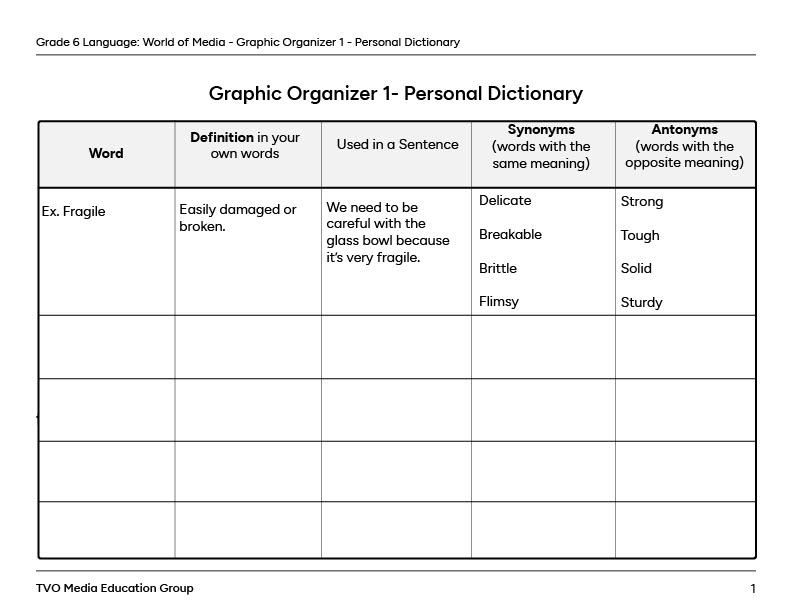
Press the Activity button to access the Graphic Organizer 1 - Personal Dictionary.
Activity(Opens in a new tab)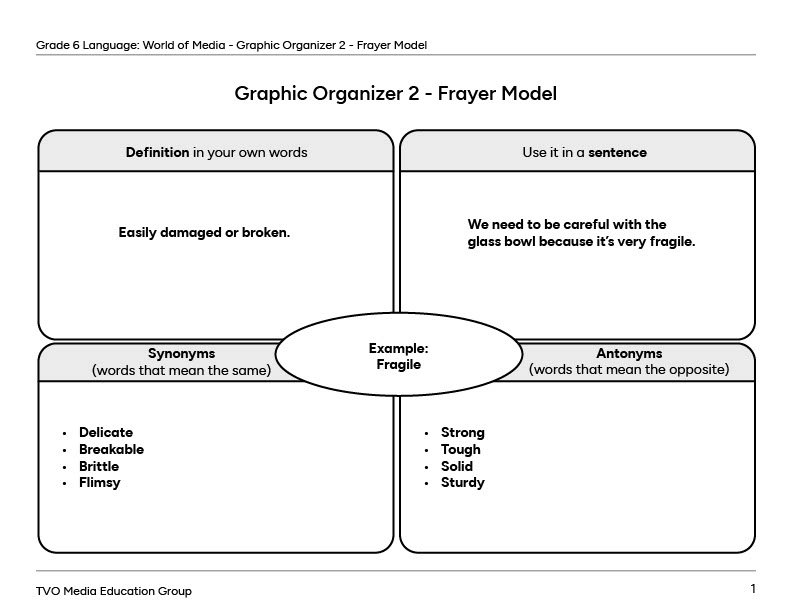
Press the Activity button to access the Graphic Organizer 2 - Frayer Model.
Activity(Opens in a new tab)You have just done a lot of work on vocabulary. Now is a great time to take a break before we look at how media can be used to fight cyberbullying!

Student Wellness
Take a break!
Time for a body break! If possible, stretch your body and move around your space.
Using media to prevent cyberbullying
The purpose of media is to communicate messages. This can include messages about staying safe. For example, Public Safety Canada has a fact sheet about cyberbullying.
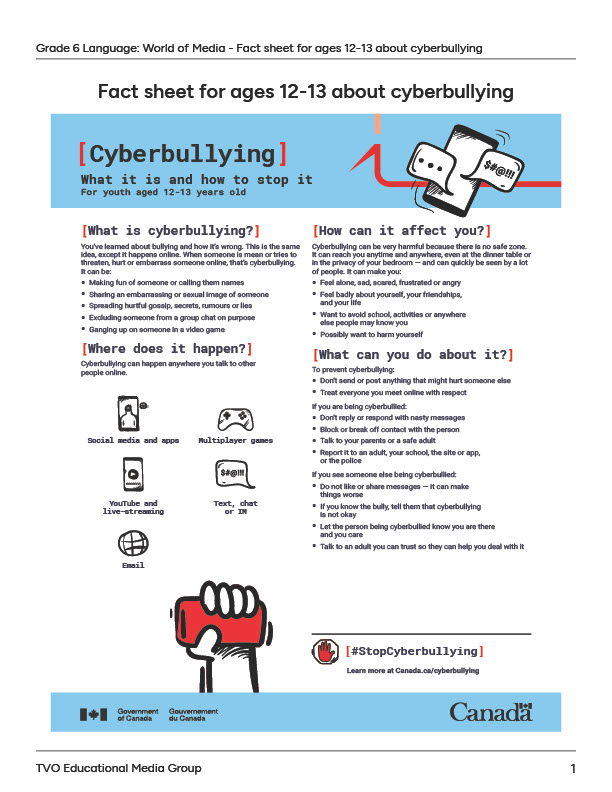
Press the Activity button to access the Fact Sheet for ages 12-13 about cyberbullying.
Activity(Opens in a new tab)Source:
Public Safety Canada. (2021, March 3). Fact sheet for ages 12-13 about cyberbullying. Government of Canada. https://www.canada.ca/en/public-safety-canada/campaigns/cyberbullying/help-protect-your-child-from-cyberbullying/additional-cyberbullying-resources-parents/fact-sheet-for-ages-12-13-about-cyberbullying.html
To communicate its message, this fact sheet uses features such as colour, fonts, images, and symbols. However, the main feature is text. It takes quite a while to read the whole thing!
Posters: Short, powerful messages
Other forms of media – such as social media platforms, advertisements, and posters – are designed to communicate messages in a short and succinct way. Their purpose is to get across a quick but lasting message to influence their audience.
Posters are a form of media that is designed to send a quick and clear message to their audience.
Let’s explore an anti-cyberbullying poster.
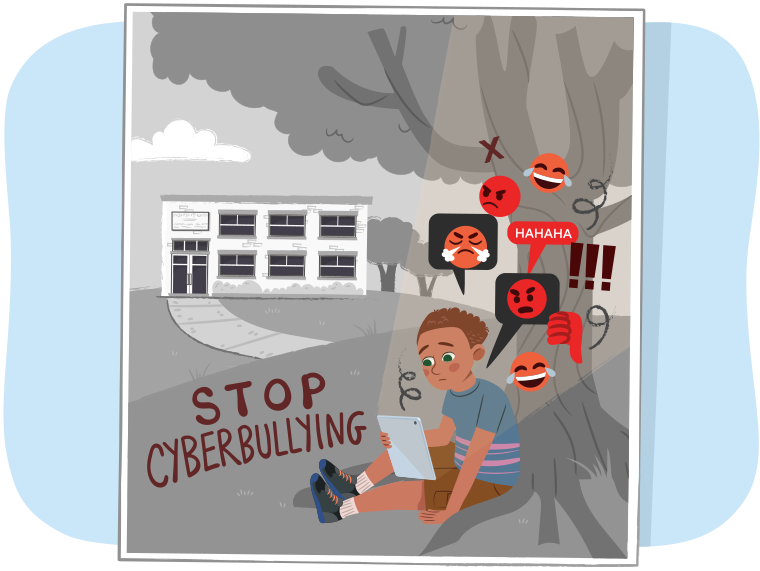
A poster featuring the words ‘STOP CYBERBULLYING.' A sad learner is sitting under a tree while looking at their tablet. Negative emojis such as a thumbs-down symbol are surrounding the learner.
Analyzing the poster
Using a method of your choice, record your answers to this question:
- What is the main message of this poster?
If possible, share your thoughts with a partner.
Press the Possible Answer button to compare your thoughts.
Features: Contributing to the message
Now let’s analyze the features the poster uses to communicate its message. Explore the following table.
| Poster features | Notes |
|---|---|
| Text | The only words on the poster are “STOP CYBERBULLYING!” Everything else on the poster is a symbol or an image, so the words and the main message of the poster stand out. |
| Images |
The computer, emojis, and speech bubbles let the audience know this is connected to digital communication and, therefore, cyberbullying. The school in the background tells us the person is a student. This suggests that the intended audience for the poster is kids and teens. |
| Use of colour |
The colour red is used to make the negative and hurtful parts of the poster stand out. This communicates the negative emotions and harm that cyberbullying causes. Only the negative pieces and the person are in colour, so they stand out as important and a key part of the main message. |
In this poster, the combination of the words, text, colours, and symbols create an impactful message about the need to stop cyberbullying.
Design your own poster!
Now that we have explored a poster, it’s your turn! You will create your own poster about online safety. As much as possible, include diverse people and perspectives.
Student Savinder is a bit worried about having to make a poster. Teacher Chiara is giving him some advice. Read their conversation:
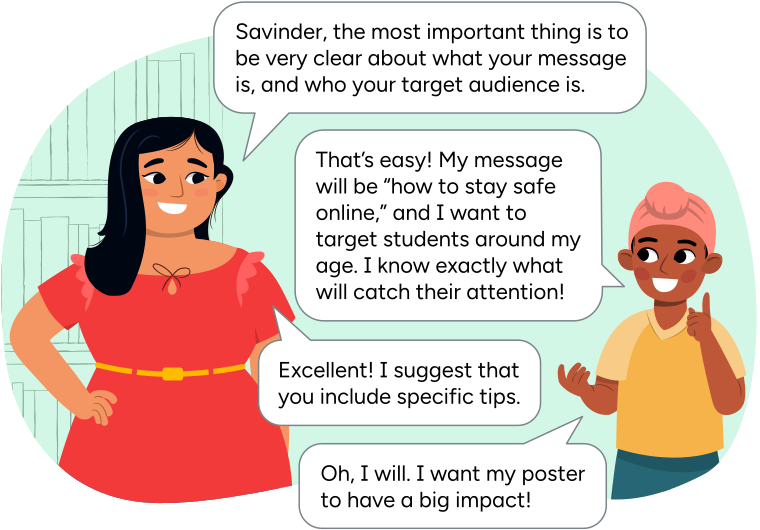
Teacher Chiara and Savinder having a conversation.
Teacher Chiara says, "Savinder, the most important thing is to be very clear
about what your message is, and who your target audience is."
Savinder replies, "That's easy! My message will be 'how to stay safe
online,' and I want to target students around my age. I know exactly what will
catch their attention!"
Teacher Chiara: "Excellent! I suggest that you include specific tips."
Savinder: "Oh, I will. I want my poster to have a big impact!"

Listen to the conversation!
To hear this conversation, check out the following audio clip:
Conversation about poster
Planning your poster
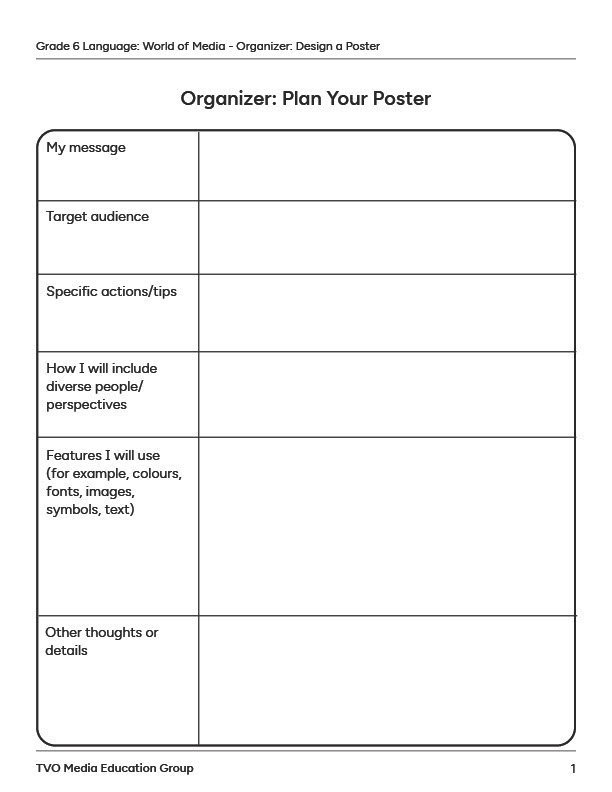
Complete Organizer: Plan Your Poster in your notebook or using the following fillable and printable document. If you prefer, use another method of your choice to record your ideas (for example, you could use speech-to-text or audio recording tools).
Good job! You have planned an impactful poster. It’s a step in the fight against cyberbullying.

Let’s check!

Throughout this learning activity, we have explored ways to stay safe and show respect in a digital environment. We have also explored the definition of cyberbullying, some of its different forms, and ways to create safer digital spaces for ourselves and others.
True or false?
Based on the information you have learned, complete the following true-or-false activity.
Select the correct answer, then press Check Answer to see how you did.
Putting it all together
It’s time to publish your poster!
Now that you’ve planned the features that you’ll include in your poster, what tool will you use to create your final product? You can create…
- a physical poster using tools such as paper and coloured pencils or paint
- a digital poster using a free digital design and production tool, like Canva, Adobe Express, or Slides
Whatever tools you choose, create an eye-catching poster that communicates your message about online safety and respect in a succinct, clear, and memorable way.
Analyze your poster
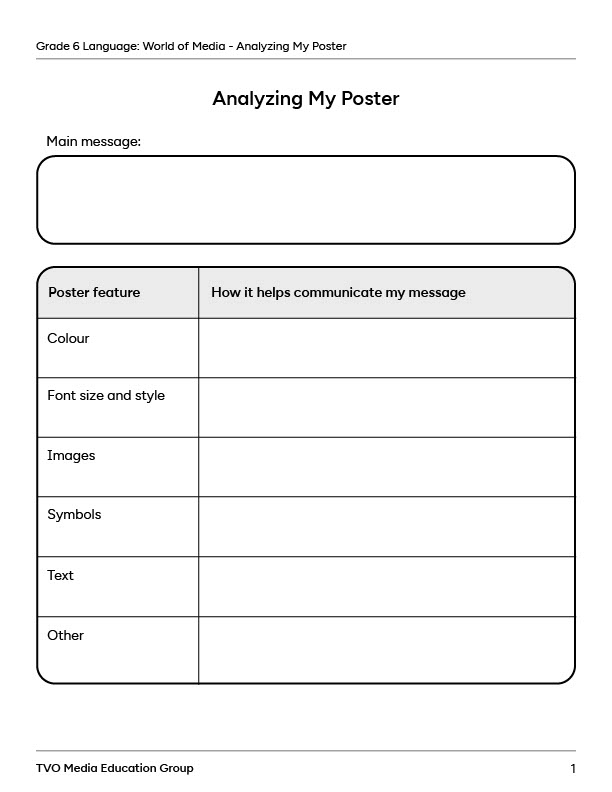
When your poster is complete, analyze how each of its features contributes to the message.
Complete Analyzing My Poster in your notebook or using the following fillable and printable document. If you prefer, use another method of your choice to record your ideas (for example, you could use speech-to-text or audio recording tools).
Throughout the learning activity, we have considered the negative effects of cyberbullying and ways to prevent it from happening.
Reflection journal
In a notebook, or using another method of your choice, answer the following questions in three to five sentences:
- Given what you have learned in this learning activity, why is it important to be kind online?
- What steps could you take to help someone who might be experiencing cyberbullying?
Reflection
As you read through these descriptions, which sentence best describes how you are feeling about your understanding of this learning activity? Press the button that is beside this sentence.

I feel...
Now, record your ideas using a voice recorder, speech-to-text, or writing tool.