Learning goals
We are learning to…
- demonstrate an understanding of the historical contexts, contributions, lived experiences, and perspectives of a diversity of individuals and communities
- summarize and record the main idea and supporting details in various texts, and draw well-supported conclusions
- synthesize information and content relevant to a topic, using a variety of appropriate strategies; evaluating the quality, bias, and accuracy of information
Success criteria
I am able to…
- use learned strategies to determine facts versus opinions in a text
- analyze media for bias using learned strategies and determine types of bias in media
- explore and explain the positive value of diversity representation in texts and media
- write a “gist summary” about learned content

Facts, opinions, and media
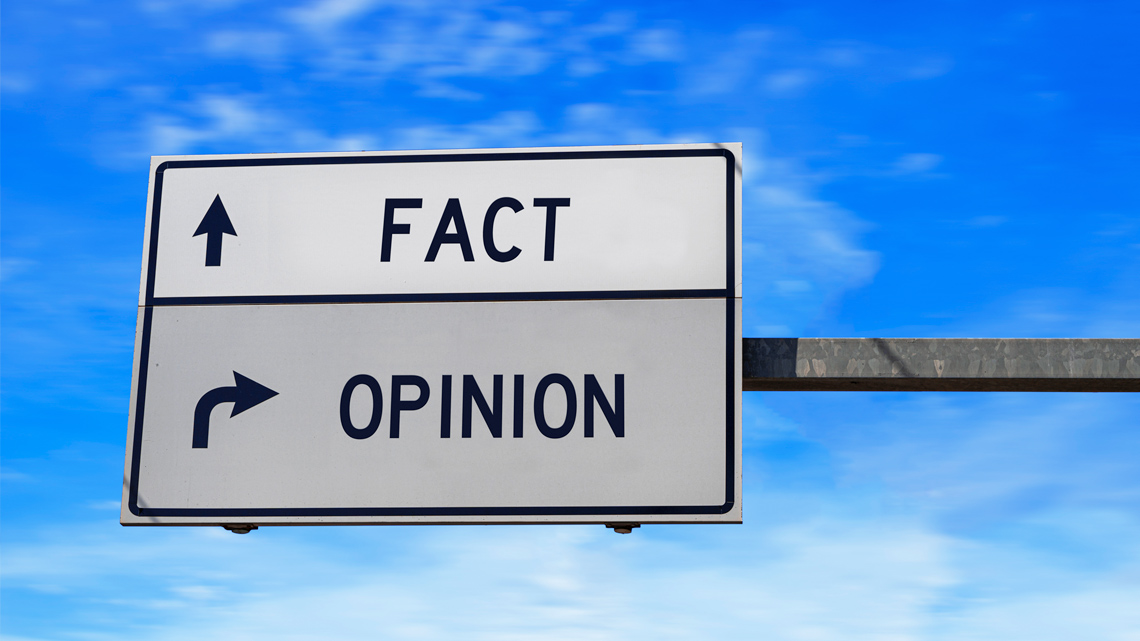
It is important to learn how to distinguish between fact and opinion. Knowing that non-fiction works are based on fact may seem simple, but sometimes the difference between a fact and an opinion can be a bit more complicated.
Consider that common media types include:
- social platforms
- television and streaming services
- music
- movies
- video games
- news articles
- magazines
- radio and podcasts
- websites
In the media, there are often many facts and opinions combined into a single text. Check out the following definitions to support your understanding and record any new details in a notebook or a method of your choice.
A fact is a statement about something that is true or can be proven to be correct.
An opinion is statement that contains beliefs rather than facts; it tells how someone feels. An opinion is not always true and cannot necessarily be proven.
Explore the following statements and choose whether they are facts or opinions, checking your answers as you go.
Select the correct answer, then press Check Answer to see how you did.

Student Success
Let’s think!
How can you tell the difference between a fact and an opinion? Are there any strategies you used?

What are media bias and stereotypes?

In the Minds On section, you were asked if you used any specific strategies when identifying a statement as either a fact or an opinion. It is fine if you weren’t sure because there are certain clues that you can look for when trying to determine facts versus opinions.
Facts versus opinions
First, consider the source of the information and the context that it has been presented in. Read the following sentences and decide if each one is a fact or an opinion.
Your turn!
Explore the following statements and determine which one is a fact and which one is an opinion.
Select the correct answer, then press Check Answer to see how you did.
Unpacking bias
Understanding the difference between facts and opinions can help to also identify bias in media.
Bias is an opinion, preference, or prejudice that limits an individual’s or group’s ability to make fair, objective, or accurate judgements. Bias isn't necessarily a bad thing, but hidden media bias can mislead, manipulate, and divide us.
Bias is shown in people’s opinions when personal feelings influence their judgement. It can be noticed in the words that writers use to express a point of view. Our biases affect the way we select facts and develop opinions. Sometimes, our biases even affect what we believe to be fact and what is opinion.
It’s part of human nature to have perspectives, preferences, or prejudices. Our brains are actually designed to classify things into categories as soon as we see them, so it makes sense that our brains tend to generalize.
Explicit and implicit bias
When examining the topic of bias, it can help us to categorize the different forms it takes to make it easier to detect. Recall that human brains are designed to classify things!
There are two main types of bias: explicit and implicit bias.
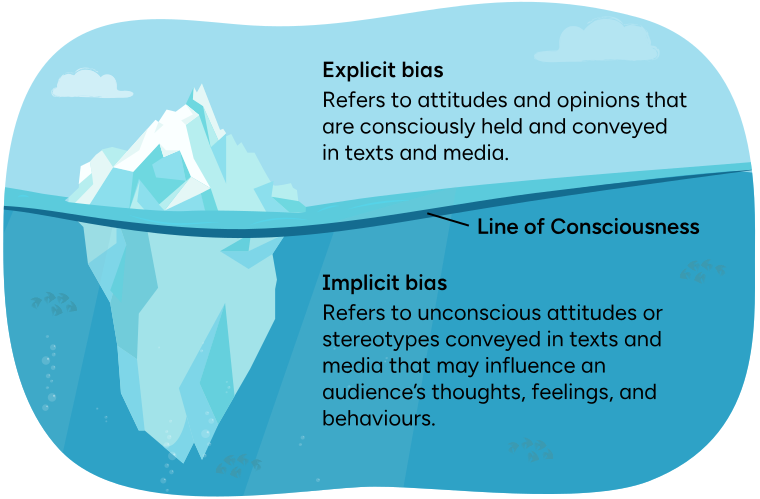
An iceberg graphic to help explain the two main types of bias: explicit and implicit.
Explicit bias is part of the iceberg that is above water. It refers to attitudes and opinions that are consciously held and conveyed in texts and media.
Implicit bias is under water. It refers to unconscious attitudes or stereotypes conveyed in texts and media that may influence an audience's thoughts, feelings, and behaviours.
The line of consciousness is right at surface level.
Bias in news media
The news is particularly important when it comes to bias because we expect the news to be reported directly, without the influence of prejudice, emotion, or personal beliefs. Bias within news media, like online publications, TV stations, newspapers, or even radio, is usually implicit. With the help of critical thinking skills, however, we become more able to identify it.
Next, you will explore different types of bias that might occur in the news in the following flashcards. As you explore, you may want to take point-form notes in a notebook or another method of your choice.
Can you think of an example of any of the previously stated forms of bias that you have witnessed online recently? Keep in mind that bias can have negative impacts on those involved. As you reflect, consider the potential impact of the example you choose.
Record your thinking in a method of your choice.
Facts and opinions in a news article
In the next section of this learning activity, you are going to explore an article and analyze the news source, looking for bias and detecting facts versus opinions.
As you explore, use the following checklist to guide your investigation:
Asking questions to find bias
Begin by exploring the following news article, “How the Pandemic Has Robbed me of a Full High School Experience,” by former student Andie Lawrence, who was in Grade 11 when the article was published.
Note that this article was published by the CBC, (the Canadian Broadcasting Company), which is Canada’s public broadcaster. CBC is a reliable source of factual information and news articles, but the following article was published as part of the “CBC First Person” series, which highlights “personal stories and experiences of Canadians, in their own words.”
Press the Article button to access the opinion piece How the Pandemic Has Robbed Me of a Full High School Experience.
Article Article (Opens in a new tab)
Let’s check!
Check your comprehension of the article by answering the following true or false questions.
Select the correct answer, then press Check Answer to see how you did.
Now, read the article again and record any facts or opinions that you notice in the article.
Press the the Check Answers button to compare your list of facts and opinions.
Facts:
- To reduce COVID-19 transmission, most sports and trips got cancelled.
- Students stay in one classroom and teachers cycle through.
Opinions:
- High school is supposed to be the “best time of my life.”
- It isn’t worth the effort to make plans with friends and get parental notes.

Social Emotional Learning
Social emotional

You’ve just learned about facts and opinions. Take a break before continuing onto the next part!
Diversity representation in the media
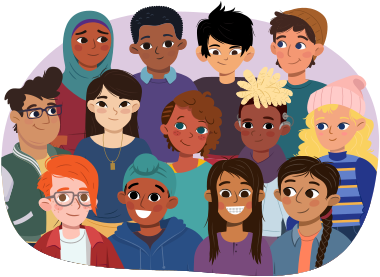
Consider the characters that you see in media, such as television shows, movies, graphic novels, video games, etc. If you had to describe the characters, what would you say? How would you describe them?
The media influences how we view the world. It influences what we think is “normal” or “important” and can affect how we see ourselves and others. What we see or don’t see in the media affects our reality.
As we begin our learning about diversity in the media, explore the following video clip “Why Representation Really Matters” by Aisha Thomas to learn more.
Aisha Thomas indicates that representation is important because it “provides the opportunity for your existence to be acknowledged in this world.” Media works can be mirrors or windows:
Media can be a mirror by reflecting your experiences and a window by giving you access to others’ experiences. If you never see yourself reflected in the media, or if those reflections are inaccurate, then it limits what you think of yourself and how others perceive you!

Did You Know?
Did you know?
Did you know that the Canadian Broadcasting Act has rules and regulations put in place to support diversity in the media? These acts include the following:
- through programming and employment, support the needs and interests of all Canadians – including Canadians from Black or other racialized communities and Canadians of diverse backgrounds, and reflect their circumstances and aspirations
- support community broadcasting that reflects the diversity of the communities being served
- support the production and broadcasting of programs in a diversity of languages
- provide opportunities to Canadians from Black or other racialized communities and diverse backgrounds to produce and broadcast programs
- cover news and current events that reflect the viewpoint of people of all backgrounds
These rules and regulations promote diversity in the media.

Vocabulary
Throughout this learning activity, you have been exposed to new vocabulary words. Begin by reviewing these words through the following matching activity. Match the word to the definition.
Let’s check!
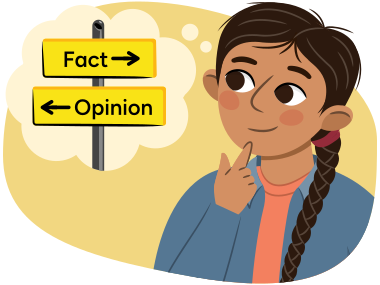
Confirm your understanding of the vocabulary words by using them in sentences. Record your sentences in your notebook, or another method of your choice.
Check out the following example!
Press the Example button to learn more.
It is important to be aware of the bias that the news outlet or author might hold when reading a news article. As you read, try to determine if the news article is giving you facts, opinions, or both, by verifying information. News outlets should include news from and about diverse experiences and avoid portraying stereotypes.
Check your understanding

Begin by checking your comprehension of the content that you’ve learned through the following multiple-choice activity.
Select the correct answer, then press Check Answer to see how you did.
Putting it all together
In this final section, you will choose one of the following activities to complete.
Option 1: Writing a “gist” summary
You will be writing a gist summary about the content that you’ve learned. “Gist” refers to the main point of something, and “summary” refers to a shortened version of a longer text that includes the main points or ideas.
Reflect on the content that you’ve learned and write a gist summary that is 100 words or less.
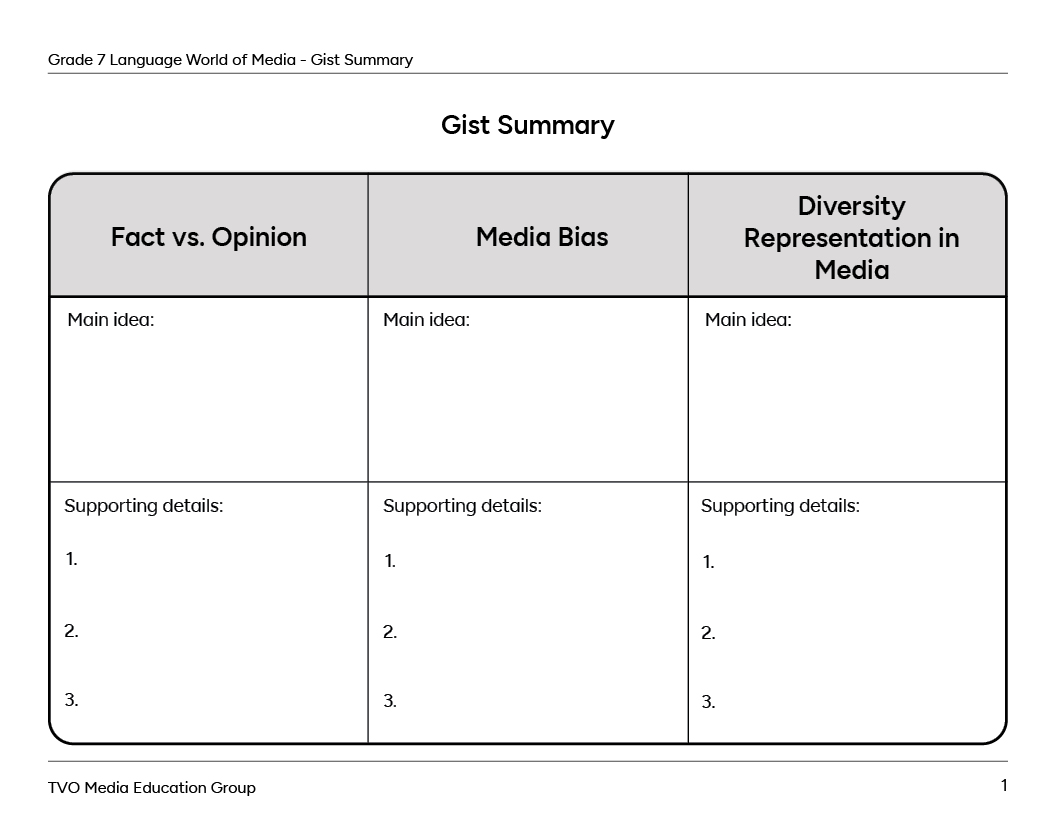
Use the graphic organizer provided or the checklist below to guide your summary.
Gist summary checklist
Complete the fillable and printable Gist Summary in your notebook or using the following document. If you would like, you can use speech-to-text or audio recording tools to record your thoughts.
Compare your gist summary with the one below.
Based on this, what might you consider next time you are asked to write a gist summary? What strategy could you use (i.e., re-read, scan the text, highlight details) to help you?
Press the Answer button to learn more.
| Fact vs. opinion | Media bias | Diversity representation in media |
|---|---|---|
| Main idea: It is important to know the difference between facts and opinions. | Main idea: Bias is an opinion or prejudice that limits an individual’s ability to make fair, objective, or accurate judgements. | Main idea: The media, including what we see or don’t see, influences how we view ourselves and the world. |
|
Supporting details: 1. look for clues 2. evaluate the source 3. helps avoid bias |
Supporting details: 1. two types (implicit and explicit) 2. there are 6 types of bias 3. always consider bias when reading or viewing news |
Supporting details: 1. mirrors and windows 2. reduces stereotypes and bias 3. creates relatable and powerful role models |
|
Gist Summary (100 words or less) The media is a tool for communicating information. When exploring the media, it is important to be able to detect the difference between facts and opinions by evaluating the source to avoid bias, which is an opinion or prejudice that limits an individual’s judgement. There are two main types—implicit and explicit—as well as various forms of bias in the media. A reader or viewer should always consider if a news source is biased or not. “Windows” and “doors” reflect experiences and allow us to see experiences of others through diverse representation in media, which removes bias and stereotypes. (98 words) |
||
Option 2: Create a presentation
You have been asked to create a “how to” presentation for your peers on detecting bias in the media. Create a “How to Detect Bias in the Media” presentation in a method of your choice (i.e., website, poster, or blog post).
As you create your presentation, consider the following checklist.
Presentation checklist
Reflection
As you read the following descriptions, select the one that best describes your current understanding of the learning in this activity. Press the corresponding button once you have made your choice.

I feel...
Now, expand on your ideas by recording your thoughts using a voice recorder, speech-to-text, or writing tool.
When you review your notes on this learning activity later, reflect on whether you would select a different description based on your further review of the material in this learning activity.