Learning goals
We are learning to…
- demonstrate an understanding of how to navigate online environments safely and interact in a way that supports our well-being and that of others
- make inferences using evidence to extend understanding of a text
- edit draft texts to improve accuracy and style, checking for errors in punctuation, spelling, grammar, and format
Success criteria
I am able to…
- make inferences to draw conclusions about a text and cite text evidence appropriately in my responses
- understand and explain how social media impacts adolescents' mental health, well-being, and relationships
- identify the pros and cons of social media use, and explain how social media can be used responsibly
- reflect on my own use of social media and analyze how it impacts my daily life, including setting goals for future responsible use of social media
Warming up
Begin by exploring the following image. As you explore, record what you notice in the image and what you think is going on in the image. What clues help you guess what is going on?

Press the Possible Answers button to learn more.
I conclude that the person blowing out candles is celebrating a birthday with their family. Some clues that suggest this are: the cake with candles, the person blowing them out, the decorations, and people of different ages gathering around a table.
When examining images, videos, or text, you can use evidence and background knowledge to make inferences. In the previous example, the student used evidence from the image (such as the cake, candles, group of people, etc.) and background knowledge (about birthday parties) to make an inference about what was happening in the image.
Let’s think about social media
Social media refers to online platforms and tools where people can create, share, and exchange information, ideas, and messages with others. Consider your experience with social media and respond to the following brainstorming questions in a method of your choice.
- How do you use social media? What platforms do you use? How do you communicate online?
- How do you think social media affects individuals, communities, and society?
- Why do you think someone might want to, or not want to, use social media?
Inferencing
As you work through the following content about social media, you are going to answer questions that require you to do some inferencing.
So, what is inferencing?
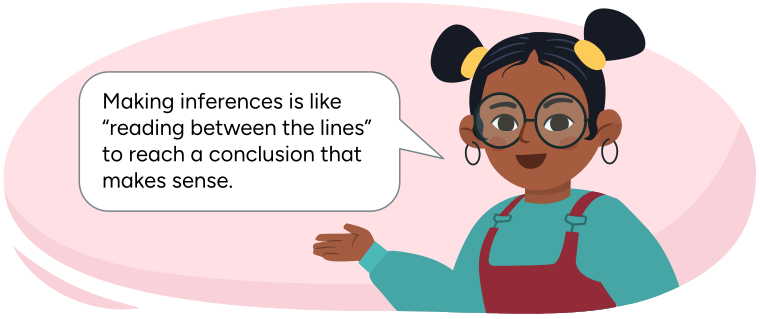
Making an inference is like a really well-supported guess! When you make an inference, you use your background knowledge and clues from the text, video, or image to draw a conclusion (when it’s not directly stated).
When you respond to questions that require inferences, it is important to cite any evidence or details that support your conclusion. Here are a few sentence starters that you can use when citing text evidence:
- According to the text…
- According to the author…
- The author states…
- One example from the text is…
- On page (Blank) , I noticed…
- The reason I think this is because…
Additionally, when you quote direct words from a text, those words should be in quotations. Explore this further in the following grammar routine.

Quotation marks
Quotation marks are a type of punctuation used to show direct quotes, dialogue, and certain titles of short works. When you are using direct (i.e., word for word) information from a text, you need to use double quotation marks. If you are using the same word, sentence, or phrase as another author or what someone else has said, those exact words are put in between quotation marks.
Quotations in direct quotes
Read the following paragraph about social media.
Social media is constantly evolving. At first, these platforms were primarily designed to connect individuals and facilitate communication. Over time, the purpose of social media has expanded to include entertainment, marketing, networking, and information. Social media has transformed how people interact, allowing them to share experiences, opinions, and content in real-time around the world. Additionally, social media is used by businesses and organizations to engage with the audience and to promote products and services. Lastly, social media has played a role in activism and social change because it enables individuals to amplify their voices.
Respond to the following comprehension question and cite text evidence using quotation marks.
How has social media expanded over time?
Press the Answer button to check your response.
Social media has expanded from a communication platform to something that has various purposes in society today. The author stated that social media is now used for “entertainment, marketing, networking, and information,” as well as “activism and social change”.
Highlighting the title of a short work
In addition to drawing quotations directly from texts or other media, you can also use quotation marks to refer to a short piece of work. This just means putting the quotation marks around the title of the work!
For example, the English language applies quotation marks to the following kinds of titles:
- chapters or parts of a book
- short stories
- episodes of a television show
- poems
- articles in a newspaper
- songs
Quotation marks are used around these titles of work so the reader knows they are a reference.
Choose the sentence with the correct quotation marks in the following multiple-choice section, then press Check Answer to see how you did.
What makes it “social”?
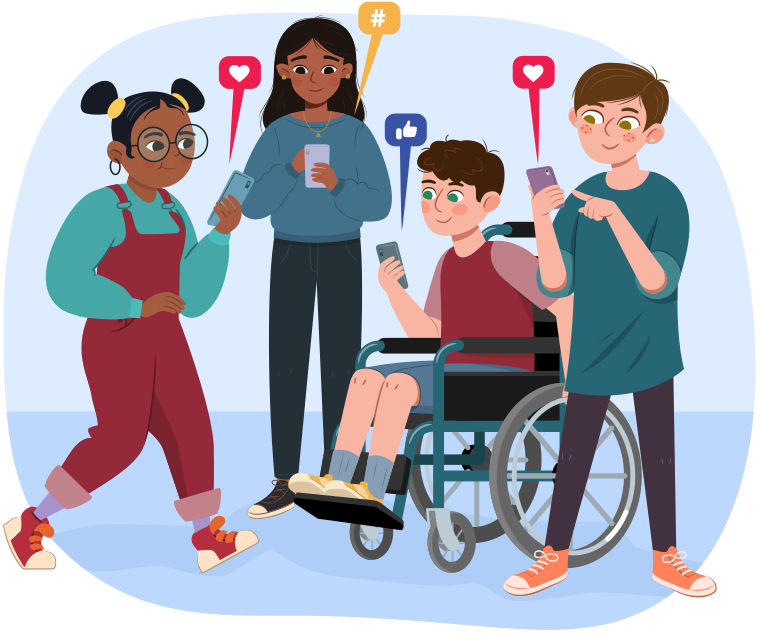
Social media and technology are a big part of our lives! Social media platforms offer opportunities to create, share, and communicate around the world. With this opportunity, it is important to understand healthy and responsible social media and technology use.
There are certainly benefits to using social media! It allows us to connect with others, including friends, family, or people with similar interests. It can be especially helpful for communicating with friends or family that live far away. Social media can be one way to find information, such as news, recipes, hobbies, and much more.

Student Success
Let’s make an inference!
How can social media be a positive experience for people? Record your ideas in your notebook or another method of your choice.
How is social media impacting society?

Social media has a profound impact on society in many ways, including the way we communicate, connect, and share information. While social media can offer numerous benefits, such as connecting with friends and family, sharing experiences, and staying informed, it also has several negative effects on society.
Social media and mental health
Let’s first explore mental health. Did you know that Statistics Canada studied adolescents aged 15 to 19 and their connection to social media? In their study, they found that:
- 47% of adolescents reported losing sleep due to social media
- 36% had difficulty concentrating due to social media
- 29% reported they engaged in less physical activity due to social media
- 22.8% reported feelings of anxiousness or depression due to social media
Let’s examine the effects of social media on mental health in more detail. Press the following tabs to find out more.
Studies have found that there is a connection between social media and lower self-esteem, as adolescents regularly compare themselves to others that they see online. Filters or digitally altered images can cause adolescents to second guess their own personal appearance or compare themselves to others, which can lead to body image issues and low self-esteem. Studies have also found a connection between increased time on social media and mental health concerns such as depression and anxiety.
Additionally, social media can disrupt a person’s sleep pattern. Whether it’s the blue light emitted by screens or the unwillingness to put a device away, social media has been connected to sleep-related issues, which also connect to mental health concerns.
In 2023, Statistics Canada reported that 1 in 4 teens reported experiencing cyberbullying on social media, and it has impacted their mental health. Social media platforms often allow users to create accounts without revealing their true identity. This anonymity can lead to cyberbullying without fear of repercussions. Content can be viewed publicly, which can increase feelings of shame or embarrassment and contribute to mental health concerns.
Social media can reduce the amount of face-to-face interactions that an adolescent experiences. Face-to-face interactions are crucial to learning how to understanding visual cues, non-verbal communication, facial expressions, and body language which is important in understanding social situations and can contributing to social success.
Studies show that children who develop the ability to understand emotional cues typically have more positive peer relationships and better social skills. With an increased amount of time being spent on social media, children are limiting their face-to-face interactions, which reduces their ability to thrive in social situations.
Let’s check!
Check your understanding of the text using the following true or false questions. Select the correct answer, then press Check Answer to see how you did.
Respond to the following comprehension questions by making inferences. It is important to cite text evidence that supports your conclusion. Remember to use quotation marks when necessary.
- How does social media impact adolescents’ mental health and well-being?
- How can social media affect relationships?
Press the Possible Answers button to learn more.
- Social media can have a negative impact on adolescents’ mental health and well-being. In the text, it stated that “there is a connection between social media and lower confidence or self-esteem” and that “1 in 4 teens reported experiencing cyberbullying online.” Both of these facts confirm that social media can impact mental health and well-being negatively.
- Social media can affect relationships both positively and negatively. Social media allows people to connect and communicate with friends and family all around the world. However, it also detracts from face-to-face interactions, which can negatively impact social skills and relationships. The text stated that “face-to-face interactions are crucial to learning how to understand visual cues, non-verbal communication, facial expressions, and body language,” which positively influences social skills.
Responsible social media use
Now that you have a better understanding of how social media can positively and negatively influence youth and society, let’s consider how social media can be used responsibly.

Brainstorm
Brainstorm
Brainstorm, in a method of your choice, how you think you can use social media responsibly. Consider: what should adolescents make note of regarding their own social media use?
Now, explore the following video clip from Social Media and the Society We Create. What are the three tips that Annelise Jacksons recommends when engaging with social media?
Press the Answer button to learn more.
Annelise Jackson recommended the following three tips:
- Be kind
- Be candid
- Think before you post or read
Explore the following flashcards for more tips on how you can use social media responsibly. If you’d like, record these ideas in a notebook or another method of your choice.
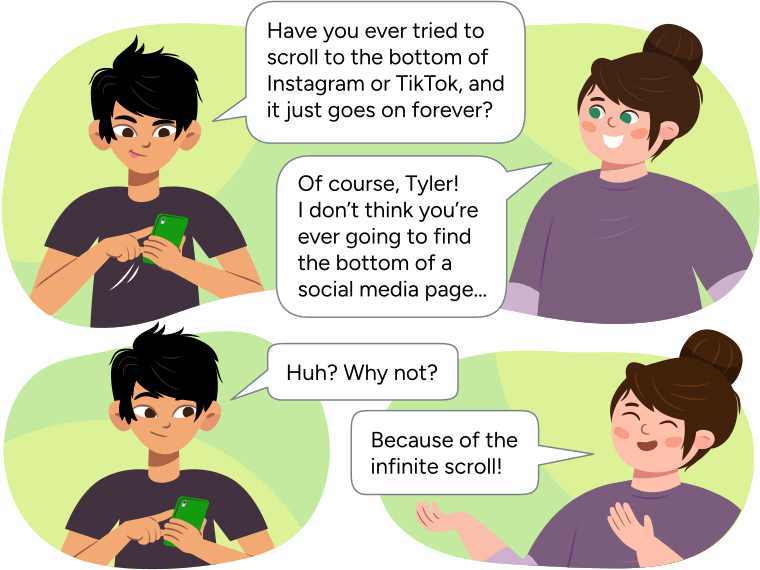
A conversation between Sam and Tyler.
Tyler says, "Have you ever tried to scroll to the bottom of Instagram or TikTok, and it just goes on forever?"
Sam says: "Of course, Tyler! [*laughs*] I don't think you're ever going to find the bottom of a social media page…"
Tyler says: "Huh? Why not?"
Sam says: "Because of the infinite scroll!"
Did you realize that the endless scroll that users experience on social media is designed like that on purpose?
Media brands and companies can use the infinite scroll feature to keep your attention and encourage you to stay on their service for longer by providing content in a ‘never-ending’ stream of posts. The longer you browse, the more opportunity that company has to show you ads and collect your information, which leads the company to gain more profit.
Features like the infinite scroll can lead to serious health and wellness concerns because they make it difficult to use social media responsibly and even cause people to overconsume social media.
Check out the following video from the TVO Kids YouTube program Know Brainers, where host Monica scrolls on her phone for nine hours as an experiment to witness its impact on her brain:
Once you have explored the video once or twice, respond to the following questions in a method of your choice.
Can you think of any other social media features that might have harmful impacts on a user’s mental health and well-being?
Press the Hint button to learn more.
One feature that is popular in social media but poses a risk to mental health is the “like” button. Having a feature that shows who and how many people liked your post promotes a competitive online atmosphere where people may feel inadequate if they attract less attention and fewer likes on their post. If you genuinely like what someone has posted, then add a heartfelt comment – the “like” button is all about popularity!

Editing and revising
Although, as social media users, we are unable to change the platforms we use, editing and revising is an important step in the writing process. Editing involves correcting grammar, punctuation, and spelling errors, while revising involves improving the overall structure and content of the writing piece.
First, we will learn more about editing and revising. Then, we will practise editing and revising a paragraph about social media.
Editing
Editing is one of the final steps before publishing and allows the writer to correct mistakes before sharing their work with others. So, how do you edit?
Press the following tabs to learn more about what to look out for when editing.
Check for punctuation – each sentence should end with proper punctuation.
- period (.) = full stop
- comma (,) semi-colon (;) or hyphen (-) = pause
- exclamation mark (!) = reading with emphasis
- question mark (?) = asking a question
Check for capitalization – each sentence and specific words need capitals
- start of every sentence - Ex. We went to the park.
- the pronoun “I” - Ex. I wish I could go to the park.
- proper nouns - Ex. Toronto, Mrs. Ryan, September, Hamlet
Check for content – does it make sense?
- Read the text to yourself or someone else, ideally out loud. Does it make sense?
- Add, change, or remove parts that don’t make sense.
Check for spelling – circle spelling errors to correct in your final piece
- Use a dictionary or online resource to help you confirm spelling.
- Ask someone else to read through your work to check for errors.
Revising
Press the following tabs to learn more about what to look out for when revising your writing.
Add Details – is anything missing from the text?
- Add small details like a word using the following symbol: ^.
- Add larger sentences or phrases by drawing arrows or using sticky notes.
- Highlight anything that needs more details added to make sense.
Remove unnecessary or repetitive parts
- Are any details irrelevant or unnecessary?
- Are there any details that are repetitive?
Rearrange for clarity – rearrange sentences or paragraphs
- Use symbols or number each sentence or paragraph, and re-write in the new order.
- Consider what order will make the text flow properly.
Evaluate your word choice – are you using the best words?
- Use a thesaurus to help enhance word choice.
- Make sure words are not repetitive (i.e., saying “said” over and over).
- Choose words that will have the best impact on the reader.
Your turn!
Review the following paragraph on social media and society. As you review, make note of editing and revising changes that you would like to make. Then, rewrite the corrected version of the paragraph using cursive writing, or type it out.
social media has fundimenaly change the fabric of modern society influencing how we connect communicate and interact with the world around us. These platformes have redefined the very nature of relationships, Enabling us to maintain connections with people across vast distances. they have dismantled the geographical boundarys that once limited our social circles, allowing us to share our lives in real-time with a global audience The instantaneous nature of social media has changed how we consume information, serving as a primary source of news, trends, and current events. however as these platforms have become a good part of our daily lives, they have also brought about a host challenges. Issues of privacy, mental health, and misinformation have become increasingly important, raising important questions about the important role and impact of social media in our society. despite these challenges, there is no dening that social media has reshaping our world, transforming how we communicate learn, and understand the world around us

Typing practice
Typing is a great skill to develop! When we need to use a computer or tablet keyboard, knowing how to type helps us:
- take notes
- respond to messages
- create final drafts of our work.
Explore the following image to see what fingers are used to type each letter or number.
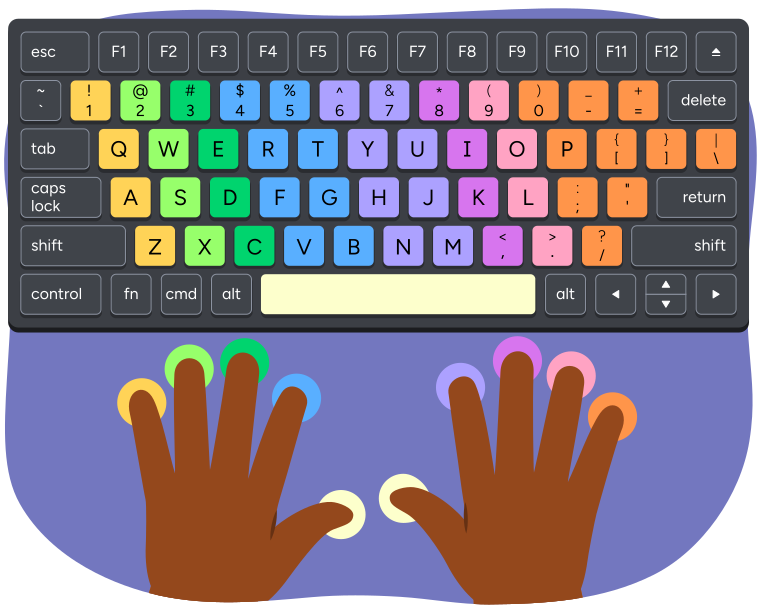
A keyboard and hands showing which fingers are used to press each key when
typing.
The left pinky finger presses the keys 1, Q, A, and Z.
The left ring finger presses the keys 2, W, S, and X.
The left middle finger presses the keys 3, E, D, and C.
The left index finger presses the keys 4, 5, R, T, F, G, V, and B.
The left or right thumb presses the space bar.
The right index finger presses the keys 6, 7, Y, U, H, J, N, and M.
The right middle finger presses the keys 8, I, K, and comma.
The right ring finger presses the keys 9, O, L, and period.
The right pinky finger presses the keys 0, minus, equal, P, open bracket, closed
bracket, backslash, semicolon, apostrophe, and forward slash.
We use specific muscles in our hands to type! It’s important to practice so that it becomes easier to type correctly without putting too much pressure on our hands and our wrist.

Cursive practice
Try it in cursive!
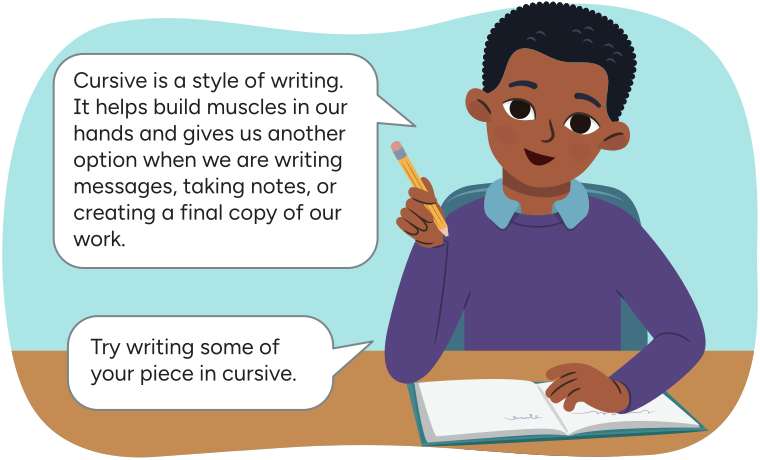
Arthur speaking. He says, "Cursive is a style of writing. It helps build muscles in our hands and gives us another option when we are writing messages, taking notes, or creating a final copy of our work. Try writing some of your piece in cursive."
Let’s review cursive writing!
Check out the following animation of how the word “social” is written in cursive, then review the tips for cursive writing provided.
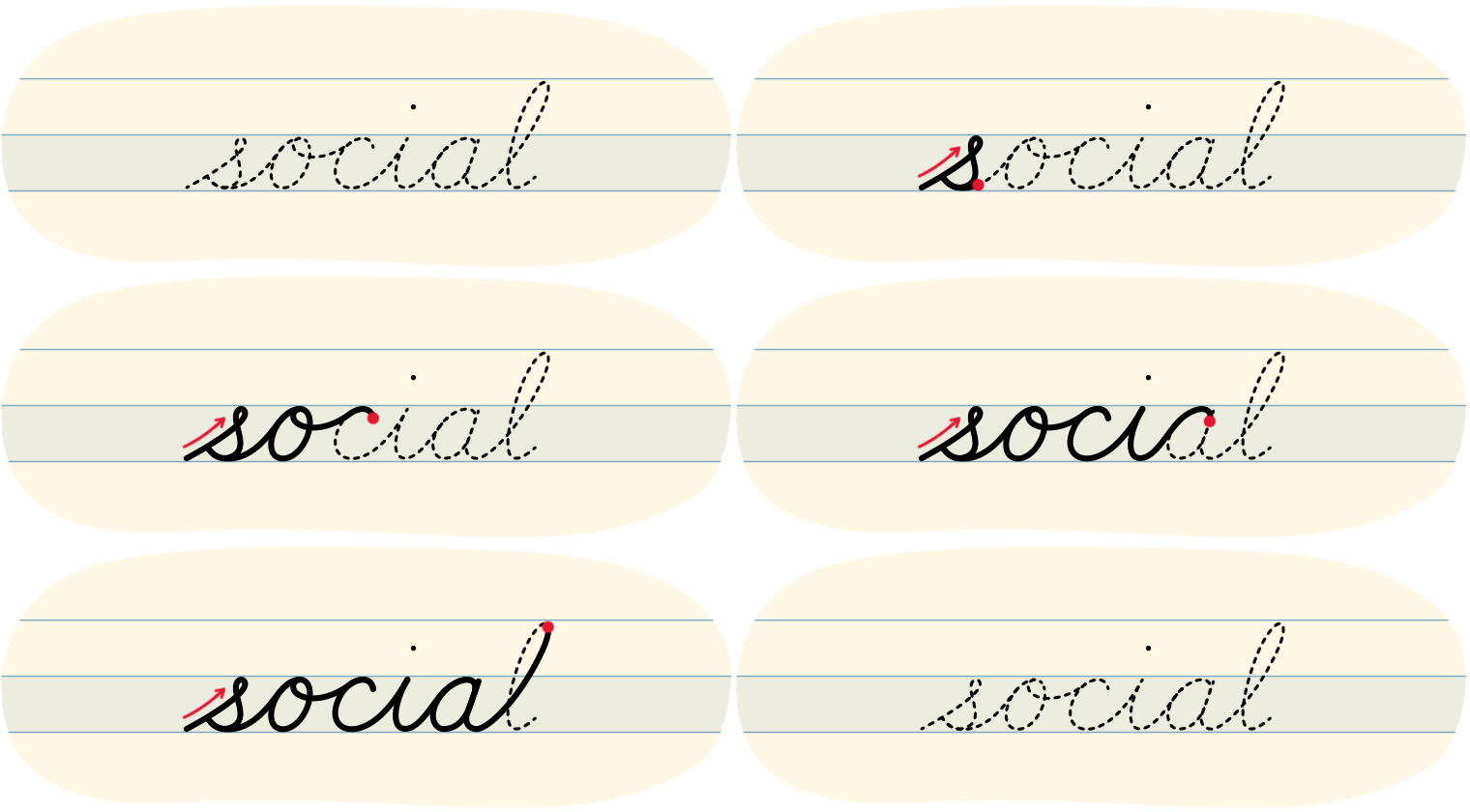
Tips for cursive letters
- When we write in lowercase, we always begin at the bottom.
- When we write in uppercase, we can start from the top or the bottom.
- Try to keep the pencil on the page until you are done the word.
- Try to press gently as you write so that your hand can move easily across the page.
- Take your time to make sure that you are writing clearly and evenly.
Left-handed tips for cursive writing

Explore the video on Left-Handed Tips to learn more.
Once finished, compare your editing and revising suggestions with the possible answer key provided.
Press the Possible Answer button to learn more.
Social media has fundamentally changed the fabric of modern society, influencing how we connect, communicate, and interact with the world around us. These platforms have redefined the very nature of relationships, enabling us to maintain connections with people across vast distances. They have dismantled the geographical boundaries that once limited our social circles, allowing us to share our lives in real-time with a global audience. The instantaneous nature of social media has changed how we consume information, serving as a primary source of news, trends, and current events. However, as these platforms have become a good part of our daily lives, they have also brought about a host of challenges. Issues of privacy, mental health, and misinformation have become increasingly important, raising questions about the role and impact of social media in our society. Despite these challenges, there is no denying that social media has reshaped our world, transforming how we communicate, learn, and understand the world around us.

Social Emotional Learning
Social emotional

Great work so far! Take a break before continuing onto the next part!

Fluency
Fluency is the ability to identify words correctly and read a text at an appropriate rate with ease, pace, automaticity, and expression. With proper phrasing and a focus on punctuation, the reader will gain more meaning from the text.
Don’t forget that you should always acknowledge punctuation when reading. A comma, semi-colon, or dash indicates a short pause, and a period indicates a longer pause. A question mark should raise your voice, and an exclamation mark should add emphasis to what you are reading.
Use the passage that you edited and revised for this fluency activity. Re-read the paragraph several times, practicing your reading fluency. When you are reading, record yourself reading the passage, or share it with someone else, and use the checklist provided to self-assess your own fluency.
Fluency checklist
Let’s check!
In the “grammar routine” section of this learning activity, you explored how to properly insert direct quotations from texts when citing text evidence.
Select the correct answer, then press Check Answer to see how you did.
Putting it all together
In this final part of the learning activity, you will select one of the following reflection tasks to complete.
Option 1: Pros and cons of social media use
Reflect on what you have learned about social media and create a list of pros and cons of social media use, specifically for adolescents. Use the graphic organizer provided, or another method of your choice, to record your ideas. If you would like, you can use speech-to-text or audio recording tools to record your thoughts.
When finished, compare your list with a peer, if possible, and then compare it with the answer key.
Complete the Pros and Cons of Social Media Use organizer in your notebook or using the following fillable and printable document.
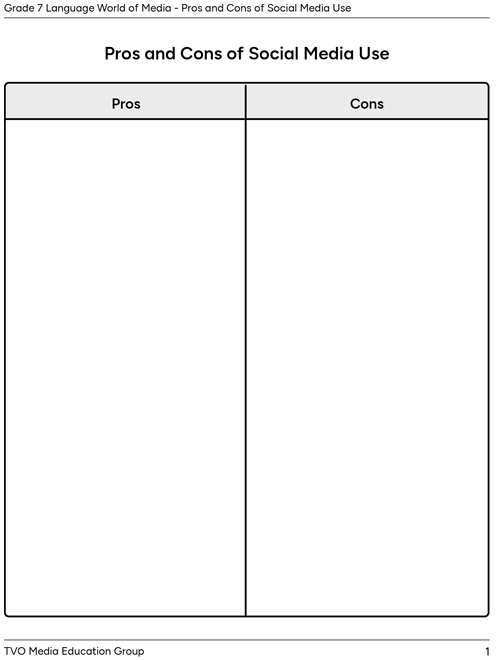
Press the Activity button to access the Pros and Cons of Social Media Use.
Activity(Opens in a new tab)Press the Possible Answers button to learn more.
| Pros | Cons |
|---|---|
|
|
Option 2: Debate
In this learning activity, you explored social media, including its impacts on society and how to navigate it responsibly. Imagine that you have been asked to attend a debate at your school about the banning of social media. It has been proposed that teenagers should not be allowed to use social media until they are a legal adult, at the age of 18.
You are asked to choose a side:
- yes, social media should be banned for teenagers until the age of 18
- no, social media can be used responsibly by teenagers
Build an argument for the side that you have chosen and prepare a presentation to share your opinion at your school. Your opinion should be supported by evidence from your learning today that highlights either the positives, negatives, or both sides of using social media.
Use the following checklist to guide your thinking.
Guiding questions
Option 3: Reflection
Reflect on your own use of social media and respond to the following questions in a method of your choice.
- What do you use social media for?
- How does social media impact your daily life?
- What is one thing you can do to promote responsible social media use?
- What is one goal you have for yourself that is connected to social media?
- What is one unanswered question you still have about the use of social media?
Reflection
As you read the following descriptions, select the one that best describes your current understanding of the learning in this activity. Press the corresponding button once you have made your choice.

I feel...
Now, expand on your ideas by recording your thoughts using a voice recorder, speech-to-text, or writing tool.
When you review your notes on this learning activity later, reflect on whether you would select a different description based on your further review of the material in this learning activity.