Learning goals
We are learning to…
- conduct research, considering accuracy, credibility, and perspectives, with a focus on misinformation, disinformation, and curated information to construct knowledge
- identify and explain prior knowledge from various sources, including personal experiences and learning in other subject areas that can be used to understand texts
- gather and synthesize information and content relevant to a topic, using a variety of textual sources and appropriate strategies; evaluate the quality, bias, and accuracy of information
Success criteria
I am able to…
- explore various types of mis- and dis- information and identify these types in media
- learn about various ‘fact checking’ strategies to avoid spreading misinformation and respond to true or false questions accurately
- apply ‘fact checking’ strategies when gathering research information about a topic of choice and organize this research based on common themes or categories
- create a public service announcement educating others on how to ‘fact check’ and avoid spreading misinformation

Disinformation
To begin, you will be exploring a video about disinformation. The Government of Canada created a video to raise awareness about checking facts before sharing content online.
Keep in mind that the source of the video is a reliable source (the Government of Canada) if you are considering the accuracy or credibility of the video.
As you explore the video, answer the following questions.
- What do you notice?
- What do you wonder?
- What do you think the overall message of the video is?
Record your ideas using a method of your choice.
Check out the following video to learn more.
In the video, they mention the word “disinformation.” What do you think the word “disinformation” means?
Record your own definition using words, examples, and non-examples.
Compare your definition with the actual definition below.
Press the Disinformation Definition button to learn more.
Disinformation is false information that someone knowingly spreads with the intention to mislead others. This is sometimes called “fake news.”
Finding information online
Using the mind map template below, or another method of your choice, brainstorm what you know about finding information online. Use the following prompts to guide your brainstorming.
- Where do you learn the news?
- Where do you go to find information online?
- How do you know which sources to use?
- How do you collect research notes for a project?
Complete the fillable and printable Mind Map in your notebook or using the following document. If you would like, you can use speech-to-text or audio recording tools to record your thoughts.

Understanding information
In our current society, the way that we access and share information has been revolutionized with the internet, social media, and other online platforms. With just a few clicks, we can access massive amounts of information and resources from all around the world.
However, not all information is accurate or reliable. In the age of “information overload” (the feeling of being overwhelmed by the amount of information being presented), it is important to critically evaluate the sources of information we encounter online, including checking the accuracy and credibility of a source. This will empower us to make informed decisions and navigate the digital world with confidence.
Begin by exploring the following definitions by pressing the tabs below.
Accuracy is the quality or state of being correct. When exploring online content, it is important that we consider how accurate, or correct, the information that we are viewing is.
Credibility is the quality of being trusted or believed in. When exploring online content, it is important that we consider the source of information and whether it is from a creator that we can trust.
Curated information is information that is carefully selected, organized, and presented to someone. On social media, curated content is content from other sources that you share to your own personal account. When sharing information online, it is important that you are thinking carefully about the information before you share or post it.
Check out the following video to learn more.
Disinformation is false information that someone knowingly or deliberately spreads that is intended to mislead. This is sometimes called “fake news.”
Misinformation is false information that someone shares without the intention of misleading.
Legal considerations include copyright (giving credit where credit is due), privacy, and cybersecurity.
Ethical considerations include honesty, integrity, respect for diversity and inclusion, and avoiding harm.
Misinformation and disinformation
When you are gathering information online, it is always important to consider the sources and whether information is accurate and credible. The rapid spread of mis- and dis-information affects everyone online and offline. Most people make decisions based on information they find online, including decisions about health, finances, or issues that affect our friends, family, and community. Mis- and dis-information can lead to inappropriate decisions being made.
There are different types of mis- and dis-information that you should be aware of when navigating the digital world. Explore these types in the flashcards below.
Your turn!
Explore the following examples of misinformation in the media. Identify which type of misinformation you are viewing. Check your answers when you are finished.
Example 1: The North American House Hippo
Check out the following video entitled “It Looks like Canada has a House Hippo Problem”, then identify the type of misinformation.
Example 2: Litter Robot
Examine the photo and headline from an online news article. Then, identify the type of misinformation.
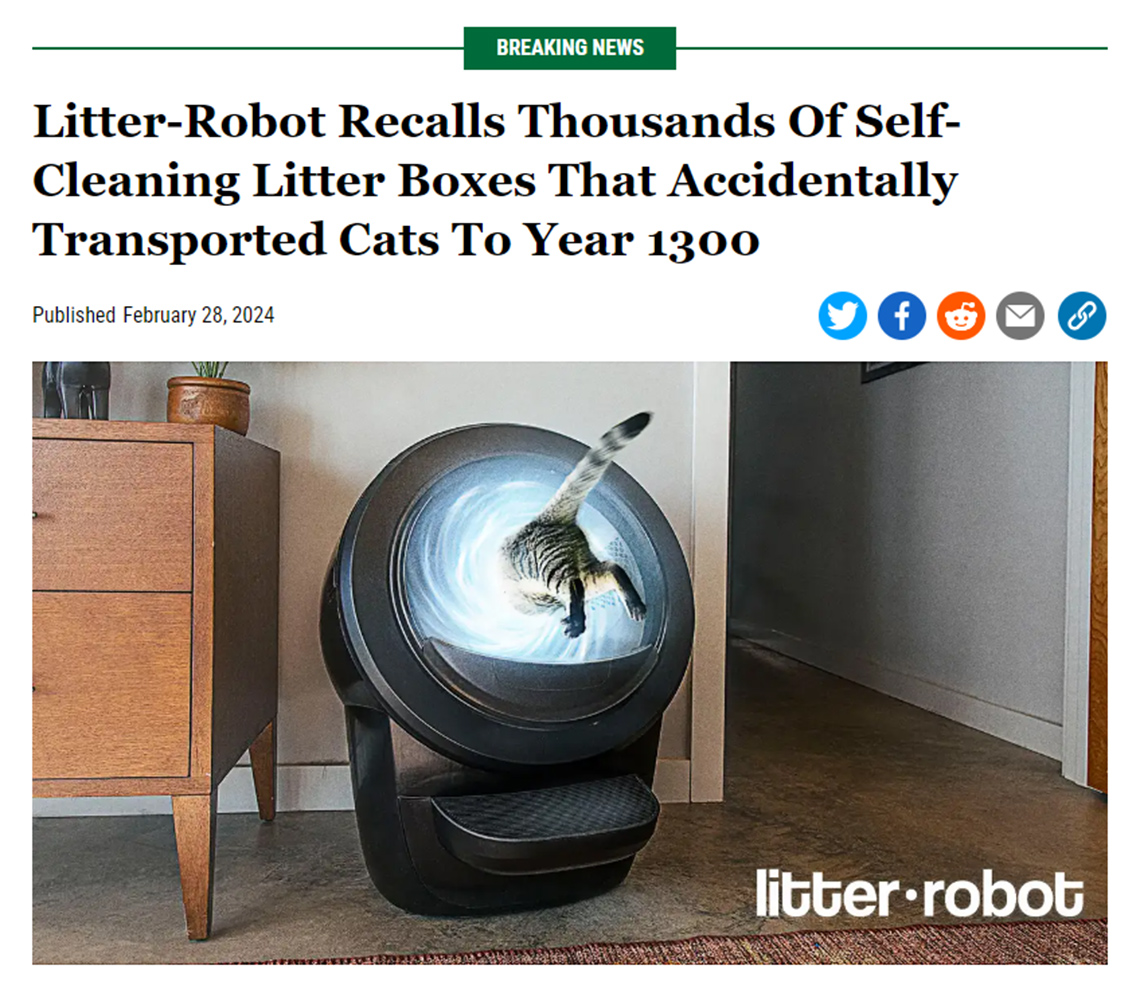
Show, T. E. (2024, February 28). Litter-robot recalls thousands of self-cleaning litter boxes that accidentally transported cats to year 1300. The Onion. https://www.theonion.com/litter-robot-recalls-thousands-of-self-cleaning-litter-1851286099
Press the Answers button to check your answers.
Example 1: “The North American House Hippo” is fabricated content. This content has been made intentionally to deceive others and there is no truth to it.
Example 2: “Litter Robot” is satirical content that is designed to be funny, but is not true, even though it looks like a real news headline.
Thinking critically about sources
Let’s remind ourselves of the difference between misinformation and disinformation by exploring the short video clip below.
When you are evaluating information online, you need to think critically about what you are viewing. You can do this by “fact checking” what you are viewing. Explore the following suggestions for evaluating information online and avoiding mis- and dis-information.
Press the following tabs to find out more.
Disinformation is often designed to cause emotions like shock, fear, hope, or laughter. Sometimes it can appear “too good to be true” or make a bold statement. If you think something might be too good to be true or is looking for you to share based on an emotional reaction, consider if it’s true or not.
There are websites and tools that are designed to check the facts of any content online. If you are unsure about something, you can check it in the fact-checking tool and it can tell you if someone else has already debunked this information or not. If there are no results, it likely hasn’t been looked into yet, and you should try another strategy.
If you copy an image or the image’s link into a search tool, you will see variations of that image, if they exist. This can show you if an image has been altered or changed.
For example, an article appeared in a news story about a polar bear taking a bus. Someone claimed that this was just a typical occurrence, but once the photo was reverse searched, the truth was revealed.
Checking for fake social media accounts can stop the spread of misinformation. You can detect a fake social media account by doing a reverse image search of the profile photo to see if it’s been taken from somewhere else online. You can also look for spelling errors, lack of details about a person, or lack of mutual connections.
When exploring online content, you should look for links to the original source of information. These can usually be found at the bottom of the post or web page. Once you’ve found the original source, analyze whether of not it is credible and trustworthy. You might search for information about the author (i.e., are they who they claim they are?) or organization.
You should always check other sources. This could be done first or last or anywhere in your verification process. If you can find multiple other sources of the same story from trustworthy and reliable sources, then you can trust the information. If you are not able to, you may consider that it could be disinformation and continue investigating.
Let’s check!
Check your understanding so far in the following true or false activity.
Select the correct answer, then press Check Answer to see how you did.
Researching and organizing information

All the strategies you just reviewed are ways that you can avoid mis- and dis-information in the media. When you have found sources that you feel are reliable, you will be able to collect information when researching a specific topic.
Selecting your topic
For this section of the learning activity, you are going to be collecting information about a topic of your choice. Begin by choosing a topic – it can be something you are interested in learning more about, or it can be one of the topics listed below.
Press the Possible Topics button to learn more.
- global warming
- renewable energy
- social media and mental health
- technology use in education
Once you have selected your topic, you are going to collect information about the topic from reliable sources. You should consider what you have learned so far about misinformation and think critically about the sources you select for information.
Researching information
As you research, record the information you find using the graphic organizer provided, or in another method of your choice. Don’t forget to record the source of your information too. You should begin by exploring trusted websites, like encyclopedias, government websites, etc.
It is important when recording information that you use “point form” notes and convert ideas into your own words. This will avoid plagiarism.

Did You Know?
Did you know?
Plagiarism is when someone uses another person’s words, ideas, or work without giving them proper credit. Plagiarism can occur in many forms, such as copying text directly, paraphrasing without sourcing the information, or using someone else's ideas without acknowledgement.
As you take notes, summarize key points, record relevant quotes, and cite sources properly. On your fillable organizer, or another method of your choice, record the website or book, creator/author, link to the source, and date on the left side, and record the notes that you’ve taken on the right.
Before you begin, explore the following example of what your organizer may look like once completed.
Press the Example button to learn more.
| Research Notes on Endangered Species in Canada | |
|---|---|
|
Source 1: World Wildlife Fund Canada (WWF) https://wwf.ca/restoration-in-the-lower-fraser/ |
|
|
Source 2: The Canadian Encyclopedia https://www.thecanadianencyclopedia.ca/en/article/endangered-animals |
|
|
Source 3: Video “Canada’s Endangered Species” by Nature Connection https://www.youtube.com/watch?v=UZ5VpZIUxKc |
|
|
Source 4: “Protecting the World’s Wild Animals Through Indigenous Knowledge” by Coni Arevalo (2023) https://faunalytics.org/protecting-the-worlds-wild-animals-through-indigenous-knowledge/ |
|
Complete the fillable and printable Research Notes Organizer in your notebook or using the following document. If you would like, you can use speech-to-text or audio recording tools to record your thoughts.
Putting your information together
Once you have collected your research notes, you are going to organize and synthesize your information for the purpose of writing an essay. You are going to take the information that you have collected and make connections between sources to come up with three big ideas. These three big ideas will be the three body paragraphs of your essay.
Use the following checklist to help you synthesize your research notes.
Research notes
Explore the example again of Endangered Species in Canada and how those research notes were broken into three overarching categories.
Press the Research Notes Example button to learn more.
Paragraph 1 – Theme: Why are animals in Canda endangered?
- reasons why species are at risk: pollution, climate change, habitat loss, invasive species (source 1)
- heat waves, superstorms, wildfires = climate change = more endangered species (source 1)
- at risk because of climate change, loss of forest and grassland when cities are built, pollution of lakes and rivers (source 2)
- as of 2021, 554 animal species were at risk in Canada (Source 2)
- Canada is warming at twice the normal rate (source 3)
- humans interfere with ecosystems with agricultural needs and city building (source 3)
Paragraph 2 – Theme: Examples of animals in Canada that are at risk
- as ice melts, polar bears have less to eat before the summer season and they get closer to human communities (source 3)
- barren ground caribou (tied to identity of Indigenous communities) impacted by climate change – food sources less available (source 3)
- American badger (Ontario and B.C.) plays an important role in controlling borrowing rodent population (one of few borrowing predators) (source 3)
Paragraph 3 – Theme: Conservation efforts
- the “Species at Risk Act” protects over 200 species and was developed by the government (source 1)
- Indigenous-led conservation is most effective way to protect habitats and increase biodiversity (source 1)
- Katzie First Nation people protect the salmon in B.C. by creating an adequate spawning area and removing blockages in the pathways of salmon (every creature matters) (source 1)
- we all have to work together (source 1)
- protection from hunting and fishing (source 2)
- natural habitats must be protected (source 2)
- organizations work to help protected parks (source 2)
- need to research species and track them (source 2)
- once identified as endangered, we must find out what habitat needs it has (source 3)
- Traditional Indigenous Knowledge plays a role in protecting wildlife and habitats (source 4)
- respect for and knowledge of the land means the protection of innumerable animal species (source 4)
- maintain the forests ecosystem (source 4)
- Indigenous advocacy (source 4)

Try It
Try it
Great work! If you’d like to take your work one step further, you could use the research notes that you collected, organized, and synthesized to write a five-paragraph essay on your topic. Your essay should include an introduction to your topic, three body paragraphs, and a conclusion. Be sure to cite your sources at the end.
Explore the sample essay on Endangered Species in Canada.
Press the Sample Essay button to learn more.
Endangered Species in Canda
In 2021, around 554 animal species were considered at risk in Canada. As the world evolves and changes before our eyes, animal species are becoming increasingly more endangered and at risk of extinction. To be able to better understand endangered species in Canada, it is important to understand the changes that are causing endangered species, what species are endangered and why, and how various knowledge systems can help.
Canada, along with other places in the world, is warming at twice the normal rate and the effects of climate change are intensifying. As the planet warms, heat waves, superstorms, and wildfires are becoming more frequent, which puts species’ homes at risk. Along with increased temperatures, pollution from humans (cars, factories, etc.) is another contributing factor to habitat loss and therefore endangered species, including in lakes and rivers. Habitats are being lost, especially in forests and grasslands, to accommodate growing populations of people and agricultural needs. As humans interfere with ecosystems, the number of endangered species climbs.
In Canada, there are several different endangered species. Let’s explore a few. As the ice melts in the oceans, polar bears are being forced to relocate to find food and proper shelter. They are often forced closer to human communities. With lack of adequate food and shelter, they are at risk. The barren ground caribou is another animal that has been impacted by climate change. As a result of fewer food sources being available, they are also at risk of extinction. Lastly, the American badger, which can be found in British Columbia and Ontario, is endangered. As one of the few borrowing predators, they are relied on to help control the borrowing rodent population. These are only a few of several animals endangered in Canada.
So what can we do to help? In 2022, the government of Canada released the “Species at Risk Act” to protect over 200 species. This would include hunting and fishing laws, direction on researching and tracking animals, and strategies for salvaging habitats. Additionally, Indigenous-led conservation is one of the most effective ways to protect habitats and increase biodiversity. Indigenous ways of knowing, being, and doing, include a respect for and knowledge of the land, including the protection of innumerable animal species. For example, the Katzie First Nation protected the salmon in B.C. by creating an adequate spawning area and removing blockages in the pathways of salmon.
If we continue to work together to lessen the impacts of climate change and protect ecosystems and endangered animals, there is hope we will see positive change. You can begin by learning more about endangered species in your area and what you can do to help protect them. Returning land to Indigenous Peoples and ensuring those who have not been evicted can remain is essential to protecting the environment and habitats.

Social Emotional Learning
Social emotional

Great work! Take a break before moving onto the next part.

Understanding vocabulary in context
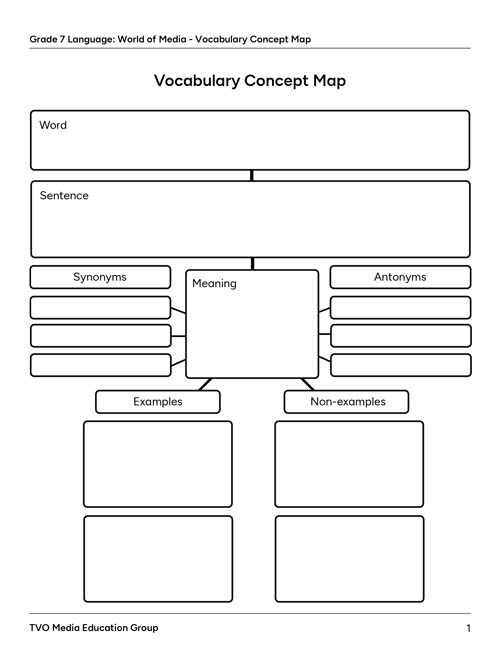
In this learning activity, you explored several new vocabulary terms. Sometimes, if we explore the sentence the word was used in, we can make meaning of the word. By finding the definition and related words, you will further understand the word.
Choose one of the vocabulary words studied in this learning activity, or choose from the list below, and complete a “Vocabulary Concept Map.” You can use the fillable organizer provided or record your ideas in another method of your choice.
Vocabulary words
Accuracy
Credibility
Disinformation
Misinformation
Satire
Fabricated
Complete the fillable and printable Vocabulary Concept Map in your notebook or using the following document. If you would like, you can use speech-to-text or audio recording tools to record your thoughts.

Gerunds
Let’s begin by reviewing what a nouns and verbs are.
A noun is a word that refers to people, places, things, and ideas.
A verb is a word that expresses an action, occurrence, or state of being.
A gerund is partly a verb and partly a noun. It is a noun that is created from a verb by adding “-ing” as a suffix. A gerund can be used as a subject, the complement, or the direct object of a sentence. By using gerunds, writers can easily describe things or activities in a precise way.
Check out the following video on gerunds.
There are four types of gerunds. Explore these below! You may wish to record these in your vocabulary notebook or another method of your choice.
Press the following tabs to find out more.
A gerund can be used as the subject of the verb.
Example: Cooking is my favourite hobby.
In this sentence, 'cooking' is the gerund and the subject of the sentence. It is the noun that the sentence is about.
A gerund can be used as a direct object for a verb.
Example: She loves singing on stage.
In this sentence, 'singing' is the gerund and direct object.
A gerund can also be used as an object of a preposition.
Example: The class talked about going to the theatre.
In this sentence, 'going' is the gerund that is the object of the preposition ‘about.’
A gerund can also be used as a subject complement, which means it comes after a linking verb (become, feel, be, sound, taste, etc.) and describes the subject of the sentence.
Example: Their hobby is fishing.
In this sentence, 'fishing' is the subject complement and gerund.

Brainstorm
Brainstorm
Brainstorm a list of other gerunds!
Press the Possible Answers button to learn more.
Gerunds: swimming, running, walking, eating, painting, crying, writing, jogging
Your turn!
Read the sentences in the following matching activity. Identify the gerund, then match the type of gerund in the sentence.
Putting it all together
Begin by confirming your understanding using the fill in the blank activity.
For each sentence, select the missing word from the drop-down menu. Press Check Answer to see how you did.
Public service announcement

Now, you are going to be creating a PSA (Public Service Announcement) to promote the message that people should check the content they are sharing online and make sure they are not sharing anything unless they are sure it is not misinformation.
Your PSA should include at least one ‘fact-checking’ example that you learned about in this learning activity.
First, decide who the audience of your PSA is. Who is your PSA aimed at?
Press the Possible Ideas button to learn more.
- people younger than you, such as a grade below
- people your age, such as in your grade
- adults, such as parents or relatives
- seniors, such as community members
- another group of your choice
As you design your PSA, keep your intended audience in mind.
Use the following checklist to complete your PSA.
PSA checklist
Reflection
As you read the following descriptions, select the one that best describes your current understanding of the learning in this activity. Press the corresponding button once you have made your choice.

I feel...
Now, expand on your ideas by recording your thoughts using a voice recorder, speech-to-text, or writing tool.
When you review your notes on this learning activity later, reflect on whether you would select a different description based on your further review of the material in this learning activity.