Learning goals
We are learning to…
- solve meaningful and complex real-life problems by taking concrete steps – identifying and analyzing the problem, creating a plan, prioritizing actions to be taken, and acting on the plan.
- generate and develop ideas and details about challenging topics, using a variety of strategies and drawing on various resources, including our own lived experiences
- evaluate the strategies and tools used to develop ideas and organize content for texts of the chosen form, explain which were most helpful, and suggest steps for future improvement as a text creator
- explain the explicit and implicit points of view and perspectives, and suggest ways to acknowledge other perspectives
Success criteria
I am able to…
- solve a meaningful and complex real-life problem by identifying and analyzing the problem, creating a plan, prioritizing actions to be taken, and acting on the plan
- generate and develop ideas and details about challenging topics, such as being permitted to have a cellular phone, using a variety of strategies, and drawing on various resources, including my own lived experiences
- evaluate the strategies and tools used to develop ideas and organize content for a persuasive essay, explain which were most helpful, and suggest steps for future improvement as a text creator
- explain explicit and implicit points of view and perspectives on cellular phone use, and suggest ways to acknowledge other perspectives
Age restrictions
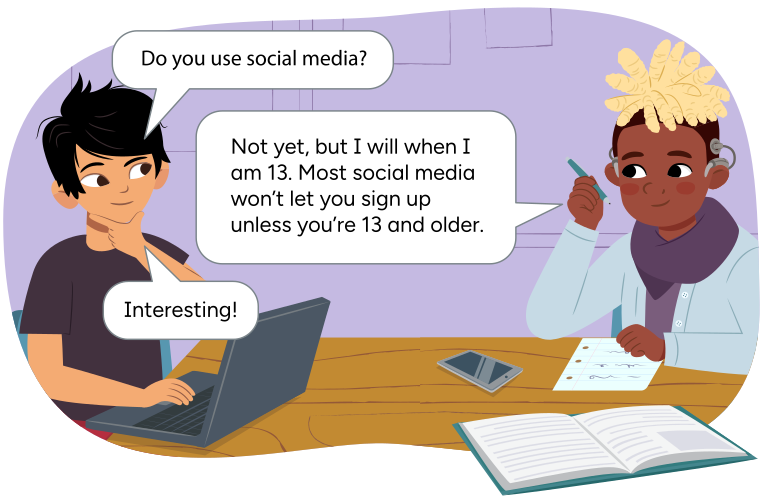
A conversation between Tyler and Marcel.
Tyler says, "Do you use social media?"
Marcel replies, "Not yet, but I will when I am 13. Most social media won't let you sign up unless you're 13 and older.
Tyler: "Interesting!"
Similar to driving or having a job, there are often age restrictions on who is permitted to use social media platforms and how. This is why many social media companies often set limitations for use based on a user’s age.
Unlike with voting or participating in extreme sports, the common age that is appropriate for unsupervised social media use is much younger; it’s just 13 years old.

Reactions
Let’s listen to the following clip to explore different reactions to the common age of social media use.
Elements of a Comic Strip

Student Success
Think
After exploring the various student reactions, think about the following:
- What was your initial reaction to the age of social media consent?
- If you were already aware of this age, do you agree that is a suitable age to use social media?
You may record your ideas in a notebook or another method of your choice.
The internet

It can be hard to imagine a time before the existence of the internet.
Being online is intertwined with nearly all aspects of everyday life, so the idea that people used to rely on other types of media to gain information can also feel like a far-fetched concept!
The creation of the “World Wide Web,” however, was not a sudden or overnight development.
Press the following tabs to learn about the history of the Internet.
As early as the 1950s, giant standalone computers were used for scientific research in both the academic and military fields. Access to these oversized machines was limited, and their initial rarity made them quite expensive; however, their popularity was growing, and the demand for building connections between these devices drove further innovation.
By the mid-1970s, the technical foundations of the internet as we know it today were being laid, and the standalone devices were gradually linked together.
A globally connected network of computers began to develop, and by the year 1993, the internet was officially available for universal use.
The online world
The release of the internet was revolutionary for a number of reasons, but the idea of an open-access source of endless, free information was unprecedented.
With internet connections now available in the home, people were becoming increasingly accustomed to the online space, more individuals were being connected across vast physical distances, and even businesses were being founded.
The rise of social media
It wasn’t long after the internet was launched to the global public that the concept of social media came about.
The internet was proving to not just be a vital source of static information but also an ideal space for real-time interaction with people around the world. Individuals connected easily with each other, and businesses looked to flourish in the virtual space, as well.

Did You Know?
Did you know?
Like all private enterprises and companies, social media platforms have a business strategy and a specific profit goal in mind. So, while they may seem to exist to help people connect with each other and share information, they are companies looking to make money.
Social media companies introduced a new business model in order to be successful and remain sustainable on the web. Because most websites and online companies make money through paid advertisements, they rely on internet users to remain on their site or platform to encounter the targeted advertising. Essentially, the main business objective is to hold your attention!
Engagement tactics
Social media companies implement very specific strategies to keep the user engaged and online.
Explore the following strategy examples that are used by social media platforms to hold your attention.
The risks of social media
With a seemingly never-ending flow of new content to explore, carefully tailored preferences, and constant reminders to check the platform, social media can pose a serious risk to users’ health and well-being by encouraging overuse.
Also, the addictive design features of social media platforms, like notifications, likes, or shares, trigger the brain’s reward system, resulting in heightened feelings of excitement and pleasure.
“When someone experiences something rewarding or uses an addictive substance, neurons [...] in the brain are activated and dopamine levels rise. Therefore, the brain receives a ‘reward’ and associates the [substance] or activity with positive reinforcement.”
– Addiction Center

While this correlation puts internet users of all ages at risk of developing an unhealthy dependence on social media, it is especially hazardous for teens due to the nature of the brain’s development at this stage. Adolescence is the second most important period of growth for the human brain, and, at this stage, it is particularly sensitive to social feedback.
A recent study by the Journal of the American Medical Association (JAMA) offers evidence that overuse of social media can actually “rewire [...] a teen’s brain to constantly seek out immediate gratification, leading to obsessive, compulsive, and addictive behaviors.”
Mental health crisis
Explore the short reading about Justice for Learners: The TDSB Case. You may use speech-to-text to listen to the text.
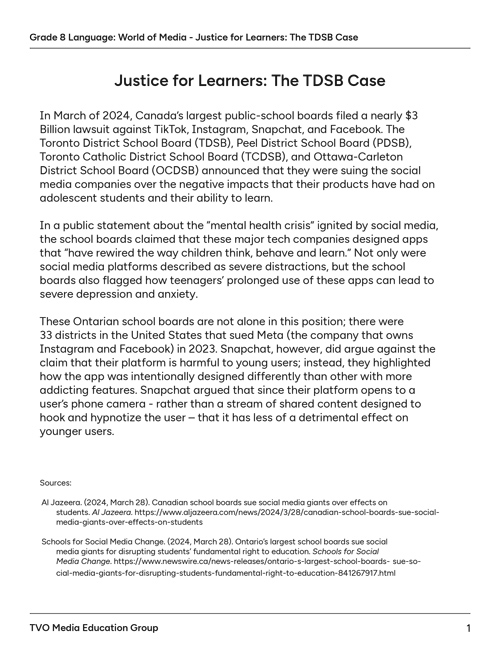
Press the Activity button to access the Justice for Learners: The TDSB Case.
Activity(Opens in a new tab)
Social Emotional Learning
Social emotional learning
Let’s check out Tyler and Marcel’s discussion:
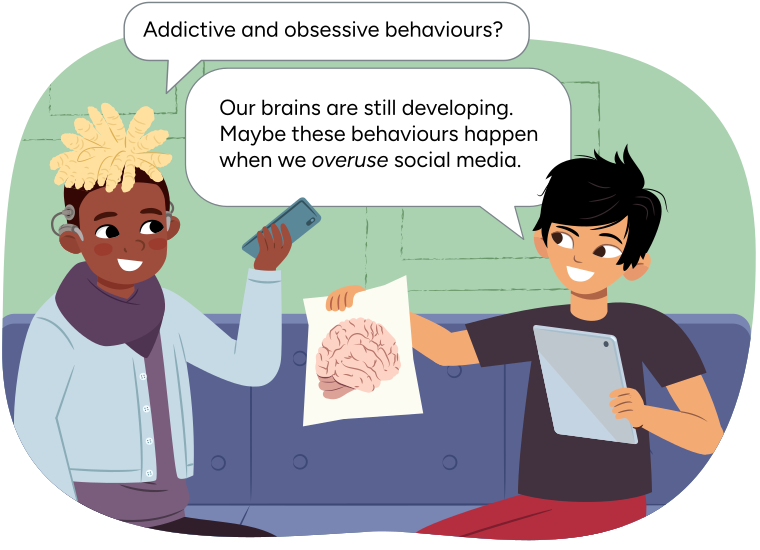
A conversation between Marcel and Tyler.
Marcel says, "Addictive and obsessive behaviours?"
Tyler says, "Our brains are still developing. Maybe these behaviours happen when we overuse social media."
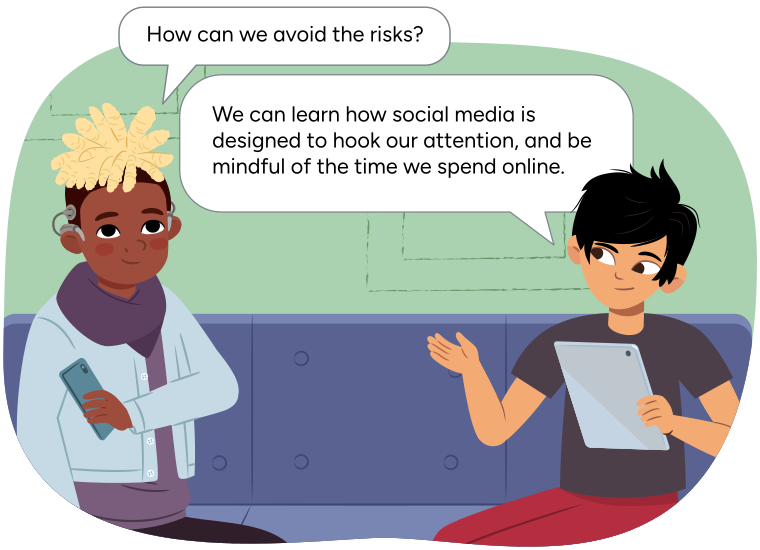
Marcel says, “How can we avoid the risks?”
Tyler says, “We can learn how social media is designed to hook our attention, and be mindful of the time we spend online.”
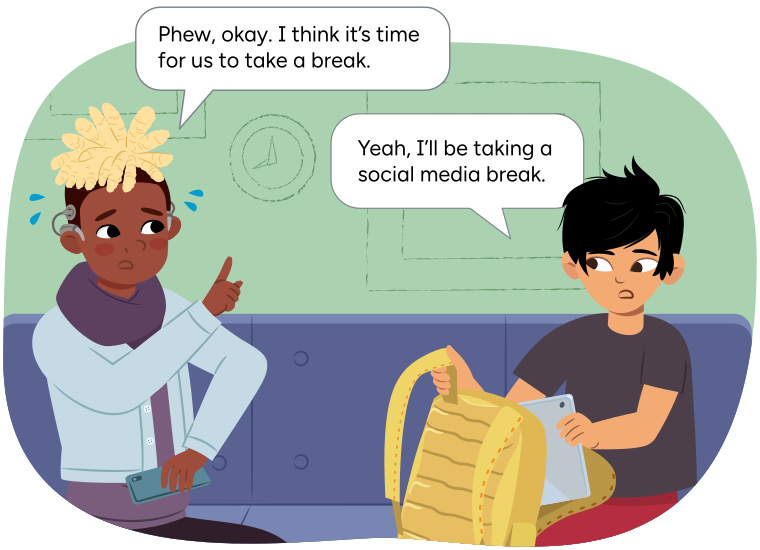
You may play the audio clip to listen to Marcel and Tyler’s conversation about social media.
Marcel & Tyler’s Conversation
1-2-3 disconnect! Let’s take a break and try an offline activity.
If possible, read a few pages of a book, solve a puzzle, move around your space, or do another activity of your choice.
Sentences
Let’s move on to the next section about sentences.
Check out the following video to learn more.
After watching the video about fragments and run-on sentences, let’s think about what we’ve learned.
Learning check!
Read each statement, then choose whether it is a sentence fragment or a run-on sentence.
Select the correct answer, then press Check Answer to see how you did.

Try it
Try it!

Task A: Making corrections
Correct three of the following sentences by adding punction, capital letters, or additional words if necessary:
- The teacher caught me recording the game with my phone he took my phone away from me I broke the school’s rule.
- My best friend Sachin said a positive thing about me on social media yesterday. And it made me feel terrific.
- I’m not the only one in my class without a cell phone my close friends don’t have them either.
- Without charging the battery.
- Reminding me about due dates and special birthdays and important games are some advantages of having a cell phone.
Record your corrected sentences in a notebook or another method of your choice.
When you’re ready, press Let’s Check! to explore the corrected sentences.
Please note that the sentences you corrected will vary with the answer provided.
- The teacher caught me recording the game with my phone. So, he took my phone away from me because I broke the school’s rule.
- My best friend, Sachin, said a positive thing about me on social media yesterday, and it made me feel terrific.
- I’m not the only one in my class without a cell phone; my close friends don’t have them either.
- I couldn’t use the cell phone without charging the battery.
- Reminding me about due dates, special birthdays, and important games are some advantages of having a cell phone.

Task B: Reading aloud
For this task, read your corrected sentences out loud.
If possible, record yourself using a recorder or another device.
Press How Did I Do? to check out a few reading strategies.
- Did you read the sentences at about the speed of a conversation? If you answered no, re-read the sentences until you are more comfortable with the words.
- Did you stumble over any words? If you answered yes, sound the word out slowly. Then practise reading the word again. Sometimes stumbling happens because you haven’t heard the word said out loud before.
- Did you read with expression? Did it sound like you were asking a question when you noticed a question mark? Did you sound excited when you read an exclamation mark?
- Did you come to a full stop at a period?
- Did you pause slightly when you came to a comma?
Essay outline

In the Minds On section, we listened to young people’s opinions about the appropriate age to start using social media. Throughout the learning activity, we have explored the strategies and risks that stem from social media usage.
In our next task, we will create an essay outline about social media age restrictions.
Press the following tabs to learn more about an essay outline.
To start your essay outline, let’s first choose a point of view to argue.
Check out the following options:
- Social media companies should have a minimum age restriction for users.
- Social media companies don’t need to restrict access based on age.
Note: You don’t need to personally agree with the position that you choose to represent. This activity is about practicing how to present and support a clear argument with supporting details and facts.
Once you have chosen which position you’d like to argue and represent, then think about a few ideas on how you can support your argument.
Consider the following to guide your thinking:
- Were there any specific facts or details throughout the learning activity that you found persuasive or convincing?
- Is there anything from your own lived experiences that could lend itself to your argument?
- Was there an aspect of this topic that wasn’t addressed? What else do you want to know?
As you review the learning activity to find any potential supporting points for your argument, you may be interested in exploring additional perspectives on social media age restrictions.
You may conduct further research to support your argument.

Reading Time
Reading time
You may check out one of the following articles to conduct further research.
You will now access the article “The Law Should Not Require Parental Consent for All Minors to Access Social Media.”
Press the Article button to access the The Law Should Not Require Parental Consent for All Minors to Access Social Media.
Article(Opens in a new tab)You will now explore the article “Social Media Gets Teens Hooked While Feeding Aggression And Impulsivity, And Researchers Think They Know Why.”
Press the Article button to access the Social Media Gets Teens Hooked While Feeding Aggression and Impulsivity, And Researchers Think They Know Why.
Article(Opens in a new tab)After checking out an article, record the supporting points from the article in a notebook or another method of your choice.
Press Example to check out a strategy.
You may use the following outline to record your supporting points from the article:
| Article Title | |
| Author | |
| Date | |
| News Outlet | |
| Supporting Points |
Organize your essay
Once you have gathered more supporting evidence for your essay argument, you will be ready to begin to plan the sequence of your essay.
Be sure to include the following:
- the main idea
- two to three supporting points
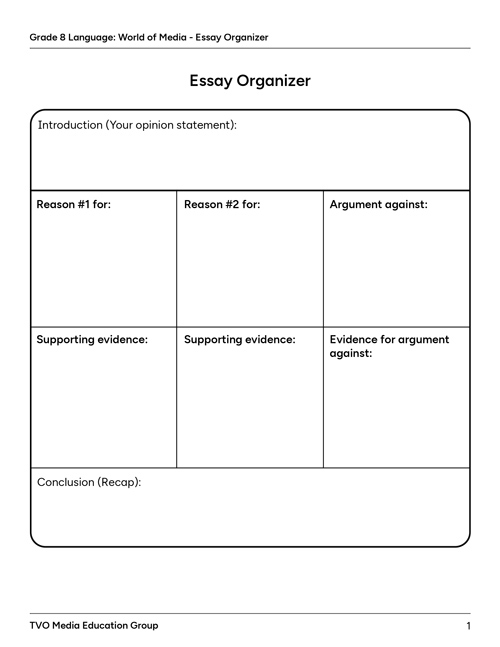
Then, note and organize your ideas in an organizer.
You may use the fillable and printable Essay Organizer in your notebook or using the following document. If you would like, you can use speech-to-text or audio recording tools to record your thoughts.
Essay checklist

You may use the following checklist to guide how you write your essay.
Consider each point:
Wrap up!

Let’s think about what we’ve learnt while writing and organizing our persuasive essay.

Pause and Reflect
Pause and reflect
Choose one of the following questions to reflect on:
- You selected a word processing software from a variety of programs available. Comment on your use of this software. How was it helpful? What did you learn? What do you need to learn?
- Think about the strategies and tools you used for developing ideas and
organizing content for your persuasive essay. Consider each step and reflect on
the following:
- Which step was most helpful? Why?
- Suggest two steps to improve.
Record your ideas in a notebook or another method of your choice.
Reflection
As you read the following descriptions, select the one that best describes your current understanding of the learning in this activity. Press the corresponding button once you have made your choice.

I feel...
Now, expand on your ideas by recording your thoughts using a voice recorder, speech-to-text, or writing tool.
When you review your notes on this learning activity later, reflect on whether you would select a different description based on your further review of the material in this learning activity.