Learning goals
We are learning to…
- evaluate the use of forms, conventions, and techniques of digital and media texts, consider the impact on the audience, and apply this knowledge when analyzing and creating texts
- demonstrate an understanding of the interrelationships between the form, message and context, the intended and unintended audience, and the purpose for production
- produce final texts, selecting a variety of suitable techniques and tools, including digital design and production tools, to achieve the intended effect and compare how various strategies and tools helped communicate the intended message
- analyze and compare how images, graphics, and visual design(Opens in a new window) create, communicate, and contribute to meaning in a variety of texts
Success criteria
I am able to…
- learn about and analyze various forms, conventions, and techniques in advertisements and explain how they impact the overall message
- explore the intended and unintended audience of advertisements
- create my own advertisement by pre-planning the form, audience, conventions, and techniques that will be needed to convey the appropriate message and self-assess my creation
- evaluate the most effective conventions and effects used when creating advertisements

Marketing

Advertising is all around us—it may be the type of media that people interact with most!
From sponsored posts to unboxing videos to product reviews, it can be difficult to avoid (and sometimes even detect) advertising in the media we consume.

Student Success
Think
Think about your experiences browsing different types of media, like:
- online social platforms
- television
- streaming services
- billboards
- posters in public and on transit
Can you always tell when a product or service is being marketed to you? What gives it away?
Record your ideas in a notebook or another method of your choice. If possible, share your ideas with a peer.

All about ads
We live in a world with an endless menu of content to consume. As a result, advertising strategies have become more sophisticated, effective, and even harder to detect.
In order to understand how advertising and marketing methods can influence people’s behaviour, it will be helpful to review some of the fundamental concepts of advertising:
- forms
- audience
- conventions
- techniques
Types of advertising
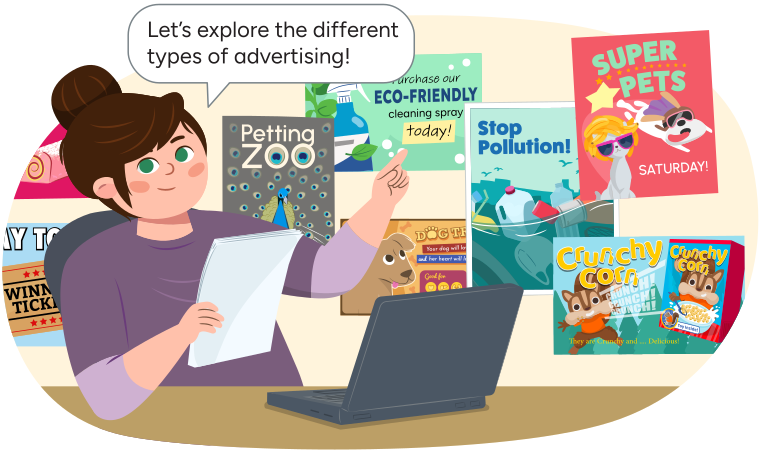
An advertisement is a public notice or announcement designed to promote or sell a product, service, or idea to the public. You may be familiar with the terms commercials or ads.
From posters made on papyrus in Ancient Egypt, to sponsored posts on social media, advertisements have continued to evolve along with the modern world.
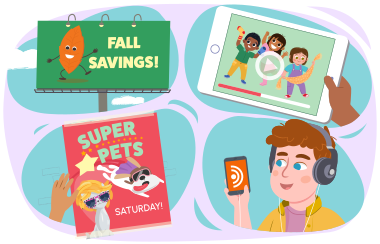
Ads may come in many forms:
- poster “campaigns”
- podcasts/radio broadcasts
- commercials on streaming services and television channels
- billboards
- sections of magazines and newspapers
Most advertisements convey their purpose or message in one of three ways:
- inform the audience of something
- persuade the audience to buy or believe something
- entertain or remind the audience of something
Audiences
Advertisers begin their process by selecting a group of people to target, known as the intended audience. This the demographic or “target market” the creator of the message hopes to reach and influence.
In addition, there is also an unintended audience, which is those who might not be the target but are still influenced by the ad. Many advertisers study the impact of the groups who are influenced by the ad, but not necessarily the target audience.
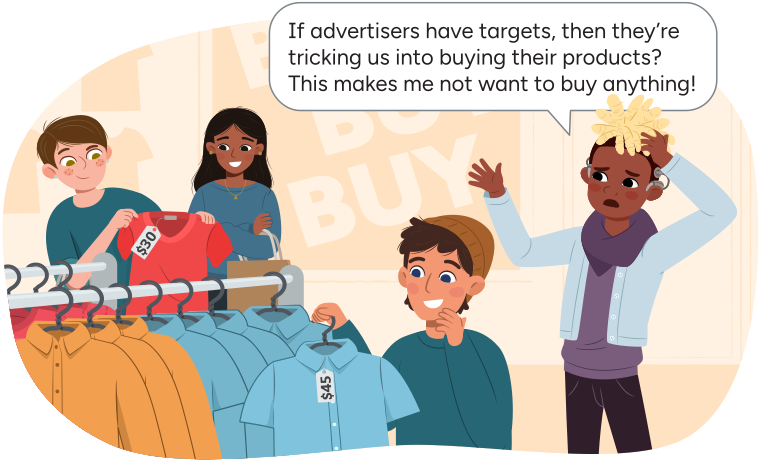
Marcel saying, "If advertisers have targets, then they're tricking us into buying their products? This makes me not want to buy anything!"

Student Tips
Student tips
Advertisers will often emphasize the positive features of their products and avoid the negative. They often anticipate aspects of human nature, such as insecurity or jealousy, in order to convince consumers that they need to purchase a certain product.
Because of this fine line between persuasion and dishonesty within the advertising world, companies and individuals are responsible for certain ethical considerations when developing their ideas, like the following:
| Avoid | Allow |
|---|---|
|
|
Learning check!
Explore the following advertisement description, and choose the likely intended audience.
Select the correct answer, then press Check Answer to see how you did.
How to advertise
Along with specific forms and intended audiences, advertisements also have specific conventions. Advertising conventions refer to the standard practices and elements that are commonly used in advertisements, regardless of the advertisement form.
These conventions help advertisers effectively communicate their message to target audiences and create a sense of familiarity and consistency within their advertising campaigns.
Let’s check out a few advertising conventions that are used quite often.
Techniques
Advertising is aimed at persuading its audience, or consumers, to take a specific action. These actions could include buying a product or service, supporting a cause, or adopting a certain behaviour.
These techniques are designed to capture the attention of the intended audience and influence their decision-making process. While exploring the examples, consider how advertisers shape their tone or messaging to reflect human nature and emotion.
For example, an advertisement for memory foam pillows might show a person resting in bed with a peaceful facial expression to indicate that the product provides comfort and rest. This peaceful imagery comforts the target audience, who then might be influenced to buy the pillows.
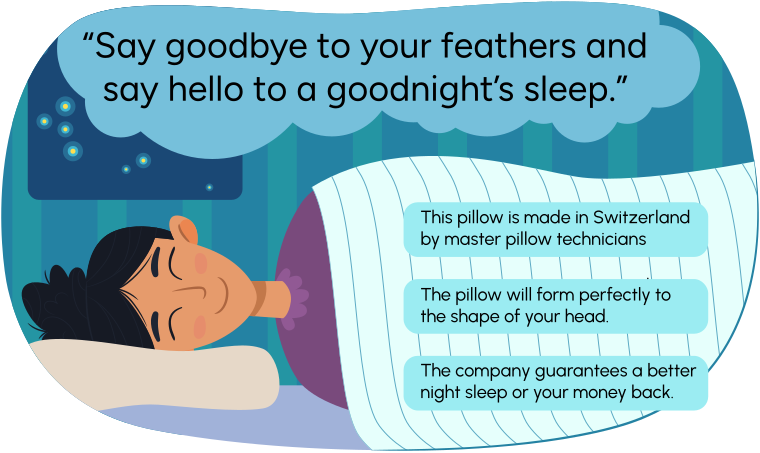
An advertisement for memory foam pillows. It features a person sleeping and the tagline: "Say goodbye to your feathers and say hello to a goodnight's sleep."
Selling points include: 'This pillow is made in Switzerland by master pillow technicians', 'The pillow will form perfectly to the shape of your head', and 'The company guarantees a better night sleep or your money back'.
Keep in mind that advertisers and marketers have the goal of persuading their target audience to take a certain action.
Press the following tabs to learn more about the various advertising techniques.
“Jumping on the bandwagon” or “bandwagoning” refers to when people join in an activity or take on a specific opinion because it’s popular and they feel excluded. Typically, if there is an extremely popular product that everyone seems to be buying, it is not uncommon for a consumer to feel motivated by their jealousy, and then purchase the product for themselves.
Promotions and rewards are also designed to respond to human psychology. This was inspired by a scientific theory about the brain’s rewards system, which processes anything that motivates or teaches us as a rewarding experience. When the brain expects to receive a reward, a special chemical, dopamine, gets released and causes that person to feel happiness.
As a result of this reaction, our brains are constantly seeking out rewarding experiences. Advertisers know this and create rewarding experiences for their customers so that they connect the happy feeling with that particular brand.
Advertisements use language like “customer loyalty,” “50% off,” “bonus,” and “buy one, get one free” (popularly referred to as “BOGO”) to hold the audience’s attention and motivate them to purchase. Some examples of advertising that use this technique include:
- promo codes for products on social media
- digital and print coupons
- special sales and discounts
- rewards points from loyalty customer programs.
Everybody wants to feel like they are getting a deal!
Marketing is all about persuasion, so advertisers often want to prove the legitimacy of their products. Presenting statistics and using data as “hard proof” that a product or service is worth purchasing encourages the consumer to trust and purchase the product.
Advertisements can also use direct quotations from people (testimonials) or specific dates to give their materials a sense of legitimacy.
For example:
- “9/10 people prefer this product!”
- “94% of people said their teeth were whiter after using this toothpaste.”
As consumers, we must ask how the data was collected.
- Did the company survey enough people?
- Were they paid?
- Were they encouraged to answer a certain way?
Without getting the answers to these questions, we should be skeptical of big claims by advertisers!
The most effective techniques in advertising is careful, intentional word choice.
Advertisements cannot lie, but sometimes words can be misleading.
For example:
- using words like "improved," "premium," or "natural" sound better
- using phrases like “Gum could give you fresher breath for up to six hours,” or possibly less
- drawing attention to what a product doesn’t have to try and sell it; advertising chips as “sugar free” might make them sound healthier

Try it
Try it!
With a better understanding of the forms, conventions, and techniques that go into creating advertisements, let’s check out two fictional video commercials for breakfast cereal.
1. First, explore the following videos to learn more about the Space Puffs and Good Vibes advertisement.
2. Then, consider the following for each advertisement:
- purpose and form
- intended and unintended audience
- conventions and techniques used
- overall message
3. Complete the fillable and printable Ad Analysis Activity in your notebook or using the following document. If you would like, you can use speech-to-text or audio recording tools to record your thoughts.
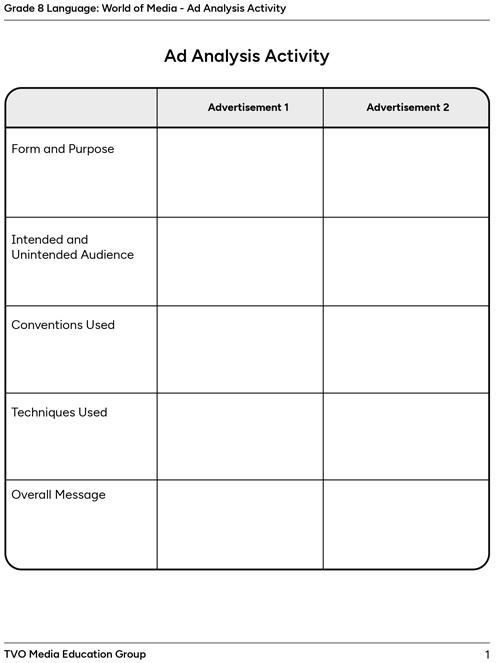
When you’re ready, press Let’s Check! to explore an example of the Ad Analysis Activity.
| Advertisement 1 | Advertisement 2 | |
|---|---|---|
| Form and Purpose | Television commercial | Television commercial |
| Intended and Unintended Audience |
Intended: children, also maybe parents Unintended: adults without children; people with gluten or lactose allergies |
Intended: adults with busy lives Unintended: people with alternative or less healthy diets; children |
| Conventions Used |
Slogan: Space Puffs: where the universe meets breakfast! Logo: “Space Puffs” on top of yellow orbital rings to resemble planets Brand colours and font: lots of bright and engaging colours are used to attract children’s attention; the font is large, colourful and easy to read Call to Action: “Just grab a bowl and add some milk!” |
Slogan: Good Vibes Cereal: nutritious goodness in a bowl. Visual elements: clips of adults exercising, getting ready for work to show being busy and health-focused Music: soft acoustic guitar music is playing to suggest this product helps busy people to relax Call to Action: “Start your day off right with a bowl of Good Vibes, and take on the world with confidence and energy!” |
| Techniques Used |
Promotions and rewards: customers get free toy in every box Word choice: most amazing, delicious, adventure, imagination, best, goodness, fun |
Word choice: perfect solution, carefully crafted, energy and focus, smart, health-conscious |
| Overall Message |
If you’re a kid, you’re going to have fun eating this cereal! |
This cereal gives you the nutrition you need without much preparation. |
Endorsements

A unique advertising technique that dominates modern media is the celebrity or influencer endorsement. This refers to when individuals or groups publicly support related brands and companies and then get paid in return for their recommendation. Before the age of social media, these kinds of endorsements usually were celebrity appearances in commercials, magazine ads, or on billboards. Another format is to have a specific professional, like a dentist, promote a product associated with their line of work.
Parasocial
Evolved in the era of social media is the idea of parasocial relationships. Formed by adding the prefix “para” to the base adjective word “social,” this term refers to when a social media user (or consumer) feels a strong personal connection to a famous person who they have never met or interacted with in real life. For example, artists, fitness influencers, athletes, etc.
While it can have benefits, this is a one-sided friendship; the famous content creator is always unaware of the individual who feels connected to them!

Unlike traditional forms of media, social media is a more personal, private, and subjective experience for the consumer. Celebrities and non-famous users post to the same platform and share their opinions alike, so there is a balance between fans and their favourites. This has led to an increased sense of trust in what well-known people post to their social media feeds, as it is often believed to be honest and authentic.

Did You Know?
Did you know?
Did you know that the term “parasocial relationships” was actually coined in the 1950s when television was first officially introduced to people’s homes?
People were experiencing this radical new form of media in the intimacy of their own homes for the first time (previously, people could only view films in a theatre). Audiences were witnessing late-night TV show hosts speak directly to the screen, as though they were addressing the viewer, so psychologists became interested in how viewers were processing this bizarre new way to engage with media.
In 1956, American psychologists D. Horton and R. Wohl published a research study on the concept of parasocial interactions, which they believed to be a type of “illusion” on the part of the viewer, since the performer on television has no interaction with them.
Trusting endorsements

Because parasocial bonding leads consumers to feel a genuine sense of trust in their favourite celebrities, they are more likely to imitate their behaviour and follow their suggestions on products and services. This is similar to the bandwagon strategy, where a product is advertised as extremely popular, so consumers are driven to buy it due to the fear of missing out.
With celebrity/influencer endorsements, the influencer discloses private information about their personal life and engages directly with their audience. When the influencer promotes a certain product, it is very likely that their followers or consumers will purchase what was recommended.
Explore the following video to learn about the impact of social media beauty influencers and makeup artists (MUAs) on people’s consumer habits. The video starts off with the host interviewing people around downtown Toronto about their experiences with beauty influencer endorsements. Let’s check it out!
In the video, they explore how common it is for people to buy beauty products that they’ve seen endorsed on social media. Some interviewees felt conflicted over the immediate impulse to buy, but others expressed positive feelings of affirmation associated with the endorsed products they had bought. This demonstrates our complex relationship to media and advertising.
Student Success
Think
After exploring the video, choose two of the following questions to think about:
- What are some of the ways that people described their relationship to beauty marketing online?
- While being persuaded to buy items is a form of media manipulation, what are some examples of the positive impact of these parasocial relationships?
- In your own words, what was the “plain, hard truth” that was stated about beauty product advertising?
Record your ideas in a notebook or another method of your choice.
When you’re ready, press Let’s Check! to explore a few sample responses.
| Reflection Question | Sample Response |
|---|---|
| What are some of the ways that people described their relationship to beauty marketing online? | Some interviewees mentioned feeling that they spend too much money as a result of feeling influenced, while others describe how they seek out influencers who share their physical traits so that the endorsements are more relevant to them. |
| While being persuaded to buy items is a form of media manipulation, what are some examples of the positive impact of these parasocial relationships? | Inclusion |
| In your own words, what was the “plain, hard truth” that was stated about beauty product advertising? | That the industry uses human psychology–such as physical insecurities and the pressure in society to look a certain way, in order to convince consumers that they “need” a certain beauty product to “fix” it. |
Creating ads
Let’s create an advertisement for a product of your choice. The product can be one that already exists, or an invention of your own.
Ad checklist
When planning your ad, consider…

Record your advertisement ideas. If possible, seek feedback before producing your final piece. Finally, create your advertisement in a method of your choice.
Press Ideas to explore product and advertising ideas.
Product ideas:
- a new sports drink
- a new television show based on your life
- a car with new features
- a piece of gum that never loses flavour
- a new social media platform
- a new chip, candy, or chocolate bar flavour
Advertising ideas:
| Create a commercial through filming a live video or using an online application. | Create a print advertisement by hand or using digital software. | Create a radio advertisement orally or using a recording program. |
Self-assessment rubric
When you’re ready, use the following rubric to self-assess the ad that you created.
| Excellent | Getting There | Not Yet | |
|---|---|---|---|
| Intended Audience |
|
|
|
| Clear Purpose |
|
|
|
| Use of Conventions |
|
|
|
| Use of Techniques |
|
|
|

Pause and Reflect
Pause and reflect
Take a few minutes to reflect on the advertisement you created:
- What strategies and tools did you use to communicate your advertisement to your intended audience?
- Do you think your advertisement was successful? Why or why not?
- If you were to re-do this assignment, what would you improve on for next time?
Vocabulary

Vocab goals!
Try it
Try it!
Choose any three of the vocabulary words, then write a sentence for each:
- advertisement
- demographic
- convention
- promotion
- endorsement
Record your sentences in a notebook or another method of your choice.
Press Let’s Check! to explore the definitions for each term.
You may use the following definitions to guide how you write each sentence.
| Advertisement | A public notice or announcement designed to promote or sell a product, service, or idea to the public. |
| Demographic | Specific population based on gender, age, income, education, occupation, ethnicity, etc. |
| Conventions | Refers to the standardized practices and elements commonly used in advertisements regardless of the form. |
| Promotion | Activities to advertise something or encourage something to happen. |
| Endorsement | The act of saying you approve of or support something or someone. |

Wrap up

For this activity, sort the advertising concepts as a form, convention, or technique.
Press and place the following cards into categories that best match.
Final thoughts
Reflect on the advertisements you’ve explored or noticed in the learning activity.
- What element of design (visuals, sounds, or words) was the most effective and conveyed the message effectively?
- Why do you think this?
Use evidence from your learning to explain your thinking.
Record your thoughts and ideas in a notebook or another method of your choice.
Press Hint to learn more.
Consider the visual elements (images, videos, graphics, colours, and fonts), sound elements (music and sound effects), and word choice of the advertisements you explored.
- What element do you feel is most effective and conveys the message the best?
- Do you think it depends on the intended audience or product? Explain.
Reflection
As you read the following descriptions, select the one that best describes your current understanding of the learning in this activity. Press the corresponding button once you have made your choice.

I feel...
Now, expand on your ideas by recording your thoughts using a voice recorder, speech-to-text, or writing tool.
When you review your notes on this learning activity later, reflect on whether you would select a different description based on your further review of the material in this learning activity.
Press ‘Discover More’ to extend your skills.
Discover MoreWrite three sentences that include a preposition and vocabulary word combined from this learning activity. When you’re finished, have a peer review and provide feedback if possible.