An excerpt from ‘ARCHIVE: ‘Everyone knew everyone’: A researcher on the Black history of a Windsor neighbourhood
TVO Today speaks with University of Windsor graduate student Willow Key about the people, businesses, and relationships that built a community — and how they inform the present.
Feb 28, 2024
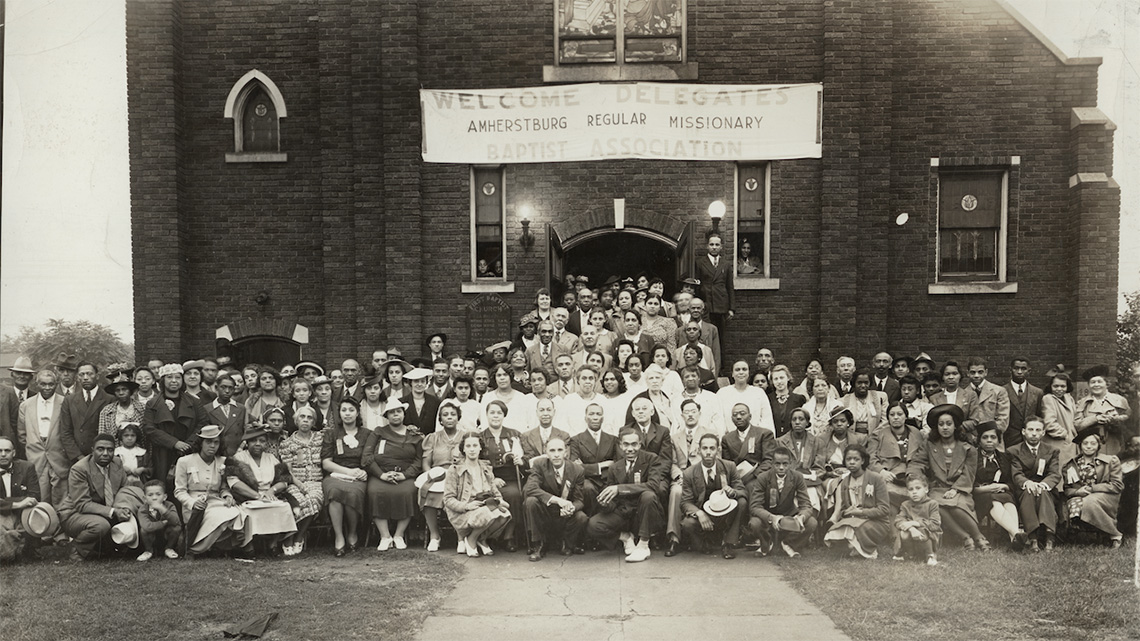
Delegates to the Amherstburg Regular Missionary Baptist Association at Windsor’s First Baptist Church, 1940.
TVO Today: Can you tell me about the process of doing this research? You were combing through the archives but also talking to people who lived in the community and seeing their own personal records.
Willow Key: You got the sense right away that this was a community that was very well-connected. Part of that was because the McDougall Street Corridor was very much a product of its time. There was housing discrimination in the city of Windsor, so it was really the only place that you could purchase a home if you were of African descent. There was also a smaller Chinese community that brushed right up against it, and they experienced a similar situation of housing discrimination. There was also a Jewish community beside the McDougall Street Corridor. It really was the case that a lot of the city’s ethnic minorities were stuck in this main downtown area.
…
In the 1950s, there were just over 1,500 people in Windsor’s Black community. Not everyone lived downtown, but a lot of them were in that area. So, it was a small community, and everyone really knew everyone. You got the sense that it was really an important space for people. It was a place where they felt safe, where they knew that they could find accommodations and access resources that were not always guaranteed outside that area. In my interviews, a lot of frustration and disappointment came through with how that community was treated in the 1950s. There is still an overwhelming sense of disappointment that the community experienced what it did with expropriation and that the community doesn’t necessarily feel the same as it did when people were growing up.
…
TVO Today: I’d like to talk a bit about the Fellowship of Coloured Churches Credit Union, which the community created to provide banking services that its members couldn’t get from mainstream banks, like loans.
Key: When I was doing some of the online research, I was going through the Windsor Star newspaper from the 1940s. I think it was mentioned in relation to First Baptist Church. It was a financial group that sprang out of the church. There was a concern with discrimination with traditional banks and the fact that it was difficult at times for people within the McDougall Street Corridor to access loans. Or they didn’t feel particularly welcome at certain banks. So, the community essentially pooled its resources and helped one another with student loans or mortgages or personal loans.
The community had a long history of doing this. I remember speaking to someone who told me about how, if someone in the community was struggling to pay their rent or their mortgage or for groceries or whatever, they would sometimes organize these things called rent parties, where people would make desserts or bake foods, and they’d have games set up. They tried to raise money for that individual —that was very common. One other thing that I noticed with almost every social organization that sprang out of the community, regardless of what the intention of the organization was, they almost all had some sort of student aid for secondary or post-secondary students coming out of the community.
I think it’s indicative of the way in which the community was formed and the way that it functioned. Everyone had to rely on their neighbours and other people in the community. Financial needs, that was no different. So, a credit union made sense for the way that that community functioned. In the 1940s, there was also an interest in promoting Black financial and economic independence.
The best way of doing that, I think the community thought, was to start their own credit union. It was a natural progression of what the community was already doing. It was just kind of a more professional form.
TVO Today: How widely used was it?
Key: By the early 1960s, they had amassed over 300 patrons. For quite a while, they were they were functioning out of somebody’s home — Hugh Burnett — then they were functioning out of the Masonic Hall. And then they were finally able to purchase their own building in the 1960s.
…
TVO Today: What’s next for your work on this community?
Key: I’m actually just finishing up my master’s degree. Then I’m hoping to maybe write a book on the McDougall Street Corridor. There are so many different aspects of this community to focus on, and this website just lightly touches upon its history. I have a lot more research that we weren’t able to add, and then I’m still conducting research. It’s definitely ongoing.
Source:
Kat Eschner (Feb 28, 2024). An excerpt from ‘ARCHIVE: ‘Everyone knew everyone’: A researcher on the Black history of a Windsor neighbourhood. TVO Today. https://www.tvo.org/article/archive-everyone-knew-everyone-a-researcher-on-the-black-history-of-a-windsor-neighbourhood
Close this tab to return to the previous window.