Learning goals
We are learning to…
- identify the features of spoken-word poetry (also known as “spoken word”)
- adjust communication strategies to suit the setting and audience
- draft texts that are personally relevant
Success criteria
I am able to…
- identify some of the features of spoken-word poetry and explain how it differs from other poetic forms
- identify and use presentation strategies suitable to the setting and audience
- create a spoken-word poem that expresses my own unique voice and lived experiences

The power of poetry
Do you recognize this poet?
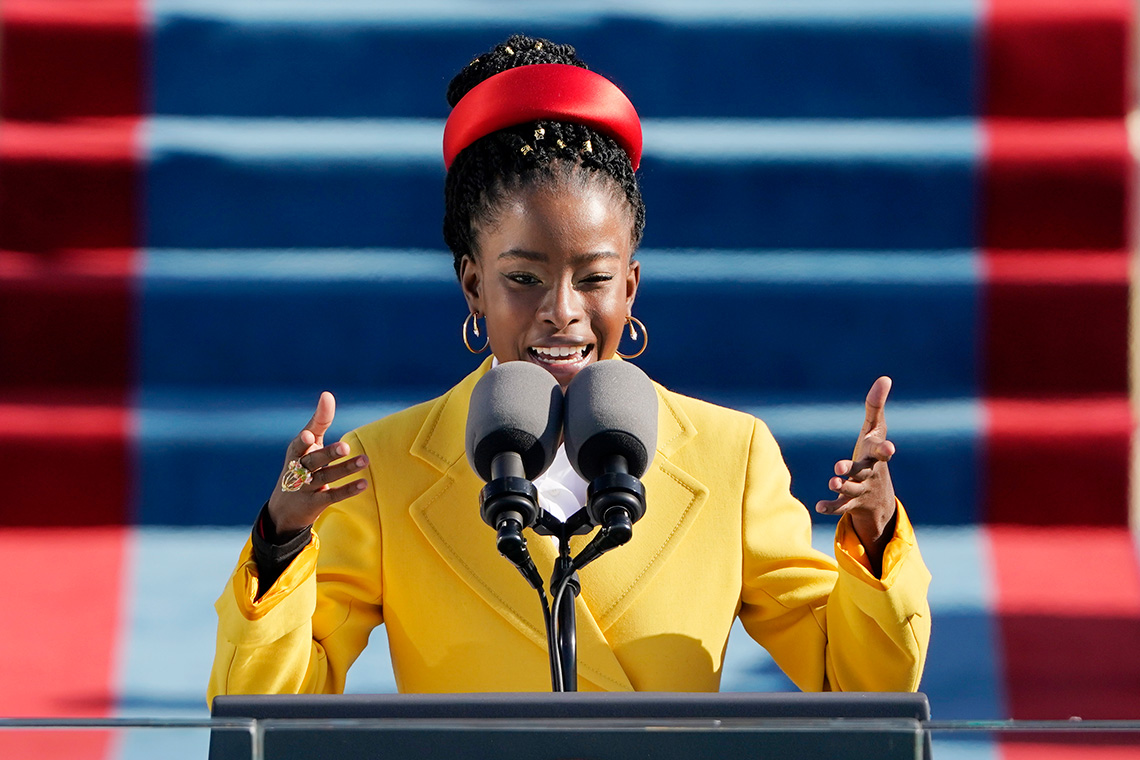
Press Poet to find out who this is.
This is Amanda Gorman, the youngest poet ever to speak at the inauguration of an American president. She read her poem “The Hill We Climb” at President Joe Biden’s ceremony in 2021. She was 22 years old.
From 2017 to 2018, Gorman was the first National Youth Poet Laureate in the United States. A poet laureate is an official poet of a country, region, city, or institution. They are appointed (chosen) by a government to promote an appreciation of poetry and to create poems for special occasions. Gorman is also an author, activist, and public speaker.
Watch the following video to experience part of Gorman’s spoken-word poetry performance at the inauguration. What do you notice about her presentation?

New vocabulary!
In this video clip, the newscaster says that “there is a renaissance in poetry right now.” What does that mean?
Let’s break down the word renaissance. Explore the following interactive image:
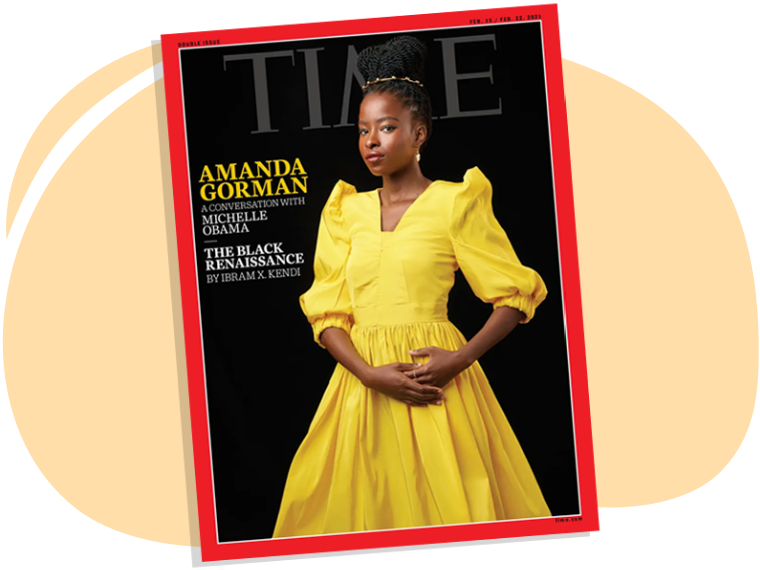
A renaissance is literally a rebirth. It can also mean a renewed interest in something. A “renaissance in poetry” is a renewed interest in poetry or an increase in poetry’s popularity. As proof of this renaissance, Amanda Gorman was featured on many magazine covers, including Time magazine.

Pause and Reflect
Poetry and you

Do you like poetry? Have you ever read poetry? Take a moment to reflect on any opinions or attitudes you may have towards poetry.
In this learning activity, you will explore a specific type of poetry known as spoken-word poetry or just spoken word. You will discover what makes it different from other forms of poetry.

What is spoken-word poetry?

Poetry is often written to express thoughts and feelings on important topics or issues. Spoken word is a form of poetry performed in front of an audience. Spoken word does not have to rhyme, though it often does. The poet deliberately paces their speech, inserts pauses, and emphasizes and repeats certain words to give the performance a musical, rhythmic feel.
You may be familiar with poetry forms that require a specific number of lines or syllables. Spoken word does not have rules for structure or length. It is a type of free verse or open poem.
The following image shows the characteristics of spoken word.
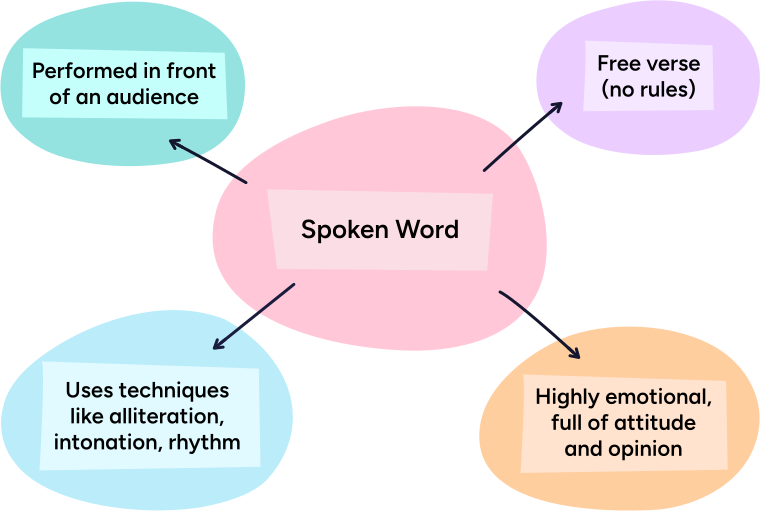
Spoken word: techniques
Let’s take a closer look at the poetic techniques used in spoken word. You may be familiar with some of these techniques already. Try the following matching activity.
For each technique, select the corresponding description.
To learn about two other techniques used in spoken word, press the following tabs.
Intonation is the rise and fall of the voice when speaking. Note how intonation can change meaning:
|
Falling intonation |
You picked the flowers. |
|
Rising intonation |
You picked the flowers? |
The rising intonation turns a statement into a question. Explore the following audio clip to hear the difference in intonation:
Rising and falling intonation
Rhythm is the beat, flow, and pattern of syllables and words. Here is the rhythm of a famous line from Shakespeare’s Hamlet:
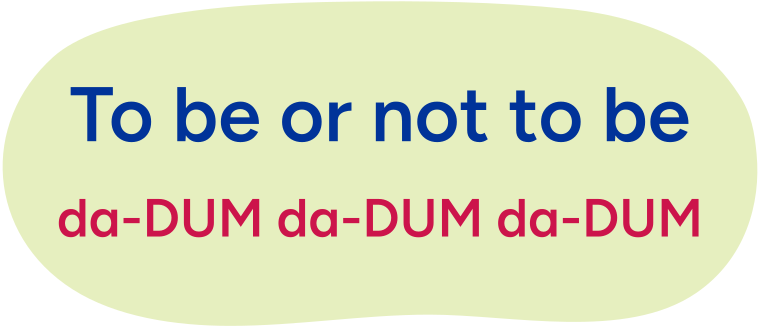
Explore the following audio clip to hear this rhythm.
To be or not to be
Analyzing spoken word: Wali Shah
Check out the following example of spoken-word poetry by Canadian performing artist Wali Shah.
Identifying techniques
Watch the clip again. Which of the following poetic techniques can you identify?
- alliteration
- pauses
- rhyme
- repetition
- intonation
- rhythm
To answer this question, complete the fillable and printable Organizer: Poetic Techniques in your notebook or using the following document. If you would like, you can use speech-to-text or audio recording tools to record your thoughts.
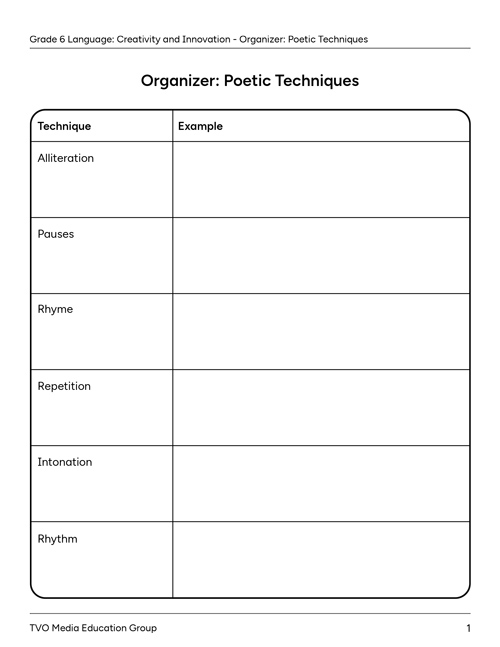
Press Possible Answers to see a filled-in organizer. (Remember, these answers are examples… your answers won’t necessarily match exactly!)
Wali Shah: Poetic techniques
| Technique | Example |
|---|---|
| Alliteration | called... came... |
| Pauses | Shah pauses after “you.” |
| Rhyme | Shah uses rhyming words such as came/flame/contain/explain. |
| Repetition | Shah repeats the word “you” six times. |
| Intonation | Shah stresses words like “world” and “you can change” by changing the pitch of his voice. |
| Rhythm | The first few lines alternate between nine and six syllables. |
Analyzing the content
Now, let’s think about content – in other words, what Shah says or the message he gets across. Spoken-word poets and other creators select and present content that fits the setting and audience.
As you listen to the clip again, identify words from the text that help you answer these questions:
- What is Shah’s topic in this clip? How do you know?
- Who is Shah’s audience for this performance? How do you know?
Now check out the clip one more time:
Pause and Reflect
Reflection questions
Write your thoughts in a notebook or record them using the method of your choice. Share your ideas with a partner, if possible.
- What is Shah’s topic in this clip? How do you know?
- Who is Shah’s audience for this performance? How do you know?
To answer these questions, try using these sentence frames:
- I think… (answer the question directly using words from the question)
- I know this because… (support your answer using a specific text reference)
Let’s learn about Wali Shah!
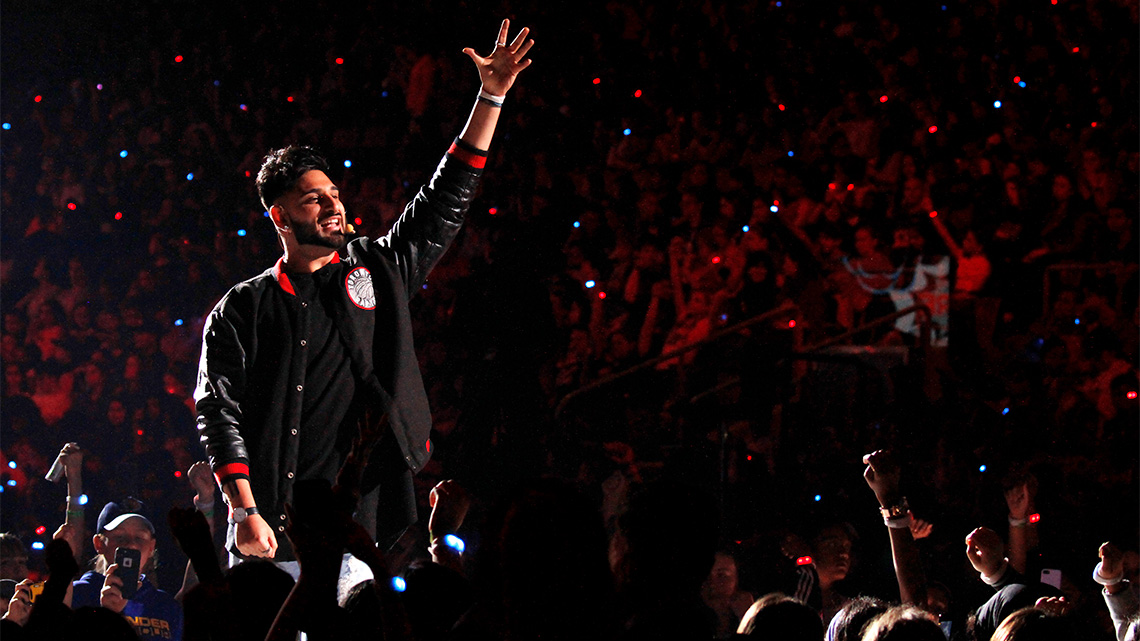
You have explored a clip of Wali Shah’s spoken-word poetry. Now it’s time to learn more about the poet!
But first, let’s look at a term you may not have come across before.
New vocabulary!
Among other things, Wali Shah is a philanthropist. What does this mean? Explore the following flashcard:
Wali Shah’s story
Wali Shah is a poet, speaker, writer, musician, and philanthropist. He was poet laureate for the city of Mississauga from 2017 to 2019. He inspires youth to find their voice and to take action to improve the world. Shah’s work features topics like bullying, racism, mental health, and social change.
Shah grew up in Mississauga, Ontario. As a Canadian newcomer from Pakistan, he experienced racism and discrimination. His life changed when a Grade 11 teacher gave him a book of poetry by rapper Tupac Shakur:
[Wali Shah] loved rap music and had played around with the form, but reading Shakur prompted him to write his first spoken-word poem. His teacher invited him to perform it in class. Shah still remembers how nervous he was: the paper shook in his trembling hands. Yet he got a standing ovation from his peers – and earned 100 per cent on the assignment. “That really changed me,” Shah says. “I realized that I had talent and I could do something with that talent.”
– Toronto Star, Feb 7, 2021
As Shah began writing and performing his own work, he discovered that poetry helped him process his thoughts and feelings and make sense of the world around him.
Effective presentation skills
You are going to explore Shah’s spoken-word poem “Dear Class of 2022,” addressed to students who lived through the COVID-19 epidemic. As you check out the following video, think about what makes Shah’s presentation effective.
Pause and Reflect
What speaks to me?
Answer the following questions in a notebook, or record your thoughts using the method of your choice.
Pick a line, or several lines, that are particularly meaningful to you. Explain why. Then analyze how Wali Shah presents this line or these lines. Consider the following:
- How does Shah use pauses to highlight certain words or ideas?
- How does he emphasize certain words or lines with rhythm and intonation?
Press Sample Answer to see student Marcel’s response.
The following lines are particularly meaningful to me:
and don't be fooled as you grow older by material things
a bee has honey in its mouth, but just remember that it stings
The rhyme “things/stings” makes this pair of lines stick in my head. It emphasizes the message that it’s easy to be taken in by material things, but that that path will lead to pain and disappointment. The pause after “mouth” creates a moment of suspense that makes the end of the second line all the more powerful: “but just remember that it stings.”
Let’s check!
Are the following statements true or false?
Select the correct answer, then press Check Answer to see how you did.

Connections
Poetry in your area
Who is the current poet laureate for your country, province, or city?
You have done a lot of thinking about poetry. Now is a great time to take a break before we turn to grammar!

Student Wellness
Take a break!

Time for a body break! If possible, stretch your body and move around your space.
Grammar time!

Gerunds
Wali Shah says that writing and performing are activities that help him work through his emotions and express himself. These two words are examples of gerunds.
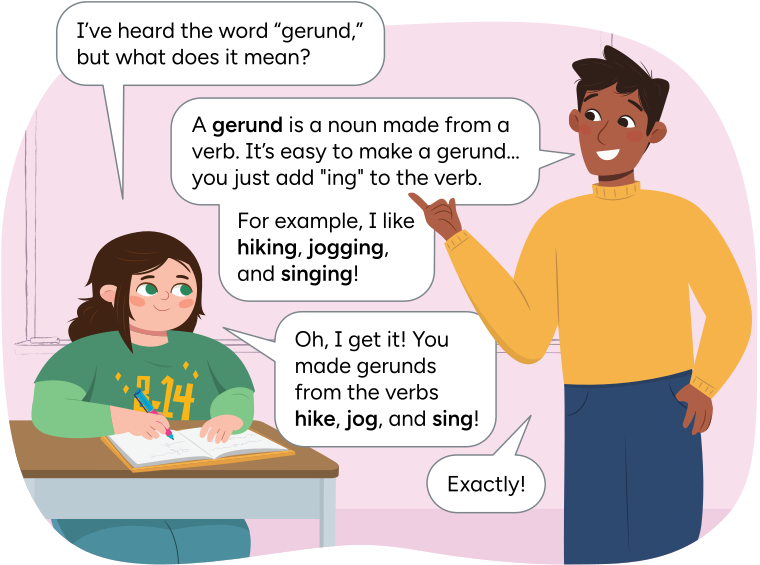
A discussion between a student and a teacher.
Student: I’ve heard the word “gerund,” but what does it mean?
Teacher: A gerund is a noun made from a verb. It’s easy to make a gerund… you just add "ing" to the verb. For example, I like hiking, jogging, and singing!
Student: Oh, I get it! You made gerunds from the verbs hike, jog, and sing!
Teacher: Exactly!
To create a gerund, add “ing” to the base form of the verb, as shown in this table:
| Verb | Gerund | Sample sentence |
|---|---|---|
| write | writing | He likes writing. |
| walk | walking | Walking helps me relax. |
| sing | singing | She’s nervous about singing. |
To reinforce what you have learned about gerunds, watch this short video:
Practice with gerunds!
For each sentence, select the missing gerund from the drop-down menu. Press Check Answer to see how you did.
Your turn!
Now it’s your turn to create some gerunds as you reflect on activities that you like and dislike.
Complete the following sentences with gerunds. You can write these sentences in a notebook, record them using another method, or share them aloud with a partner.
- I enjoy (Blank)ing because it makes me feel...
- (Blank)ing is a good way for me to relieve stress.
- (Blank)ing with friends or family helps me...
- I practise (Blank)ing regularly.
- I dislike (Blank)ing because it makes me feel...
Thinking about presentation strategies
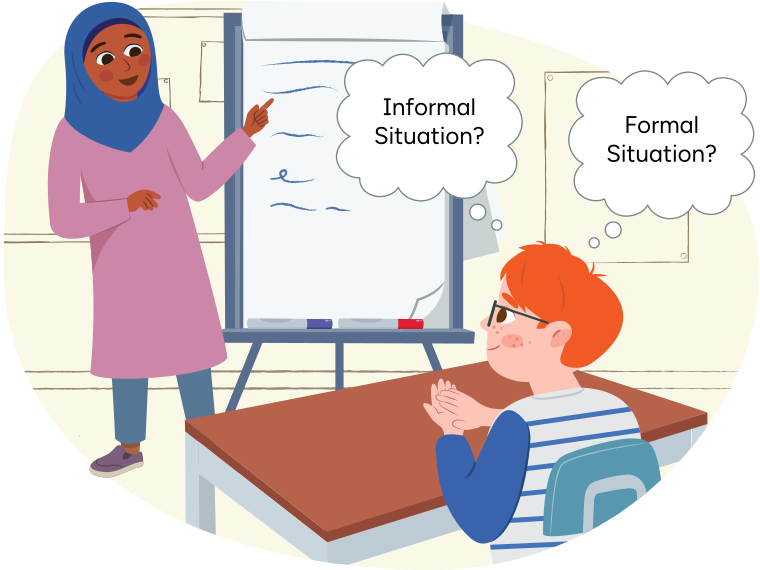
Public speakers like Wali Shah carefully adjust their content and delivery to match their audience. In fact, we all use different communication strategies depending on the situation we find ourselves in.
When communicating orally, we need to consider the situation. Here are some elements to think about:
- Setting: Is it formal or informal?
- Size of group: Am I speaking with one person, a small group, or a large group?
- Audience: What topics and words are appropriate for the people in my audience?
Press the following tabs to learn more about formal and informal situations.
These are situations that are planned and organized. They have been created for a specific reason and have a purpose. Some examples of formal situations are speeches, debates, speaking competitions, or interviews.
These are situations that are unplanned and casual. They typically occur with people who know each other. Some examples of informal situations are recess activities or moments with friends and family.
Sort it out!
Are the following situations formal or informal? Place each card in the right category. Use the arrow buttons to navigate between cards.
Meet Mahlikha Awe:ri!
Mahlikha Awe:ri is Haudenosaunee Kanien’kéhà:ka (Mohawk) and Mi’kmaw L’sitkuk of the Wolf Clan, from Kahnawá:ke and the unceded traditional homelands of the Mi’kma’ki of Kespukwitk with African American, Afro-Caribbean, and Irish ancestry. She is a spoken word artist, activist and educator.
Explore the following video entitled “The Space: Mahlikah Awe:ri” to check out a performance of one of her poems.
Analyzing the poem
What spoken-word strategies or techniques did Mahlikah use? What was the setting, group, and audience of this performance?
Complete the Organizer: Spoken-word Poetry Analysis in your notebook or using the following fillable and printable document. If you would like, you can use speech-to-text or audio recording tools to record your thoughts.
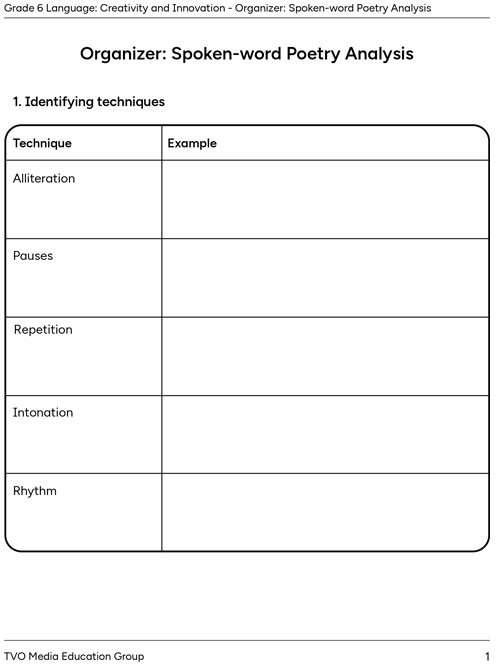
Press the Activity button to access the Organizer: Spoken-word Poetry Analysis.
Activity(Opens in a new tab)Press Possible Answers to observe student Marcel’s filled-in organizer.
- Identifying techniques
|
Technique |
Example |
|---|---|
| Alliteration | “arcing, arching strength” |
| Pauses | Mahlikah pauses her drumming before the phrases “word story” and “the Earth on which we stand” to give them more power. |
| Repetition | “I make echoes, echo, echo” |
| Intonation | “word story” and “the Earth on which we stand” are both emphasized by a change in the tone of her voice. She also slows down her speaking to emphasize the words “I am my people’s stories. I am a tracker. I am my people’s stories.” |
| Rhythm | She uses the drum to help keep a steady rhythm to her words. She also starts the poem with a much faster pace and then slows it down towards the end when she is making connections to her heritage. |
- Identifying setting, group size, and audience
|
Setting: formal or informal? |
The setting is formal because it’s in a studio set for a performance. |
| Group size | The group size in the studio itself is probably small but the message is meant to reach a large audience because it’s a digital media show for the public. |
| Who is the audience? How can you tell? | The audience is kids. I can tell because at the beginning of the video the host says “Welcome to The Space TVO kids” and then a 10-year-old kid calls into the show with a question for Mahlikah. |
- Reflecting on speaking strategies
| How might the speaking strategies change if the audience size were different (i.e. bigger or smaller)? | With a larger, in-person group, Mahlikah might speak louder, and with a stronger tone. She might feed off of the audience’s energy and place stronger emphasis on different parts of her performance depending on the audience’s reactions. |
Thinking about meaning
Let’s explore a written version of Mahlikah Awe:ri’s spoken word poem to analyze some features of this form of communication.
(Singing in Mohawk)
I’m a tracker, which means I make tracks. I make beats, I make echoes, echo, echo. I make etchings and pictographs. I make skylines and tree lines and river beds. I make journeys and dreams, dreams and journeys. I make prophesy, I make prophesy. I make my people’s histories and her stories.
(Singing in Mohawk)
Word story.
(Singing in Mohawk)
The earth in which we stand. I am my people’s stories. I am a tracker. I am my people’s stories. I am. I am the stone. Gentle, jagged and smooth and still. I am the birch swaying longingly, branches open signalling for change. I am the mountain arcing, arching strength, resilience, an indomitable force. I am my people’s stories. I am a tracker. I am my people’s stories. I am.
(Singing in Mohawk)
-Mahlikah Awe:ri
Source: https://www.tvokids.com/school-age/space/videos/mahlikah-aweri

Pause and Reflect
Pause and reflect
Consider the following questions:
- What you do you think is message of Mahlikah Awe:ri’s poem?
- How does the written version of this spoken-word poem compare to the live performance of it?
- How does the written version of this spoken-word poem compare to a traditional written poem in its form and structure?
Record your thinking in a notebook or using another method of your choice. If possible, share your thoughts with a partner.

Putting it all together
You can be a spoken-word poet too!
It’s time to plan your own spoken-word presentation. How do you like to express yourself? What thoughts and feelings do you need or wish to express? What issues are important to you?
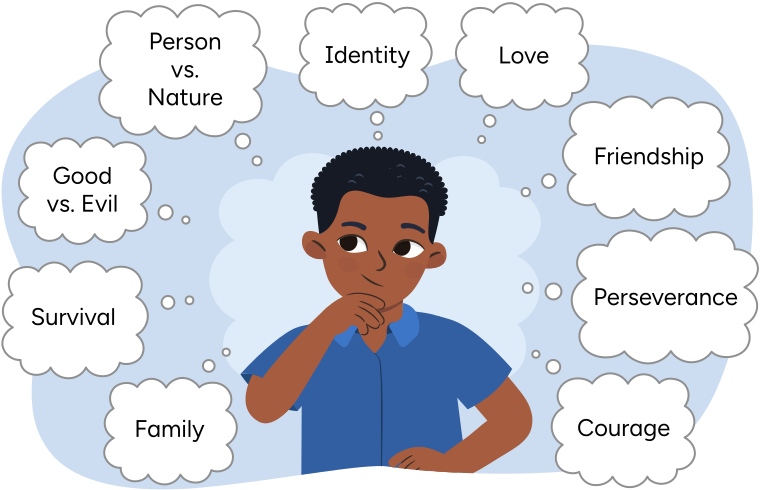
Start by brainstorming possible topics and ideas for your spoken-word poem.
Complete the fillable and printable Mind Map: Ideas for Poem in your notebook or using the following document. If you would like, you can use speech-to-text or audio recording tools to record your thoughts.
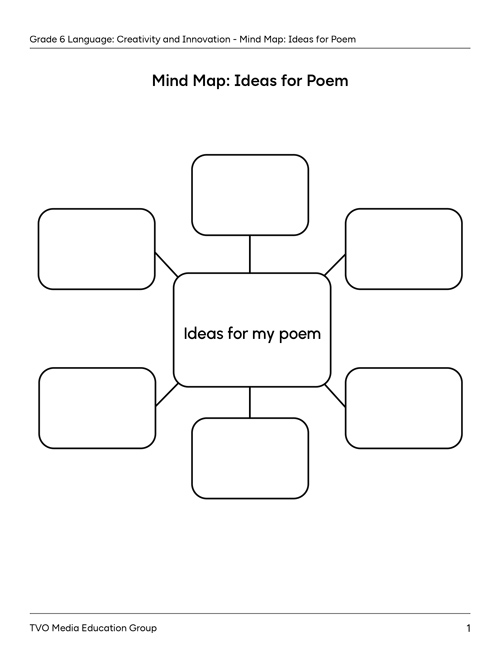
Plan your poem
Follow these steps to organize your ideas and plan your poem. Press the following tabs. For every step, jot down your ideas on paper, or record them using the method of your choice.
Refer to the mind map you used for brainstorming. Pick a theme or idea that you are passionate about! This will allow you to inject a lot of emotion into your performance. Your audience will be able to tell that you care and will respond accordingly.
The first line of your poem must do two things: draw the audience in and tell them what your poem is about. The rest of the poem expands and builds on that idea. This is free-verse poetry, so let your thoughts and ideas just flow on the page. Your poem should read a bit like a conversation or a story. You don’t have to follow a particular rhyme scheme, but you can include rhymes if you want to. It can be a powerful strategy to rhyme only in certain spots rather than throughout the whole poem.
Use strong, vivid words that will engage the senses of the audience and draw them into your story. You may choose to use some or all of the poetic techniques we learned about earlier.
Press Poetic Techniques to review these techniques.
| Technique | Definition |
| Alliteration | Several words that start with the same letter or sound. Example: The calico cat curled up on the comfy couch. |
| Rhyme | Two or more words with endings that sound the same. Example: See you later, alligator! |
| Pauses | Short moments of silence that add emphasis. Example: But my greatest fear is [short silence] rejection. |
| Repetition | Reuse of certain words or phrases. Example: Repeated use of “I have a dream” in Martin Luther King Jr.’s speech. |
| Intonation | The rise and fall of the voice when speaking Example: “You love poetry?” versus “You love poetry.” |
| Rhythm | The beat, flow, and pattern of syllables and words. |
Spoken-word poetry is meant to be shared aloud – so listen to it! Read it aloud and record yourself, if possible. Consider the impact it has. Change the order of words and sentences and play around with different words. How could you add pauses or vary your intonation to highlight different ideas? Consider repeating important words for emphasis.
The last line, what your audience experiences last, should be impactful. You want them to remember not just your performance, but also your message or your story. What is the last thing you want to say to them? Don’t just end your poem – end it with purpose and intention. Create a feeling with your ending. Will you leave your audience happy and smiling? Wondering? Angry? Excited? Motivated?
Once you have finished your poem, use the following checklist to reflect on your work.
Checklist: My spoken-word poem
My poem…

Reflection
As you read through these descriptions, which sentence best describes how you are feeling about your understanding of this learning activity? Press the button that is beside this sentence.

I feel...
Now, record your ideas using a voice recorder, speech-to-text, or writing tool.