Learning goals

We are learning to…

Success criteria

I am able to…

Understanding identity

Identity is about who we are as individuals and as part of different groups in society. It's also about how others see and name us. Our ideas about identity come from many sources, some of these include:

  • interactions with family, friends, school, media, and other people we meet
  • socioeconomic status
  • religion
  • culture
  • traditions
  • values

Sometimes, we don't even notice we're learning these ideas because they become part of who we are without us realizing it.

Brainstorm

Brainstorm

In a method of your choice, respond to the following questions.

  1. What do you think contributes to your identity?
  2. Do you think your identity can change over time?
  3. What might cause someone’s identity to change?

Exploring identity in texts

In this learning activity, you will be exploring the topic of identity through the text The Secret Pocket by Peggy Janicki. As you work through the text, use various comprehension strategies to help with your understanding. Let’s begin by reviewing some reading comprehension strategies. 

reading

Reading comprehension strategies 

There are several reading comprehension strategies that you can use before, during, and after reading to help you understand a text. They encourage you to think more critically, take away key information, and construct meaning.  

Press the following tabs to learn more about reading comprehension strategies. 

When: Before reading 

How: Examine the text (for example, the cover, the title, subheadings, images, etc.)  

Why:  

  • to active prior knowledge 
  • make predictions 
  • set a purpose for reading  

When: Before, during, and after 

How:  

  • ask questions about what you expect to learn 
  • ask questions about specific details you encounter 
  • why and how questions 

Why:  

  • encourages critical thinking 
  • active engagement 

When: Before (make your predictions), during and after (monitor your predictions) 

How:  

  • make educated guesses based on clues 
  • create predictions about what the text will be about and what will happen next 
  • follow up and change your prediction when needed 

Why:  

  • activates prior knowledge 
  • builds anticipation and curiosity  
  • ensures comprehension 

When: After reading  

How: Re-state the main idea and key details into a concise summary 

Why:  

  • reinforces comprehension  
  • ensures understanding of key details 

When: During  

How: Create a mental image or picture in your mind  

Why: Improves understanding and connection with the text  

When: During 

How:  

  • go back and read the same sentence, paragraph, or chapter over 
  • re-read if something doesn’t make sense  

Why:  

  • confirms understanding 
  • allows opportunity to understand new details you missed the first time 

When: Before, during, after 

How:  

  • talk about important ideas or themes that you notice 
  • ask questions that others can help answer 

Why:  

  • deepens understanding 
  • clarifies questions 
  • see multiple perspectives 

Before reading 

Before we read The Secret Pocket by Peggy Janicki, let’s learn a little bit more about the book, its author, and some historical context. 

About the author 

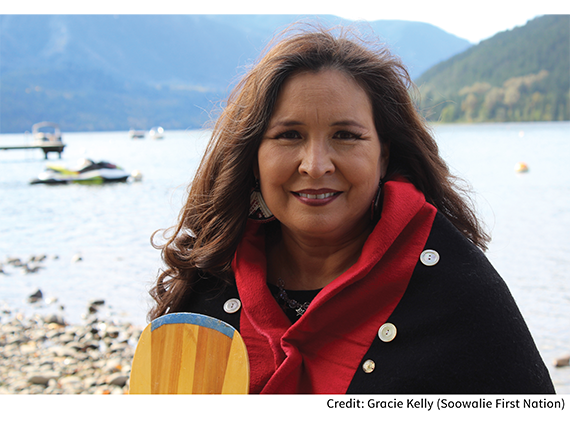
A portrait of author Peggy Janicki.

Author Peggy Janicki

Peggy Janicki is a Dakelh teacher from the Nak’azdli Whut’en First Nation, born and raised in the unceded territory of the Stó:lō Coast Salish peoples.

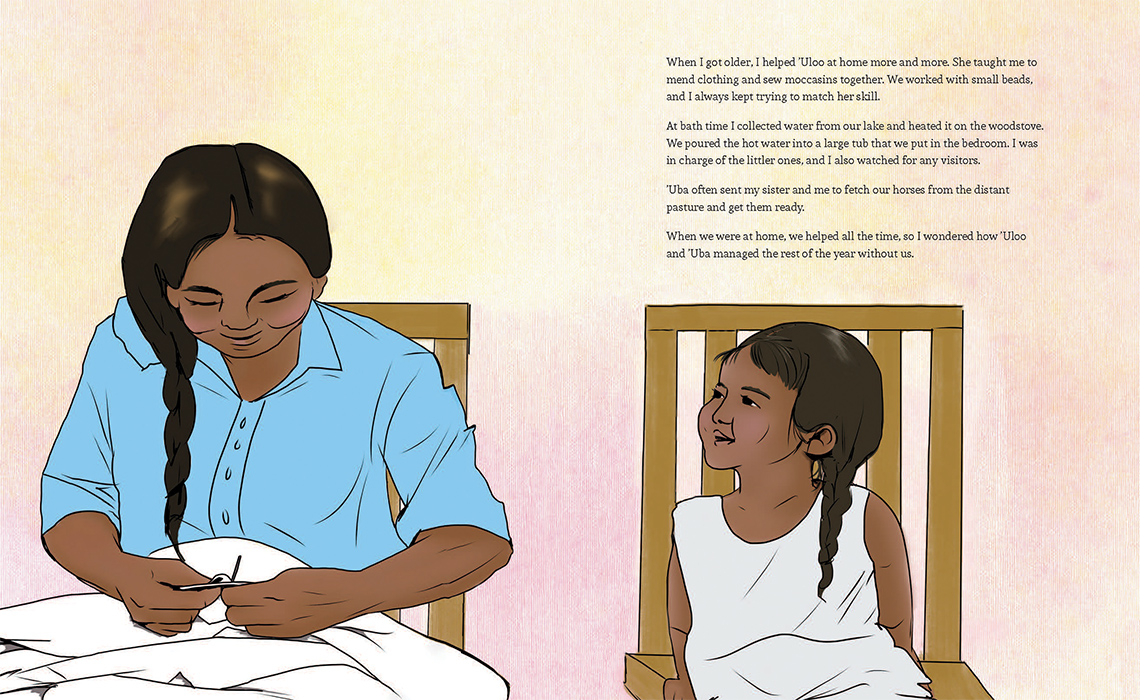
When Peggy was a child, her mother Mary and her auntie Carrie taught her traditional Dakelh (Carrier) sewing and beadwork – beading moccasins and sewing intricate floral patterns onto hides. 

Peggy’s mother Mary became a master Salish weaver and a member of the Salish Weavers Guild in Chilliwack, B.C. In the 1960s and 1970s, the guild helped bring back traditional weaving skills lost during the residential school era. Bringing weaving back to life rebuilds and celebrates part of their identity that was damaged by colonialism.    

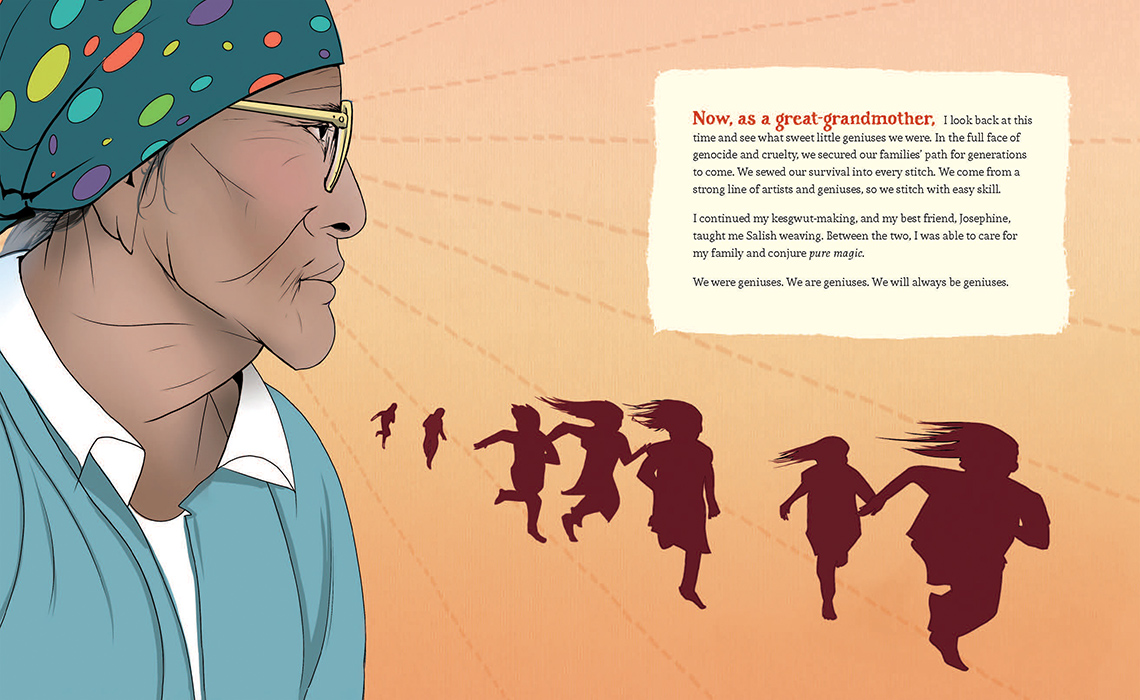
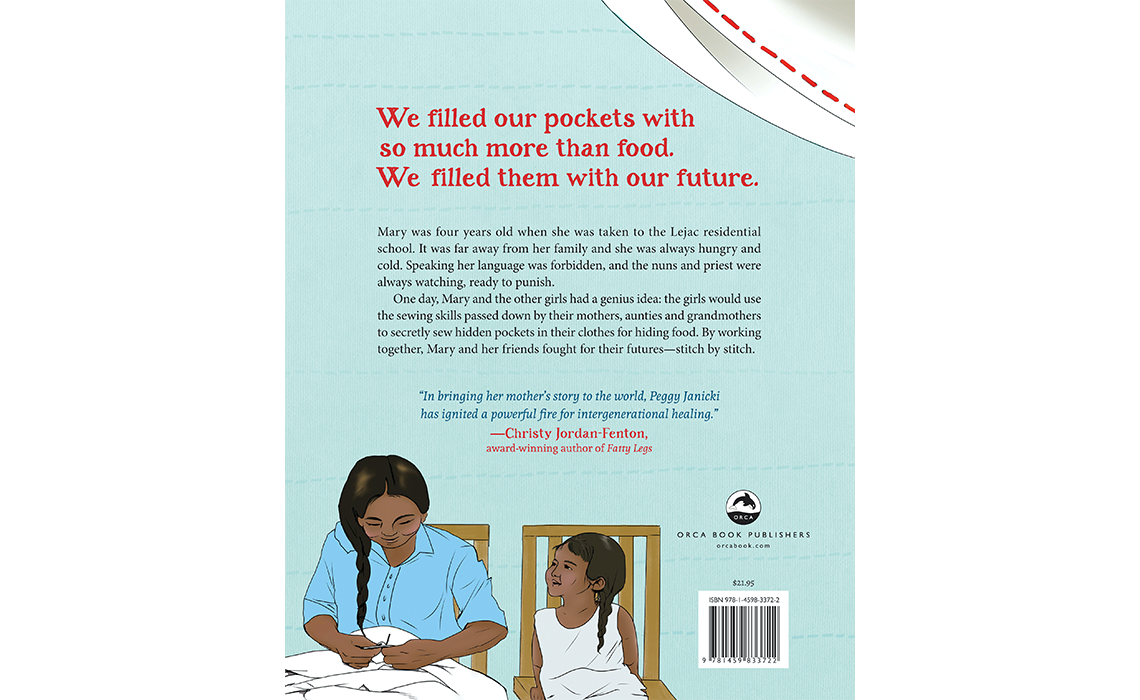
In her later years, Mary gifted Peggy with a story from her time at a residential school. Mary’s story became the book The Secret Pocket.  

What is a residential school? 

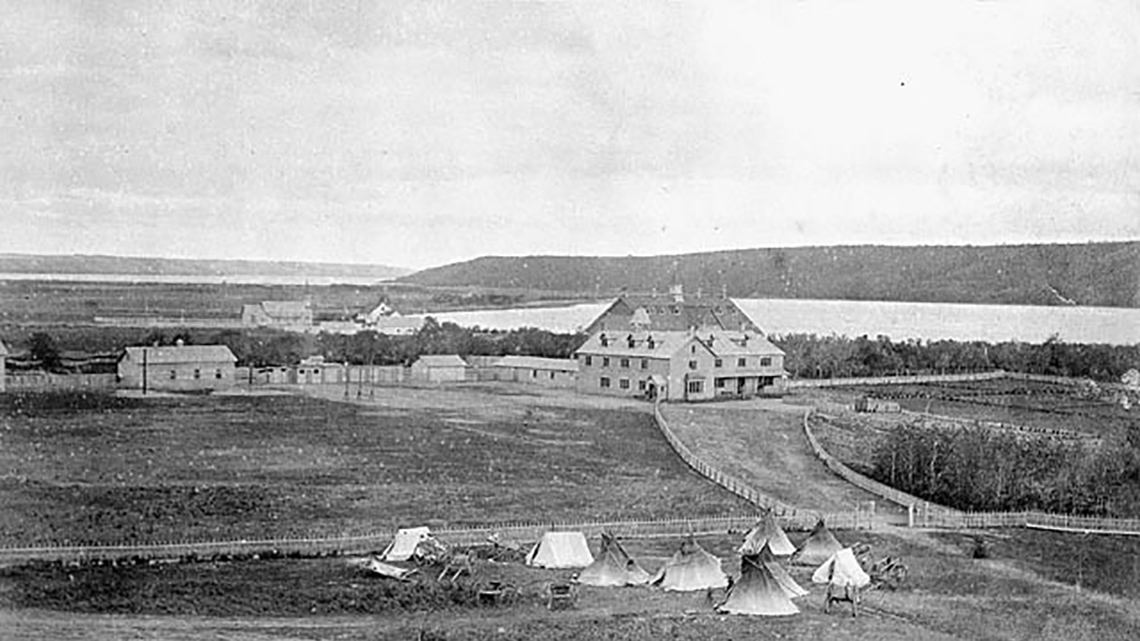
A historical photograph of the Qu’Appelle Indian Industrial Residential School.

The Qu’Appelle Indian Industrial School in Saskatchewan was a residential school that operated from 1884 to 1969. Families of students were forced to camp outside of the school’s gates if they hoped to visit their children. (c. 1885)


Under the Indian Act, the federal government mandated the education of First Nations children and partnered with the Catholic and Christian churches to create the residential school system. The residential school system was created to give First Nations children an education with a focus on assimilating them (erasing their identities, language, and culture). While the Inuit and Métis peoples were not included in the Indian Act, they were still enrolled in residential schools. 

The residential school system operated for more than 100 years in Canada. More than 150,000 First Nations, Métis, and Inuit children were removed from their families and forced to attend residential schools where they were abused, mistreated, and alienated from their families and culture. 

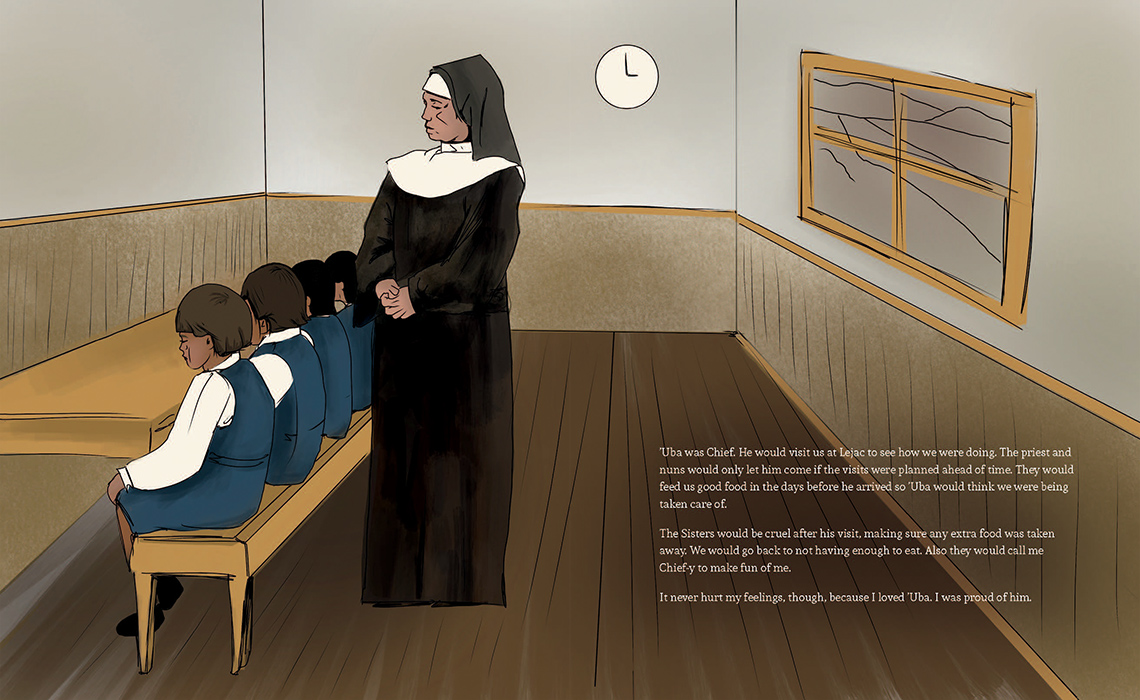
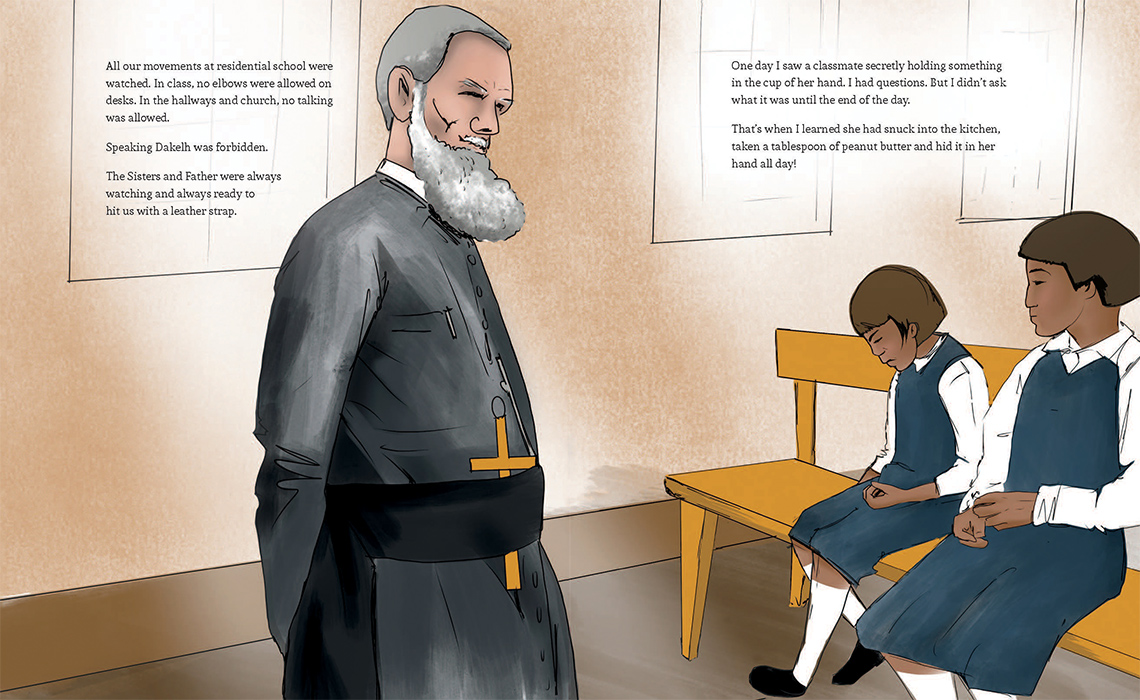
Although the 130 different institutions were called “schools,” their focus was unlearning Indigenous culture rather than learning school subjects. Indigenous children were not allowed to speak their own language, practise their spirituality, or follow the wisdom and teachings of their Elders. They were punished severely if they did these things. It was hoped that they would lose their Indigenous identity and assimilate into Canadian society. 

Residential schools caused generational trauma that continues today. Children taken to the schools were robbed of their childhood, while older generations were robbed of their children. Generations of children and grandchildren have also suffered, as their parents and grandparents are haunted by the experiences. 

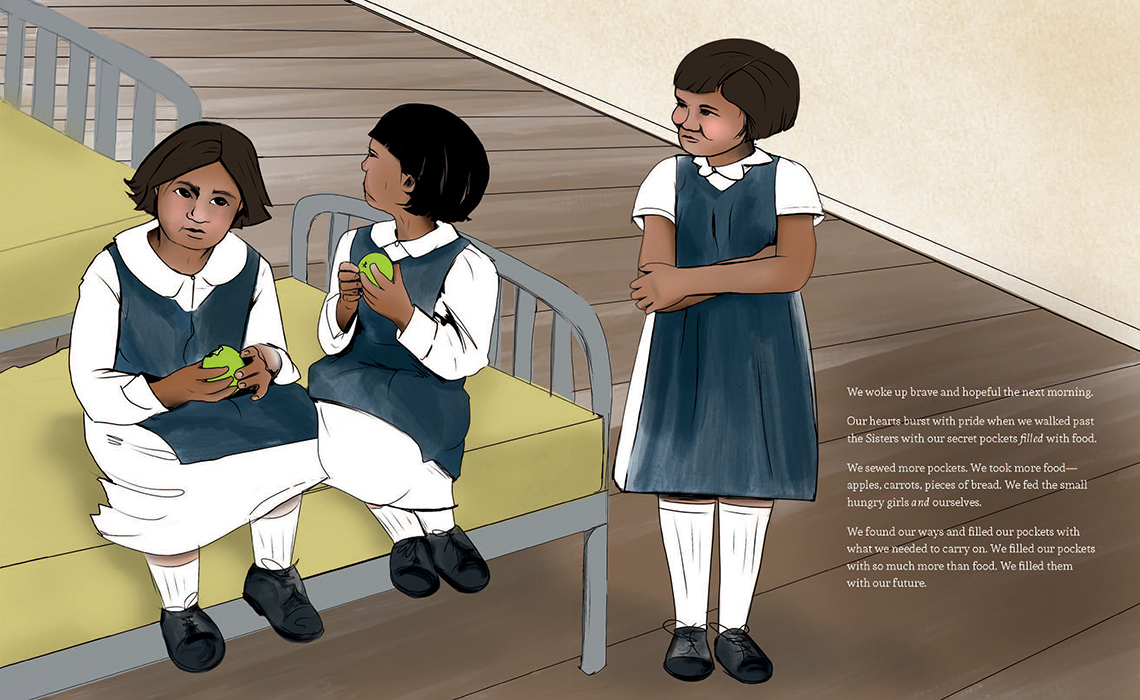
There are no happy-ending stories about residential school systems. But there are stories of resilience and ingenuity in those shared by survivors and their children and families. When faced with the worst circumstances, many children used traditional skills and teachings to cope. 

Pause and Reflect

Reflection question 

In a notebook, or using another method of your choice, reflect on the following question. 

How did residential schools aim to harm Indigenous identities and cultures? 

The Secret Pocket 

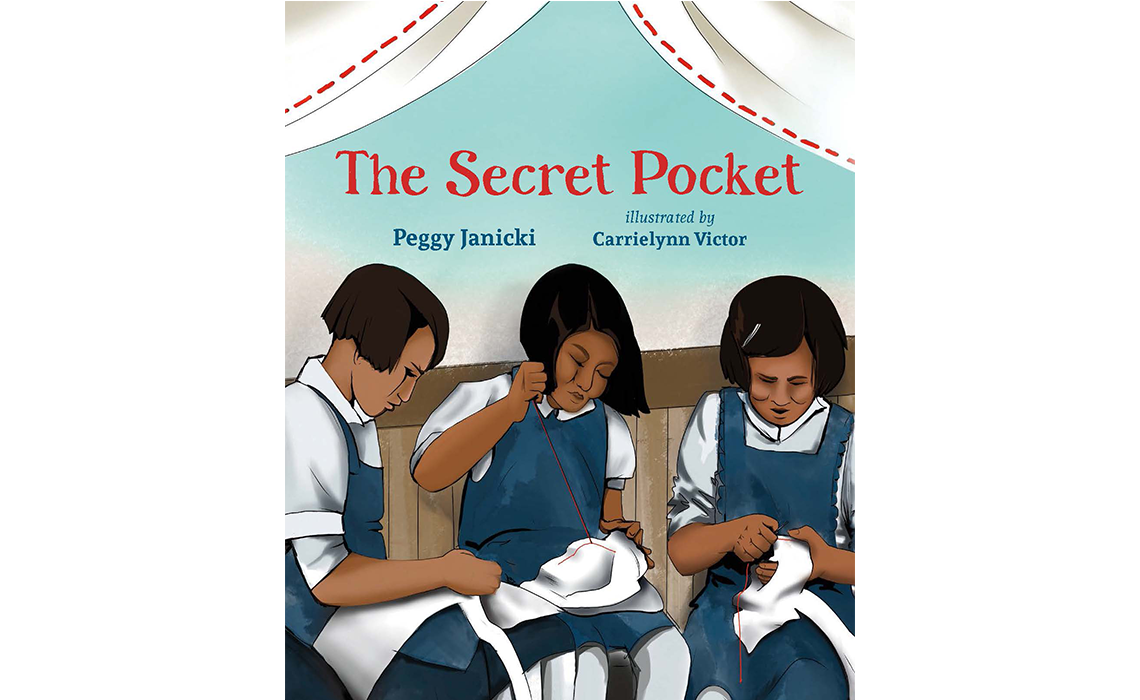
Let’s begin by previewing the text. This means examining the book cover to activate your prior knowledge and set a goal for reading.

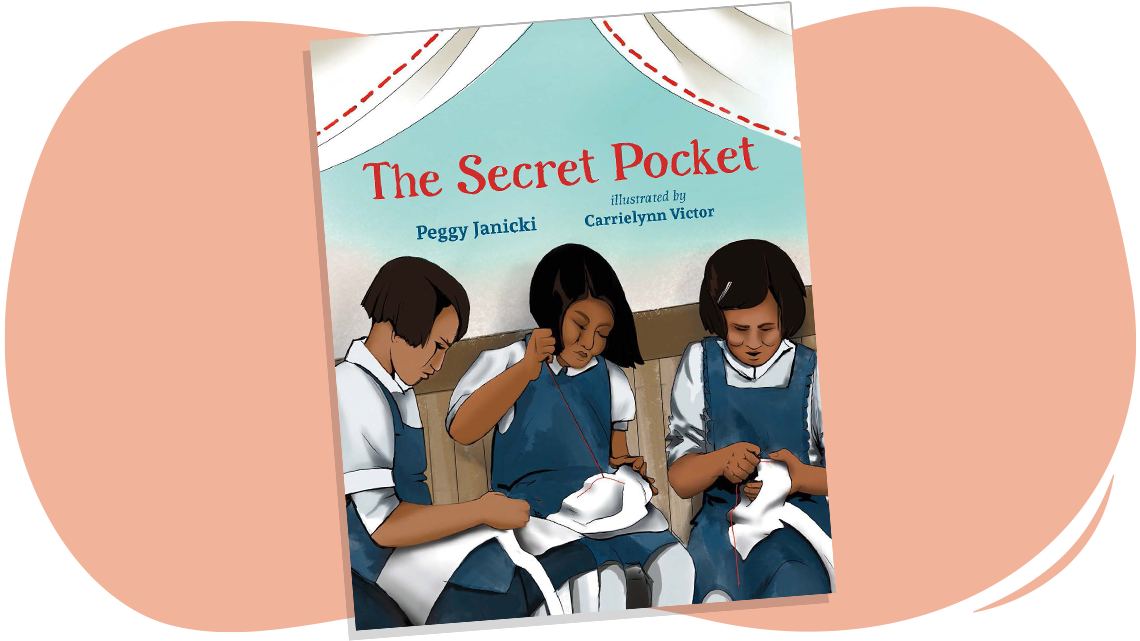
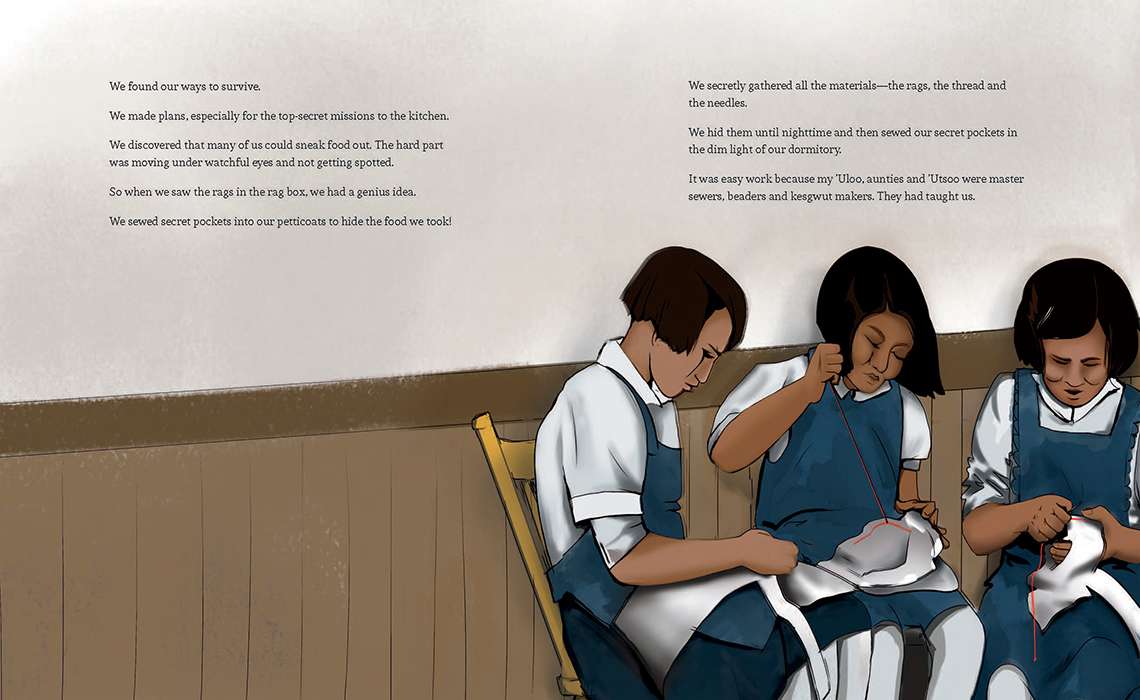
Book cover of ‘The Secret Pocket’, with three young children sewing white cloth. They are wearing plain school uniforms.


This is also the time to ask questions about what you expect to learn and make predictions about what you think you’ll encounter (come across) in the text. 

Student Success

Think

Record your goal, questions, and prediction about the book The Secret Pocket in a notebook or using another method of your choice.  

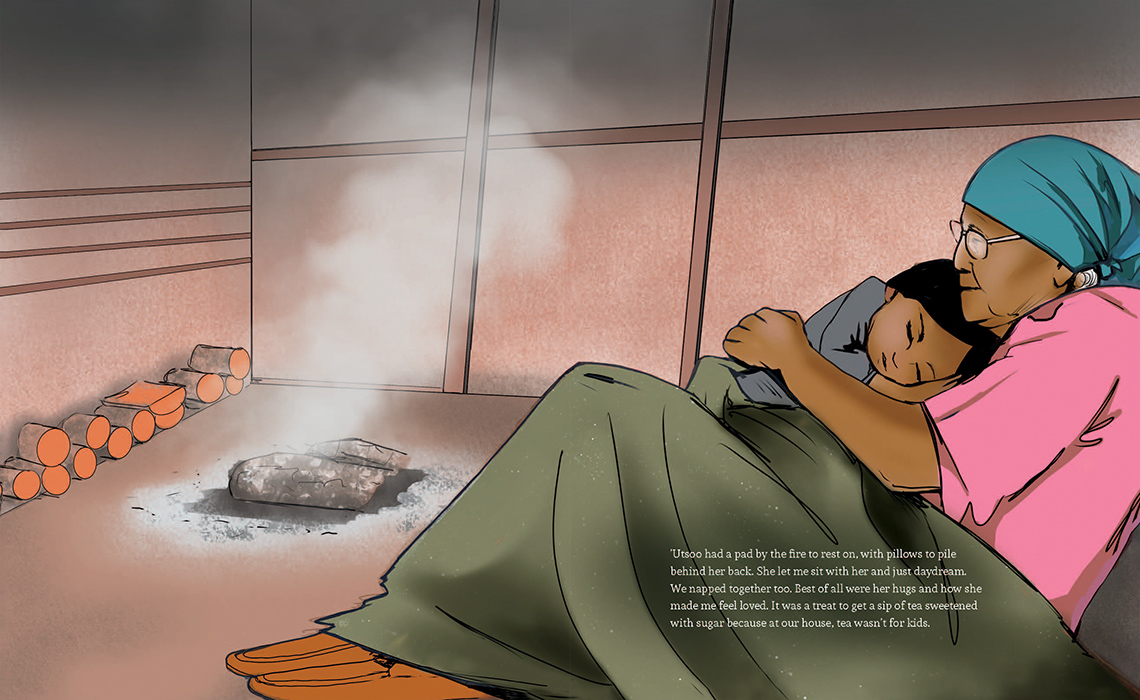
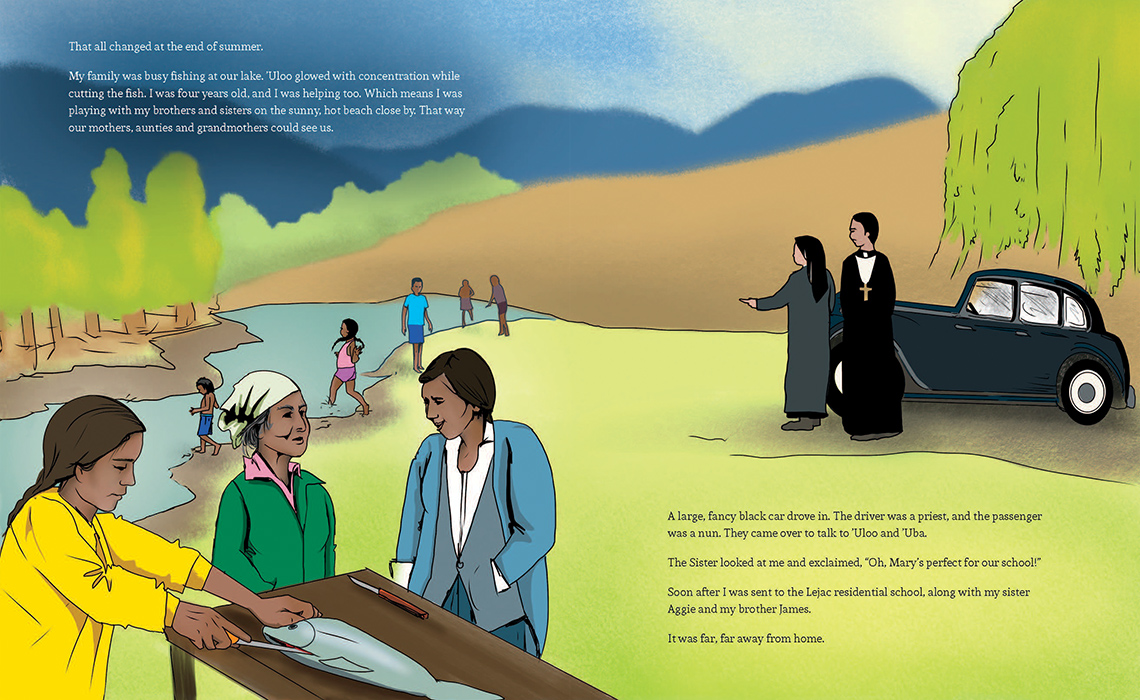
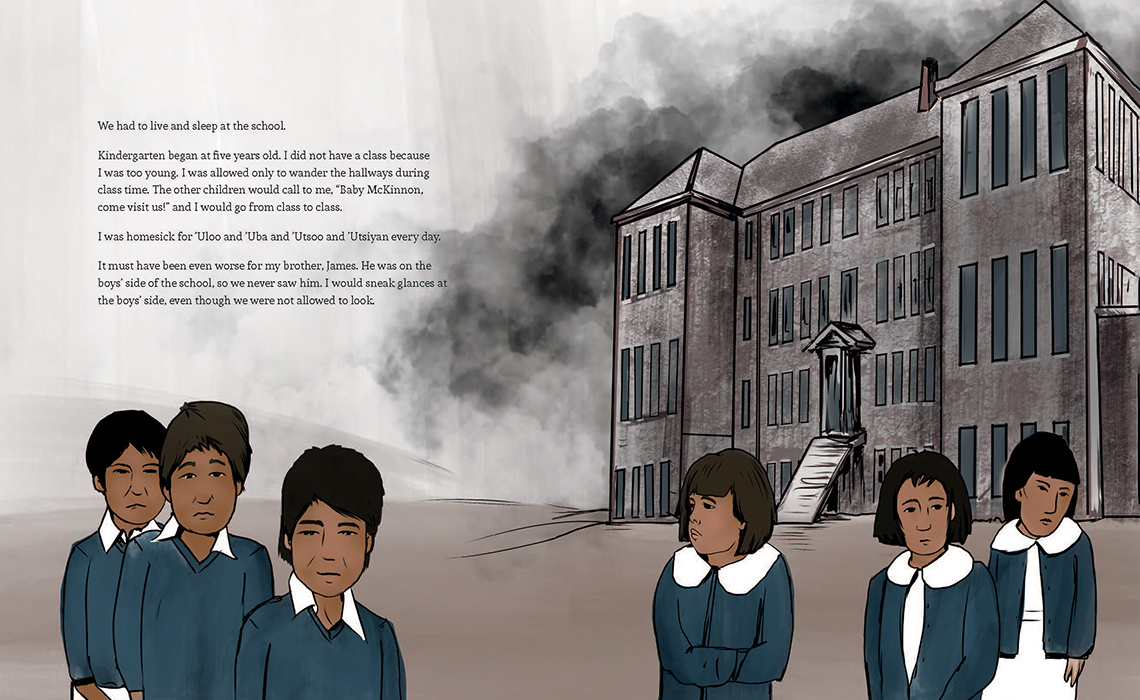
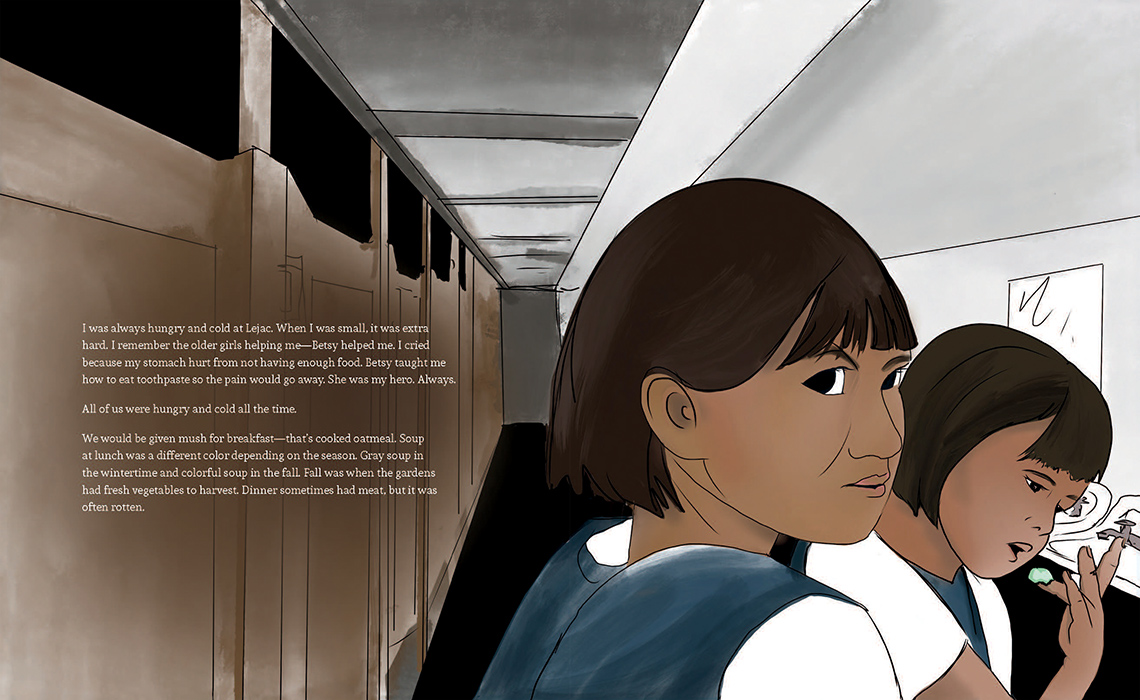
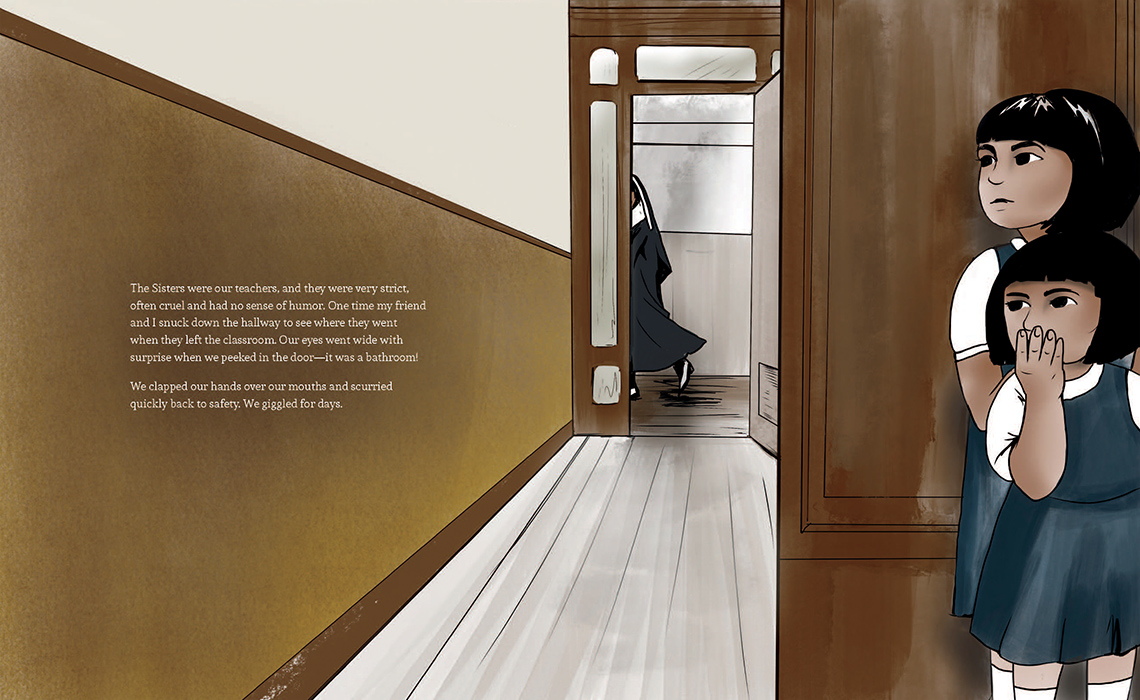
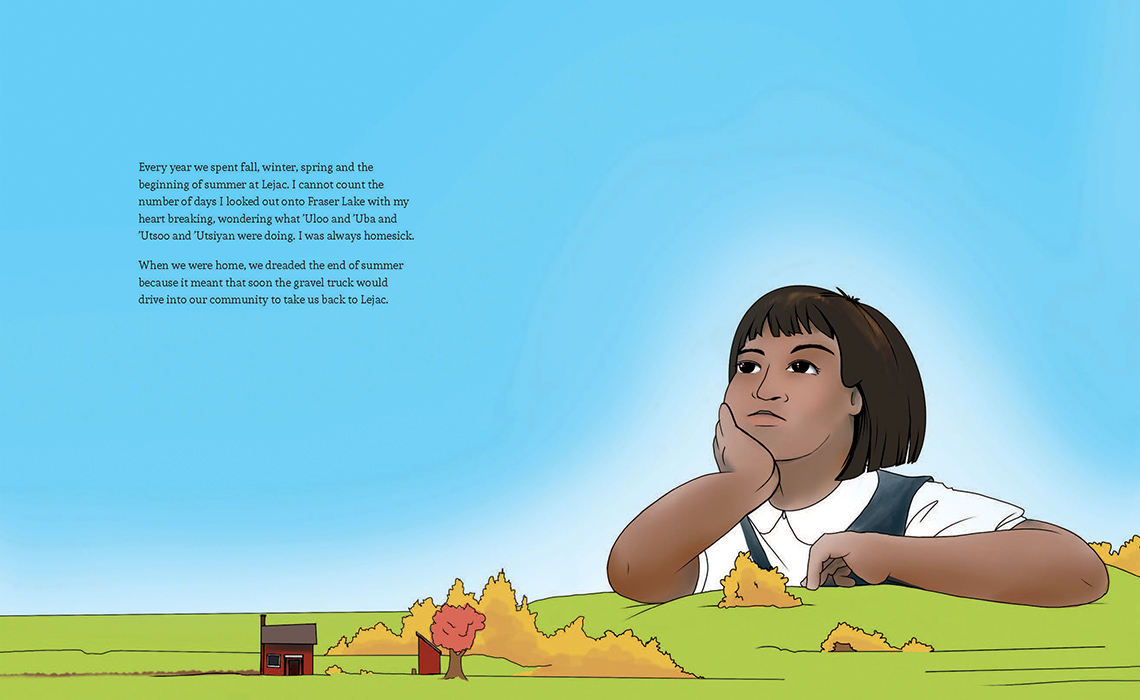
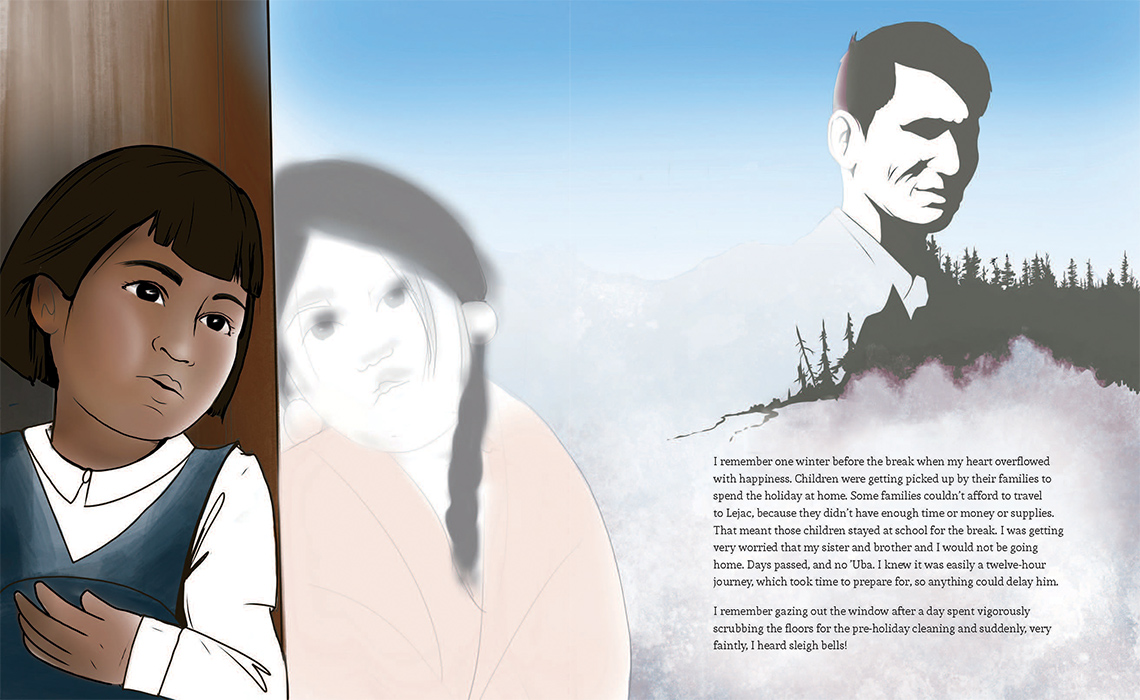
Mary and other Dakelh children from the Fort James area were forced to attend the Lejac Residential School. As you read The Secret Pocket by Peggy Janicki, consider how the girls used their knowledge to help them survive physically, emotionally, and spiritually. 

View Transcript

Post-reading 

Evaluate the reading strategies that you used by answering the following questions using a method of your choice.  

  • Go back to the predictions that you made before reading the book. Were your predictions correct? Explain your answer in detail.  
  • How effective were the reading strategies you used before, during, and after reading to help you understand the main message of the story?  

Summarizing texts 

After reading, a helpful comprehension strategy is to summarize what you have read. Summarizing helps the reader to pull out important details from the text and identify the main message in a story. 

Check out the following interactive image to learn more about the structure of a summary. 

Check out the following interactive to learn more about summaries. 


Your turn! 

In a notebook, or using another method of your choice, draft a summary of the story and the main message behind the book The Secret Pocket by Peggy Janicki. What evidence from the text can you use to support the idea that Mary and the other Lejac girls are trying to hold on to their identities? 

Important note: 

What Indigenous stories can non-Indigenous people or Indigenous people outside of the community tell or share? 

  • oral stories when the storyteller has given permission 
  • published stories 

Review the following guidelines to learn how to share Indigenous stories respectfully: 

  • Make sure you have the author or storyteller’s permission to share. 
  • Give credit/acknowledge the author or storyteller. 
  • Share the Indigenous Nation the storyteller and/or the story comes from. 
  • Share where the story was found (a book, website, and so on). 
  • Don’t change any of the main ideas or details of the story. 
grammar

Focus on grammar: direct and indirect objects 

We are going to review the grammar concept of direct and indirect objects. Before you begin, press the following tabs to review the definitions of a noun, pronoun, and verb.  

A noun is a word that refers to people, places, things, and ideas. 

A verb is a word that expresses an action, occurrence, or state of being.  

A pronoun is a word that replaces a noun. 

Next, press the following tabs to find out more about direct and indirect objects. 

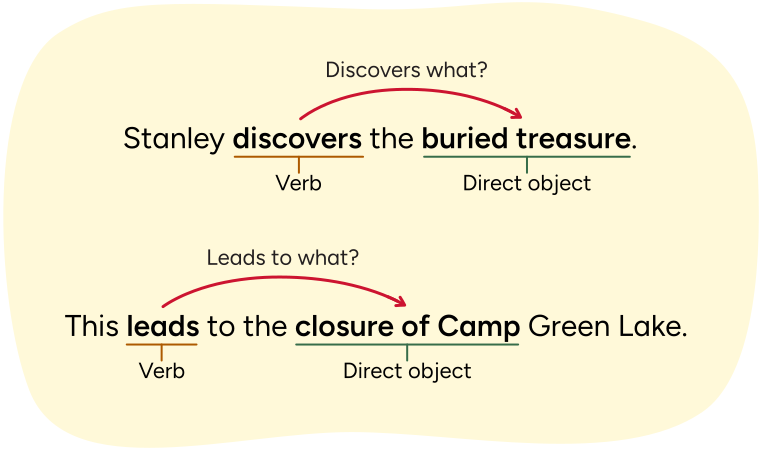
A direct object is a noun or pronoun being acted upon by a verb, it receives the verb’s action. You can identify the direct object by finding the verb in the sentence and asking what? Or whom?  

Let’s explore an example in the following sentence. 

Example sentence: Stanley discovers the buried treasure, which ultimately leads to the closure of Camp Green Lake.

In the example sentence, there are two verbs and two direct objects. Each verb is connected to its direct object with an arrow that asks ‘what?’

The first verb is ‘discovers.’ To find the direct object, the connecting arrow asks, ‘discovers what?’ The arrow is connected to the first direct object ‘buried treasure.’

The second verb is ‘leads.’ To find the direct object, the connecting arrow asks, ‘leads to what?’ The arrow is connected to the second direct object ‘closure of Camp.’

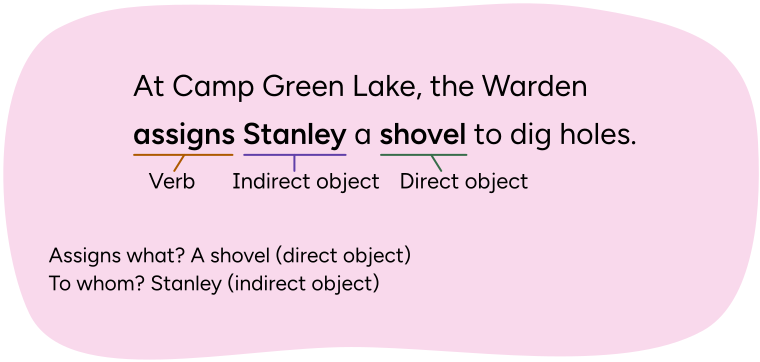
An indirect object is a word or phrase that receives the direct object.   

  • Indirect objects often answer the question of “to whom” or “for whom” in relation to the verb and the direct object.  
  • Indirect objects can only be placed directly after the verb or before the direct object.  

Let’s explore an example in the following sentence. 

 Example sentence: At Camp Green Lake, the Warden assigns Stanley a shovel to dig holes.

Verb: Assigns

Assigns what? A shovel (direct object)

To whom? Stanley (indirect object)


Identify the direct and indirect objects in the following sentences. Select the correct answer, then press Check Answer to see how you did.  


Putting it all together 

Peggy Janicki’s mother, Mary, gifted her with her Lejac Residential School story. With her permission, Peggy published her mother’s story in the book The Secret Pocket and has shared the story and its message in many other ways as well.  

Listen to the following audio clip of an interview between journalist Shelagh Rogers and author Peggy Janicki. As you listen, take note of Peggy’s message about why it is important to share stories such as her mother Mary’s. 

The Next Chapter


Press the TRC Explained button to gain a better understanding of what the Truth and Reconciliation Commission is.

The Truth and Reconciliation Commission of Canada was created by survivors to tell all Canadians about what happened in residential schools. It gathered the stories of Indigenous Peoples who went to these schools, their families, and others affected. This included First Nations, Inuit, and Métis residential school survivors, their families, communities, church workers, government officials, and other Canadians. 

Pause and Reflect

Pause and reflect

How does hearing the author’s words impact your understanding and experience with the book? Did you learn anything new that would change what you wrote in your summary? 

Indigenous stories are important because they share truths of what happened. Truth comes before reconciliation. 

To consolidate your learning, you will be publishing your summary of The Secret Pocket so that you can share its message and the importance of knowing Indigenous stories and truths.  

Before publishing, it is important to edit and revise our work. Explore the following content to learn more about how to edit and revise your summary.  

Editing

Editing is one of the final steps before publishing and allows the writer to correct mistakes before sharing it with others. So, how do you edit? Press the following tabs to learn more about the steps of editing.

Each sentence should end with proper punctuation.

  • period (.) = full stop
  • comma (,) semi-colon (;) or hyphen (-) = pause
  • exclamation mark (!) = reading with emphasis
  • question mark (?) = asking a question

The first letter of each sentence and specific words need capitals.

  • start of every sentence (ex. We went to the park.)
  • the pronoun “I” (ex. I wish I could go to the park.)
  • proper nouns (ex. Toronto, Mrs. Ryan, September, Hamlet)

Does it make sense?

  • read the text to yourself or someone else, ideally out loud, and decide if it makes sense
  • add, change, or remove parts that don’t make sense

Circle spelling errors to correct in your final piece.

  • use a dictionary or online resource to help you confirm spelling
  • ask someone else to read through your work looking for errors

Revising

Once you have completed the editing process, you can improve your writing by revising. Press the following tabs to learn more about what to look out for when revising your writing.

Is anything missing from the text?

  • add small details, like a word, using the following caret symbol to show where a word or punctuation needs to be inserted: ^
  • add larger sentences or phrases by drawing arrows or using sticky notes
  • highlight anything that needs more details added to make sense

Remove unnecessary or repetitive parts.

Remove:

  • any details that are irrelevant or unnecessary
  • any details that are repetitive
  • anything that is not necessary for the reader to know

Rearrange sentences or paragraphs for clarity.

  • consider what order will make the text flow properly
  • if you need to change the order, use symbols or number each sentence or paragraph and re-write in new order

Are you using the best words?

  • use a thesaurus to help improve word choice
  • make sure words are not repetitive (i.e., saying “said” over and over)
  • choose words that will have the best impact on the reader


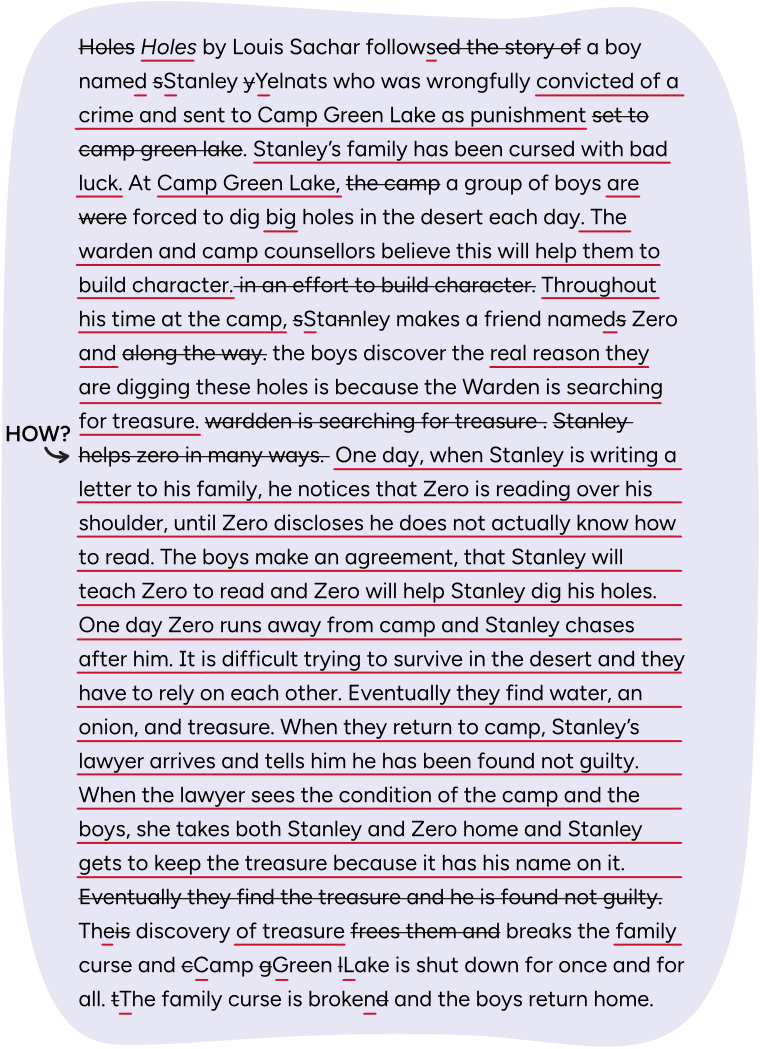
To explore a model of an edited and revised summary of another text, press the Sample Summary button. 

The revised text reads: Holes by Louis Sachar follows a boy named Stanley Yelnats who was wrongfully convicted of a crime and sent to Camp Green Lake as punishment. Stanley's family has been cursed with bad luck. At Camp Green Lake, a group of boys are forced to dig big holes in the desert each day. The warden and camp counsellors believe this will help them to build character. Throughout his time at the camp, Stanley makes a friend named Zero and the boys discover the real reason they are digging these holes is because the Warden is searching for treasure. One day, when Stanley is writing a letter to his family, he notices that Zero is reading over his shoulder, until Zero discloses he does not actually know how to read. The boys make an agreement, that Stanley will teach Zero to read and Zero will help Stanley dig his holes.  One day Zero runs away from camp and Stanley chases after him. It is difficult trying to survive in the desert and they have to rely on each other. Eventually they find water, an onion, and treasure. When they return to camp, Stanley's lawyer arrives and tells him he has been found not guilty. When the lawyer sees the condition of the camp and the boys, she takes both Stanley and Zero home and Stanley gets to keep the treasure because it has his name on it. The discovery of treasure breaks the family curse and Camp Green Lake is shut down for once and for all. the family curse is broken and the boys return home.

Publishing your summary 

Now it is time to publish your summary of The Secret Pocket. Consider the following questions as you plan your summary:

  • What format will you use to present your final summary?
  • Who will you share it with?
  • Consider your audience when choosing your format.

Most importantly, remember the goal of publishing your summary is to share the story and continue the conversation to engage in truth and reconciliation. 

Reflecting on strategies 

Reflect on the reading strategies that you used in this learning activity and respond to the following prompts in your notebook or in another method of your choice. 

  1. Explain and compare how various strategies (previewing, making predictions, visualizing, asking questions, and summarizing) helped you better understand the text. Be sure to use specific examples. 
  2. Moving forward, what goals do you have to improve your comprehension of a text? What strategy will you focus on using next time? 
  3. How could these strategies help you analyze other texts or understand information learned in other subject areas? Could they help you in other areas of your life? 

Reflection

As you read the following descriptions, select the one that best describes your current understanding of the learning in this activity. Press the corresponding button once you have made your choice.

I feel...

Now, expand on your ideas by recording your thoughts using a voice recorder, speech-to-text, or writing tool.

When you review your notes on this learning activity later, reflect on whether you would select a different description based on your further review of the material in this learning activity.