Learning goals
We are learning to…
- communicate and collaborate with various communities in a safe, respectful, responsible, and inclusive manner when using online platforms and environments, including digital and media tools, and demonstrate and model cultural awareness with members of the community
- explain how the ideas expressed in texts connect to our knowledge and lived experiences, the ideas in other texts, and the world around us
- produce final texts, selecting a variety of suitable techniques and tools, including digital design and production tools, to achieve the intended effect
Success criteria
I am able to…
- explore a text about safe spaces online, and respond to comprehension questions accurately and make connections (text, self, world) with the text
- analyze online scenarios and brainstorm solutions that contribute to a safe, inclusive, and culturally aware online environment
- explain cultural awareness and how it contributes to a safe and inclusive online environment
- create a text that includes digital elements to promote cultural awareness and inclusivity
- reflect on my own experiences online and explain how I can model cultural awareness and contribute to a positive online space
Brainstorming about safe spaces
Consider the spaces and places in your life. Consider the phrase “safe space.” What do you think it means to have a safe space? What do you think a safe space should include?
Brainstorm your ideas orally, digitally, in your notebook, or in another method of your choice.
Press the Possible Answer button to learn more.
You might have brainstormed ideas like a space where you feel welcome, accepted, and trusted. Or perhaps you thought about a space where you feel everyone is welcomed and respectful. Both are great examples of a safe space!
A safe space is an environment where individuals feel comfortable, respected, and free from discrimination or judgement. It is a place where people can express themselves, share their experiences, and celebrate their differences without concern or fear. Safe spaces can exist in schools, workplaces, communities, support groups, and even online.
Reflect on your own experiences online in the following questions.
- Do you feel there are safe spaces online? Why or why not?
- What made it a safe or unsafe space?
Record your ideas in a method of your choice.
Introducing vocabulary
In this learning activity, you will be exposed to new vocabulary words! Before you begin, listen to the following vocabulary words and the sentences that they are used in.
Based on this, attempt to spell the word, and record your best guess at a definition. To help you decide on the possible definition, consider the sample sentence and your background knowledge. Record your spelling of the word and its definition in your vocabulary notebook, or another method of your choice.
Check out the following audio clips to hear the vocabulary words and their definitions.
Collaboration
Empathy
Inclusive
Etiquette
Discrimination
Press the Definitions button to check the actual definitions of the words you explored previously and check to see how you did with spelling.
- Collaboration: When two or more people work together to create or achieve the same thing.
- Empathy: The ability to share some else’s feelings or experiences by imaging what it would be like to be in their situation.
- Inclusive: Including everything or all types of people.
- Etiquette: A set of rules or customs that control accepted behaviour in particular groups or social situations.
- Discrimination: Treating a person or group of people differently because of their race, gender, religion, sexuality, etc.
Creating safe spaces online
Whether you are in a school, grocery store, community centre, or even online, there are always community norms that exist. For example, you know you can’t yell at the top of your lungs for no reason in the grocery store or bump your cart into other people. These are examples of norms, which are almost like unwritten rules, that need to be followed.
Just like in person, online spaces can develop policies and rules that promote respect and discourage inappropriate and harmful behaviours. By establishing norms online, it provides safe spaces for people to maintain a sense of well-being and belonging. A safe space online provides people with a network of support, communication, and understanding. It is common for safe spaces to have rules so that people know what is acceptable and unacceptable.
In a method of your choice, brainstorm some rules that you feel should exist for online spaces to help create safe and inclusive spaces.
Press the Possible Answer button to learn more.
You may have thought of several ideas: be kind, respect others' opinions, only share content that is your own, no bullying, or treat people online the way you would treat them face to face.
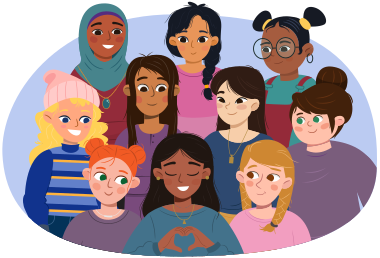
One example of a safe space created online for women and girls is “Laaha,” a website created by UNICEF for women and girls in Iraq, Lebanon, and Ecuador to gain information, build skills, connect with peers, and gain support. The goal of this safe space online is to provide women and girls with a space where they can connect with others and seek support when needed.
Making connections
One effective reading strategy is
making connections. When exploring a text, you
can make connections to other texts, your personal experiences,
and the world around you. Making connections can enhance your
understanding of a text.
Explore the three types of connections in the following accordion. Press the following tabs to find out more.
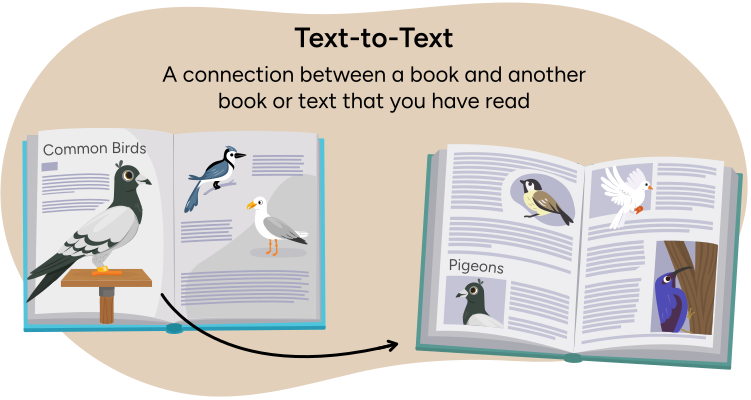
This is a connection between the text you are reading and another text or story that you have read before.
You might consider the following questions when making text-to-text connections:
- What does this remind you of in another text you have read?
- How is this text similar to or different from other things you have read?
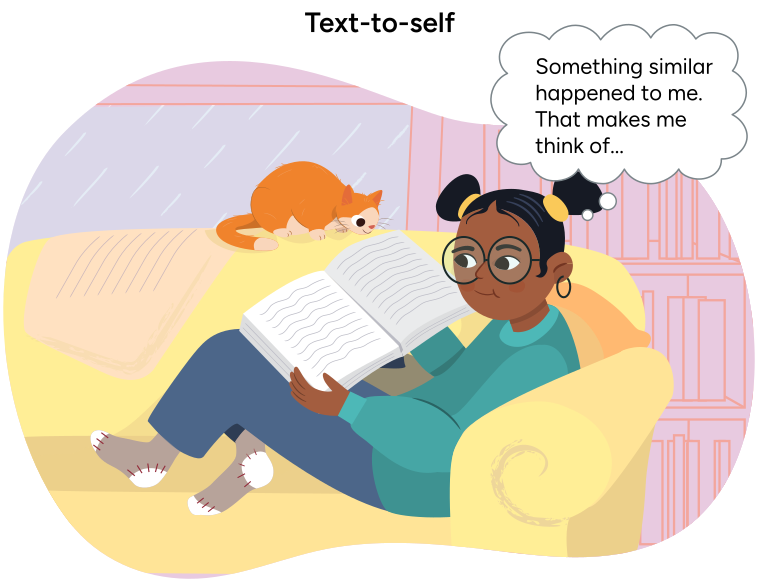
Text-to-self. Tiara is sitting on a couch with a book open. A thought bubble reads, "Something similar happened to me. That makes me think of…"
This is a connection between a text and something that you have experienced in your own life.
You might consider the following questions when making text-to-self connections:
- What does this text remind you of?
- Can you relate to the character or content?
- Does anything in this text remind you of anything in your own life?
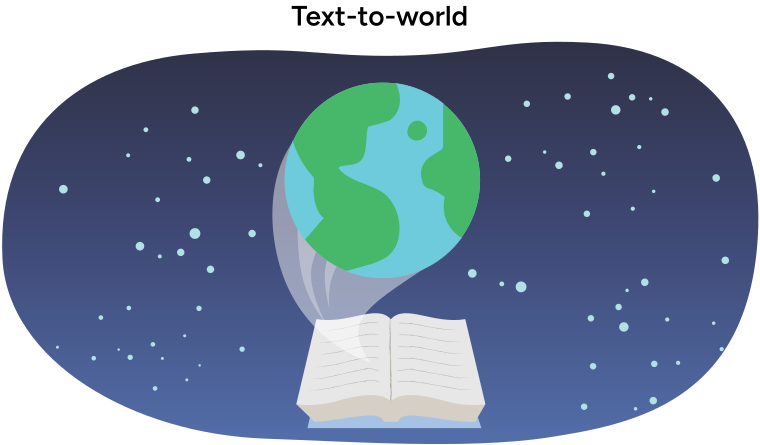
This is a connection between the text and something that is currently occurring or has previously occurred in the world.
You might consider the following questions when making text-to-world connections:
- What does this remind you of in the real world?
- How are events in this text similar to things that happen in the real world?
Your turn!
You will be exploring the following article titled, “Creating Safe Spaces Online and Online Etiquette.” Begin by previewing the text, respond to the following questions in a method of your choice.
- What kind of text do you think this is (poem, play, essay, informational, speech, etc.)?
- What do you think this text will be about?
- List three facts that you know, or experiences you have, that you think will relate to the text.
Next, as you read the article, record any connections you make using the graphic organizer provided, or in another method of your choice.
Complete the following fillable and printable Making Connections document or record your answers in your notebook. If you would like, you can use speech-to-text or audio recording tools to record your thoughts.
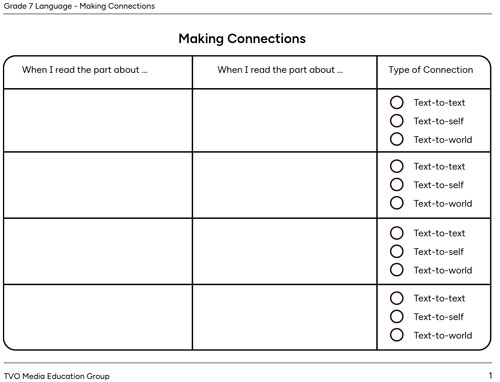
Read the following article Creating Safe Spaces Online and Online Etiquette and record any connections you make.
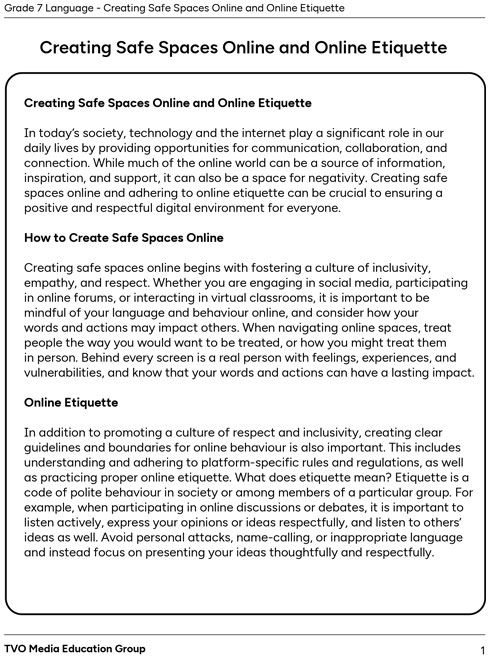
Press the Activity button to access the Creating Safe Spaces Online and Online Etiquette.
Activity(Opens in a new tab)The University of Queenland. (n.d.). Guidelines for safe and respectful online engagement . UQ Respect. https://respect.uq.edu.au/files/1084/SS-UQRespect-SMSUBooklet2021-DIGITAL.pdf
Dictionary.com. (n.d.). Etiquette definition & meaning. Dictionary.com. https://www.dictionary.com/browse/etiquette
Check your understanding of the article through the following fill-in-the-blanks activity. For each sentence, select the missing word from the drop-down menu. Press Check Answer to see how you did.

Social Emotional Learning
Take a break

Great work so far! Take a break before continuing onto the next part!

The colon

A colon (:) is a punctuation mark that can be used in various ways. For example, it can be used for introducing a list after a complete sentence or to indicate new speakers in a script.
When using a colon to introduce a list after a complete sentence, the colon comes after the description of the list, and each word in the list is often separated by commas and not capitalized. You can only use a colon for a list when the sentence before the colon can stand alone as a sentence.
Explore the following examples.
- You will need to buy ingredients for the recipe: eggs, milk, flour, sugar, and vanilla.
- On your vacation, you should pack several items: sunscreen, swimsuit, towel, sunglasses, and a hat.
- I have several different hobbies: painting, playing guitar, reading, hiking, and cooking.

Student Tips
Student tips
If you already have specific words that set up a list such as “consists of,” “for example,” or “such as,” then you DO NOT need the colon. These words set up the list already.
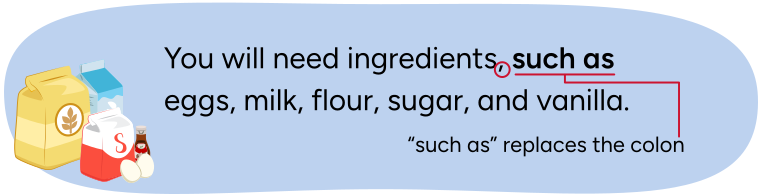
Example of when you don't need a colon: "You will need ingredients such as eggs, milk, flour, sugar, and vanilla." 'Such as' replaces the colon.
Check your understanding of using colons for lists by identifying the correct use in the following sentences.
Select the correct answer, then press Check Answer to see how you did.
A colon can also be used to indicate new speakers in a scripted dialogue. The script would introduce the speaker, followed by a colon, and then the speaker'ås dialogue after the colon. Begin a new line with each new speaker. For example…
JAMIE: I was wondering if you wanted to go to the park?
MIKA: Yes! I’d love to.
JAMIE: Great. I will meet you at my house after school and we can bike down together.
MIKA: Awesome. See you then!
Your turn!
Choose one of the topics that you explored in this learning activity. Write a short script, using colons appropriately, between two people having a conversation about one of the following topics.
Press the Possible Topics button to learn more.
- You could write a conversation between two students as they navigate safe spaces online.
- You could write a conversation between group members working on a presentation about online etiquette.
- You could write a conversation between a student and an adult as the student tells the adult about their experiences online.
Cultural awareness
Cultural awareness involves recognizing and understanding the cultural differences, norms, values, and perspectives of others. In the diverse and interconnected world of the internet, individuals from different backgrounds come together to communicate, collaborate, and share ideas.

Brainstorm
Brainstorm
Why do you think it is important to recognize and understand different cultures, norms, and perspectives when interacting online? Record your ideas in a method of your choice.
Cultural awareness plays a crucial role in promoting understanding and respect in online interactions by:
- preventing misunderstandings and misrepresentations online
- promoting empathy by encouraging curiosity
- facilitating communication styles and languages to accommodate cultural differences
- building positive and meaningful relationships online by demonstrating respect for others’ cultural identities and perspectives
- recognizing and addressing bias, stereotypes, and discrimination in online interactions
- promoting global citizenship by learning from diverse cultures and communities around the world and embracing cultural diversity
Let’s learn about a few traditions from diverse communities around the world. As you explore, consider the role of cultural awareness in fostering understanding and respect in online interactions.
Press the following tabs to find out more.
The Japanese Tea Ceremony (茶道, sadō or chadō, lit. "the way of tea" or 茶の湯, chanoyu) is a traditional practice centred around the preparation and serving of tea. This tradition began in the 1300s when tea drinking parties became popular, and those who attended would show off their tea bowls and share their knowledge about tea. As time went on, a more refined version of these parties was developed with a more “zen inspired” simplicity and emphasis on harmony, respect, and tranquility.
Check out the following video to learn more.
Diwali, also known as “The Festival of Lights,” celebrates the success of good over evil or light over darkness. Those who are part of the Hindu, Sikh, and Jain faiths typically celebrate it. It is often celebrated in India, Singapore, and several other South Asian countries. On the night of Diwali (typically in autumn for the northern hemisphere), those who celebrate light candles, oil lamps, fireworks, and clay lamps. They feast and exchange goods and spend time around family.
Check out the following video to learn more.
Day of the Dead, or el Dia de los Muertos, is a Mexican holiday celebrated to honour and remember deceased loved ones in a reunion that includes food, drinks, and celebration with music and dance. The holiday is celebrated each year from October 31st to November 2nd.
Check out the following video to learn more.
Respond to the following questions in your notebook or another method of your choice.
- How can cultural awareness foster a sense of inclusion and understanding online?
- How can learning about various cultures help you be more inclusive and respectful online?
- What about your cultural background? How can you share your personal background and experiences online?

Connections
Connections
Don’t forget to make connections using a method of your choice.
Digital storytelling
There are various applications and websites that you can use to create and share digital stories online!
Your task is to create a digital story that promotes cultural awareness and inclusivity. You are encouraged to incorporate your new learning of cultural traditions, or other traditions you are aware of, and diverse characters and perspectives.
Before creating your story, you will need to follow the brainstorming steps in the following checklist. You can record your ideas in a method of your choice or in the graphic organizer provided.
Use the following checklist to begin.
Digital story brainstorming checklist
Complete the Digital Story Brainstorming organizer in your notebook or using the following fillable and printable document. If you would like, you can use speech-to-text or audio recording tools to record your thoughts.
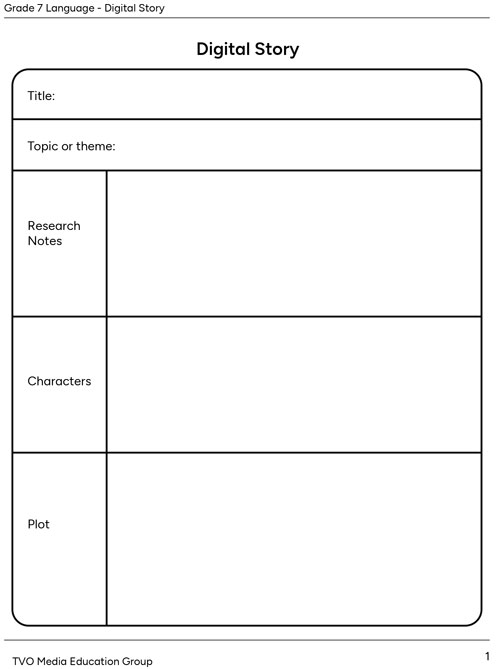
Using the ideas you have brainstormed in your graphic organizer, or other method of your choice, create your digital story by completing the following steps.
- Write a narrative story (in text, using a comic strip, etc.) Be sure to use descriptive language and vivid imagery to bring your characters and settings to life.
- Create digital components to bring your story to life – including creating a digital book, comic, animation, video, or interactive presentation.
- Use multimedia elements such as images, audio, video clips, animations, etc. to enhance your story.
If possible, share your story with someone else!
Putting it all together
Begin by checking your understanding of learned concepts in the following multiple-choice activity.
Self-assessment reflection
Reflect on the digital story that you created that promoted cultural awareness and inclusivity.
Consider the following assessment criteria and assign yourself a grade based on it.
Use the following checklist to evaluate your digital story.
Digital story reflection
Consider the following reflection questions.
- Why did you give yourself this grade?
- What is one thing that you feel you did really well?
- What do you think you might do differently next time you create a digital story?
Record your ideas in your notebook or another method of your choice.
Reflection
As you read the following descriptions, select the one that best describes your current understanding of the learning in this activity. Press the corresponding button once you have made your choice.

I feel...
Now, expand on your ideas by recording your thoughts using a voice recorder, speech-to-text, or writing tool.
When you review your notes on this learning activity later, reflect on whether you would select a different description based on your further review of the material in this learning activity.