Learning goals
We are learning to…
- demonstrate an understanding of the historical contexts, contributions, lived experiences, and perspectives of a diversity of individuals and communities
- identify various elements of style in texts, including voice(Opens in a new window), word choice, word patterns, and sentence structure, and analyze how each element helps create meaning
- identify the topic, purpose, and audience for various texts we plan to create, and analyze why the chosen text form, genre, and medium suit the purpose and audience, and how that will help communicate the intended meaning
- create a piece of work that combines poetry and media with choice of audience, topic, and format, and evaluate their own piece
Success criteria
I am able to…
- identify elements of poetry and media in multiple pieces of work and reflect on how they convey a message, emotions, and story
- identify and analyze how poetry and media can be combined to create impactful pieces
- create a piece that combines poetry and media with choice of audience, topic, and format and analyze their own piece of work
- learn about elements of style (word choice, voice, sentence structure, word patterns) and analyze elements of style in multiple texts, including my own
The significance of poetry
Could poems lead to world peace?
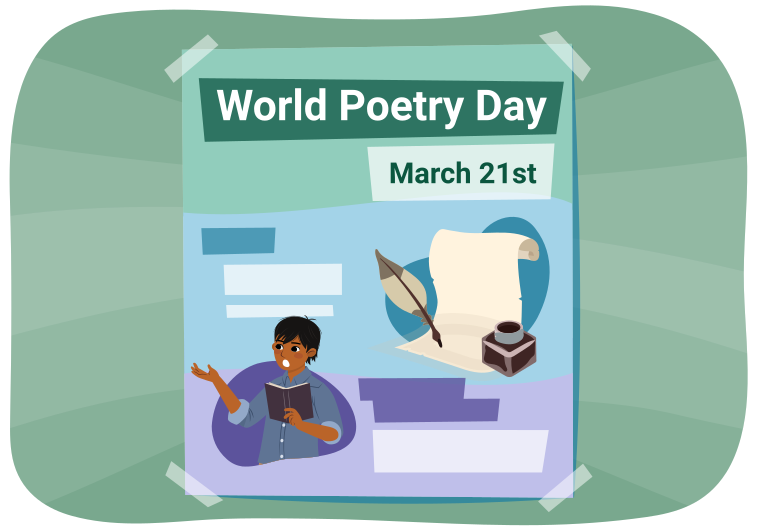
More than just a genre of literature, poetry expresses the human experience in a uniquely emotional way. For many cultures, there is a longstanding tradition of sharing stories, values, and customs through spoken poetry and folklore.
Due to the way that poetry can bring people together, the United Nations Educational, Scientific and Cultural Organization (UNESCO) established World Poetry Day on March 21. Browse the following quotation from the UNESCO website about the cultural significance of poetry:
“Poetry reaffirms our common humanity by revealing to us that individuals, everywhere in the world, share the same questions and feelings…
One of the main objectives of the Day is to support linguistic diversity through poetic expression and to offer endangered languages the opportunity to be heard within their communities.
.. [The] art of poetry will no longer be considered an outdated form of art, but one which enables society as a whole to regain and assert its identity.”
What do you think about the genre of poetry? Does it seem like “an outdated form of art” to you, or do you agree that it is still important today? Why or why not?
Record your thinking in a method of your choice.

Using language to communicate meaning
While poetry and media are separate art forms, they both communicate messages, emotions, and stories in different ways.
Let’s begin by exploring how we use language to communicate meaning through the use of literary devices and the elements of style.
Literary devices
Literary devices are special tools used in writing in order to enhance the emotion or overall mood, create a sense of rhythm, or add deeper meaning to a piece of work. Review a few literary devices you may find in poetry in the following flashcards. Press the flip button to reveal the definition. Use the arrow keys to navigate between cards.
Elements of style
Similar to the literary elements you just reviewed, the elements of style in writing have a specific purpose: they help to engage the reader, communicate deeper meaning, improve general understanding, and enhance the overall reading experience.
Explore the following tabs about the elements of style before you begin to analyze poetry and media.
Word choice is the careful selection of specific words by an author to convey a certain meaning or tone. When authors use word choice to communicate a specific message, mood, or writing style, it can deepen the overall meaning of the text. Explore these two sentences as an example:
- The chef turned off the oven.
- The chef lunged across the smoking stovetop to slam off the oven's power button.
Do you notice that the second sentence has a lot more descriptive language? This helps the reader get a better understanding of what is happening in the text.
Explore the following excerpt from the poem, “I Wandered Lonely as a Cloud,” by William Wordsworth and respond to the following prompts in a method of your choice.
- What emotions or feelings do the words evoke?
- Do the words create vivid images or feelings?
- How do the words contribute to the overall tone or mood of the text?
- Are there words that have multiple meanings or interpretations?
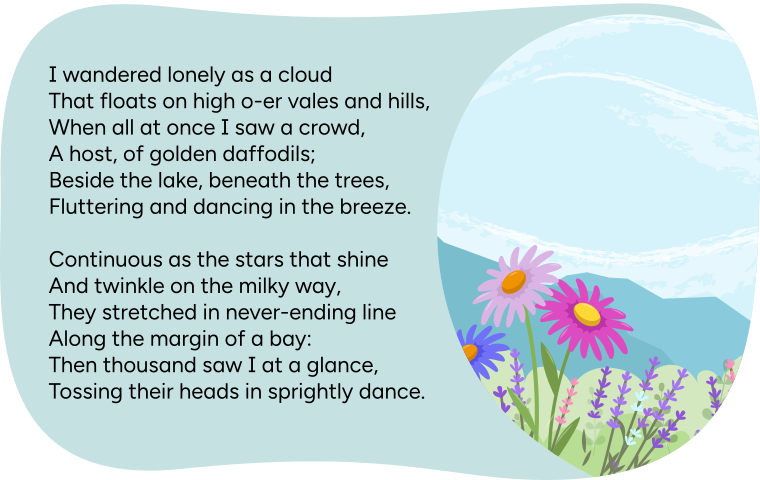
I wandered lonely as a cloudThat floats on high o-er vales and hills,When all at once I saw a crowd,A host, of golden daffodils;Beside the lake, beneath the trees,Fluttering and dancing in the breeze.Continuous as the stars that shineAnd twinkle on the milky way,They stretched in never-ending lineAlong the margin of a bay:Then thousand I saw at a glance,Tossing their heads in sprightly dance.
Voice refers to the individual writing style used by an author to establish a certain mood and add meaning to their text. Authors often use features like literary devices and other stylistic elements to help establish their voice. Most of the time, an author’s voice is pretty consistent across their entire body of work. Elements of voice include:
- Attitude: How do you think the speaker or writer feels about the subject or theme of the text?
- Tone: What is the overall mood or feeling conveyed by the speaker’s or writer’s words?
- Perspective: What point of view is the speaker or writer presenting, and how does this affect the reader’s understanding of the text?
There are a variety of sentence types and sentence forms. Using different types of sentences keeps writing interesting and contributes to the rhythm and clarity of the writing.
Sentence forms include:
- Simple: a sentence with one independent clause
- Compound: a sentence made up of two or more independent clauses, joined by a semicolon or coordinating conjunction (i.e., for, and, not, but, or, yet, so), usually with a comma in front.
- Complex: a sentence made up of one independent clause and one or more dependent clauses.
- Compound-complex: a sentence made up of two or more independent clauses and one or more dependent clauses
Sentence types include:
- Declarative: a sentence that makes a statement
- Imperative: a sentence that makes a request or gives a command or instruction
- Interrogative: a sentence that asks a question
- Exclamatory: a sentence that expresses strong emotion or feelings, usually ending in an exclamation mark
When analyzing a text, you can ask the following questions about sentence structure:
- How are sentences varied in the text? What effect does this create?
- Are sentences simple and shorter, or more complex? How does this contribute to the meaning?
- What impact do the sentences have on the reader or viewer?
Another element of style is the “word pattern” that the author or creator may use. Word patterns are recurring clusters of words or phrases that create a certain emphasis or rhythm within a text.
When analyzing word patterns, you can ask yourself the following questions:
- What words, phrases, or sounds are repeated in the text?
- What themes, emotions, or imagery are emphasized through repetition?
- How do word patterns and repetition create rhythm and flow in the text?
Analyzing poetry and media
In this section of the learning activity, you are going to explore poetry and various forms of media. Using what you have learned about literary devices and elements of style, choose three pieces to analyze. Take notes in the graphic organizer, or another method of your choice, about how the poem and media pieces communicate a message, emotions, or story.
Complete the fillable and printable Poetry and Media Graphic Organizer in your notebook or using the following document, filling in the boxes that apply. If you would like, you can use speech-to-text or audio recording tools to record your thoughts.
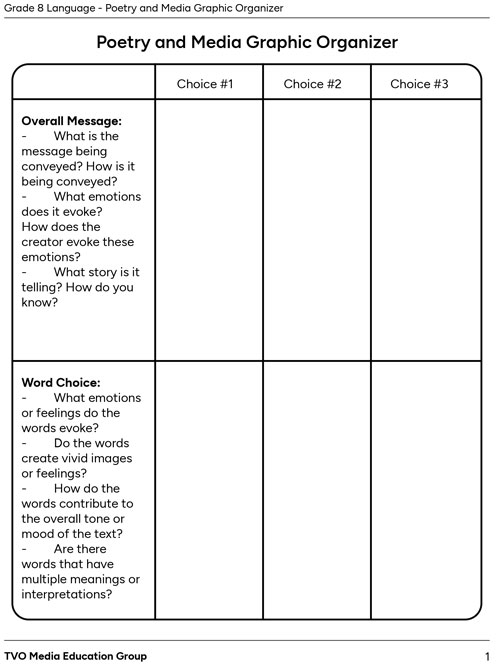
Press the Activity button to access the Poetry and Media Graphic Organizer.
Activity(Opens in a new tab)Option 1: Amanda Gorman’s inaugural poem
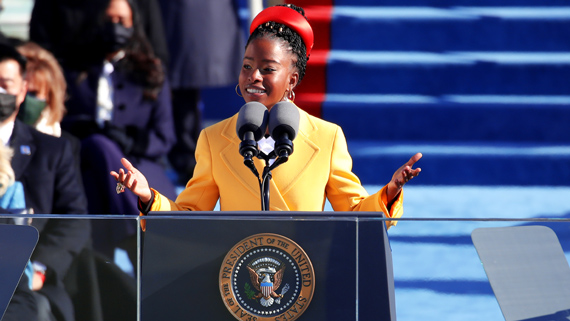
Amanda Gorman is a poet and author who was the youngest poet, at the age of 22, to deliver a reading at a presidential inauguration. She is also known for the books she’s written, Change Sings, Something, Someday, and Call Us What We Carry. First, let’s explore a section of the poem The Hill We Climb by Amanda Gorman.
We are striving to forge a union with purpose
To compose a country committed to all cultures, colors, characters and
conditions of man
And so we lift our gazes not to what stands between us
but what stands before us
We close the divide because we know, to put our future first,
we must first put our differences aside
We lay down our arms
so we can reach out our arms
to one another
We seek harm to none and harmony for all
Amanda Gorman’s Inaugural Poem
Did you notice any of the literary devices in this section of the poem? Add them to your graphic organizer or another method of your choice.
Press the Answer button to learn more.
- Alliteration – “compose a country committed to all cultures, colors, characters and conditions”
- Imagery – “we lay down our arms so we can reach out our 'arms' to one another” – note that, in this sentence, the word 'arms' refers to weapons we must put down and to the arms on our bodies that we can reach out.
Go back and explore the section of the poem a few times and record your thoughts on the use of the elements of style, as well as the overall message, emotions, and story of the poem in your graphic organizer or another method of your choice.
Press the Possible Answer button to learn more.
The overall message of “The Hill We Climb” is that we need to set aside our differences and work together to achieve progress. It has a message of hope and harmony over fear and fighting. Amanda uses powerful language, imagery, and alliteration to achieve this message. With the use of vivid imagery and language, she evokes the emotion of hope and unity and urges the reader to see past differences and work together, regardless of race or culture.
Option 2: Hair Love short film
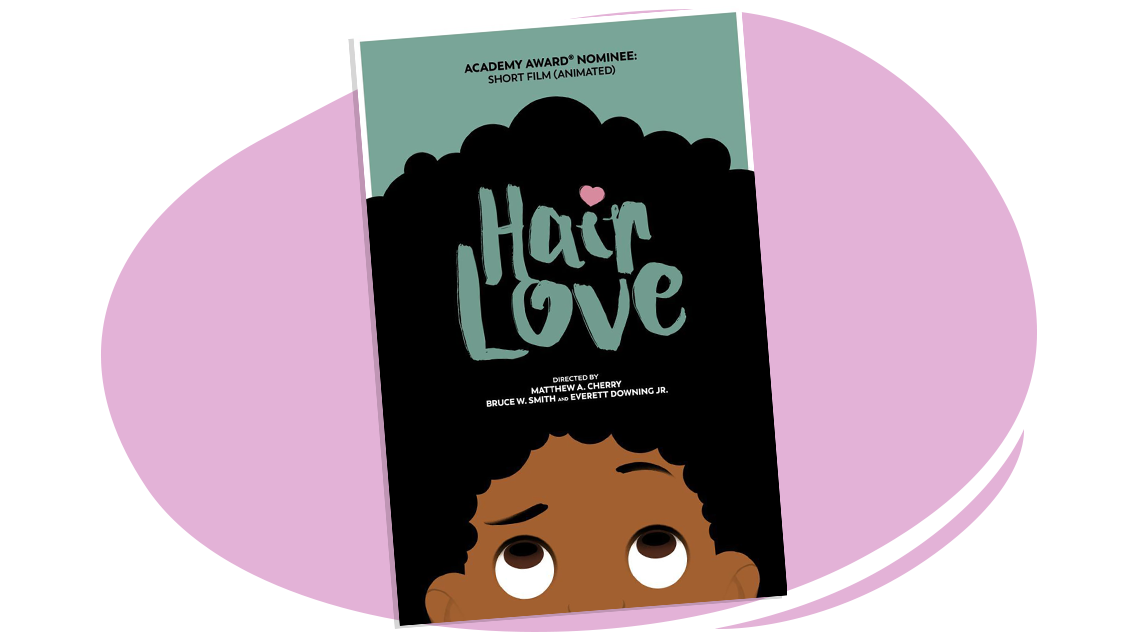
You are going to explore a short animated film created by Sony Pictures Animation called Hair Love. This film was directed by Matthew A. Cherry and produced by Frank E. Abney and was created due to a lack of representation in media and to promote an appreciation of natural hair among Black people.
Check out the following video entitled Hair Love. As you explore, consider the overall message of the video, any emotions it evokes, and the story that’s being told. Also consider how the creator does this. Record your ideas in your graphic organizer or another method of your choice.
What elements of style did you notice? Add them to your graphic organizer or another method of your choice, along with the theme or message, emotions that were evoked, and how language and other elements were used to create the story.
Press the Possible Answer button to learn more about the message in the video.
Hair Love highlights the story of an African American family as they take on different family roles and explore self-acceptance. In this clip, Stephen - who does not usually do his daughter Zuri's hair - uses a video tutorial to help him get it done. You later find out that the tutorial was created by Zuri’s mom, Angela, who appears to be sick. The film emphasizes the importance of loving one's hair in all its forms and celebrates the relationships between fathers and daughters.
Option 3: We Accept commercial advertisement
You are going to explore a commercial advertisement created by Airbnb. As you explore the commercial, be sure to add your ideas to your graphic organizer or another method of your choice by highlighting what message is being conveyed and how emotions are evoked and the story is told.
What elements of poetry and media do you notice in this piece?
What elements of style did you notice? Add them to your graphic organizer or another method of your choice, along with the theme or message, emotions that were evoked, and how language and other elements were used to create the story.
Press the Possible Answer button to learn more about the commercial’s message.
In this commercial, the message is that regardless of personal factors like race, ethnicity, gender, or faith, everyone should feel like they belong. The more we accept this, the better our world will be. The creator used powerful words and images of real people to help evoke these emotions.
Option 4: Spoken word poetry
Spoken word poetry is one example of how poetry and media can be combined. Spoken word poetry is a poem that is meant to be performed for an audience rather than just read on a page. The poet uses visual and audio elements of media, in combination with the figurative language, imagery, and symbolism of poetry, to create a powerful piece.
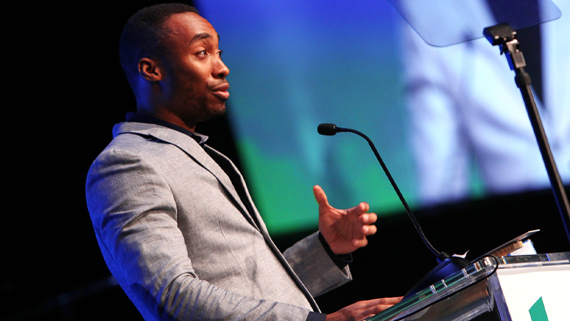
Meet Richard Williams, also known as Prince Ea, a rapper, poet, and filmmaker. Prince Ea began his career in 2014 with the intention of motivating and inspiring people through film and written and spoken content.
Check out the following video of Prince Ea performing his spoken word poem entitled “Dear Future Generations: Sorry (2024)”.
What elements of style did you notice? Go back to your graphic organizer or other method of your choice and record them, along with the theme or message, emotions that were evoked, and how language and other elements were used to create the story.
Press the Possible Answer button to learn more.
Prince Ea uses the figurative language and imagery of a poem, combined with the audio background music, text, and visual images of the media.
Prince Ea uses word choice to contribute to the overall tone and mood of his poem. He suggests that we need to work together to solve problems like global warming, poverty and inflation, and protect nature. His words evoke a regretful but hopeful emotion by emphasizing where we’ve gone wrong and why we need to fix it.
The voice that Prince Ea uses while speaking the poem tells the audience that he feels shame and sadness about the current condition of our planet but that, with a combined effort, we can make a change to better our planet for future generations.
His sentence structure and word patterns impact the reader/viewer because he repeats the same words in juxtaposed phrases, such as, “we are not apart from nature,” then, “we are a part of nature.” He uses phrases such as climate change and global warming (part of the problem) to create phrases like, “we must globally warm our hearts and change the climate of our soul” (part of the solution) – this enhances the evoked emotions, rhythm, and flow of the poem.
Option 5: Coca Cola print advertisement
Poetry and media are sometimes combined in print advertisements. Companies use poetry as part of their marketing strategy to help convey their message, tell a story, and evoke emotion among their viewers. By incorporating poetry, the advertisements can reach the customers’ feelings and emotions while being concise and impactful.
Explore the following print advertisement called “Open for Summer” by Coca Cola. As you explore, make connections between poetry and media – how are these two art forms merging together to create enriched content?

Coca Cola advertisement. Features four bottles of Coca Cola. Each bottle has a different poem.First bottle: 100 degrees. Zero breeze. Shirt soaked. Time for a Coke.Second bottle: Salty popcorn. Coke. Real fizzy. Movie marathon. My kind of busy.Third bottle: Runner on third. Dad on your left. Coke in hand. Base hit.Fourth bottle: Last day. Finals done. Open a Coke. Chill in the sun.
What elements of style did you notice? Go back to your graphic organizer or other method of your choice, and record the theme or message in the print advertisement, emotions that were evoked, and how language and other elements were used.
Press the Possible Answers button to learn more.
In the Coca Cola advertisement, the short and catchy poems are memorable for the viewer and help to promote the product. Poetry and media are combined to create a powerful piece that evokes emotion, tells a story, and conveys a message.
The creator used descriptive language that paints an image in the reader’s mind. This word choice puts the reader in each situation in hopes of visualizing wanting to drink the product.
They used short and vivid sentence patterns to engage the reader quickly and encourage the use of the product.
Making Connections
In this learning activity, you explored elements of poetry and media pieces, along with elements of style. You discovered that when they are combined, they can create a powerful piece of work. Sort the following elements into “Poetry” or “Media”.
Place the cards into categories that best match. Use the arrow buttons to navigate between cards.
Are there any elements that you feel apply to both media and poetry? What can they accomplish when combined? Record your ideas in a method of your choice.
Social emotional

Social Emotional Learning
Social emotional learning
You’re doing great! Take a break before exploring fluency and gerunds!

Fluency
Fluency is the ability to identify words correctly and read a text at an appropriate rate with ease, pace, automaticity, and expression. With proper phrasing and a focus on punctuation, the reader will gain more meaning from the text.
Choose one of the poem excerpts from this learning activity to practice your reading fluency. Re-read the same piece several times, focusing on the following criteria.
Option 1: Amanda Gorman’s inaugural poem
We are striving to forge a union with purpose
To compose a country committed to all cultures, colors, characters and
conditions of man
And so we lift our gazes not to what stands between us
but what stands before us
We close the divide because we know, to put our future first,
we must first put our differences aside
We lay down our arms
so we can reach out our arms
to one another
We seek harm to none and harmony for all
Option 2: Prince Ea’s Dear Future Generations
We are the root, we are the foundation, this generation
It is up to us to take care of this planet
It is our only home, we must globally warm our hearts
And change the climate of our souls
And realize that we are not apart from nature
We are a part of nature
And to betray nature is to betray us
To save nature, is to save us
Ea, P. (n.d.). Prince EA – dear future generations: Sorry. Genius. https://genius.com/Prince-ea-dear-future-generations-sorry-lyrics
Use the checklist provided to self-assess your own fluency. If possible, share your poem with someone else and ask them to provide feedback on your fluency.
Fluency checklist
Based on the checklist, choose one area of fluency to focus on and set a goal for yourself. What strategies could you use to help you achieve this goal?

Gerunds
Let’s begin by reviewing what a noun and verb are. A noun is a word that refers to people, places, things, and ideas. A verb is a word that expresses an action, occurrence, or state of being.
A gerund is partly a verb and partly a noun. It is a noun that is created from a verb by adding “-ing” as a suffix. A gerund can be used as the subject, the complement, or the direct object of a sentence.
Check out the following video on gerunds.
There are four types of gerunds. Explore these below! You may wish to record these in your vocabulary notebook or another method of your choice.
Press the following tabs to find out more.
A gerund can be used as the subject of the verb.
Example: Cooking is my favourite hobby.
In that sentence, 'cooking' is the gerund and the subject of the sentence. It is the noun that the sentence is about.
A gerund can be used as a direct object for a verb.
Example: She loves singing on stage.
In that sentence, 'singing' is the gerund and direct object.
A gerund can also be used as an object of a preposition.
Example: The class talked about going to the theatre.
In that sentence, 'going' is the gerund that is the object of the preposition ‘about’.
A gerund can also be used as a subject complement, which means it comes after a linking verb (become, feel, be, sound, taste, etc.) and describes the subject of the sentence.
Example: Their hobby is fishing.
In this sentence, 'fishing' is the subject complement and gerund.
By using gerunds, writers can easily describe things or activities in a precise way.

Brainstorm
Brainstorm
Brainstorm a list of other gerunds! Did you notice any in this learning activity?
Press the Possible Answers button to learn more.
Gerunds: swimming, running, walking, eating, painting, crying, writing, jogging
Gerunds in this learning activity: exploring, learning, understanding
Your turn!
Match the following sentences with the type of gerund that it exemplifies.
Let’s check!

In this learning activity, you explored elements of style that are used in texts to contribute and create meaning to the text form. Begin by checking your understanding of these elements of style in the fill in the blanks activity below.
For each sentence, select the missing word(s) from the drop-down menu. Press Check Answer to see how you did.
Reflecting on poetry and media
Now that you’ve explored poetry and uses of poetry in different forms of media, respond to the following reflection questions. If possible, discuss your answers with someone else.
- What similarities and differences were there between the poem and the media?
- What overall theme do you think the pieces have in common? How do you know?
- Thinking back to what you’ve explored, how do you think these art forms resonate with diverse audiences? How do they resonate with you?
Press the Possible Answers button to check your answers.
- Some similarities you may have noticed are that all three pieces told a story, conveyed a message, and evoked emotions. However, how they communicated with the audience was different. The poem used mostly language to convey its message. The media pieces used powerful images and music to convey their meaning.
- All pieces had a central theme of celebrating diversity and togetherness. The poem speaks of setting our differences aside and working together, regardless of “culture, colour, character, and condition.” The short film was created because of the underrepresentation of black people in the media, a hope to celebrate diversity, and a love of hair among black men, women, and children, as well as the theme of togetherness through family. Lastly, the commercial also celebrates diversity and togetherness by promoting the idea that, if everyone is accepted, our world becomes a better place.
Putting it all together
Your task is to create a piece of work that combines media and poetry about a topic of your choice. You might want to focus on some of the themes you explored throughout this learning activity, such as climate change, social justice, inclusion, diversity, family, etc., or another theme of your choice.
You will need to choose the audience, theme, and format for your creation. You can use the following suggestions to guide your thinking or another idea you may have.
| Audience ideas | Theme | Format |
|---|---|---|
|
|
|
When you are creating your piece of work, use the following checklist.
Poetry-media creation
If possible, share your creation with someone else.
Reflection
Reflect on and analyze your own creation by responding to three of the following questions:
- Reflect on the audience, purpose, and format that you chose. How did the format best suit the audience and purpose? How did this format help convey meaning to this audience?
- What is the message being conveyed? How is it being conveyed?
- What emotions did you evoke? How?
- What story is your creation telling? How do you know?
- What elements of poetry (i.e., figurative language, imagery, symbolism) and media (i.e., audio, visual, editing) did you incorporate?
- If you had to re-do the task, what is one thing that you would change? Why?
Reflection
As you read the following descriptions, select the one that best describes your current understanding of the learning in this activity. Press the corresponding button once you have made your choice.

I feel...
Now, expand on your ideas by recording your thoughts using a voice recorder, speech-to-text, or writing tool.
When you review your notes on this learning activity later, reflect on whether you would select a different description based on your further review of the material in this learning activity.